Over $1 Billion in Cryptocurrencies Forced to Liquidate, Bitcoin Plunges 6% Below $67,000

华尔街日报Publicado em 2026-06-02Última atualização em 2026-06-02

Resumo

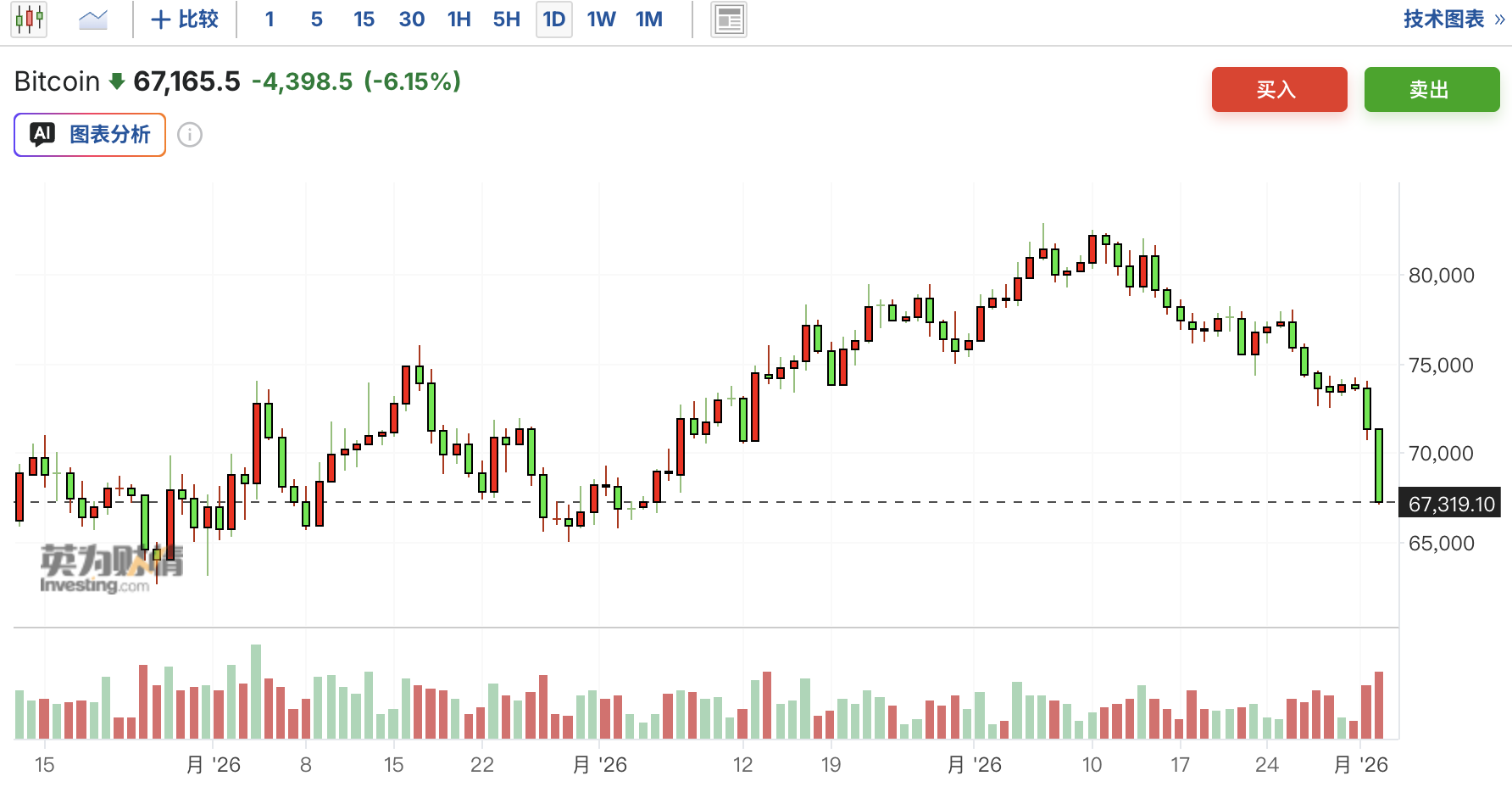
Bitcoin plunged over 6%, breaching the $67,000 mark for the first time since April 5, triggering more than $1 billion in cryptocurrency liquidations—the highest level since February. The sell-off was driven by deteriorating market sentiment amid heightened geopolitical risks from the Iran situation and a symbolic shift in strategy from a major holder. In a significant psychological blow to the market, MicroStrategy disclosed the sale of approximately 32 bitcoins, marking its first divestment since late 2022 and breaking its long-standing "buy-only" stance. Concurrently, U.S. spot Bitcoin ETFs have seen net outflows for a record 11 consecutive days, with approximately $3.5 billion withdrawn, removing a key traditional price support. Analysts note that positive catalysts from U.S. crypto regulatory progress have been completely offset by prevailing risk-off sentiment. Bitcoin is now down nearly 50% from its all-time high of around $126,000 set in October last year, starkly underperforming the rising Wall Street equity markets.

Bitcoin sentiment deteriorated sharply, triggering a wave of forced liquidations exceeding $1 billion, the most severe market pressure in recent months.

Bitcoin fell as much as 6% on Tuesday, breaking below $67,000 for the first time since April 5th. Geopolitical risks from the ongoing situation in Iran, coupled with selling actions from major holder Strategy, jointly dampened investor risk appetite. According to CoinGlass data, the scale of forced liquidations in this round reached its highest level since February this year.

Simultaneously, the two major traditional sources of demand that have historically supported Bitcoin's price—spot ETFs and Strategy—are concurrently turning into drags on the price, further intensifying market pressure.
Strategy's Selling Triggers Sentiment Turning Point

Strategy disclosed on Monday that the company sold approximately 32 bitcoins, raising about $2.5 million, marking its first reduction in holdings since late 2022. Compared to its total Bitcoin position of about $59 billion, the scale of this sale is minuscule. However, it broke the company's long-standing "only buy, never sell" minimalist strategy at a sensitive moment for the market.

Jasper De Maere, an over-the-counter trader at market maker Wintermute, stated:

"This selling wave appears to have been triggered by Strategy's disclosure of selling 32 bitcoins. But the reality is that even without this news, market momentum was already waning, and institutional participation on OTC desks had also receded to low levels."

Sustained ETF Net Outflows Heighten Price Fragility

According to data compiled by Bloomberg, U.S. spot Bitcoin ETFs have recorded net outflows for 11 consecutive trading days, setting a record for the longest consecutive outflow streak. During this period, investors redeemed a total of approximately $3.5 billion.

James Butterfill, Head of Research at CoinShares, pointed out that the price cushioning effect brought by the advancement of U.S. crypto regulatory legislation has been "completely offset" by safe-haven sentiment triggered by the situation in Iran.

Bitcoin is now down nearly 50% from its all-time high of approximately $126,000, which was set in October last year. Meanwhile, Wall Street stocks continue to rise amid a resurgence in AI trading and expectations of a ceasefire agreement, forming a stark contrast with the crypto market.


Perguntas relacionadas

QWhat event triggered over $1 billion in cryptocurrency liquidations according to the article?

AA sharp deterioration in Bitcoin sentiment, triggered by a combination of geopolitical risks from the Iran situation and the symbolic selling of 32 bitcoins by MicroStrategy.

QHow much did Bitcoin's price fall on Tuesday, and what key level did it break?

ABitcoin fell 6% and broke below the $67,000 level for the first time since April 5.

QWhat was significant about MicroStrategy's recent sale of 32 bitcoins, as described in the article?

AIt marked the company's first sale since late 2022 and broke its long-standing 'buy and hold only' minimalist strategy, acting as a negative sentiment trigger in a sensitive market.

QWhat is the current state of U.S. spot Bitcoin ETFs, and what record was mentioned?

AU.S. spot Bitcoin ETFs have experienced 11 consecutive days of net outflows, which is a record-long streak, with investors redeeming approximately $3.5 billion during this period.

QWhat two major traditional sources of Bitcoin demand have turned into a drag on its price?

ASpot Bitcoin ETFs (due to sustained net outflows) and MicroStrategy (due to its symbolic sell-off), both of which are now contributing to market pressure.

Leituras Relacionadas

SpaceX, OpenAI, Anthropic: The Three AI Giants Racing for IPO, Which One Is Worth Betting On?

SpaceX, OpenAI, and Anthropic are poised for historic IPOs within weeks, potentially raising a combined $180 billion—a sum exceeding the entire internet bubble's fundraising. The hosts of the Limitless Podcast argue this isn't just individual company financing but an unprecedented capital concentration for AI infrastructure, driven by an insatiable need for compute, data centers, power, and chips. SpaceX's IPO is notable for reportedly changing market index rules to allow faster inclusion, potentially funneling trillions in passive retirement funds into its stock, despite its unproven space-based data center business model. In contrast, Anthropic demonstrates explosive growth, with ARR reportedly hitting $45 billion and approaching profitability, fueled by strong enterprise adoption of products like Claude Code. Google's separate $80 billion raise highlights the immense capital pressure, even for giants. The discussion acknowledges bubble risks but leans optimistic. The hosts contend the massive spending is building essential physical infrastructure for the next technological era. A key bottleneck isn't capital but the real-world limits of chip manufacturing and construction speed. As long as demand for AI compute outstrips supply, this investment cycle represents a foundational build-out rather than a purely financial bubble. All three companies are seen as foundational bets on the future, with Anthropic often cited as the most immediately compelling due to its proven revenue trajectory.

marsbitHá 2h

SpaceX, OpenAI, Anthropic: The Three AI Giants Racing for IPO, Which One Is Worth Betting On?

marsbitHá 2h

From 'Old Guys' to 'New Favorites': How AI Is Revaluing Old Infrastructure from Dell to Nokia?

From "Vintage Tech" to "New AI Darlings": How AI Revalues Old Infrastructure One year ago, tech giants like Dell, Nokia, Cisco, and Western Data were seen as slow-growth, low-valuation stories, far from the AI spotlight dominated by players like Nvidia. Now, these legacy tech stocks are gaining market attention, sparking debate on whether this is genuine industry revaluation or a temporary narrative. As AI moves from model parameters to real-world data centers, the market is recognizing companies with proven delivery and infrastructure capabilities. This shift marks a change in the AI investment thesis: from pure model and GPU focus to the complex systems engineering required for deployment. Companies like Dell, HPE, and Corning are being revalued not for being "sexy" AI innovators, but for their decades of accumulated expertise in supply chains, enterprise delivery, and infrastructure—assets that have become critical in the AI buildout phase. The revaluation is unfolding across three key infrastructure lines: 1. **Servers & System Integration:** Dell and HPE are emerging as crucial system integrators or "general contractors" for AI data centers, translating GPU orders into complete, deployable server racks integrated with power, cooling, and networking. 2. **Networking & Connectivity:** AI's scale demands robust high-speed connections. Corning (fiber optics), Nokia (AI-RAN, 6G), and Cisco (data center switches) are gaining importance for enabling efficient data transfer within and between AI clusters. 3. **Storage:** Beyond high-speed memory (HBM/DRAM), the AI data explosion is driving demand for high-capacity hard drives (HDDs) from companies like Western Digital and Seagate to handle training data, logs, and cold storage cost-effectively. For this revaluation to be substantive and not just a narrative, three criteria are key: 1) Concrete AI-related order and revenue growth (e.g., Dell's AI server sales), 2) Upward revisions to company financial guidance, and 3) Sustainable improvements in profit quality, not just top-line revenue spikes. In essence, AI's transition to a real construction phase is re-pricing "old assets" against "new demand." The opportunity, however, is selective. Only those legacy firms that are demonstrably integrated into the capital expenditure chains of data center and enterprise AI deployment are likely to experience a true "logic re-rating" rather than just a temporary valuation bounce.

marsbitHá 2h

From 'Old Guys' to 'New Favorites': How AI Is Revaluing Old Infrastructure from Dell to Nokia?

marsbitHá 2h

Trading

Spot
Futuros
活动图片




