Optimism Proposes Using 50% of Superchain Revenue for OP Token Buybacks

TheNewsCryptoPublicado em 2026-01-09Última atualização em 2026-01-09

Resumo

Optimism has proposed a major shift in its tokenomics by allocating 50% of Superchain revenue to monthly OP token buybacks, pending community approval. If passed, the program will begin in February 2026, using sequencer fees to purchase OP tokens via an OTC provider. The purchased tokens will be returned to the treasury, not immediately burned or sold, with future governance deciding their use. This initiative aims to tie OP’s value directly to ecosystem usage and economic activity, reflecting Optimism’s significant role in the L2 space, where it holds 61.4% of the fee market share. The proposal has sparked debate over combining buybacks and expanded treasury discretion in a single vote. A governance call is scheduled for January 12, with a formal vote on January 22.

Optimism has proposed a major change to how its ecosystem uses its revenue. The plan is to buy back the OP tokens every month by using 50% of its Superchain revenue. If the Community approves this plan, Optimism is planned to start in February 2026. This makes a major shift in OP’s Role from being just a governance token to a token that is directly tied to the usage and revenue of the Ecosystem.
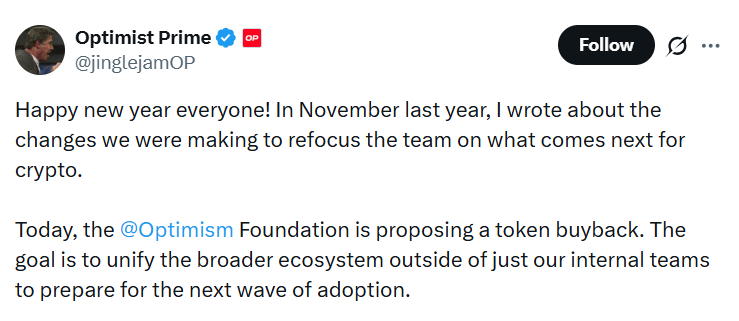
How Optimism Plans to Turn Superchain Fees Into OP Token Demand

The Buyback will happen from the revenue earned by the Superchain from the Sequencer fees. Over the past years, these chains have generated over 5,800 ETH in revenue. So under the proposal, 50% of the revenue will be used to buy OP tokens. Purchases will be made monthly through the OTC Provider. The bought OP tokens will be sent back to the treasury. This will be paused if monthly revenue drops below $200,000. These treasury tokens would not be burned or sold immediately. The Governance would later decide whether to burn or use them for staking and ecosystem incentives.

The reason for this new plan is to make the OP’s value reflect its real economic activity instead of revenue sitting unused in the treasury. Optimism and Superchain agave become dominant players in layer-2. 61.4% of the L2 fee market share and 13% of all on-chain transactions are where the most L2 economic activity is happening.

The Foundation will have the limited discretion to manage remaining ETH. They can use it to generate yield and support ecosystem development. This reduces slow governance overhead while keeping spending within set rules. The Staking partnerships have already generated yield and aim to strengthen OP mainnet’s institutional appeal.

There has been some debate going on for the community members because the proposal combines OP buybacks and expanded treasury discretion in one vote. The Critics argue that these should be voted on separately to avoid bias from the price expectations. The community discussion is going on, a governance call is scheduled for Jan 12, and a formal vote happens on Jan 22. Once it is approved, the buyback will begin in February and the program will run for 12 months.

Highlighted Crypto News:

A Bearish Wall Looms Over BONK: Fade Lower or Fight Back for Gains?

TagsOptimismsuperchain

Perguntas relacionadas

QWhat is the main change proposed by Optimism regarding its Superchain revenue?

AOptimism has proposed using 50% of its Superchain revenue to buy back OP tokens every month.

QWhen is the proposed buyback program planned to begin if approved by the community?

AThe buyback program is planned to start in February 2026 if the community approves the proposal.

QWhat is the source of the revenue that will be used for the OP token buybacks?

AThe buybacks will be funded from the revenue earned by the Superchain from sequencer fees.

QWhat will happen to the purchased OP tokens after they are bought back?

AThe purchased OP tokens will be sent back to the treasury, and governance will later decide whether to burn them or use them for staking and ecosystem incentives.

QWhat is the minimum revenue threshold that would pause the monthly buyback program?

AThe monthly buyback program will be paused if the monthly revenue drops below $200,000.

Leituras Relacionadas

Goldman Sachs Bows Down, Bitcoin Finally Breaks Through the Gates of Wall Street

Wall Street giants, including Goldman Sachs, Morgan Stanley, Charles Schwab, and the New York Stock Exchange, have reversed their long-standing opposition to Bitcoin and are now actively embracing it. After years of dismissing Bitcoin as a scam, a bubble, or a tool for illicit activities, these institutions are launching Bitcoin ETFs, enabling spot trading, and building dedicated crypto infrastructure. Goldman Sachs, which once called Bitcoin a "fraud tool," is now offering Bitcoin ETFs. Morgan Stanley, which internally banned the term "cryptocurrency," has launched its largest-ever ETF backed by Bitcoin. Charles Schwab has opened spot crypto trading for its retail clients, integrating Bitcoin alongside traditional assets. The NYSE is building robust infrastructure to support digital assets, signaling a long-term commitment. This dramatic shift is driven not by a change in ideology but by economic necessity. As Bitcoin repeatedly survived market crashes and grew into a multi-trillion-dollar asset class, ignoring it became too costly. Wall Street’s business model relies on capturing fees, and Bitcoin’s rise represented a massive wealth transfer occurring outside their ecosystem. The fear of missing out (FOMO) and client demand forced these institutions to capitulate. The article frames this as a historic surrender to Bitcoin’s mathematical inevitability. Unlike the trust-based traditional financial system, Bitcoin operates on decentralized, transparent, and unchangeable rules. Its scarcity and resilience make it a hedge against fiat currency devaluation and systemic risk. The narrative has flipped: not holding Bitcoin is now seen as the greater risk. The author concludes that Bitcoin has not been co-opted by Wall Street; instead, it has co-opted Wall Street, marking a fundamental shift in the global financial architecture.

marsbitHá 49m

Goldman Sachs Bows Down, Bitcoin Finally Breaks Through the Gates of Wall Street

marsbitHá 49m

Trading

Spot
Futuros
活动图片





