Opinion: Most Tokenized Assets Are Still Traditional Finance Wrapped On-Chain

marsbitPublicado em 2026-05-25Última atualização em 2026-05-25

Resumo

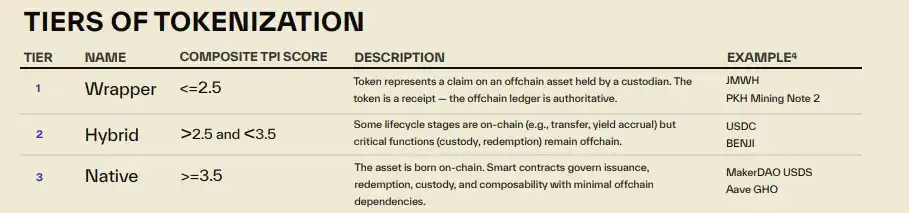
**Summary:** A market analysis reveals that the vast majority of tokenized assets remain mere "wrappers" for traditional finance on-chain. Of 593 surveyed assets, 77.6% are "Wrapped" assets where the token exists on-chain but key lifecycle functions (issuance, redemption, custody, access) remain off-chain. Only 11.1% are "Hybrid" assets, where some operational logic (transfers, settlement, yield accrual) is migrating on-chain, representing the true beginning of transformation. A mere 2.7% are "Native" assets built with a fully on-chain operational model. This explains why stablecoins feel structurally advanced compared to other RWA—they are true on-chain financial primitives, not just digitized traditional processes. The key future distinction won't be between tokenized and non-tokenized assets, but between those that are merely distributed on-chain and those that begin to *operate* on-chain.

Author: Yaroslav Writtle

Compiled by: Deep Tide TechFlow

Deep Tide Guide: The RWA sector has been discussed for so long, yet 77.6% of tokenized assets are still just "on-chain wrapping paper" — the token is on-chain, but issuance, redemption, and custody are entirely off-chain. What's truly worth attention are the 11.1% of "hybrid" assets, which are moving part of their lifecycle on-chain. This explains why stablecoins feel far ahead of other RWAs: they are genuine on-chain financial primitives, not just digital shells for traditional processes.

Market Size Growing Faster Than Market Maturity

An effective way to understand this market is not to look at whether it's tokenized or not.

Instead, look at:

  • Wrapped
  • Hybrid
  • Native

A 2026 market survey covering 593 tokenized assets showed that 460 assets, or 77.6%, were still classified as wrapped. Only 66 assets, or 11.1%, were hybrid, and a mere 16 assets, or 2.7%, had reached a native state.

This is the true shape of the market.

Wrapped Remains the Default Form
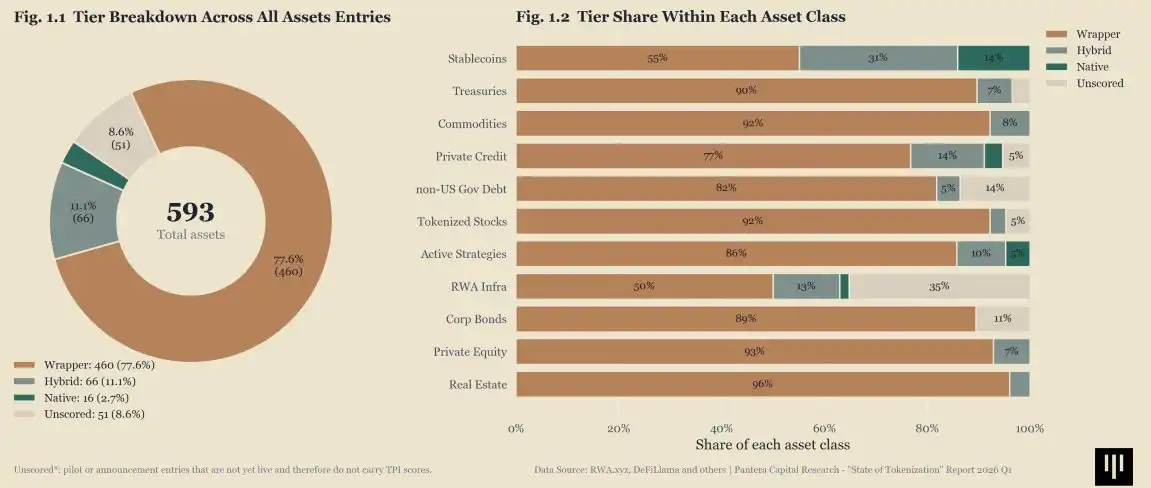
Most tokenized assets improve distribution, not infrastructure.

The token exists on-chain.

Most of its lifecycle does not.

Issuance, redemption, custody, transfer permissions, pricing, and investor access still heavily rely on off-chain systems.

So surface growth may be real, but on-chain autonomy remains low.

Hybrid Is Where Real Transformation Begins

Hybrid is the part of the market worth watching.

This is where certain parts of the lifecycle begin migrating on-chain:

  • Transfer logic
  • Settlement processes
  • Yield accrual
  • Partial compliance or access controls

Not fully native.

But no longer just wrapping paper.

This middle category is still small, which is why the market feels like it's moving faster than it actually is.

Native Is Rare for a Reason

Native assets are rare because the bar is high.

To reach that level, it's not just about the token being on-chain.

The operating model must also be on-chain.

This includes:

  • Issuance and redemption
  • Transfer execution
  • Custody assumptions
  • Composability with other systems

Very few assets truly meet this standard today.

Stablecoins Still Feel Ahead of Other Assets

This also helps explain why stablecoins still feel structurally ahead of most RWAs.
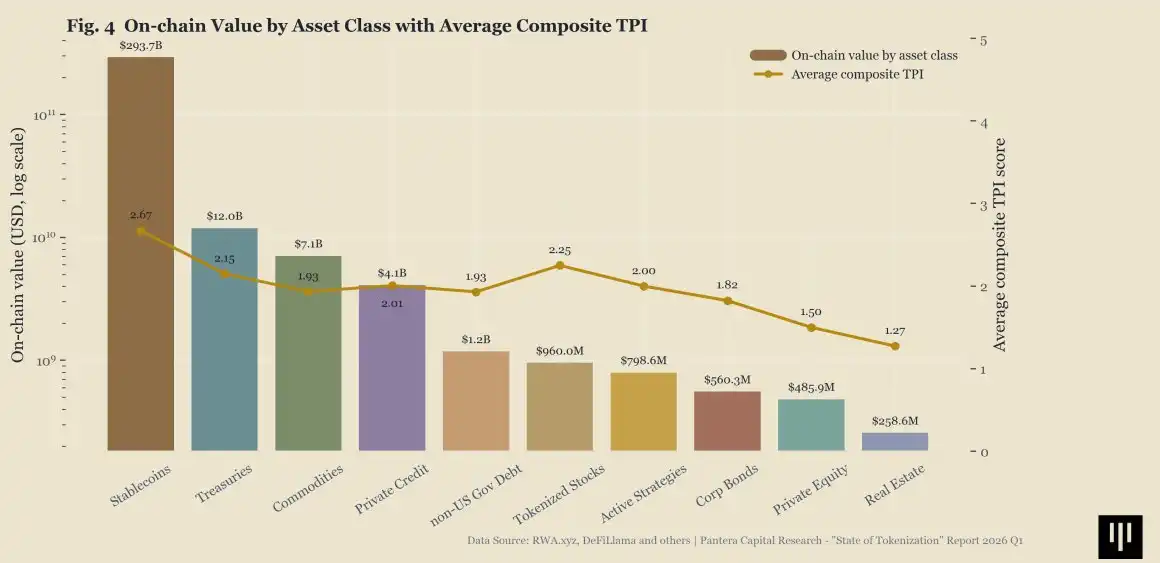
They are closer to being true on-chain financial primitives.

Many other tokenized assets still resemble digital wrapping paper for traditional processes, rather than assets that genuinely operate within an on-chain financial system.

What Matters Next

The market doesn't need more proof that assets can be tokenized.

A more useful question now is: which parts of the lifecycle have truly migrated along with it?

This is where the next round of differentiation will occur.

Not between tokenized and non-tokenized.

But between assets that are still distributed on-chain, and assets that are beginning to operate on-chain.


Perguntas relacionadas

QAccording to the article, what percentage of tokenized assets are considered 'wrapped' and what does this category mean?

A77.6% of tokenized assets are considered 'wrapped'. This means the token exists on-chain, but key lifecycle functions like issuance, redemption, custody, transfer permissions, pricing, and investor access remain heavily dependent on off-chain systems.

QWhat is the 'hybrid' category of tokenized assets, and why does the article suggest it's the important one to watch?

AThe 'hybrid' category refers to assets where some parts of their lifecycle, like transfer logic, settlement, yield accrual, or compliance controls, are beginning to move on-chain. The article suggests this is the important category because it represents the real start of infrastructure transformation, moving beyond just being a digital wrapper for traditional processes.

QWhy are truly 'native' on-chain assets still so rare according to the analysis?

ATruly 'native' on-chain assets are rare because the bar is very high. It requires not just the token to be on-chain, but the entire operational model—including issuance, redemption, transfer execution, custody assumptions, and composability with other systems—to be fundamentally built on-chain.

QHow does the article explain the perceived structural lead of stablecoins over most other Real World Assets (RWAs)?

AThe article explains that stablecoins feel structurally ahead because they are closer to being genuine on-chain financial primitives. In contrast, many other tokenized RWAs still resemble digital wrappers for traditional financial processes, not assets operating within an on-chain financial system.

QWhat does the article propose as the key question for the next phase of development in tokenized assets?

AThe article proposes that the key question is no longer whether assets can be put on-chain, but which parts of their lifecycle are genuinely migrating on-chain. The next phase of differentiation will occur between assets that are merely distributed on-chain and those that are beginning to operate on-chain.

Leituras Relacionadas

Ten-Thousand-Word Analysis: From $10 to $290, MRVL Wins the Entire AI Era by 'Not Making GPUs'

Marvell Technology's stock price surged from under $10 in 2016 to a record $290 in June 2026, fueled not by making GPUs, but by dominating AI infrastructure connectivity. This analysis argues the market misvalues MRVL as merely a smaller Broadcom in custom AI chips, overlooking its true, unique position. Marvell's core strength lies in enabling high-speed data flow for AI clusters through three interconnected businesses. First, it holds a commanding ~70% market share in high-speed optical DSPs (essential for data center light modules), a deep-moat business with accelerating growth. Second, its custom AI chip design business serves hyperscalers like AWS, Microsoft, and Google, with a significant revenue pipeline despite lower margins. Third, stable cash flows come from Ethernet switch chips and enterprise storage controllers. Together, they form a full-stack "AI data movement" platform. CEO Matt Murphy's transformative leadership since 2016, involving strategic divestments, key acquisitions (like Inphi for optical DSPs), and securing long-term agreements with major cloud providers, repositioned the company. A pivotal $2 billion strategic investment from NVIDIA in 2026 underscored Marvell's critical role in the AI ecosystem, particularly through collaborations like NVLink Fusion. While Marvell faces risks—including client concentration (losing the Amazon Trainium3 design), lower-margin business mix, competitive threats, insider selling, and complex supply chains—its fundamentals remain strong. The optical interconnect moat is widening with the acquisition of Celestial AI (photonics fabric), and financial metrics show accelerating revenue growth and operating leverage. With a PEG ratio suggesting undervaluation relative to its growth, the thesis is that the market undervalues Marvell's monopolistic position in AI "plumbing" while overemphasizing its competitive custom chip segment. The story transcends investing, symbolizing how in any complex system—from the internet to AI—the value of "connection" ultimately surpasses that of individual "nodes."

marsbitHá 14m

Ten-Thousand-Word Analysis: From $10 to $290, MRVL Wins the Entire AI Era by 'Not Making GPUs'

marsbitHá 14m

AI Relay Stations Spark Heated Debate on Zhihu: Behind Cheap Tokens, What Are Users Really Worried About?

A discussion on Zhihu about "AI relay stations" shifted the niche developer topic of "cheap tokens" into broader user awareness. Users moved beyond simply questioning the legitimacy of these services to focus on practical concerns: Where do cheap tokens truly come from? Is the model being accessed the real one? Can relay stations see prompts, code, and API keys? For occasional users, are the risks worth it? The core debate centered less on price and more on trust. A primary worry is model authenticity—the risk of "model swapping," where users paying for a premium model might be routed to a cheaper one, creating an information asymmetry. Others argued that cost comparisons matter; while cheaper than official pay-as-you-go APIs, relay stations may not be the lowest-cost option versus subscriptions, domestic models, or free tiers, making user needs assessment crucial. Speculation about token sources ranged from legitimate bulk discounts to gray-area methods like account sharing or exploiting regional pricing. This opacity makes risk assessment difficult for users. Data security emerged as a critical concern, especially for enterprise use. When processing sensitive information like code, contracts, or client data, the inability to verify a relay station's data handling, retention, or access policies poses significant compliance and confidentiality risks. The evolving consensus suggests relay stations can be used cautiously for low-sensitivity, disposable tasks (e.g., summarizing public info, simple translation). However, they should not be the default for sensitive, professional, or production workflows involving proprietary data, Agents, or automated systems. Recommendations include avoiding large prepayments, not relying on a single service, using test prompts to monitor quality, anonymizing data where possible, and keeping official channels as backups. Ultimately, the discussion framed tokens not just as a billing unit but as a measure of real cost encompassing price, model integrity, data security, and service stability. The popularity of relay stations highlights user demand for affordable access, but the debate underscores a key trade-off: the savings from cheap tokens may come at the price of trust, transparency, and control over one's data and AI experience.

marsbitHá 44m

AI Relay Stations Spark Heated Debate on Zhihu: Behind Cheap Tokens, What Are Users Really Worried About?

marsbitHá 44m

In-Depth Research Report on TradFi: The Convergence Wave of Crypto and Traditional Finance

In 2026, the crypto industry is undergoing a profound infrastructure-level transformation—TradFi assets are migrating on-chain at an unprecedented pace. According to CoinGecko's Q1 2026 report, the total value locked (TVL) of tokenized real-world assets (RWA) has surpassed $31 billion, a nearly 4x increase from $7.8 billion at the beginning of 2025, with the sector’s aggregate market capitalization reaching $19.3 billion. Among these, the market cap of tokenized stocks surged from $2 million to $486 million, with Q1 spot trading volume reaching $15.1 billion—a single quarter already surpassing the entire second half of 2025. RWA perpetual contract Q1 trading volume reached a staggering $524.8 billion, far exceeding the $313 billion for all of 2025. Meanwhile, BlackRock's BUIDL fund has reached $2.3 billion in scale and has filed for two new tokenized funds, signaling that the world's largest asset manager's tokenization strategy is evolving from pilot to product suite expansion. HTX, as a core participant in the crypto exchange sector, officially launched TradFi perpetual futures products including NVDA, AAPL, MSFT, META, and SPY in 2026, enabling crypto users to gain 24/7 trading access to core U.S. equities. Boston Consulting Group predicts that global tokenized asset scale could reach $16 trillion by 2030, while McKinsey offers a conservative estimate of approximately $2 trillion. The on-chain migration of TradFi assets is no longer a "future narrative" but a structural transformation unfolding in real time, as crypto exchanges evolve from single crypto asset trading platforms toward "multi-asset-class trading infrastructure."

HTX LearnHá 46m

In-Depth Research Report on TradFi: The Convergence Wave of Crypto and Traditional Finance

HTX LearnHá 46m

Trading

Spot
Futuros
活动图片