Author: knimkar
Compiled By: Plain Language Blockchain
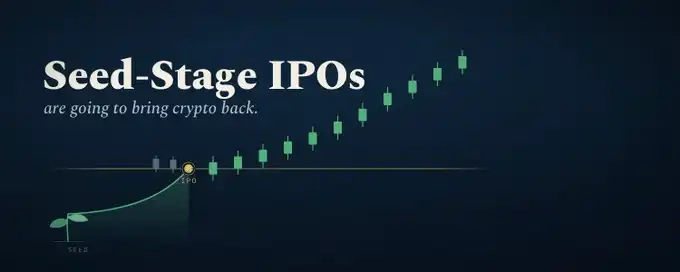
I don't think perpetual contracts, stablecoins, or prediction markets will bring crypto back. The true prerequisite for a "crypto comeback" is this: On-chain assets must emerge that people believe they can profit from and are fundamentally unavailable elsewhere. It's that simple.
I believe the most likely path to achieving this again is an upcoming trend I call the "Seed Round IPO." That is, using @MetaDAOProject's Ownership Coins, combined with decision markets, to create publicly tradable markets for early-stage companies.
My judgment is based on the following beliefs:
1/ I predict that more people will attempt to start companies because AI models are dramatically reducing the time and cost of building things by orders of magnitude. This is self-evident.
2/ For many—perhaps even most—companies, acquiring distribution is the hardest part. In this close-quarters battle, Ownership Coins give founders a new distribution tool: Tokens. Anyone who has been in crypto knows how powerful the "user-owner" mechanism is. Someone who already likes your product, if they can also share in the upside, becomes an extremely fervent supporter. Cynical crypto veterans might say, "We've seen how ICOs ended." But there is a huge difference between what Ownership Coins represent and what those past tokens represented.
3/ I believe the ongoing expansion of the private equity market will make public market participants increasingly uncomfortable. Traditional equity IPOs are starting to look more and more like harvesting events (look at structures like SPCX). It's just moving the BN ICO to the NYSE. Too much has already been said about "retail being unable to participate in OpenAI/Anthropic"—at least not without those outrageous SPVs—so I won't dwell on it.
4/ Retail investors today already have access to a plethora of extremely high-volatility "gambling-type financial products": 0DTE options, mobile casinos, sports betting, prediction-market-style sports betting, and perpetual contracts. They are already trained to be users chasing high-variance outcomes. Rather than continue playing purely negative expected value (EV) games, I can easily imagine the tide turning towards the other side: retail investors putting money into companies they like, use, and want to support, where they might even possess some advantage—because they are heavy users themselves.
Current securities laws make it essentially impossible for early-stage companies to be publicly traded. Ownership Coins and decision markets offer a workaround: they allow capital formation to continue while preserving a degree of investor protection. MetaDAO is increasingly demonstrating this.
In summary, I believe Ownership Coins can meet the needs of a growing population of entrepreneurs (corresponding to points 1/ and 2/ above) while also providing a unique opportunity for investors, especially retail investors (corresponding to points 3/ and 4/).
Remember, the two strongest drivers of crypto adoption, in order, are:
A/ Price appreciation (see Bitcoin)
B/ Giving people access to financial products they genuinely want but previously couldn't get at all (see Tether, Hyperliquid)
In my view, MetaDAO and Ownership Coins have already provided a solution for B/: giving people access to the "Seed Round IPO" of early companies. And now we're just waiting for one Ownership Coin's market cap to reach the $100 million to $1 billion range to satisfy condition A/.
I believe that once MetaDAO achieves a sufficiently large outcome, it will change the way early-stage companies raise capital.
If this sounds unlikely, consider this: IPOs themselves are already evolving to include retail allocations, and I believe this trend will only continue. All I'm saying is that this trend will next spill over into seed-stage companies. You can think of it as a more mature version of the 2017 ICO frenzy.
I can't wait. We're really coming back.
Appendix: Yes, yes, I know you want to say 'Adverse Selection'
I acknowledge that the history of crowdfunding and launchpads isn't pretty, and adverse selection problems will always find ways to surface; I also acknowledge that I'm now saying "this time is different." But I genuinely think this time is different. Below, I'll address some common objections to Ownership Coins one by one.
Adverse Selection [1]: Good founders will take the traditional VC route; only bad founders will do a seed round IPO.
Yes, this is the biggest risk. Top VCs don't just pick winners; they also make winners. I think in the future you'll see "good VCs" participating in seed round IPOs, and MetaDAO's launches are increasingly moving in this direction (VC + retail). Therefore, I believe truly high-quality seed round IPOs will likely feature a mix of branded VCs and retail investors. IPO book-building and underwriting is already a mature process; we're just putting the company on the market at an earlier stage.
Adverse Selection [2]: Good founders won't want decision markets limiting their decision-making power.
This issue requires a longer discussion, but in short, I believe over time we'll gradually find a balance in decision markets that is both investor-friendly and founder-friendly. MetaDAO is already continuously adjusting the design of its decision markets based on feedback (for example, proposals from the team now have a slight advantage). I'm not certain what the optimal parameters for decision markets will ultimately be, but I believe this direction can be fine-tuned gradually.
Adverse Selection [3]: The equity market is larger and has a much higher ceiling than the token market. Excellent founders won't want to limit their upside.
Sure, but I believe that if an asset is good enough, market participants will buy it, whether it's equity or a token. Bitcoin has grown into a trillion-dollar asset; Hyperliquid has also become a massive asset, and so on. Again, "price going up" is an incredibly powerful driver in itself.
Adverse Selection [4]: Good founders won't choose to have their assets publicly traded because it's a distraction.
The benefits of the "user-owner" relationship might outweigh the distraction costs of having a publicly traded asset. At least to me, it's not an obvious conclusion that having a publicly traded asset would dramatically change the final outcome. I've repeatedly seen that pressure creates diamonds. After speaking with MetaDAO founders, I get the sense that many actually see it as a scoreboard and a source of motivation.
Ownership Coins are just a way to circumvent securities laws.
Yes, that's true. But in my view, that's not a bug; it's a feature. The best products in crypto often have a strong component of regulatory arbitrage. And that is precisely part of the reason for their success.
Retail investors are too impatient for VCs.
Retail investors are indeed impatient, but I don't think it matters much. For retail, volatility itself is the product. And the lifecycle of an early-stage company is naturally filled with significant volatility. My argument is not that retail investors will become skilled at VC-style investing; I'm simply saying they will participate, and likely on a large scale.







