Opinion Almost Entirely Flipped, Airdrop Value Less Than Platform Fee Revenue?

Odaily星球日报Publicado em 2026-03-05Última atualização em 2026-03-05

Resumo

Opinion, a prediction market platform once hailed as one of the most anticipated airdrops of 2026, has sparked significant community backlash following its Token Generation Event (TGE). Despite raising over $25 million from top VCs and being deeply integrated with the Binance ecosystem, the project repeatedly delayed its TGE, causing its points' OTC value to drop from a peak of $45 to around $6. The controversy intensified when the tokenomics were revealed: only 3.5% of the airdropped tokens (23.5% of total supply) were unlocked at TGE, with the rest vested over 7 months. In contrast, the marketing allocation saw 7.7% unlocked immediately. This, combined with large allocations to investors, team, and advisors (totaling over 54%), angered early users who had paid high transaction fees to earn points. Many users reported losses, with one notable example being an investment of $200,000 yielding only around $1,000 worth of tokens at launch. Ironically, the platform’s cumulative fee revenue exceeded $17 million, surpassing the initial airdrop’s value. As a result, user activity and TVL plummeted, raising questions about the future of prediction markets on BNB Chain.

Original | Odaily Planet Daily (@OdailyChina)

Author | Asher(@Asher_ 0210)

TGE Repeatedly Delayed, Leading to a Continuous Drop in OTC Points Price

Another $20 Million Funding Round in February Made Opinion One of the Most Anticipated Airdrops of 2026

The rising narrative around prediction markets garnered significant attention for Opinion even before its TGE. Combined with top-tier VC backing and deep integration with the Binance ecosystem, the market once regarded it as one of the most anticipated airdrop projects of 2026.

In terms of funding, Opinion completed two rounds, raising over $25 million in total. In March 2024, the project was selected for the 7th season of Yzi Labs' MVB accelerator program, becoming one of 13 early-stage projects. In March 2025, Opinion completed a $5 million seed round led by Yzi Labs, with participation from Echo, Animoca Ventures, Manifold Trading, Amber Group, and others. By February 2026, Opinion announced another $20 million Pre-Series A funding round, co-led by Hack VC and Jump Crypto, with participation from Primitive Ventures, Decasonic, Continue Fund, and others.

Continuous support from several leading institutions led to higher market expectations for the airdrop scale and potential valuation.

TGE Was Originally Scheduled Before Chinese New Year But Repeatedly Postponed Due to Market Conditions

In December 2025, Opinion founder Forrest stated in the official Discord that the project's TGE was expected before the Chinese New Year. This quickly ignited community sentiment, with many users starting to "work overtime" to farm points and frequently participate in various prediction events to boost trading volume. As point farming became more competitive, some users' farming costs even exceeded $20 per point, all to accumulate more points before the TGE, hoping to snag the first "big airdrop" of 2026.

Opinion founder previously stated TGE would occur before Chinese New Year

However, entering February, the overall crypto market experienced a significant correction, and Opinion's TGE timeline became uncertain. The TGE, originally anticipated before the New Year, had no news, causing market expectations for the points to cool. Although Binance launched the Opinion-related Binance Wallet Booster and Alpha airdrop activities on February 4th, the official team still did not announce a clear TGE schedule. As expectations gradually cooled, the OTC price of Opinion points also fell from a high of about $45 per point to around $20 per point.

As the TGE was repeatedly delayed, community sentiment gradually turned negative. Some users began questioning the project's progress in community groups, but in the official Discord, any obvious negative comments often led to the swift removal of the involved members. Some dissatisfied users even went to other prediction market project communities, such as predict.fun, to continue venting their frustrations about Opinion's various issues.
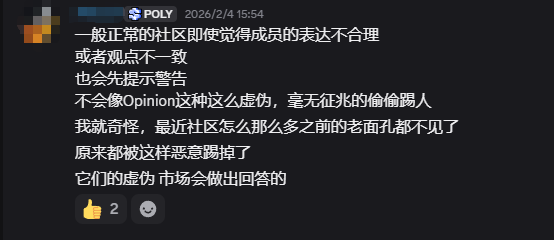
Opinion community members complaining in other prediction market project communities

Repeated TGE delays, continuous point dilution, and arbitrary kicking of members from the official community led to accumulating dissatisfaction within the Opinion community. Points kept increasing, fees kept being paid, but the answers to when the project would TGE and what it would ultimately be worth became increasingly elusive.

Airdrop Allocation Sparks Controversy: Only 3.5% of TGE Airdrop Unlocked, Marketing Allocation Unlocks a High 7.7%

After Tokenomics Revealed, Point Price Plunged to $6

On the evening of March 2nd, the Opinion Foundation officially announced the tokenomics of its native token OPN. The total supply of OPN is 1 billion tokens, with the airdrop accounting for 23.5% (235 million tokens). At first glance, this proportion is not low compared to current crypto projects.

However, the actual unlock ratio at TGE sparked controversy. Of the total airdrop allocation, only 3.5% (35 million tokens) were released on TGE day, with the remaining portion to be linearly released over 7 months. This means that for the vast majority of users who farmed points for the airdrop, the number of tokens actually received on TGE day was far lower than previous market expectations.

What further displeased the community was the unlock ratio of other allocation parts. According to the official token distribution, the Marketing portion accounts for 8.9%, but 7.7% is released at TGE, significantly higher than the airdrop release ratio. In comparison, users who participated in early interactions and contributed trading volume only received 3.5% at TGE.

This comparison quickly sparked controversy within the community—early interactive users contributing trading volume received a minimal share at TGE, while the related marketing share received a higher proportion of unlocks at launch. Simultaneously, Binance Launchpool directly received 2% of the token supply, further intensifying community dissatisfaction.

At the same time, the internal holding比例 further exacerbated community discontent. According to the token distribution, investors account for 23%, the team and advisors account for 19.5%, and the foundation accounts for 12%, totaling over 54%.
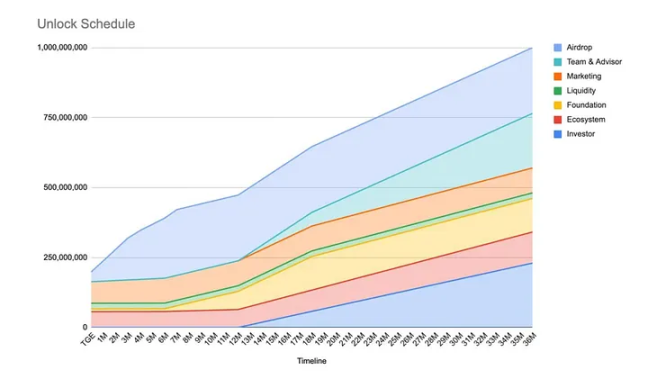
OPN Token Unlock Schedule

After the tokenomics were announced, market expectations quickly changed. Prior to this, OPN points were once quoted at $45 per point on the secondary market. With only 3.5% being airdropped at TGE, the OTC price of Opinion points plummeted, with pre-market quotes quickly falling to $6 per point.

Furthermore, many "airdrop farming whales" spent real money on fees to farm points, only to be flagged as Sybils. According to feedback data from community members, 1 point ultimately corresponded to $6, but many users with high point rankings received an airdrop value even lower than this. KOL Daidaidai Bitcoin posted his loss details on platform X: invested $200,000 to farm points,最终 received 2000 OPN, worth about $1000 at current prices. "200k USD for 2000 tokens. Yes, you read that right." This phrase quickly went viral in the Chinese crypto community.

What the community found even more ironic was that according to Dune data, Opinion's cumulative revenue from trading fees over the past months has exceeded $17 million. Calculated at current market prices, the TGE airdrop value is even lower than this figure.
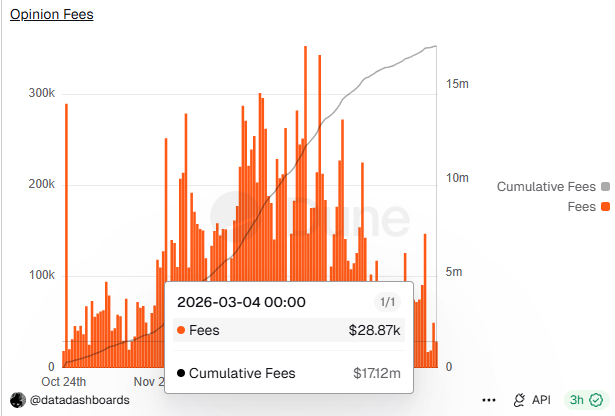
Opinion's cumulative fee revenue exceeds $17 million

Summary

From "the most anticipated airdrop of 2026" to being joked about by the community as "almost entirely flipped," Opinion's plot twist took only a few months. Although Opinion founder Forrest recently stated that more emphasis would be placed on Season 2 rewards, for many early participants, the Season 1 airdrop result has severely透支 trust.
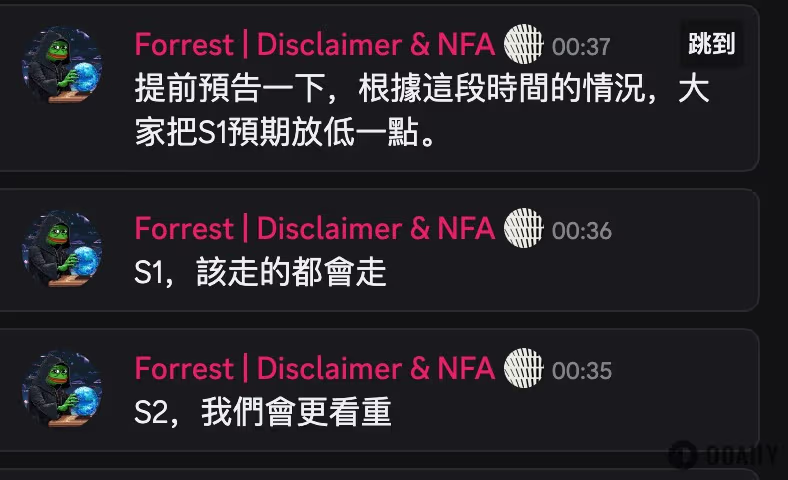
Opinion founder emphasizes greater focus on S2 rewards

This sentiment was quickly reflected in user behavior. More and more participants chose to reduce or even stop trading on the platform, and on-chain data showed a significant subsequent decline. Platform TVL plummeted from about $150 million to $36 million, and trading volume dropped from $150 million to about $15 million, indicating a clear cooling off in user activity.

Against this backdrop, the controversy surrounding Opinion is more than just an airdrop incident. As one of the most watched prediction market projects in the BNB Chain ecosystem, this event has also had a significant impact on the entire sector.

After this storm, can the BNB Chain ecosystem still produce new prediction market platforms?

Perguntas relacionadas

QWhat was the main reason for the community's disappointment with Opinion's airdrop?

AThe main reason was the extremely low initial unlock of the airdrop allocation. Only 3.5% of the total airdropped tokens (23.5% of total supply) were distributed at TGE, while a much higher percentage (7.7%) of the marketing allocation was unlocked immediately.

QHow did the delay of the TGE (Token Generation Event) impact the perceived value of Opinion's points?

AThe repeated delays of the TGE caused the OTC (Over-The-Counter) price of Opinion points to plummet, falling from a high of approximately $45 per point to around $6 per point after the tokenomics were revealed.

QAccording to the article, what was the total amount of fees that the Opinion platform generated from user transactions?

AAccording to Dune data cited in the article, the Opinion platform accumulated over $17 million in revenue from transaction fees.

QWhat drastic change in user activity did Opinion experience following the airdrop controversy?

AUser activity dropped significantly. The platform's TVL (Total Value Locked) plummeted from about $150 million to $36 million, and its trading volume fell from $150 million to approximately $15 million.

QWhat was the total supply of OPN tokens and what percentage was allocated to the airdrop?

AThe total supply of OPN tokens was 1 billion. The airdrop allocation was 23.5% of the total supply, which equals 235 million tokens.

Leituras Relacionadas

Analyzing the Impact of AI on Economic Growth and Productivity

**Title: Analyzing AI's Impact on Economic Growth and Productivity** This article examines three contrasting views on AI's influence on economic growth and productivity. **The Optimistic View** posits that AI, especially through automating R&D ("recursive self-improvement"), could dramatically accelerate growth, even triggering a technological "singularity" with explosive, potentially infinite, economic expansion. **The Moderate/Mainstream View** acknowledges AI's productivity benefits but emphasizes significant real-world constraints that could limit its impact. These include: limited cost savings per task, structural ceilings on which jobs and industries are "exposed" to AI, adoption bottlenecks (e.g., compute, energy, regulatory hurdles), and the "weak link" effect where non-automatable tasks cap overall gains. Consequently, the realized AI dividend may be far lower than optimistic projections, with estimates typically ranging from 0.1% to 1.3% annual productivity growth. **The Pessimistic View** stems from two strands. The first aligns with the moderate view but applies extremely conservative assumptions about task exposure and efficiency gains, yielding minimal projected impact. The second introduces a demand-side critique: if AI primarily replaces rather than augments labor, it could depress labor's share of income, weaken consumer demand, and create a "demand trap" that ultimately stifles growth, unless offset by redistribution policies. **The authors' assessment** is nuanced: * **Short-term (1-2 years):** AI will support growth primarily through investment spending, not significant productivity gains. * **Medium-term (3-5 years):** Three potential paths emerge based on AI demand and bottleneck severity: 1. **"Optimistic Path":** High demand, few bottlenecks. Rapid productivity gains but risk of major job displacement and social conflict without redistribution. 2. **"Moderate Path" (most likely):** High demand but significant, surmountable bottlenecks. Leads to moderate productivity gains, financial market volatility (K-shaped returns), and sectoral job losses. 3. **"Pessimistic Path":** Low demand or severe bottlenecks. Minimal productivity and growth impact, triggering financial market corrections but allowing a smoother societal transition with less labor disruption. * **Long-term:** AI holds potential for a major productivity revolution and prosperity. The conclusion stresses that no path is smooth. Technologically "optimistic" outcomes could be socially detrimental, while "pessimistic" technological diffusion might be more socially stable. Policymakers must monitor developments and prepare balanced responses to manage economic, financial, and social sustainability.

marsbitHá 27m

Analyzing the Impact of AI on Economic Growth and Productivity

marsbitHá 27m

The New Cold War is a Tech Stock War

The New Cold War is a Tech Stock War The article argues that the contemporary geopolitical and economic rivalry between the US and China represents a "New Cold War," but one fundamentally fought through technology and financial markets, not physical barriers or conventional trade. Historically, US dominance was secured through financial systems. The Soviet Union, reliant on the rigid "Transferable Ruble," was ultimately undermined by its dependency on the US dollar for oil trade. Later, Japan's semiconductor challenge was countered not just by tariffs (e.g., Plaza Accord, 301 investigations) but by binding it to US Treasury bonds. China presents a more complex, "embedded" challenger. While it holds vast dollar reserves and US debt like Japan, its industrial base is stronger and more diversified than the Soviet Union's. Surviving the initial 2018 trade war phase, the conflict has evolved into a "tech-financial war." The core battlefield is now the stock market. US tech stocks (AI, semiconductors) are treated as sovereign assets, buoyed by bipartisan national will. China is pushing to strengthen its own financial markets to convert industrial strength into financial power and fund its tech ambitions. Companies like ChangXin (semiconductors), Moonshot AI, and DJI compete not just for market share but as financial proxies for their respective systems. The new paradigm is moving from globally efficient monopolies (Apple, Google) towards companies that achieve monopolistic profits within their respective geopolitical spheres. This competition over "pricing power" and financial valuation in segmented markets defines the current era, making the stock market the primary arena for this tech-centric struggle.

marsbitHá 36m

The New Cold War is a Tech Stock War

marsbitHá 36m

Trading

Spot
活动图片