ForkLog is not responsible for readers' investment decisions. Financial market forecasts represent the author's personal opinion and do not necessarily reflect the editorial position.
In an author's column for ForkLog, trader and Coen+ Telegram channel author Vladimir Coen analyzed how a shift in Fed rate expectations, rising yields, and fuel prices impacted markets, while inflows into crypto funds supported bitcoin after an intraweek reversal.
Financial Markets: August 31 — September 4, 2026.
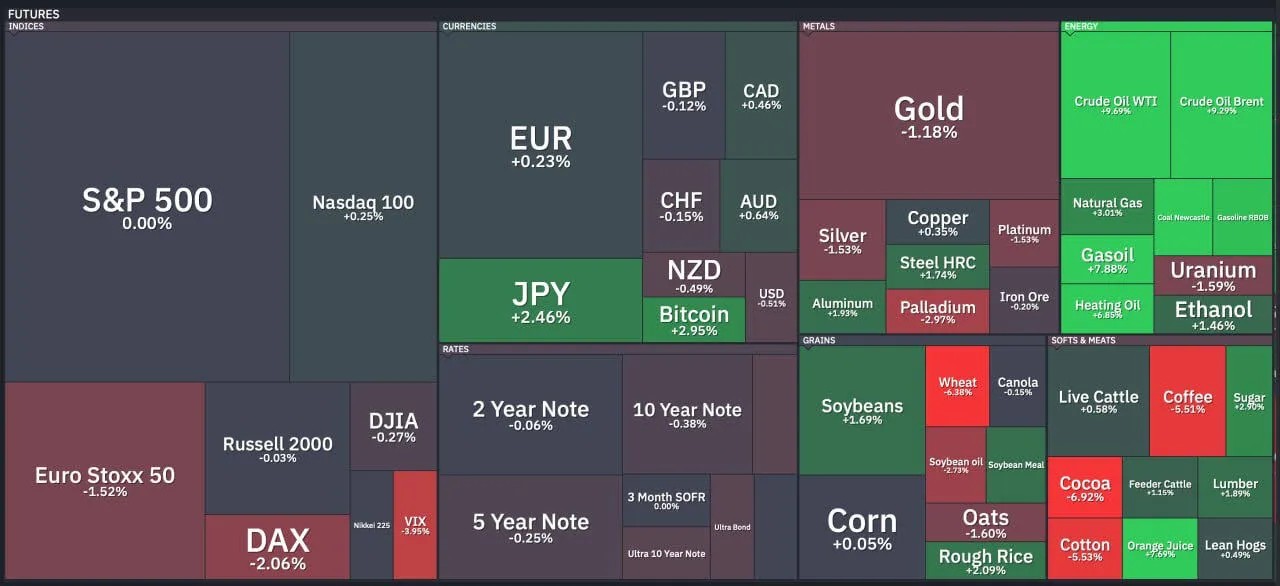
Indices closed almost unchanged: the S&P 500 gained 0.1%, the Nasdaq Composite rose 0.4%, while the Dow Jones Industrial Average fell 0.3%. Behind this flat picture lie two shifts in direction and a noticeably changed market internal structure.
The Pendulum of Rate Expectations
The week began in a sentiment typical for September: a historically weak month for markets, escalation in the Middle East, expensive oil, and inflation risks. The reaction was predictable: defensive positioning, growth in short positions, and heightened sensitivity to data.
The trajectory of probability for a September rate hike:
- Hawkish impulse after Fed Chair Kevin Warsh's speech in Jackson Hole — 65%;
- Verbal interventions by Fed Governor Christopher Waller and New York Fed President John Williams — a drop to around 50% and a short squeeze on Thursday;
- Strong employment report on September 4 — return to 63%.
Employment grew by 162,000 against expectations of 45,000-55,000. Unemployment was 4.1%. The July figure was revised from negative territory to positive.
A key nuance: the report removed the argument for easing but did not show a new wage overheat. This was not a hawkish shock, but rather a cancellation of dovish hope.
The reaction was appropriate: on Friday, the S&P 500 fell 0.38%, Nasdaq — 0.29%.
The probability of at least one rate hike by year-end reached 71.5%.
How Does the Fed Rate Affect Cryptocurrency Prices?
Rates: Pressure Became Global
The yield on 10-year U.S. Treasury bonds ranged between 4.75-4.80%, for 30-year bonds — above 5.2%.
Simultaneously, yields on German, British, and especially Japanese bonds rose. Therefore, this can no longer be considered solely an American story.
The market is globally re-evaluating three factors: the term premium, the volume of government borrowing, and the neutral rate level.
The main divergence of the week: the probability of a rate hike is rising, yields are rising, but the dollar index remains below 100.
The dollar does not confirm the scale of the move in the bond market. In my opinion, participants are pricing in a targeted tightening but are not yet pricing in the start of a new rate hike cycle. These are different scenarios.
Oil: The Shortage Isn't in Crude
Brent closed the week at $92.68 (+7.6%), WTI — at $91.48 (+10%).
But the barrel price itself doesn't show the main thing. According to U.S. Energy Department data:
- Crude oil inventories fell by 4.5 million barrels;
- Gasoline inventories decreased by 1.2 million barrels;
- Distillate inventories were 104.2 million barrels, which is 14% below the five-year average;
- Refinery utilization reached 98%;
- Petroleum product deliveries over four weeks fell 4% year-over-year.
The combination is atypical: demand is not overheated, but plants are operating near physical capacity, and fuel inventories remain low. So, the bottleneck now is not in crude oil, but in refining capacity and diesel fuel availability.
American diesel reached a record $5.85 per gallon. European crack spreads exceeded $100 per barrel.
This is an inflationary impulse with a lag. It penetrates core inflation through transportation costs and production costs and may persist even after oil prices stabilize.
Gold: Rates Proved Stronger Than Fear
Gold fell 3.5% over the week — from $4601 to $4438. This happened against the backdrop of military escalation.
The mechanics look like this: rising tensions push oil up, expensive oil supports real yields, and rising yields put pressure on gold.
As a result, the rate effect proved stronger than safe-haven demand. As long as real yields are rising, international tension alone is not a sufficient driver for gold.
Stocks: The Index Held, Structure Changed
The semiconductor sector outperformed the market. Part of the software companies and growth stocks from the consumer segment came under pressure.
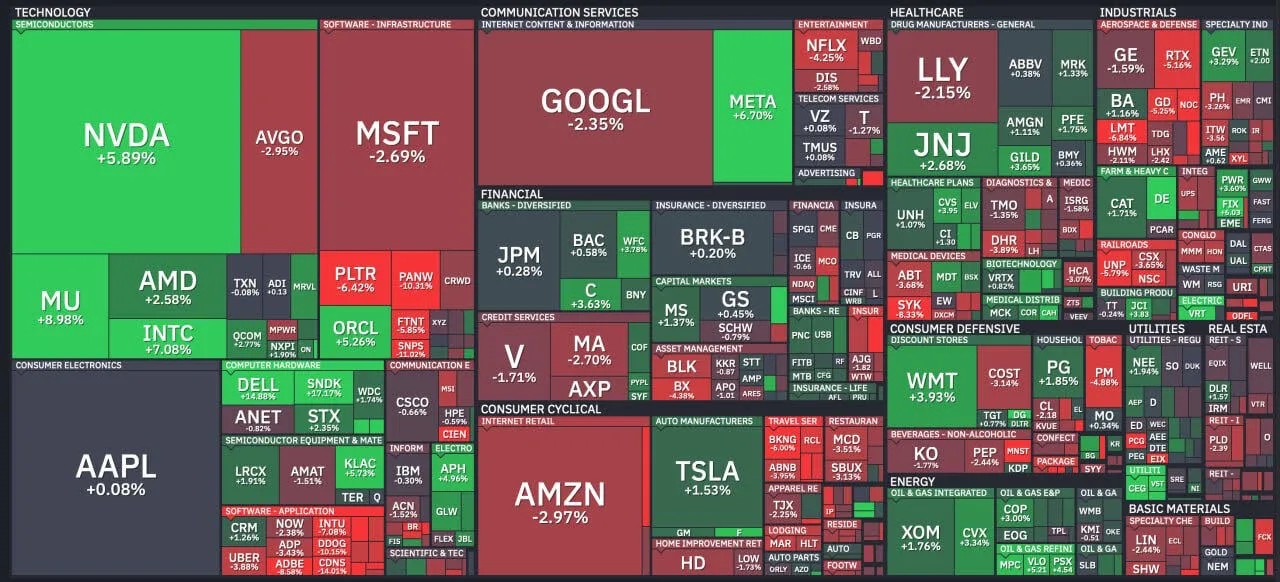
On Friday, the SOX index gained 3.4% against a decline in broad indices. This already looks more like market stratification than ordinary rotation.
Simultaneously, capital outflow continues:
- U.S. equity funds saw outflows of $11.1 billion for the week to September 2, compared to $22.7 billion the previous week.
- Money market funds received $48.8 billion;
- Short- and medium-term government bonds saw inflows of $4.5 billion.
Old capital maintains positions, while new money is mainly going into cash and short-term debt.
Cryptocurrencies: Inflow Returned Sharply
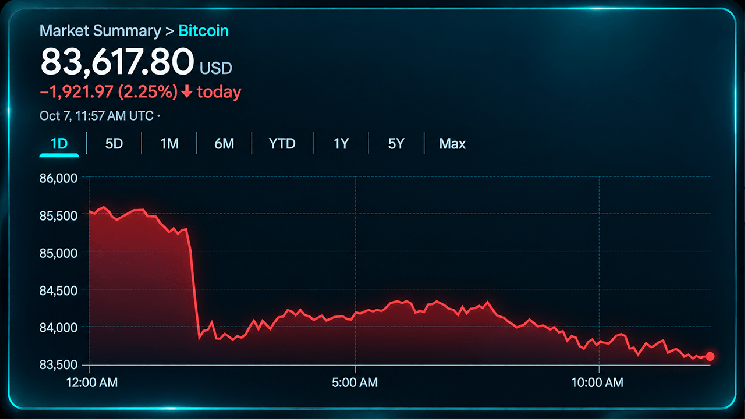
Bitcoin traversed a route from $76,200 through $82,200 to $79,766 over the week.
Closing prices for the week:
- Bitcoin — $79,766 (+0.44%).
- Ethereum — $2461 (+0.34%).
- BNB — $766.30 (+6.99%).
- Solana — $103.27 (+1.68%).
- $XRP — $1.4176 (+0.44%).
Total market capitalization was $2.7 trillion with a trading volume of $67.4 billion.
Is a Bitcoin Price "Golden Cross" Expected in 2026?
Bitcoin dominance reached 59.4%, Ethereum — 11.1%, with other assets accounting for 29.5%.
The Fear and Greed Index stood at 75, in the greed zone. The Altseason Index — 40 out of 100. A full altcoin season is still far away: major capital remains in the first tier.
Open interest in perpetual contracts was $408.59 billion, in futures — $2.37 billion.
Implied volatility Volmex for Bitcoin reached 39.32, for Ethereum — 52.84. The leading altcoin is trading at a volatility premium against the comparative weakness of its price. This indicates higher demand for hedging specifically in this asset.
The main change of the week occurred in exchange-traded crypto fund flows:
- August 27 — +$540 million.
- August 31 — +$310 million.
- September 1 — −$194.4 million.
- September 2 — +$60 million.
- September 3 — +$820 million.
- September 4 — +$205.8 million.
On September 4, Bitcoin saw inflows of +$174.6 million, Ethereum — +$25.9 million, HYPE — +$10.5 million. Solana recorded an outflow of $5.2 million, $XRP — a zero result.
Final flows were +$1.238 billion for the week, +$5.745 billion for the month, and +$4.164 billion for the quarter. Combined crypto fund assets reached $122.57 billion across 32 products from 11 issuers.
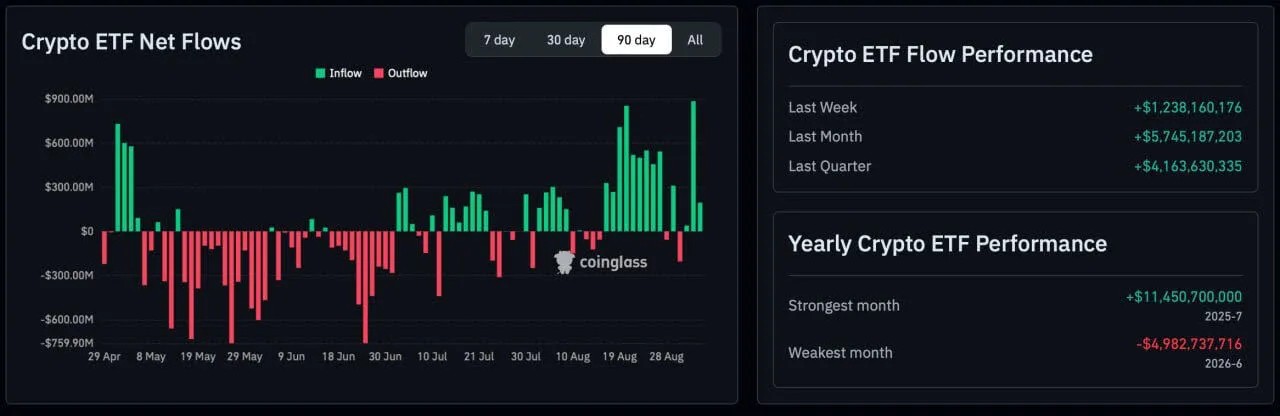
The intraweek reversal here mirrors the stock market: selling on Tuesday, a strong reversal on Thursday, and consolidation on Friday.
Why the Decline Was Mild
For me, this is the key to the entire week:
- The market entered the week with a defensive skew: accumulated short positions, purchased hedges, and heightened sensitivity to news.
- A series of verbal interventions on Wednesday and Thursday lowered the probability of a rate hike from about 65% to 50%. Short positions began to close, amplifying the rise on Thursday.
- By Friday, a significant portion of shorts had already been closed, but hedges remained ahead of the employment data release.
- The report was strong. However, a significant part of the speculative overhang had disappeared the day before, and the remaining hedges softened the move.
As a result, the market declined, but from higher levels and with relatively restrained volatility. Positioning and defensive structures partially absorbed the blow in advance.
The Timing Puzzle
On the eve of the September 4 data release, an unusually dense series of public statements was heard: from Fed representatives, Secretary of Commerce Howard Latnik, the Treasury Secretary, and U.S. President Donald Trump himself.
This was not one speech, but a whole series immediately before the report.
In my view, such a sequence looks deliberate. Administration representatives might have understood the direction of the data in advance and prepared the market, softening rate expectations before the publication.
The result was a strong short squeeze against the backdrop of general September pessimism. By the time negative stock data was released, the market was already much less vulnerable in terms of positioning.
The link looks consistent: a series of interventions → a reversal of expectations → closing of short positions → a milder reaction to strong data.
The closer the elections get, the more such interventions we are likely to see. The battle for managing expectations is already intensifying.
Week's Summary
The week ended almost unchanged for major indices, but with increased sensitivity to rates and record diesel prices as one source of inflation risk.
The crypto market closed the week on the return of institutional demand: net inflows into exchange-traded products amounted to $1.238 billion after a reversal of flows within the week.
Main trends:
- The divergence between the dollar and yields remains unresolved: the market prices in targeted tightening but not the start of a new rate hike cycle.
- A shortage of refining capacity and low distillate inventories create an inflation channel with a lag that is not fully dependent on oil prices.
- Outflows from U.S. stocks continue against the backdrop of index resilience: the direction of capital movement diverges from price dynamics.
- The crypto market remains in a Bitcoin dominance phase. The Altseason Index is 40 out of 100, a noticeable rotation into altcoins has not yet begun.
Triggers for the next week:
- Fed meeting on September 15-16. The current probability of a rate hike is 63%;
- CPI publication before the meeting, which will determine the final trajectory of expectations;
- Continued verbal interventions before the rate decision;
- Dynamics of distillate inventories and refinery utilization as a signal of the persistence or weakening of inflation risk from fuel.
The market closes the week in a state of a compressed spring: indices are near highs, rates are at multi-year peaks, and the dollar does not confirm the move. Next week will show which of these forces changes direction first.