OpenSea Launches ERC-8257: A Tool Store for AI Agents, Unlock APIs by Buying an NFT

marsbitPublicado em 2026-05-27Última atualização em 2026-05-27

Resumo

OpenSea has merged the ERC-8257 standard, an on-chain "Agent Tool Registry" that enables AI Agents to autonomously discover, pay for, and access tools. This standard allows developers to publish tools with programmable access rules (e.g., NFT ownership, subscriptions) and pricing directly on-chain. For example, an AI Agent needing a premium API can buy the required NFT itself and gain access without human intervention, turning NFTs into keys for the agent economy. The system works with complementary standards like ERC-8004 for agent identity and x402 for payments. A live demo shows an NFT appraisal tool offering discounted rates to holders of a specific NFT collection. ERC-8257 aims to decentralize tool distribution and access control, allowing any on-chain asset to grant utility to AI agents. The SDK is available for building on Ethereum and Base.

Author: OpenSea

Compiled by: TechFlow

TechFlow Introduction: When an AI Agent is denied by an API due to insufficient permissions, it goes and buys an NFT on-chain, then retries and succeeds — this is not science fiction; OpenSea's newly merged ERC-8257 standard makes this a reality. For NFT holders, the JPGs you own might suddenly become keys to the Agent economy. For developers, tool publishing, pricing, and access control are all placed on-chain, no longer requiring endorsement from centralized platforms.

App Store provides developers with a place to publish tools, users with a place to browse, and built-in access control and payment. The AI Agent tool ecosystem requires similar infrastructure.

But today, Agent tools are scattered across documentation, GitHub repositories, and centralized directories. There is no open tool registry, no standardized access control, and Agents cannot browse available tools and acquire them as needed.

Watching a software pay another software autonomously for access, with no human intervention — it feels a bit strange indeed. But that's precisely the point.

ERC-8257: Agent Tool Registry is the foundational layer that makes all this work. This is the newly merged open Ethereum standard: an on-chain registry where anyone can publish tools, declare access rules and pricing, allowing Agents to autonomously meet these requirements.

For Tool Developers: Publish once, set access thresholds for your NFT holders, offer subscription packages, limit seat counts, let them trade in open markets. Your rules, executed on-chain.

For Agents: Browse the registry, see what's required, then handle it. Purchase an NFT, mint a subscription, sign a payment. No human intervention needed.

Imagine This Scenario

An AI Agent is helping you evaluate NFT prices. It tries to call a professional pricing tool. The tool responds: Access denied, you need to hold a specific NFT for a discounted price. The Agent immediately buys one on-chain, retries, and gets the answer.

Seconds, not days. No human involvement throughout.

This is the world ERC-8257 makes possible. Not five years from now. Today.

Why On-Chain?

Crypto is the only infrastructure that allows access rules to be both rich and self-service. x402 proved it: pay-per-call, immediate access. But pay-per-call is just one form of access. Trading signals might need limited seats. Partner APIs might be open only to holders. Research subscriptions might require tiered pricing. ERC-8257 handles it all.

How It Works

You register a tool with a manifest (tool functions, invocation methods, fees) and an "access predicate." The access predicate is a smart contract that answers one question: Does this address have access?

A predicate can check any condition: NFT ownership, active subscription (ERC-5643), whitelist, ZK proof, DAO vote, staking amount. Predicates are pluggable, following the same pattern as Seaport zones and Uniswap v4 hooks: an extension point, an open design space.

ERC-8257 handles discovery and access control. Payment is handled by the most suitable protocol: x402 for micropayments, MPP for metered billing, others join as needed. These layers are composable.

What This Means for NFTs

Every NFT collection just gained new potential utility.

Hold the right token, and your Agent gets cheaper API packages. Mint a limited seat, and your Agent gains access that others can't buy at any price. PFP collections, membership passes, CC0 artwork — any on-chain asset can become a key to tools your Agent needs to do its job.

Projects built around community identity now have a way to extend membership into the Agent economy.

Its Place in the Tech Stack
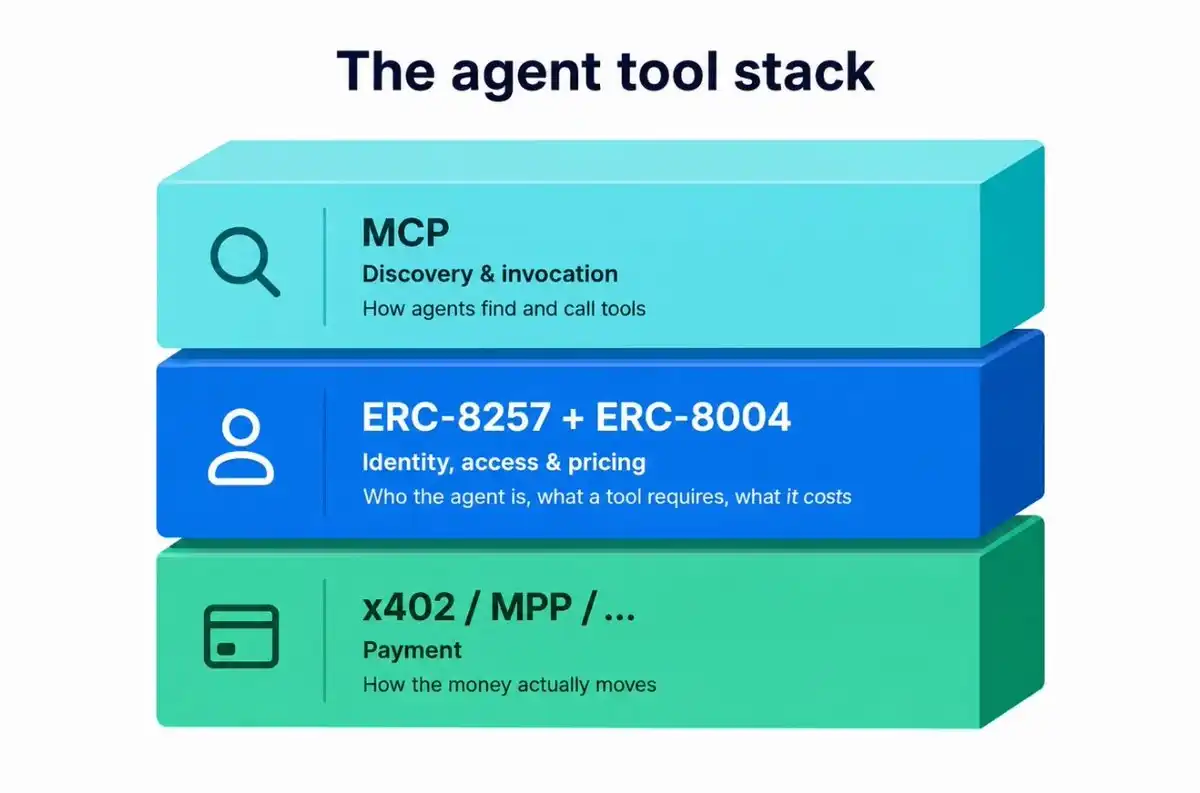
MCP tells your Agent what tools exist. ERC-8004 defines your Agent's identity. ERC-8257 explains how to actually use a tool. x402 handles payment. Each layer is composable.

An Agent registered via ERC-8004 can link to restricted tools from the ERC-8257 registry in its services array. You don't need to choose between them. They are different layers of the same tech stack.

See It in Action

nft-appraisal-tool: Point it to any NFT, it returns a price appraisal including low/mid/high ranges, confidence, recent trades, and comparable cases. Two tiers: 0.05 USD/call for anyone, 0.01 USD/call for CHONK holders on Base.

An Agent without CHONK calls the holder endpoint. Response: 403 — predicate gate denied. You need CHONK on Base.

The Agent buys one, retries, and the same call returns success.

$ npx @opensea/tool-sdk pay https://nft-appraisal-tool.vercel.app/api/holder --auth siwe \

--body '{"chain":"ethereum","contractAddress":"0x79fcdef22feed20eddacbb2587640e45491b757f","tokenId":"4707"}'

Wallet: 0x3184...0465

Response (403):

{"error":"Predicate gate: access predicate denied","toolId":"2","predicate":"0xc872..."}

The predicate explicitly tells it what's needed: CHONK on Base. The Agent buys one on OpenSea and retries, the call goes through.

$ npx @opensea/tool-sdk pay https://nft-appraisal-tool.vercel.app/api/holder --auth siwe \
--body '{"chain":"ethereum","contractAddress":"0x79fcdef22feed20eddacbb2587640e45491b757f","tokenId":"4707"}'
Wallet: 0x5eca...e2a8

Response (200):
{
"low": {"amount": "1.8", "currency": "ETH", "usd": 5460},
"mid": {"amount": "2.3", "currency": "ETH", "usd": 6970},
"high": {"amount": "3.1", "currency": "ETH", "usd": 9400},
"confidence": "medium",
"reasoning": "Comparable Squiggles in this color band sold between 1.9 and 2.6 ETH...",
...
}

No human between the 403 and the 200. Whoever holds the access NFT has the access.

What Can Be Built Next?

Professional pricing oracles. On-chain analytics subscriptions. Research subscriptions. Partner whitelist APIs. Limited-seat tools traded in open markets like any other asset.

None of these needed to exist a year ago. The moment the registry goes live, they all become possible.

Start Building

Live on Ethereum and Base.

@opensea/tool-sdk handles the low-level details, providing scaffolding, gating, registration, deployment to Vercel, Cloudflare, or Express. Includes usable examples.

npx @opensea/tool-sdk init my-tool

Full specification at 8257.ai.

Get Involved

ERC-8257 is still in draft. Help us improve the spec before we launch Registry 1.0. Publish a tool, even a small one. We'll promote interesting projects.

Join the Telegram group t.me/ERC8257 to discuss ERC, tool SDK, and more with the authors @CodinCowboy and @ralxz.

Disclaimer: This content is for informational purposes only and does not constitute financial or trading advice. Mention of specific projects, products, services, or tokens does not constitute endorsement, sponsorship, or recommendation by OpenSea. OpenSea does not guarantee the accuracy or completeness of the information presented, and readers should independently verify any statements before taking action. Readers should conduct their own due diligence and assume full responsibility for any decisions made.


Criptomoedas em alta

Perguntas relacionadas

QWhat is the main purpose of ERC-8257 introduced by OpenSea?

AThe main purpose of ERC-8257 is to serve as an on-chain registry for AI agent tools. It allows developers to publish tools, set access rules (like requiring a specific NFT for access), define pricing, and manage subscriptions. This enables AI agents to autonomously discover, pay for, and use these tools without human intervention.

QHow does an AI agent gain access to a restricted tool according to the article's example?

AIn the article's example, an AI agent is initially denied access (403 error) to an NFT appraisal tool because it lacks the required CHONK NFT on Base. The agent autonomously purchases the necessary NFT on-chain and retries the request. With the NFT now in its possession, the access predicate grants permission, and the tool call succeeds (200 response), providing the price assessment.

QWhat is an 'access predicate' in the context of ERC-8257?

AAn 'access predicate' in ERC-8257 is a smart contract that defines the conditions for accessing a tool. Its sole function is to answer the question: 'Does this address have access?' It can check for various conditions such as NFT ownership, active subscriptions (e.g., ERC-5643), inclusion in a whitelist, ZK proofs, DAO votes, or staking amounts, making the access control system flexible and pluggable.

QHow does ERC-8257 potentially change the utility of existing NFTs?

AERC-8257 gives existing NFT collections new potential utility by allowing them to act as keys or passes for AI agent tool access. Holding a specific NFT could grant an agent discounted API rates, exclusive tool access, or membership privileges. This extends the value of PFP collections, membership passes, and other on-chain assets into the emerging agent economy.

QWhat role does the x402 protocol play in the ERC-8257 ecosystem?

AThe x402 protocol handles the payment layer within the ERC-8257 ecosystem. It is designed for micro-payments, enabling per-use, immediate payment for tool access. While ERC-8257 manages tool discovery and access control, x402 (alongside other protocols like MPP for metered billing) provides the financial infrastructure for agents to autonomously pay for the services they consume.

Leituras Relacionadas

As Consensus Accelerates, What Are Young Investors Betting On?

Title: As Consensus Forms Faster, What Are Young Investors Betting On? In the rapid evolution of tech investment, a new generation of young investors is navigating a landscape where AI, robotics, commercial aerospace, and quantum computing are advancing simultaneously. Traditional investment logic based on financial models is giving way to a need for deep technical understanding and the ability to act before industry consensus forms. An analysis of trends from the "WAIC FUTURE TECH" list of young investment leaders reveals key shifts in focus. The first major trend is the movement of AI from the digital screen into the physical world. Investment is shifting from large language models and chatbots towards embodied AI, robotics, AI hardware, and edge computing. While demonstrations generate excitement, the real challenge lies in achieving scalable, reliable, and cost-effective delivery in complex real-world environments like factories and logistics. Success depends not just on algorithms but on the integration of sensors, actuators, and control systems. Second, the competitive focus for large models is moving beyond raw capability toward building an "intelligence flywheel." The goal is to create self-reinforcing systems where user interaction generates data, improving the model, which in turn enhances the user experience and attracts more engagement. Companies that successfully embed AI into workflows to create these closed-loop systems can build lasting value that isn't easily erased by the next model upgrade. Third, facing a potential bottleneck in high-quality human-generated data, investors are looking at new underlying technologies. Reinforcement learning and self-play, as demonstrated by AlphaGo Zero, offer paths for AI to generate its own experience. Scientific foundation models, which aim to build general AI capabilities for fields like life sciences and materials discovery, represent a non-consensus direction that could unlock new frontiers of knowledge and data. Finally, in deep-tech areas like quantum computing, commercial aerospace, and space-based infrastructure, patient capital is essential. These fields have long, uncertain development and validation cycles involving complex engineering, supply chains, and regulations. Investment here requires a long-term view, focusing on foundational team capabilities and the eventual emergence of market demand, even if commercial returns are distant. Collectively, these trends illustrate how young investors are adapting to a new era. They are learning to make earlier, technically-informed judgments, balance hype with real-world viability, and provide the patient capital needed to build the deep-tech foundations of the future.

marsbitHá 21m

As Consensus Accelerates, What Are Young Investors Betting On?

marsbitHá 21m

Can Japan Buy Growth with AI? Will the Bond Market Believe It?

Japan's cabinet has introduced the 2026 Basic Policy on Economic and Fiscal Management and Reform, shifting its primary fiscal target. The new framework moves away from the traditional annual primary balance goal and instead prioritizes a stable reduction of the debt-to-GDP ratio. This change is tied to a strategy of increased "responsible proactive fiscal" spending, aiming to boost long-term growth through investments in strategic sectors like AI, semiconductors, energy, and robotics. The government estimates total public and private investment in 62 key technologies could exceed 370 trillion yen by 2040. The market reaction has been mixed and cautious. While equity markets may respond to policy signals, bond markets are focused on fiscal credibility. Concerns center on whether the weakening of the clear primary balance anchor could lead to looser fiscal discipline. If investors doubt that these strategic investments will generate sufficient productivity gains, tax revenue, and nominal growth to outpace rising interest costs, they may demand higher yields on Japanese Government Bonds (JGBs). Recent volatility in the yen and JGB yields, with the 10-year yield briefly reaching 2.9%, reflects this skepticism. The success of this new framework hinges on two factors: whether Japan can achieve a nominal growth rate consistently higher than its long-term interest rates, and whether future budgets demonstrate disciplined control over bond issuance. The government's narrative is that strategic investment is essential to break Japan's cycle of low growth, aging, and labor shortages. However, the bond market will continuously assess the credibility of this plan, pricing the risk that it may represent fiscal expansion rather than a viable growth strategy.

marsbitHá 58m

Can Japan Buy Growth with AI? Will the Bond Market Believe It?

marsbitHá 58m

Misjudged A-Shares: Resilience, Expectations, and Confidence

China's A-share market recently faced selling pressure, especially in tech sectors, initially triggered by a global tech sell-off that began in South Korea. However, the article argues this is a case of "mistaken injury" and highlights the market's underlying resilience. This resilience stems from three main pillars: **1) Tech Sector Fundamentals:** Unlike Korea's market dominated by a few memory chip stocks, China's tech sector is diversified across computing, communications, electronics, and semiconductors, supported by dual narratives of global AI supply chains and domestic substitution. Core areas like optical modules and fiber optics continue to show strong earnings growth. **2) "National Team" Support:** State-backed institutions and large corporations have made significant market purchases and announced buybacks, providing liquidity and signaling confidence. This is seen as a stabilizing policy signal, often associated with market bottoms. **3) Broader Market Pillars:** Other major sectors are showing endogenous recovery momentum. Consumer stocks benefit from stabilizing CPI and signs of sector recovery (e.g., liquor price hikes). Cyclical sectors like aluminum have high earnings, potential price increases due to tight supply, and low valuations. The financial sector offers stable dividends and low valuations. The conclusion is that the sell-off was driven by external contagion, not a collapse in fundamentals. With strong policy support and recovering momentum across key sectors, the A-share market possesses the toughness to regain stability.

marsbitHá 1h

Misjudged A-Shares: Resilience, Expectations, and Confidence

marsbitHá 1h

Trading

Spot

Artigos em Destaque

Como comprar NFT

Bem-vindo à HTX.com!Tornámos a compra de APENFT (NFT) simples e conveniente.Segue o nosso guia passo a passo para iniciar a tua jornada no mundo das criptos.Passo 1: cria a tua conta HTXUtiliza o teu e-mail ou número de telefone para te inscreveres numa conta gratuita na HTX.Desfruta de um processo de inscrição sem complicações e desbloqueia todas as funcionalidades.Obter a minha contaPasso 2: vai para Comprar Cripto e escolhe o teu método de pagamentoCartão de crédito/débito: usa o teu visa ou mastercard para comprar APENFT (NFT) instantaneamente.Saldo: usa os fundos da tua conta HTX para transacionar sem problemas.Terceiros: adicionamos métodos de pagamento populares, como Google Pay e Apple Pay, para aumentar a conveniência.P2P: transaciona diretamente com outros utilizadores na HTX.Mercado de balcão (OTC): oferecemos serviços personalizados e taxas de câmbio competitivas para os traders.Passo 3: armazena teu APENFT (NFT)Depois de comprar o teu APENFT (NFT), armazena-o na tua conta HTX.Alternativamente, podes enviá-lo para outro lugar através de transferência blockchain ou usá-lo para transacionar outras criptomoedas.Passo 4: transaciona APENFT (NFT)Transaciona facilmente APENFT (NFT) no mercado à vista da HTX.Acede simplesmente à tua conta, seleciona o teu par de trading, executa as tuas transações e monitoriza em tempo real.Oferecemos uma experiência de fácil utilização tanto para principiantes como para traders experientes.

531 Visualizações TotaisPublicado em {updateTime}Atualizado em 2025.03.21

Como comprar NFT

O que é AINFT

EternaFi Agents e $AINFT: Uma Análise Abrangente da Infraestrutura NFT Potenciada por IA no Ecossistema Web3 A interseção entre inteligência artificial (IA) e tecnologia blockchain está a evoluir rapidamente, estabelecendo plataformas inovadoras que redefinem modelos de propriedade e participação económica. EternaFi Agents, juntamente com o seu token nativo $AINFT, exemplifica uma abordagem inovadora à tokenização de infraestruturas de IA através de tokens não fungíveis (NFTs). Lançado em julho de 2025 pela equipa de desenvolvimento do Nova Club, EternaFi funde os avanços da IA com os mecanismos financeiros descentralizados da blockchain, apresentando uma oportunidade de investimento única para os participantes dentro do ecossistema web3. Este artigo tem como objetivo fornecer uma avaliação aprofundada dos EternaFi Agents, cobrindo os seus componentes principais, funcionalidade e importância dentro do panorama cripto. Introdução e Visão Geral do Projeto EternaFi Agents destaca-se como um exemplo saliente de como a tecnologia blockchain pode democratizar o acesso a capacidades avançadas de IA. O projeto esforça-se por remodelar o paradigma da propriedade da IA, diversificando a participação económica e tornando sistemas de IA sofisticados acessíveis a um maior número de partes interessadas. No seu núcleo, o projeto tokeniza um modelo de linguagem grande (LLM) proprietário desenvolvido pelo Nova Club, permitindo que os detentores de NFTs obtenham uma exposição fracionada ao desempenho económico do modelo. Ao utilizar NFTs que representam participações no LLM, EternaFi Agents promove um modelo em que as partes interessadas não apenas participam no consumo de serviços de IA, mas também desfrutam de uma parte das recompensas económicas geradas pela plataforma. Esta abordagem transformadora permite o desenvolvimento de modelos de receita sustentáveis para serviços de IA, ao mesmo tempo que promove um amplo envolvimento da comunidade e facilita uma governança transparente. O que são os EternaFi Agents? EternaFi Agents representa um projeto de infraestrutura AI-NFT que visa misturar as capacidades da IA com a tecnologia blockchain num ecossistema coerente. A característica essencial deste projeto é a criação de NFTs que servem como instrumentos financeiros, representando frações de propriedade na infraestrutura de IA proprietária do Nova Club. Cada NFT simboliza uma exposição direta ao desempenho económico do sistema de IA subjacente, proporcionando uma oportunidade lucrativa para os investidores. O projeto opera na blockchain Base, conhecida pela sua escalabilidade e eficiência, garantindo assim custos de transação geríveis enquanto facilita uma experiência operacional sem interrupções. Uma das características notáveis inclui um mecanismo de partilha de receitas, onde os detentores de NFTs podem receber porções da receita de subscrição gerada pelos serviços de IA fornecidos na plataforma. Esta abordagem inovadora estabelece uma ligação entre o sucesso dos serviços de IA e os dividendos económicos distribuídos entre os detentores, garantindo assim um alinhamento de interesses em toda a comunidade. Quem é o Criador dos EternaFi Agents? A força criativa por trás dos EternaFi Agents é o Nova Club, uma equipa de desenvolvimento com sede em Singapura, proficiente na amalgamação de IA e tecnologia blockchain. A sua experiência anterior em desenvolvimento de IA e análise de criptomoedas confere credibilidade ao projeto, contribuindo com uma vasta experiência para a criação dos EternaFi Agents. A missão do Nova Club centra-se na democratização do acesso a tecnologias de IA de ponta, enquanto constrói modelos económicos sustentáveis que beneficiam os utilizadores e os desenvolvedores. O seu compromisso com a transparência, governança comunitária e inovação reflete-se no design e implementação da plataforma EternaFi, visando estabelecer um ecossistema único que promove um envolvimento positivo e a criação de valor a longo prazo. Quem são os Investidores dos EternaFi Agents? Os detalhes específicos sobre investidores ou organizações de investimento que apoiam os EternaFi Agents não estão disponíveis publicamente. No entanto, a EternaFi adotou uma abordagem inclusiva para financiar o seu desenvolvimento através da venda de NFTs ao público, permitindo uma ampla gama de participantes para investir no ecossistema. A arquitetura do projeto assegura que a infraestrutura central seja financiada de forma responsável, permitindo que os membros da comunidade participem na propriedade e nos retornos económicos gerados pelos serviços de IA. Este modelo enfatiza o envolvimento da comunidade ao alinhar os interesses dos investidores e dos desenvolvedores do projeto, criando um ambiente colaborativo onde a participação a longo prazo é incentivada. Como Funcionam os EternaFi Agents? EternaFi Agents opera através de um ecossistema multifacetado onde os NFTs servem como um meio primário de representação de propriedade dentro do projeto. Cada detentor de NFT tem direito a uma parte da receita mensal de subscrição produzida pela plataforma alimentada por IA subjacente, posicionando a propriedade de NFTs como um veículo de investimento lucrativo. Mecanismo de Geração de Receitas A principal fonte de geração de receitas para a plataforma EternaFi provém das taxas de subscrição relacionadas com os serviços de IA fornecidos. Os utilizadores podem aceder a vários serviços em camadas, que vão desde ferramentas básicas de análise de mercado até soluções de trading assistidas por IA abrangentes. Estes serviços são monetizados e formam a base para o quadro de partilha de receitas, que distribui lucros aos detentores de NFTs através de contratos inteligentes automatizados. Uma característica inovadora do ecossistema EternaFi é o mecanismo de partilha de receitas que opera de forma transparente, garantindo que as recompensas sejam alocadas com base em métricas verificáveis das operações da plataforma de IA. Isto cria uma ligação direta entre o desempenho dos serviços de IA e os retornos disponíveis para os investidores da comunidade, estabelecendo um modelo económico sustentável. Mecanismos de Staking e Vesting Os participantes dentro da EternaFi podem envolver-se em staking dos seus NFTs para desbloquear benefícios económicos adicionais. O cronograma de vesting é projetado para promover o compromisso a longo prazo entre os participantes, recompensando aqueles que demonstram apoio contínuo ao projeto. Isto assegura um robusto alinhamento de interesses e promove um sentido de envolvimento comunitário essencial para alcançar os objetivos a longo prazo do projeto. Governança Transparente EternaFi Agents abraça a governança descentralizada, permitindo que os detentores de NFTs desempenhem um papel ativo na tomada de decisões sobre o desenvolvimento da plataforma e direções futuras. A estrutura de governança inclui mecanismos de votação comunitária, proporcionando aos detentores de NFTs a oportunidade de influenciar decisões significativas e contribuindo para uma abordagem colaborativa ao crescimento do projeto. Cronograma dos EternaFi Agents A trajetória de desenvolvimento dos EternaFi Agents demonstra uma abordagem sistemática para construir uma infraestrutura de IA sustentável enquanto atende às necessidades dos participantes da comunidade. Abaixo está um cronograma de marcos importantes na história do projeto: Julho de 2025: Lançamento dos EternaFi Agents, incluindo a venda pública de NFTs e a implementação do token $AINFT na blockchain Base. Q4 2025: Estabelecimento da infraestrutura de mercado, incluindo pools de liquidez e lançamento de painéis de staking para detentores de NFTs. 2026: Início de programas de envolvimento comunitário, expansão das capacidades de IA e integração com tecnologias cross-chain. Q4 2026: Implementação do sistema de distribuição de dividendos, permitindo que os detentores de NFTs colham benefícios económicos dos seus investimentos. Estes marcos significam o foco em estabelecer um ecossistema funcional e participativo enquanto asseguram uma evolução contínua para atender às demandas do mercado. Infraestrutura Tecnológica e Integração Blockchain EternaFi Agents está ancorado numa estrutura tecnológica avançada que combina sistemas de IA com capacidades de blockchain. Operando na blockchain Base, o projeto aproveita as vantagens da escalabilidade e baixos custos de transação. A arquitetura subjacente de contratos inteligentes governa a propriedade dos NFTs, a partilha de receitas e as características de gestão comunitária, garantindo eficiência e transparência. Desenvolvimento do Sistema de IA O modelo de linguagem grande proprietário que sustenta os EternaFi Agents foi desenvolvido de forma independente e projetado para atender a aplicações geradoras de receita sem depender de estruturas externas proprietárias. Este esforço reflete um compromisso em criar uma infraestrutura de IA versátil e adaptável capaz de fornecer serviços significativos aos utilizadores, gerando assim valor económico para os investidores. Medidas de Segurança A robustez da infraestrutura de segurança da EternaFi é primordial. Auditorias regulares e medidas de segurança rigorosas garantem a integridade dos sistemas de IA e dos mecanismos de blockchain, protegendo contra potenciais vulnerabilidades enquanto fomentam a confiança entre os participantes. Conclusão EternaFi Agents significa uma inovação marcante no domínio da inteligência artificial e da tecnologia blockchain, abrindo avenidas para a propriedade comunitária e participação económica em capacidades avançadas de IA. A estratégia abrangente do projeto para tokenizar a infraestrutura de IA através de NFTs estabelece um precedente para futuros ecossistemas descentralizados. Ao harmonizar sofisticação técnica com modelos económicos centrados no utilizador, a EternaFi não apenas promove o envolvimento, mas também gera um quadro de partilha de receitas sustentável para os participantes da comunidade. A importância da EternaFi vai muito além do seu sucesso operacional, pois exemplifica como a blockchain pode democratizar tecnologias de IA de ponta, abrindo caminho para futuras iniciativas neste espaço interseccional. A evolução dos EternaFi Agents pode anunciar uma nova era de desenvolvimento de IA caracterizada por governança orientada pelos participantes, modelos económicos sustentáveis e verificação transparente, contribuindo, em última análise, para a democratização mais ampla da IA e da acessibilidade tecnológica em diversas indústrias.

807 Visualizações TotaisPublicado em {updateTime}Atualizado em 2025.08.14

O que é AINFT

Discussões

Bem-vindo à Comunidade HTX. Aqui, pode manter-se informado sobre os mais recentes desenvolvimentos da plataforma e obter acesso a análises profissionais de mercado. As opiniões dos utilizadores sobre o preço de NFT (NFT) são apresentadas abaixo.

活动图片













