OpenSea Launches ERC-8257: A Tool Store for AI Agents, Unlock APIs by Buying an NFT

marsbitPublicado em 2026-05-27Última atualização em 2026-05-27

Resumo

OpenSea has merged the ERC-8257 standard, an on-chain "Agent Tool Registry" that enables AI Agents to autonomously discover, pay for, and access tools. This standard allows developers to publish tools with programmable access rules (e.g., NFT ownership, subscriptions) and pricing directly on-chain. For example, an AI Agent needing a premium API can buy the required NFT itself and gain access without human intervention, turning NFTs into keys for the agent economy. The system works with complementary standards like ERC-8004 for agent identity and x402 for payments. A live demo shows an NFT appraisal tool offering discounted rates to holders of a specific NFT collection. ERC-8257 aims to decentralize tool distribution and access control, allowing any on-chain asset to grant utility to AI agents. The SDK is available for building on Ethereum and Base.

Author: OpenSea

Compiled by: TechFlow

TechFlow Introduction: When an AI Agent is denied by an API due to insufficient permissions, it goes and buys an NFT on-chain, then retries and succeeds — this is not science fiction; OpenSea's newly merged ERC-8257 standard makes this a reality. For NFT holders, the JPGs you own might suddenly become keys to the Agent economy. For developers, tool publishing, pricing, and access control are all placed on-chain, no longer requiring endorsement from centralized platforms.

App Store provides developers with a place to publish tools, users with a place to browse, and built-in access control and payment. The AI Agent tool ecosystem requires similar infrastructure.

But today, Agent tools are scattered across documentation, GitHub repositories, and centralized directories. There is no open tool registry, no standardized access control, and Agents cannot browse available tools and acquire them as needed.

Watching a software pay another software autonomously for access, with no human intervention — it feels a bit strange indeed. But that's precisely the point.

ERC-8257: Agent Tool Registry is the foundational layer that makes all this work. This is the newly merged open Ethereum standard: an on-chain registry where anyone can publish tools, declare access rules and pricing, allowing Agents to autonomously meet these requirements.

For Tool Developers: Publish once, set access thresholds for your NFT holders, offer subscription packages, limit seat counts, let them trade in open markets. Your rules, executed on-chain.

For Agents: Browse the registry, see what's required, then handle it. Purchase an NFT, mint a subscription, sign a payment. No human intervention needed.

Imagine This Scenario

An AI Agent is helping you evaluate NFT prices. It tries to call a professional pricing tool. The tool responds: Access denied, you need to hold a specific NFT for a discounted price. The Agent immediately buys one on-chain, retries, and gets the answer.

Seconds, not days. No human involvement throughout.

This is the world ERC-8257 makes possible. Not five years from now. Today.

Why On-Chain?

Crypto is the only infrastructure that allows access rules to be both rich and self-service. x402 proved it: pay-per-call, immediate access. But pay-per-call is just one form of access. Trading signals might need limited seats. Partner APIs might be open only to holders. Research subscriptions might require tiered pricing. ERC-8257 handles it all.

How It Works

You register a tool with a manifest (tool functions, invocation methods, fees) and an "access predicate." The access predicate is a smart contract that answers one question: Does this address have access?

A predicate can check any condition: NFT ownership, active subscription (ERC-5643), whitelist, ZK proof, DAO vote, staking amount. Predicates are pluggable, following the same pattern as Seaport zones and Uniswap v4 hooks: an extension point, an open design space.

ERC-8257 handles discovery and access control. Payment is handled by the most suitable protocol: x402 for micropayments, MPP for metered billing, others join as needed. These layers are composable.

What This Means for NFTs

Every NFT collection just gained new potential utility.

Hold the right token, and your Agent gets cheaper API packages. Mint a limited seat, and your Agent gains access that others can't buy at any price. PFP collections, membership passes, CC0 artwork — any on-chain asset can become a key to tools your Agent needs to do its job.

Projects built around community identity now have a way to extend membership into the Agent economy.

Its Place in the Tech Stack
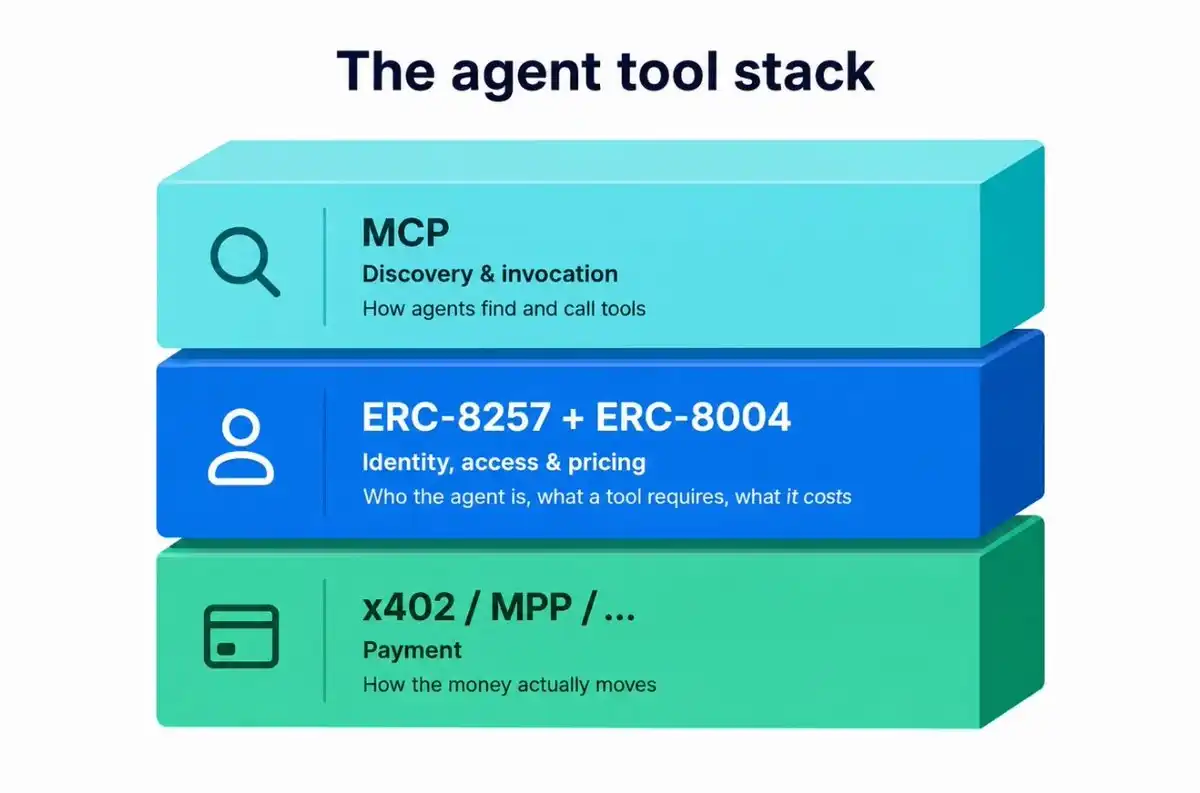
MCP tells your Agent what tools exist. ERC-8004 defines your Agent's identity. ERC-8257 explains how to actually use a tool. x402 handles payment. Each layer is composable.

An Agent registered via ERC-8004 can link to restricted tools from the ERC-8257 registry in its services array. You don't need to choose between them. They are different layers of the same tech stack.

See It in Action

nft-appraisal-tool: Point it to any NFT, it returns a price appraisal including low/mid/high ranges, confidence, recent trades, and comparable cases. Two tiers: 0.05 USD/call for anyone, 0.01 USD/call for CHONK holders on Base.

An Agent without CHONK calls the holder endpoint. Response: 403 — predicate gate denied. You need CHONK on Base.

The Agent buys one, retries, and the same call returns success.

$ npx @opensea/tool-sdk pay https://nft-appraisal-tool.vercel.app/api/holder --auth siwe \

--body '{"chain":"ethereum","contractAddress":"0x79fcdef22feed20eddacbb2587640e45491b757f","tokenId":"4707"}'

Wallet: 0x3184...0465

Response (403):

{"error":"Predicate gate: access predicate denied","toolId":"2","predicate":"0xc872..."}

The predicate explicitly tells it what's needed: CHONK on Base. The Agent buys one on OpenSea and retries, the call goes through.

$ npx @opensea/tool-sdk pay https://nft-appraisal-tool.vercel.app/api/holder --auth siwe \
--body '{"chain":"ethereum","contractAddress":"0x79fcdef22feed20eddacbb2587640e45491b757f","tokenId":"4707"}'
Wallet: 0x5eca...e2a8

Response (200):
{
"low": {"amount": "1.8", "currency": "ETH", "usd": 5460},
"mid": {"amount": "2.3", "currency": "ETH", "usd": 6970},
"high": {"amount": "3.1", "currency": "ETH", "usd": 9400},
"confidence": "medium",
"reasoning": "Comparable Squiggles in this color band sold between 1.9 and 2.6 ETH...",
...
}

No human between the 403 and the 200. Whoever holds the access NFT has the access.

What Can Be Built Next?

Professional pricing oracles. On-chain analytics subscriptions. Research subscriptions. Partner whitelist APIs. Limited-seat tools traded in open markets like any other asset.

None of these needed to exist a year ago. The moment the registry goes live, they all become possible.

Start Building

Live on Ethereum and Base.

@opensea/tool-sdk handles the low-level details, providing scaffolding, gating, registration, deployment to Vercel, Cloudflare, or Express. Includes usable examples.

npx @opensea/tool-sdk init my-tool

Full specification at 8257.ai.

Get Involved

ERC-8257 is still in draft. Help us improve the spec before we launch Registry 1.0. Publish a tool, even a small one. We'll promote interesting projects.

Join the Telegram group t.me/ERC8257 to discuss ERC, tool SDK, and more with the authors @CodinCowboy and @ralxz.

Disclaimer: This content is for informational purposes only and does not constitute financial or trading advice. Mention of specific projects, products, services, or tokens does not constitute endorsement, sponsorship, or recommendation by OpenSea. OpenSea does not guarantee the accuracy or completeness of the information presented, and readers should independently verify any statements before taking action. Readers should conduct their own due diligence and assume full responsibility for any decisions made.

Perguntas relacionadas

QWhat is the main purpose of ERC-8257 introduced by OpenSea?

AThe main purpose of ERC-8257 is to serve as an on-chain registry for AI agent tools. It allows developers to publish tools, set access rules (like requiring a specific NFT for access), define pricing, and manage subscriptions. This enables AI agents to autonomously discover, pay for, and use these tools without human intervention.

QHow does an AI agent gain access to a restricted tool according to the article's example?

AIn the article's example, an AI agent is initially denied access (403 error) to an NFT appraisal tool because it lacks the required CHONK NFT on Base. The agent autonomously purchases the necessary NFT on-chain and retries the request. With the NFT now in its possession, the access predicate grants permission, and the tool call succeeds (200 response), providing the price assessment.

QWhat is an 'access predicate' in the context of ERC-8257?

AAn 'access predicate' in ERC-8257 is a smart contract that defines the conditions for accessing a tool. Its sole function is to answer the question: 'Does this address have access?' It can check for various conditions such as NFT ownership, active subscriptions (e.g., ERC-5643), inclusion in a whitelist, ZK proofs, DAO votes, or staking amounts, making the access control system flexible and pluggable.

QHow does ERC-8257 potentially change the utility of existing NFTs?

AERC-8257 gives existing NFT collections new potential utility by allowing them to act as keys or passes for AI agent tool access. Holding a specific NFT could grant an agent discounted API rates, exclusive tool access, or membership privileges. This extends the value of PFP collections, membership passes, and other on-chain assets into the emerging agent economy.

QWhat role does the x402 protocol play in the ERC-8257 ecosystem?

AThe x402 protocol handles the payment layer within the ERC-8257 ecosystem. It is designed for micro-payments, enabling per-use, immediate payment for tool access. While ERC-8257 manages tool discovery and access control, x402 (alongside other protocols like MPP for metered billing) provides the financial infrastructure for agents to autonomously pay for the services they consume.

Leituras Relacionadas

Samsung Relies on Technology Cycles, SK Hynix on HBM, How Did Micron Win a Trillion-Dollar Market Cap?

Micron Technology, the third-largest memory chip maker alongside Samsung and SK Hynix, recently saw its market cap surpass $1 trillion. Founded in 1978 in Boise, Idaho, Micron survived brutal industry cycles while American peers and Japan's memory sector faltered. Its survival is attributed to a dual strategy: leveraging political and legal avenues for critical breathing room, coupled with relentless manufacturing cost control. Historically, Micron sought U.S. government intervention three times. In 1985, it filed an anti-dumping complaint against Japanese firms, leading to the U.S.-Japan Semiconductor Agreement. Ironically, this created an opening for Samsung, which later became its toughest competitor. In 2002, Micron turned "whistleblower" in a DRAM price-fixing investigation, escaping penalties while rivals were fined. In 2017, it sued China's Fujian Jinhua, contributing to its placement on a U.S. entity list, stifling a nascent competitor. However, a major strategic misstep occurred in 2013 with the acquisition of bankrupt Japanese firm Elpida. Integrating Elpida's mobile-DRAM-focused technology diverted resources, causing Micron to miss the critical early decade of development for High Bandwidth Memory (HBM)—the high-performance memory essential for AI chips like NVIDIA GPUs. By the time AI demand exploded in 2022, SK Hynix, which launched the first HBM in 2013, held about 85% of the HBM3 market, leaving Micron with roughly 3%. Micron now faces a triple squeeze. In the high-end HBM market, it lags significantly behind SK Hynix and Samsung. In the mid-to-low end DRAM market, it faces aggressive price competition from China's CXMT. Furthermore, a 2023 Chinese cybersecurity ban on its products slashed its revenue from China, a once-core market, from over 10% to just 7.1% by FY2025, causing it to exit China's data center server business. Beneath its political maneuvering lies Micron's core strength: exceptional manufacturing efficiency and cost control. Decades of engineering have yielded DRAM chips with a smaller cell area than rivals, meaning more chips per wafer and lower unit costs. This efficiency, not subsidies, has allowed it to withstand price wars. While political leverage bought time, Micron is now paying a "time debt" in the HBM race. It is racing to ramp up HBM3E production and develop HBM4, but catching up to competitors who started a decade earlier is a monumental challenge. Its future hinges on whether its expertise in cost control and political strategy can compensate for the lost time in a technology race where early-mover advantage is decisive.

链捕手Há 23m

Samsung Relies on Technology Cycles, SK Hynix on HBM, How Did Micron Win a Trillion-Dollar Market Cap?

链捕手Há 23m

New AMD Paper Overturns Conventional Wisdom: FP4 Training Instability's Cause Is Not Insufficient Randomness

AMD's new research challenges the conventional understanding of FP4 training instability. While reducing precision from FP8 to FP4 promises doubled computational throughput and is supported by new hardware like NVIDIA Blackwell and AMD MI350 series, training large language models natively with FP4 has been notoriously unstable, often attributed to insufficient stochasticity. The paper "Pretraining large language models with MXFP4 on Native FP4 Hardware" demonstrates successful end-to-end FP4 pre-training of Llama 3.1-8B on AMD MI355X GPUs using the MXFP4 format, achieving a 9-10% overall speedup over FP8. Crucially, it identifies the root cause of instability: not randomness, but the accumulation of *structural micro-scaling errors* along the sensitive weight gradient (Wgrad) path. Through controlled experiments, researchers found that quantizing the Wgrad operation to FP4 caused significant convergence degradation. Counterintuitively, common stochasticity-based mitigation techniques like stochastic rounding and randomized Hadamard transforms worsened performance. In contrast, applying a *deterministic* Hadamard transform successfully stabilized training by ensuring consistent error patterns, reducing the extra token cost from 26-27% to just 8-9%. This work has significant implications: 1) It provides a clear diagnostic for low-precision training instability, steering focus towards structural errors. 2) It pushes FP4 from a primarily inference-focused format into the realm of viable training. 3) It leverages the open OCP Microscaling (MX) standard, promoting cross-vendor compatibility. The research marks a critical step towards more economical large model training by further pushing the boundaries of low-precision computation.

marsbitHá 43m

New AMD Paper Overturns Conventional Wisdom: FP4 Training Instability's Cause Is Not Insufficient Randomness

marsbitHá 43m

Will ONDO's 'Tokenization Narrative' Change After Its CEO's Unexpected Passing?

Ondo Finance founder and CEO Nathan Allman has passed away unexpectedly. Allman, a Brown University graduate with a background in private credit and Goldman Sachs' digital asset team, was a key architect of Ondo's pivot from DeFi structured yield products to becoming a leading Real-World Asset (RWA) protocol. He drove the strategy to tokenize traditional financial assets like US Treasuries (OUSG), yield-generating dollar assets (USDY), and US stocks/ETFs (Ondo Global Markets) for on-chain accessibility. The company announced that President Ian De Bode, a former McKinsey partner with a strong institutional strategy and operations background, will succeed Allman as CEO. While Allman's sudden departure presents a near-term challenge, testing market confidence and Ondo's continuity, the project is seen as more than a founder-driven narrative. It has an established product suite and a management team with deep traditional finance experience. The long-term impact hinges on the new leadership's ability to execute. De Bode's expertise in compliance, distribution, and institutional partnerships aligns with RWA's next phase of scaling infrastructure. The core question is whether Ondo can maintain its product momentum and institutional relationships. Ondo's native ONDO token represents governance and RWA narrative value, not direct revenue from the underlying assets. Its future as a "top tokenization play" will depend on the team's continued delivery of product growth, asset scale, and real-world demand, moving beyond the initial emotional shock.

marsbitHá 1h

Will ONDO's 'Tokenization Narrative' Change After Its CEO's Unexpected Passing?

marsbitHá 1h

Bankless Co-founder's Confession on Selling Off ETH: Ethereum Did the Right Thing, but 'ETH as Money' Has No Future

Bankless co-founder David Hoffman recently sold his remaining ETH holdings, sparking debate within the Ethereum community. In a detailed explanation, Hoffman clarifies that his decision was not based on bearish sentiment towards Ethereum itself, which he remains highly optimistic about, but rather on the conclusion that the "ETH is Money" narrative has largely run its course. Hoffman argues that for ETH to achieve its envisioned status as global money, Ethereum needed to execute flawlessly across multiple layers—governance, technology, and market dominance—in a highly coordinated manner. He acknowledges Ethereum's significant successes and current justified valuation but suggests the window for a major revaluation based on this monetary narrative is closing. The post examines several challenges: the strong correlation between L1 chain activity/fees and native token value; the perceived failure of the "strong version" of crypto (user-owned, egalitarian systems) versus the rise of a "weak version" (efficient ledger technology for traditional finance); and the possibility that ETH's momentum as money was uniquely tied to the distorted conditions of the 2020-2021 period. Crucially, Hoffman highlights a structural tension: Ethereum is architected as a "giver, not a taker," providing critical infrastructure like secure block space and tokenization at cost. This ethos benefits the broader ecosystem (applications, L2s) but doesn't prioritize extracting maximum value for ETH itself. The "ETH is Money" thesis required Ethereum to win a war of overwhelming market dominance—a war its design philosophy refuses to explicitly fight. Therefore, while he sees continued immense success for the Ethereum network and its ecosystem (following a "fat application" theory where value accrues to apps and L2s), Hoffman finds it increasingly difficult to foresee a structural upward revaluation for the ETH asset based on the monetary narrative. His capital reallocation reflects a belief that this particular investment thesis has played out.

Odaily星球日报Há 1h

Bankless Co-founder's Confession on Selling Off ETH: Ethereum Did the Right Thing, but 'ETH as Money' Has No Future

Odaily星球日报Há 1h

Trading

Spot
Futuros

Artigos em Destaque

Como comprar NFT

Bem-vindo à HTX.com!Tornámos a compra de APENFT (NFT) simples e conveniente.Segue o nosso guia passo a passo para iniciar a tua jornada no mundo das criptos.Passo 1: cria a tua conta HTXUtiliza o teu e-mail ou número de telefone para te inscreveres numa conta gratuita na HTX.Desfruta de um processo de inscrição sem complicações e desbloqueia todas as funcionalidades.Obter a minha contaPasso 2: vai para Comprar Cripto e escolhe o teu método de pagamentoCartão de crédito/débito: usa o teu visa ou mastercard para comprar APENFT (NFT) instantaneamente.Saldo: usa os fundos da tua conta HTX para transacionar sem problemas.Terceiros: adicionamos métodos de pagamento populares, como Google Pay e Apple Pay, para aumentar a conveniência.P2P: transaciona diretamente com outros utilizadores na HTX.Mercado de balcão (OTC): oferecemos serviços personalizados e taxas de câmbio competitivas para os traders.Passo 3: armazena teu APENFT (NFT)Depois de comprar o teu APENFT (NFT), armazena-o na tua conta HTX.Alternativamente, podes enviá-lo para outro lugar através de transferência blockchain ou usá-lo para transacionar outras criptomoedas.Passo 4: transaciona APENFT (NFT)Transaciona facilmente APENFT (NFT) no mercado à vista da HTX.Acede simplesmente à tua conta, seleciona o teu par de trading, executa as tuas transações e monitoriza em tempo real.Oferecemos uma experiência de fácil utilização tanto para principiantes como para traders experientes.

476 Visualizações TotaisPublicado em {updateTime}Atualizado em 2025.03.21

Como comprar NFT

O que é AINFT

EternaFi Agents e $AINFT: Uma Análise Abrangente da Infraestrutura NFT Potenciada por IA no Ecossistema Web3 A interseção entre inteligência artificial (IA) e tecnologia blockchain está a evoluir rapidamente, estabelecendo plataformas inovadoras que redefinem modelos de propriedade e participação económica. EternaFi Agents, juntamente com o seu token nativo $AINFT, exemplifica uma abordagem inovadora à tokenização de infraestruturas de IA através de tokens não fungíveis (NFTs). Lançado em julho de 2025 pela equipa de desenvolvimento do Nova Club, EternaFi funde os avanços da IA com os mecanismos financeiros descentralizados da blockchain, apresentando uma oportunidade de investimento única para os participantes dentro do ecossistema web3. Este artigo tem como objetivo fornecer uma avaliação aprofundada dos EternaFi Agents, cobrindo os seus componentes principais, funcionalidade e importância dentro do panorama cripto. Introdução e Visão Geral do Projeto EternaFi Agents destaca-se como um exemplo saliente de como a tecnologia blockchain pode democratizar o acesso a capacidades avançadas de IA. O projeto esforça-se por remodelar o paradigma da propriedade da IA, diversificando a participação económica e tornando sistemas de IA sofisticados acessíveis a um maior número de partes interessadas. No seu núcleo, o projeto tokeniza um modelo de linguagem grande (LLM) proprietário desenvolvido pelo Nova Club, permitindo que os detentores de NFTs obtenham uma exposição fracionada ao desempenho económico do modelo. Ao utilizar NFTs que representam participações no LLM, EternaFi Agents promove um modelo em que as partes interessadas não apenas participam no consumo de serviços de IA, mas também desfrutam de uma parte das recompensas económicas geradas pela plataforma. Esta abordagem transformadora permite o desenvolvimento de modelos de receita sustentáveis para serviços de IA, ao mesmo tempo que promove um amplo envolvimento da comunidade e facilita uma governança transparente. O que são os EternaFi Agents? EternaFi Agents representa um projeto de infraestrutura AI-NFT que visa misturar as capacidades da IA com a tecnologia blockchain num ecossistema coerente. A característica essencial deste projeto é a criação de NFTs que servem como instrumentos financeiros, representando frações de propriedade na infraestrutura de IA proprietária do Nova Club. Cada NFT simboliza uma exposição direta ao desempenho económico do sistema de IA subjacente, proporcionando uma oportunidade lucrativa para os investidores. O projeto opera na blockchain Base, conhecida pela sua escalabilidade e eficiência, garantindo assim custos de transação geríveis enquanto facilita uma experiência operacional sem interrupções. Uma das características notáveis inclui um mecanismo de partilha de receitas, onde os detentores de NFTs podem receber porções da receita de subscrição gerada pelos serviços de IA fornecidos na plataforma. Esta abordagem inovadora estabelece uma ligação entre o sucesso dos serviços de IA e os dividendos económicos distribuídos entre os detentores, garantindo assim um alinhamento de interesses em toda a comunidade. Quem é o Criador dos EternaFi Agents? A força criativa por trás dos EternaFi Agents é o Nova Club, uma equipa de desenvolvimento com sede em Singapura, proficiente na amalgamação de IA e tecnologia blockchain. A sua experiência anterior em desenvolvimento de IA e análise de criptomoedas confere credibilidade ao projeto, contribuindo com uma vasta experiência para a criação dos EternaFi Agents. A missão do Nova Club centra-se na democratização do acesso a tecnologias de IA de ponta, enquanto constrói modelos económicos sustentáveis que beneficiam os utilizadores e os desenvolvedores. O seu compromisso com a transparência, governança comunitária e inovação reflete-se no design e implementação da plataforma EternaFi, visando estabelecer um ecossistema único que promove um envolvimento positivo e a criação de valor a longo prazo. Quem são os Investidores dos EternaFi Agents? Os detalhes específicos sobre investidores ou organizações de investimento que apoiam os EternaFi Agents não estão disponíveis publicamente. No entanto, a EternaFi adotou uma abordagem inclusiva para financiar o seu desenvolvimento através da venda de NFTs ao público, permitindo uma ampla gama de participantes para investir no ecossistema. A arquitetura do projeto assegura que a infraestrutura central seja financiada de forma responsável, permitindo que os membros da comunidade participem na propriedade e nos retornos económicos gerados pelos serviços de IA. Este modelo enfatiza o envolvimento da comunidade ao alinhar os interesses dos investidores e dos desenvolvedores do projeto, criando um ambiente colaborativo onde a participação a longo prazo é incentivada. Como Funcionam os EternaFi Agents? EternaFi Agents opera através de um ecossistema multifacetado onde os NFTs servem como um meio primário de representação de propriedade dentro do projeto. Cada detentor de NFT tem direito a uma parte da receita mensal de subscrição produzida pela plataforma alimentada por IA subjacente, posicionando a propriedade de NFTs como um veículo de investimento lucrativo. Mecanismo de Geração de Receitas A principal fonte de geração de receitas para a plataforma EternaFi provém das taxas de subscrição relacionadas com os serviços de IA fornecidos. Os utilizadores podem aceder a vários serviços em camadas, que vão desde ferramentas básicas de análise de mercado até soluções de trading assistidas por IA abrangentes. Estes serviços são monetizados e formam a base para o quadro de partilha de receitas, que distribui lucros aos detentores de NFTs através de contratos inteligentes automatizados. Uma característica inovadora do ecossistema EternaFi é o mecanismo de partilha de receitas que opera de forma transparente, garantindo que as recompensas sejam alocadas com base em métricas verificáveis das operações da plataforma de IA. Isto cria uma ligação direta entre o desempenho dos serviços de IA e os retornos disponíveis para os investidores da comunidade, estabelecendo um modelo económico sustentável. Mecanismos de Staking e Vesting Os participantes dentro da EternaFi podem envolver-se em staking dos seus NFTs para desbloquear benefícios económicos adicionais. O cronograma de vesting é projetado para promover o compromisso a longo prazo entre os participantes, recompensando aqueles que demonstram apoio contínuo ao projeto. Isto assegura um robusto alinhamento de interesses e promove um sentido de envolvimento comunitário essencial para alcançar os objetivos a longo prazo do projeto. Governança Transparente EternaFi Agents abraça a governança descentralizada, permitindo que os detentores de NFTs desempenhem um papel ativo na tomada de decisões sobre o desenvolvimento da plataforma e direções futuras. A estrutura de governança inclui mecanismos de votação comunitária, proporcionando aos detentores de NFTs a oportunidade de influenciar decisões significativas e contribuindo para uma abordagem colaborativa ao crescimento do projeto. Cronograma dos EternaFi Agents A trajetória de desenvolvimento dos EternaFi Agents demonstra uma abordagem sistemática para construir uma infraestrutura de IA sustentável enquanto atende às necessidades dos participantes da comunidade. Abaixo está um cronograma de marcos importantes na história do projeto: Julho de 2025: Lançamento dos EternaFi Agents, incluindo a venda pública de NFTs e a implementação do token $AINFT na blockchain Base. Q4 2025: Estabelecimento da infraestrutura de mercado, incluindo pools de liquidez e lançamento de painéis de staking para detentores de NFTs. 2026: Início de programas de envolvimento comunitário, expansão das capacidades de IA e integração com tecnologias cross-chain. Q4 2026: Implementação do sistema de distribuição de dividendos, permitindo que os detentores de NFTs colham benefícios económicos dos seus investimentos. Estes marcos significam o foco em estabelecer um ecossistema funcional e participativo enquanto asseguram uma evolução contínua para atender às demandas do mercado. Infraestrutura Tecnológica e Integração Blockchain EternaFi Agents está ancorado numa estrutura tecnológica avançada que combina sistemas de IA com capacidades de blockchain. Operando na blockchain Base, o projeto aproveita as vantagens da escalabilidade e baixos custos de transação. A arquitetura subjacente de contratos inteligentes governa a propriedade dos NFTs, a partilha de receitas e as características de gestão comunitária, garantindo eficiência e transparência. Desenvolvimento do Sistema de IA O modelo de linguagem grande proprietário que sustenta os EternaFi Agents foi desenvolvido de forma independente e projetado para atender a aplicações geradoras de receita sem depender de estruturas externas proprietárias. Este esforço reflete um compromisso em criar uma infraestrutura de IA versátil e adaptável capaz de fornecer serviços significativos aos utilizadores, gerando assim valor económico para os investidores. Medidas de Segurança A robustez da infraestrutura de segurança da EternaFi é primordial. Auditorias regulares e medidas de segurança rigorosas garantem a integridade dos sistemas de IA e dos mecanismos de blockchain, protegendo contra potenciais vulnerabilidades enquanto fomentam a confiança entre os participantes. Conclusão EternaFi Agents significa uma inovação marcante no domínio da inteligência artificial e da tecnologia blockchain, abrindo avenidas para a propriedade comunitária e participação económica em capacidades avançadas de IA. A estratégia abrangente do projeto para tokenizar a infraestrutura de IA através de NFTs estabelece um precedente para futuros ecossistemas descentralizados. Ao harmonizar sofisticação técnica com modelos económicos centrados no utilizador, a EternaFi não apenas promove o envolvimento, mas também gera um quadro de partilha de receitas sustentável para os participantes da comunidade. A importância da EternaFi vai muito além do seu sucesso operacional, pois exemplifica como a blockchain pode democratizar tecnologias de IA de ponta, abrindo caminho para futuras iniciativas neste espaço interseccional. A evolução dos EternaFi Agents pode anunciar uma nova era de desenvolvimento de IA caracterizada por governança orientada pelos participantes, modelos económicos sustentáveis e verificação transparente, contribuindo, em última análise, para a democratização mais ampla da IA e da acessibilidade tecnológica em diversas indústrias.

754 Visualizações TotaisPublicado em {updateTime}Atualizado em 2025.08.14

O que é AINFT

Discussões

Bem-vindo à Comunidade HTX. Aqui, pode manter-se informado sobre os mais recentes desenvolvimentos da plataforma e obter acesso a análises profissionais de mercado. As opiniões dos utilizadores sobre o preço de NFT (NFT) são apresentadas abaixo.

活动图片