OpenMind, the Leader in the Robotics Track, is About to TGE: Is the $400 Million Valuation New Token Sale Worth Participating In?

marsbitPublicado em 2026-01-25Última atualização em 2026-01-25

Resumo

OpenMind, a leading robotics company, is set for its Token Generation Event (TGE) with the sale of its native token ROBO on the Kaito platform. Founded by Stanford professor Jan Liphardt, OpenMind is building a universal operating system and decentralized network for intelligent machines, enabling global collaboration between robots. It has received backing from major investors, including Pantera Capital, and was recognized among the top 100 robotics startups of 2025. The project is closely tied to the Fabric Foundation, which now oversees the protocol's governance and ecosystem. The ROBO token sale begins on January 26 with a $400 million FDV valuation, aiming to raise $2 million (0.5% of total supply). Tokens are fully unlocked at TGE, expected in Q1 2026. However, the $400 million valuation is considered high compared to similar AI and robotics tokens like Virtuals ($540M) and Sentient ($200M). Despite strong institutional support, the tokenomics lack transparency regarding early investor unlocks, which could lead to selling pressure. The public sale may offer limited upside at this valuation.

Author | Asher(@Asher_ 0210)
On January 23, the foundation account Fabric Foundation of OpenMind, the leader in the robotics track, posted on platform X that its native token ROBO is about to conduct a token sale on the Kaito platform.

Below, Odaily Planet Daily will take you through the details of robotics track leader OpenMind, its relationship with Fabric Foundation, and the specifics of the new token sale.

OpenMind: Building a Universal Operating System and Decentralized Collaboration Network for Intelligent Machines

OpenMind was founded by Stanford University professor Jan Liphardt. It is dedicated to building a universal operating system and a decentralized collaboration network for intelligent machines, enabling robots from different manufacturers and of different forms to securely, trustfully share information and collaborate on a global scale. Furthermore, OpenMind was successfully selected as one of the Top 100 Global Robotics Startups in 2025.

It is worth mentioning that NVIDIA's official Robotics account reposted a robot testing video from OpenMind, and the two parties have close business dealings.
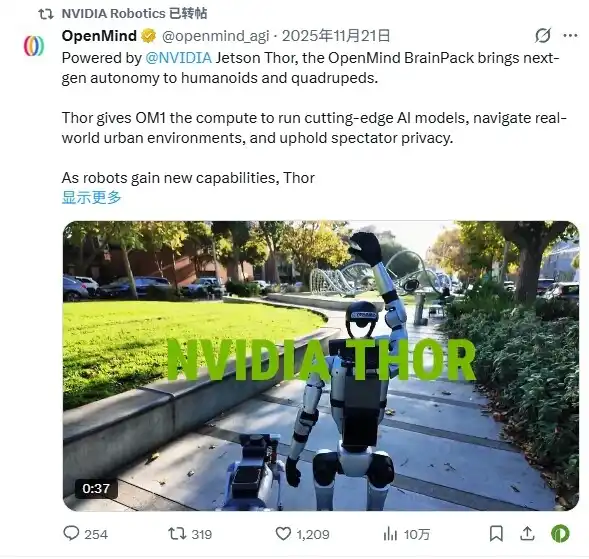
NVIDIA Robotics official account reposts OpenMind's tweet

In early August this year, OpenMind announced the completion of a $20 million funding round, led by Pantera Capital, with participation from multiple institutions including Ribbit, Sequoia, Coinbase Ventures, DCG, Lightspeed Faction, Anagram, Pi Network Ventures, Topology, Primitive Ventures, Amber Group, and several renowned angel investors.

The Relationship Between OpenMind and Fabric

OpenMind is the founding team and core developer of the Fabric protocol, as well as a core contributor and initiator of the Fabric Foundation. Fabric was initially designed and developed by the OpenMind team, responsible for the core technical architecture and early implementation of the protocol.

As the project developed, to prevent the protocol from being controlled by a single company and to achieve a more open and neutral governance structure, OpenMind spun off the governance, economic model, and community coordination functions of Fabric to establish an independent non-profit organization, the Fabric Foundation. This foundation is responsible for the long-term maintenance, standard setting, ecosystem incentives, and global coordination of the protocol, promoting the sustainable development of Fabric.

Currently, OpenMind continues to participate in the construction of the Fabric protocol as a core contributor. Its official introduction also clearly states "We’re a core contributor of @FabricFND". Meanwhile, the community brand has been unified towards Fabric, including the renaming of Discord, and the unified narrative of the protocol and the ROBO token, further strengthening Fabric's position as the main brand.
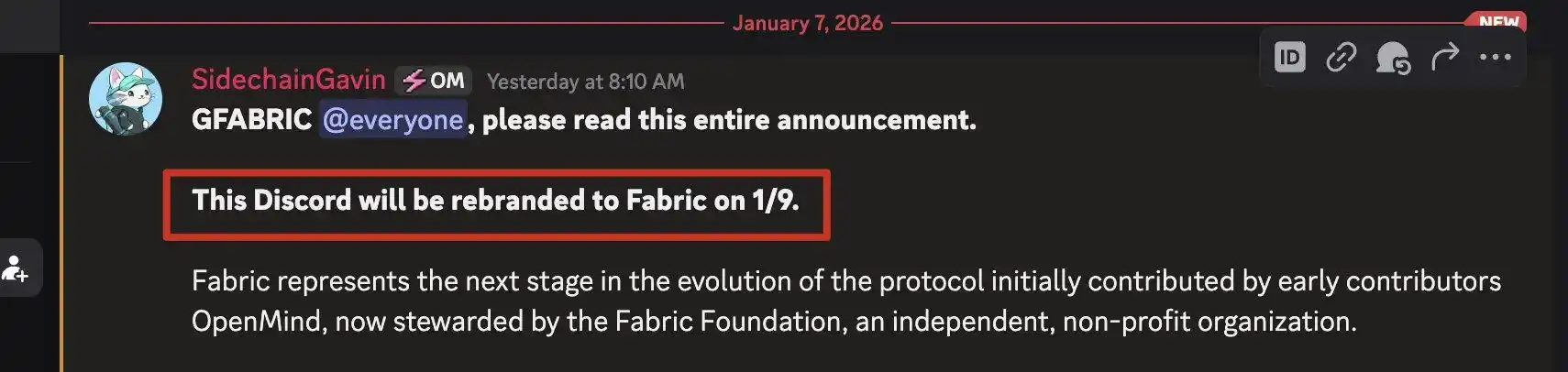
OpenMind's official Discord renamed to Fabric

Fabric New Token Sale Details

According to official information, the native token ROBO of the Fabric protocol will be sold on the Kaito platform. The specific details for participation are as follows:

  • Sale Start Time: January 26, 8:00 PM Beijing Time;
  • Valuation: $400 million FDV;
  • Fundraising Goal: $2 million;
  • Sale Proportion: 0.5% of the total supply of ROBO tokens;
  • Unlock Condition: 100% unlocked at TGE;
  • Single Address Subscription Limit: Minimum $1,000, Maximum $250,000;
  • Expected TGE Time: Q1 2026 (specific date not announced).

Additionally, 40% of the total public sale allocation on the Kaito platform is Priority Allocation, dedicated to partner communities:

  • Fabric Foundation community (based on past participation in Platinum/Emerald/Diamond tiers, OG, Developer, Backpack, Researcher, and other badge holders): 15%;
  • Kaito AI community (sKAITO holders, etc.): 10%;
  • Virtuals community (>100 veVIRTUAL holders): 5%;
  • Surf AI community (Pro/Max annual subscribers or NFT Pass holders): 5%;
  • Other Kaito referral programs: 5%.

The remaining 60% of the new token sale allocation is the public portion (for general eligible users).

The $400 Million Valuation for the New Sale Offers Less Than Ideal Value

From a valuation comparison perspective, OpenMind's token ROBO is priced at a $400 million FDV, significantly higher than the reasonable range for comparable projects in the same track that have already issued tokens. For reference, among related projects in the AI robotics sector, Virtuals currently has a market cap of approximately $540 million, Sentient around $200 million, and Grass about $127 million. ROBO's starting valuation is already on the high side.

Although OpenMind has backing from top-tier investment firms like Pantera Capital, Coinbase Ventures, and DCG, which provides some endorsement for the project, the detailed token economics of ROBO have not yet been released, particularly the unlock ratio for institutional investors at TGE remains unclear.

If institutions have liquid tokens at TGE, combined with the 100% unlock of the public sale portion, it could create significant dual selling pressure, putting downward pressure on the early price movement. Under this uncertainty, the $400 million FDV pricing for the new sale offers less than ideal overall value.


Perguntas relacionadas

QWhat is OpenMind and what does it aim to build?

AOpenMind is a leader in the robotics sector, founded by Stanford Professor Jan Liphardt. It aims to build a universal operating system and a decentralized collaboration network for intelligent machines, enabling robots from different manufacturers and of different forms to securely share information and work together globally.

QWhat is the key relationship between OpenMind and the Fabric Foundation?

AOpenMind is the founding team and core developer of the Fabric protocol. To avoid control by a single company and achieve a more open governance structure, OpenMind spun off the protocol's governance and economic model to form the independent, non-profit Fabric Foundation. OpenMind remains a core contributor to the ongoing development of the Fabric protocol.

QWhat are the key details of the ROBO token sale on the Kaito platform?

AThe ROBO token sale on Kaito has a Fully Diluted Valuation (FDV) of $400 million. It aims to raise $2 million, selling 0.5% of the total token supply. The sale starts on January 26th at 8 PM Beijing Time. Tokens are 100% unlocked at TGE, with individual address limits from $1,000 to $250,000. The TGE is expected in Q1 2026.

QWhy does the article suggest the $400 million FDV valuation might not be ideal for participants?

AThe article suggests the $400 million FDV is not ideal because it is significantly higher than the current market capitalizations of comparable projects in the AI and robotics sector, such as Virtuals ($540M), Sentient (~$200M), and Grass (~$127M). Furthermore, the lack of clarity on the tokenomics, specifically the unlock schedule for institutional investors, could create significant selling pressure at TGE alongside the fully unlocked public sale tokens, potentially negatively impacting the early token price.

QWhich major investment firms participated in OpenMind's funding round?

AOpenMind raised $20 million in a funding round led by Pantera Capital. Other participants included Ribbit, Sequoia Capital, Coinbase Ventures, DCG, Lightspeed Faction, Anagram, Pi Network Ventures, Topology, Primitive Ventures, and Amber Group.

Leituras Relacionadas

Dan Koe: The Counterintuitive Truth—You Don't Need to Remember Everything You Read

Dan Koe: The Counterintuitive Truth — You Don't Need to Remember Everything You Read The central idea is that deliberately trying to remember information is often misguided. True learning isn't about memorizing facts but about having important knowledge surface naturally when needed through use. Most forgetting is normal, not a failure. The article reframes learning using a control theory framework—a four-step feedback loop: having a clear Goal, accurately Sensing your current state, Comparing the gap, and Acting to close it. Most learning stalls because people only do step 2 (blind input) without a goal to create the necessary "error signal" for focused action. The most effective method is to start with output, not input. Begin a meaningful personal project first, and learn only what's necessary to complete it. This project-driven, "just-in-time" learning ensures knowledge is contextual and retained. The concept of a "Second Brain" often fails because it becomes a digital graveyard—over-collected and under-utilized. The goal should be building a "Second Subconscious"—a dynamic system that proactively surfaces relevant ideas during creation, not a static storage vault. Tools like Obsidian+Claude or Eden can help by automating organization and enabling semantic search, but their value depends on linking knowledge to active projects. Ultimately, what matters is not what you store, but what you filter and internalize. Focus on ideas that shape your worldview, use projects as filters, and transform collected material through writing and sharing. AI should be used to reduce friction in research and editing, not to formulate your core views. In conclusion, remembering is a byproduct, not the goal. Knowledge that sticks comes from pursuing personal goals, applying it in real projects, and digesting it through creation. The tools are merely aids; the crucial step is to start doing meaningful work and let the necessary knowledge find you.

marsbitHá 7m

Dan Koe: The Counterintuitive Truth—You Don't Need to Remember Everything You Read

marsbitHá 7m

A New Era: The Fundamental Transformation of China's Entrepreneurs

A profound generational shift is underway among Chinese entrepreneurs. The wealth and influence once dominated by real estate and internet giants is now being claimed by a new wave of founders driving breakthroughs in AI, semiconductors, and robotics. This change is vividly reflected in 2026's wealth rankings. Figures like Zhang Yiming (ByteDance), Liang Wenfeng (DeepSeek), Chen Tianshi (Cambricon), and Wang Xingxing (Unitree Robotics) are ascending. Their wealth stems not from traditional business models but from market expectations for future technological competitiveness, with AI, chips, and smart hardware becoming the primary engines of wealth creation. Their common trait is a foundational focus on technology, often starting from the laboratory rather than a business plan. Examples include Chen Tianshi's decade-long push in AI chips, Liang Wenfeng's core algorithmic innovations at DeepSeek with a compact team, and Zhu Yiming's "no salary until profitable" 9-year journey to build Changxin Memory into a global DRAM player. This transition marks a fundamental shift in China's economic imperative: from commercial expansion and learning to indigenous innovation and deep industrial capability. While the previous generation built the foundational market and infrastructure, this new cohort is tasked with achieving global leadership in core technologies, moving China from "keeping pace" to pioneering original, breakthrough innovations that are industrialized at scale. The baton is being passed to those competing on the world stage through technological originality.

marsbitHá 7m

A New Era: The Fundamental Transformation of China's Entrepreneurs

marsbitHá 7m

Once-Popular Web3 Enters Wave of Layoffs

The once-hot Web3 industry is experiencing a severe wave of layoffs. While many companies attribute job cuts to AI-driven restructuring, the primary reason is often financial pressure. The Web3 sector, at the intersection of tech and finance, has been hit particularly hard. Employees at major cryptocurrency exchanges report sudden, impersonal layoffs—often with system access revoked overnight—and minimal or no severance. Common tactics include setting impossible performance targets or terminating employees for minor policy violations. The working atmosphere has become toxic, marked by intense monitoring, excessive meetings, and management obsessed with control and internal politics rather than product innovation. The industry's core business model is collapsing. Exchange revenue from trading fees and listing charges has plummeted due to a decline in quality projects and retail investor exodus. Events like the massive forced liquidation on October 10th further shattered confidence. Competition from on-chain derivatives platforms and prediction markets is intensifying the downturn. As layoffs continue, displaced workers struggle to find new opportunities. Many transition to the AI sector, but face significant bias from traditional finance and even some AI firms, which view crypto industry experience with suspicion. The current downturn appears more structural than cyclical, driven by unsustainable practices, internal strife, and a failure to innovate, raising questions about the industry's future trajectory.

marsbitHá 1h

Once-Popular Web3 Enters Wave of Layoffs

marsbitHá 1h

Trading

Spot
活动图片