OpenAI's Partnership with U.S. Department of Defense Sparks 300% Surge in ChatGPT Uninstallations on Announcement Day

marsbitPublicado em 2026-03-04Última atualização em 2026-03-04

Resumo

On February 28th, the number of ChatGPT app uninstalls by U.S. users surged by 295% compared to the previous day, following the announcement of OpenAI's partnership with the U.S. Department of Defense (referred to as the "Department of War" during the Trump administration). Data from Sensor Tower indicates this was a significant deviation from ChatGPT’s average 30-day uninstall rate of 9%. In contrast, downloads of Claude, the AI app from OpenAI competitor Anthropic, increased by 51% on the same day. This shift in user behavior is attributed to Anthropic’s public refusal to collaborate with the Defense Department due to ethical concerns, including potential use of AI for citizen monitoring and autonomous weapons. ChatGPT’s download numbers fell by 13% on Saturday and a further 5% on Sunday. User sentiment was reflected in app reviews, with 1-star ratings for ChatGPT increasing by 775% on Saturday. Meanwhile, Claude rose to the top of the U.S. App Store’s free apps chart and also led charts in several other countries. Data from Appfigures and Similarweb corroborated these trends, noting Claude’s rapid growth in the U.S. and internationally.

Author: TechCrunch / Sensor Tower

Compiled by: Deep Tide TechFlow

Deep Tide Insight: News of OpenAI's collaboration with the U.S. Department of Defense (renamed the "Department of War" under the Trump administration) has triggered strong backlash among users.

Meanwhile, Anthropic gained user trust by refusing to cooperate, with Claude's daily downloads surging and topping the App Store. This data directly quantify the practical impact of AI ethics stances on user behavior.

Full Text:

On February 28 (Saturday), the number of U.S. users uninstalling the ChatGPT mobile app increased by 295% compared to the previous day. This reaction was directly triggered by the news of OpenAI's partnership with the U.S. Department of Defense (DoD)—a department renamed the "Department of War" during the Trump administration.

This data comes from market research firm Sensor Tower. Compared to ChatGPT's average 9% daily uninstallation rate over the past 30 days, the 295% single-day spike is a significant anomaly.

At the same time, downloads of Claude, developed by OpenAI's competitor Anthropic, saw a reverse trend in the U.S. On February 27 (Friday), downloads increased by 37% compared to the previous day, and on February 28 (Saturday), they rose by another 51%. Earlier, Anthropic announced its refusal to collaborate with the U.S. Department of Defense, citing an inability to agree on terms—Anthropic expressed concerns that AI would be used for surveilling U.S. citizens and deployed in fully autonomous weapon systems lacking safety capabilities.

The data indicates that a significant portion of users support Anthropic's stance on this issue.

ChatGPT's download numbers were also affected. On the Saturday following the announcement of the partnership, its U.S. downloads decreased by 13% compared to the previous day. The decline continued into Sunday, with another 5% drop. In contrast, on the Friday before the announcement, the app had recorded a 14% day-over-day growth in downloads.

These rapid changes were also reflected in Claude's App Store ranking. On Saturday, Claude climbed to the top of the U.S. App Store's free app chart, maintaining this position as of March 2 (Monday). This represents a rise of over 20 spots compared to about a week earlier (February 22, 2026).

Users also expressed their opinions on OpenAI's decision through app ratings. Sensor Tower data shows that on Saturday, the number of 1-star reviews for ChatGPT surged by 775%, with a further 100% increase on Sunday. Meanwhile, 5-star reviews decreased by 50% during the same period.

Other third-party data providers corroborated Sensor Tower's findings.

For example, Appfigures noted that on Saturday, Claude's total daily downloads in the U.S. surpassed ChatGPT's for the first time. The agency also observed an increase in Claude's U.S. downloads, though its estimates were higher: an 88% day-over-day increase on Saturday.
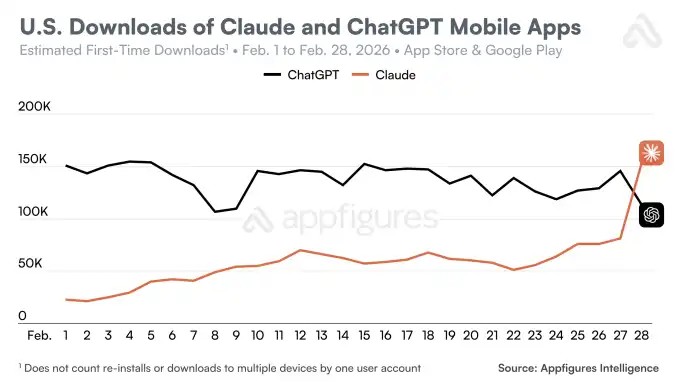
Appfigures also noted that Claude has now topped the free iPhone app charts in six countries outside the U.S., including Belgium, Canada, Germany, Luxembourg, Norway, and Switzerland.

A third market research firm, Similarweb, reported that Claude's U.S. downloads over the past week were approximately 20 times higher than in January. However, the agency cautioned that this may not be entirely due to political factors and could involve other reasons.

Perguntas relacionadas

QWhat was the 295% surge in ChatGPT mobile uninstallations on February 28th a direct reaction to?

AThe 295% surge in ChatGPT mobile uninstallations on February 28th was a direct reaction to the news of OpenAI signing a cooperation agreement with the U.S. Department of Defense (DoD).

QWhich competitor's app saw a significant increase in downloads and topped the U.S. App Store charts following its refusal to work with the Department of Defense?

AAnthropic's Claude app saw a significant increase in downloads and topped the U.S. App Store charts after it announced its refusal to cooperate with the Department of Defense.

QWhat were Anthropic's stated reasons for refusing to cooperate with the U.S. Department of Defense?

AAnthropic refused to cooperate due to concerns that AI would be used for surveillance of U.S. citizens and for fully autonomous weapon systems that do not yet have safety capabilities.

QHow did the user ratings for ChatGPT change, specifically the number of 1-star and 5-star reviews, after the news of the DoD partnership?

AAfter the news, the number of 1-star reviews for ChatGPT surged by 775% on Saturday and increased by another 100% on Sunday, while 5-star reviews decreased by 50% during the same period.

QAccording to the data, in how many countries outside the U.S. did Claude's app top the free iPhone application chart?

AClaude's app topped the free iPhone application chart in six countries outside the U.S.: Belgium, Canada, Germany, Luxembourg, Norway, and Switzerland.

Leituras Relacionadas

380,000 Apps Exposed, 2,000+ Apps Leaked Secrets: AI Programming Turns 'Intranet' into Public Internet

Israeli cybersecurity firm RedAccess uncovered a severe data exposure trend linked to "vibe coding" or AI-powered software development tools. Their research found approximately 38,000 publicly accessible web applications built with platforms like Lovable, Base44, Netlify, and Replit. Of these, an estimated 2,000 apps exposed sensitive corporate and personal data, including medical records, financial information, internal strategic documents, and customer chat logs. In some cases, access even granted administrative privileges. The core issue stems from default privacy settings that make applications public by default, combined with a lack of built-in security controls (like authentication) in the AI-generated code. This allows employees without security expertise—"citizen developers"—to easily create and deploy applications that bypass standard corporate security reviews. The exposed apps, often indexed by search engines, are trivially discoverable. While some platform providers (Replit, Lovable, Wix/Base44) argue that security configuration is the user's responsibility and question the validity of some findings, security researchers confirm the widespread reality of such exposures. This pattern, also noted in prior studies, highlights a critical security gap as AI democratizes app creation, potentially leading to massive, unintentional data leaks.

marsbitHá 30m

380,000 Apps Exposed, 2,000+ Apps Leaked Secrets: AI Programming Turns 'Intranet' into Public Internet

marsbitHá 30m

Attracting Global Capital, Asia's New 'Super Cycle' Is Unfolding

Investors are turning to Asia as the next frontier for global equity growth, with a new "super cycle" unfolding across the region. Driven by the AI revolution, Asian markets, particularly South Korea, have seen significant rallies. According to Morgan Stanley analysis, the underlying drivers of Asia's industrial cycle are shifting from traditional sectors like real estate and manufacturing to massive investments in AI infrastructure, energy security and transition, and supply chain resilience. Fixed asset investment in Asia is projected to grow from around $11 trillion in 2025 to $16 trillion by 2030, with a 7% annual growth rate from 2026-2030. The AI wave is a primary catalyst, driving immense capital expenditure for chips, servers, data centers, and power systems. Asia is central to this hardware supply chain. In China, AI investment is focused on building a full-system domestic capability, with the local AI chip market potentially reaching $86 billion by 2030. Beyond AI, China's export story is expanding from EVs and batteries to robotics. The country already captures about half of new global industrial robot demand and over 90% of humanoid robot shipments. This growth phase mirrors the early stages of China's EV export boom. Simultaneously, energy security investments, spurred by AI's massive power needs, are rising, with China benefiting from its leadership in solar, batteries, and EVs. Regional defense spending is also increasing structurally, supporting demand for advanced manufacturing. The main beneficiaries are China, South Korea, and Japan, positioned in core supply chain areas. However, risks remain, including potential overcapacity, profit margin pressures from competition, persistent technological restrictions, geopolitical friction, and workforce displacement due to AI-driven automation. Market volatility is also expected to increase as investor expectations diverge on the realization of these capital investment and export themes.

marsbitHá 31m

Attracting Global Capital, Asia's New 'Super Cycle' Is Unfolding

marsbitHá 31m

Funding Weekly Report | 14 Public Funding Events, Kalshi Completes $10B New Funding Round at $220B Valuation Led by Coatue Management

Weekly Funding Roundup: 14 Deals and $10.49B+ in Total Funding, Led by Kalshi's $1B Round Last week (5.4-5.10) saw 14 notable funding events in the global blockchain ecosystem, raising over $10.49 billion in total. Key highlights include Kalshi, a prediction market platform, securing a $1 billion round led by Coatue Management, reaching a $22 billion valuation. The platform now boasts ~2 million MAUs and $178B in annualized trading volume. In DeFi, regulated on-chain reinsurer OnRe raised $5 million in Series A funding, and Bitcoin-backed credit protocol Saturn Credit completed a $2 million seed round. For Infrastructure & Tools, OpenTrade raised $17 million to expand its stablecoin yield infrastructure, and RWA platform Balcony secured $12.7 million to deploy its property settlement service in the US. Centralized Finance saw one deal: AI-driven trading platform Stockcoin.ai completed a seed round led by Amber Group. In the prediction market sector alongside Kalshi, AI-powered platform Elastics raised $2 million. Other notable deals include SC Ventures' strategic investment in crypto market maker GSR and Centrifuge securing a "seven-figure" investment from Coinbase to become a core RWA partner for Base. On the investor side, Haun Ventures raised a new $1 billion fund targeting crypto and AI, and Multi Investment raised ~$616 million to focus on blockchain and Web3 investments.

marsbitHá 1h

Funding Weekly Report | 14 Public Funding Events, Kalshi Completes $10B New Funding Round at $220B Valuation Led by Coatue Management

marsbitHá 1h

Trading

Spot
Futuros
活动图片