OpenAI, Open-Sourced

marsbitPublicado em 2026-07-30Última atualização em 2026-07-30

Resumo

OpenAI has open-sourced its code security tool, Codex Security CLI. The tool, which originated from the private beta project Aardvark in October 2025, is designed to automatically discover, verify, and fix vulnerabilities in codebases. It functions as an application security agent, first analyzing a repository to build a threat model, then identifying and ranking vulnerabilities based on real-world impact, and finally testing them in a sandbox for validation. According to OpenAI, in its first 30 days, the tool scanned over 1.2 million commits, uncovering 792 critical and 10,561 high-severity vulnerabilities, with a reported reduction of over 50% in false positives upon repeated scans of the same repositories. However, initial user experiences on platforms like Hacker News highlighted significant issues, particularly concerning cost and reliability. Developers reported failed scans that consumed substantial portions of API rate limits and incurred high expenses, with one user noting a cost of approximately $13 for an aborted run. The high cost is attributed to the tool's default configuration, which uses the premium GPT-5.6-sol model with inference intensity set to "extra-high." The release follows public statements by NVIDIA's Jensen Huang advocating for open-source AI. While OpenAI has open-sourced the application-layer CLI and SDK, the core AI models remain proprietary. The move opens the door for community development and potential adaptations of the tool.

OpenAI has finally become "Open" once again!

Recently, OpenAI officially announced: it has quietly released an open-source code security tool—Codex Security CLI.
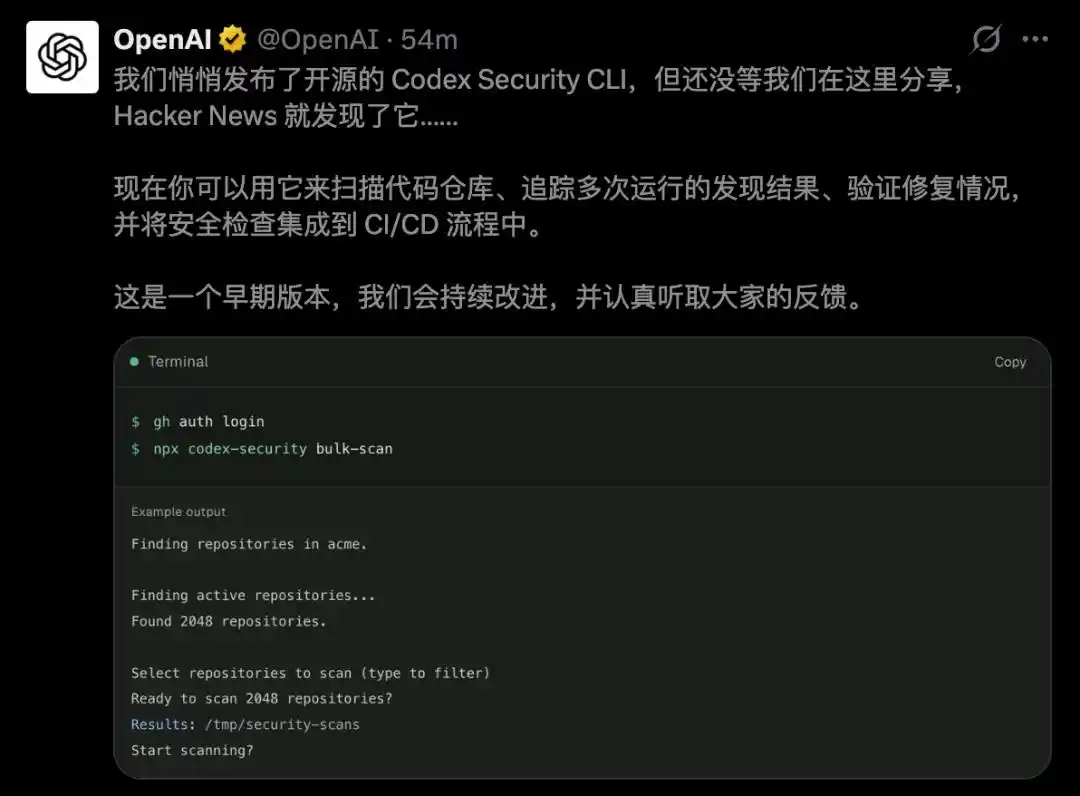
Previously, someone on Hacker News discovered it first, sparking instant discussions, and GitHub stars surged to 1.2k.

Seeing that it could no longer be kept hidden, OpenAI had no choice but to come forward and claim it.

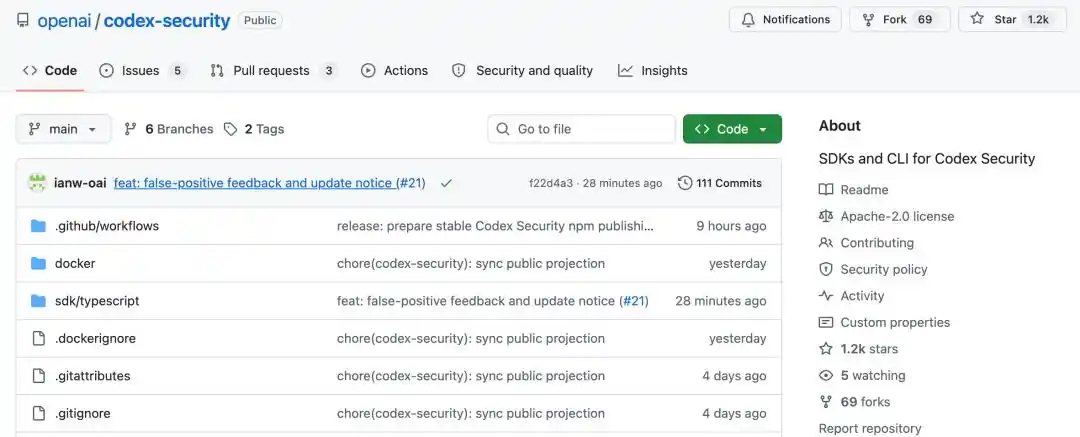
GitHub address: https://github.com/openai/codex-security

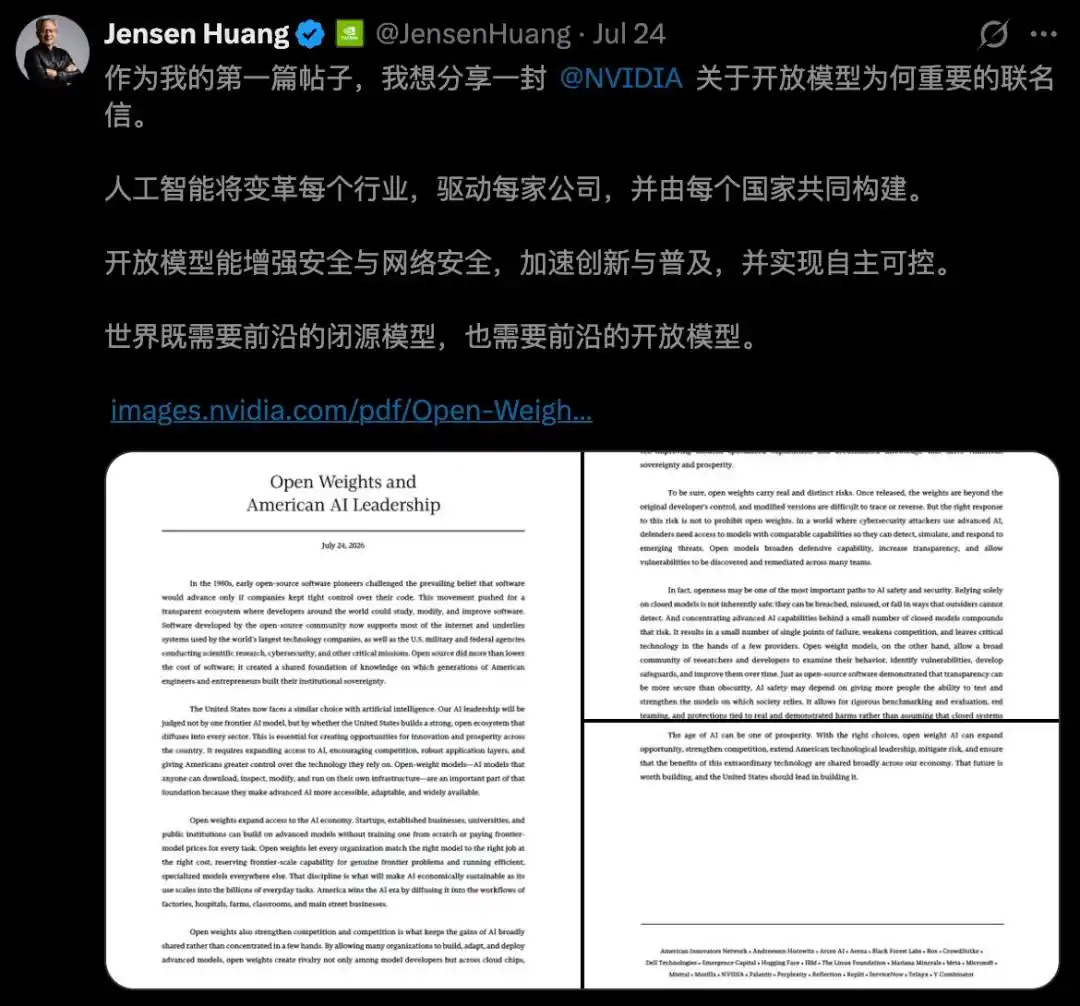
A few days ago, Jensen Huang personally stepped in, publicly expressing strong support for open-source AI, and soon after, OpenAI officially joined the camp.

Little did we expect that the surprise would come so quickly, as the heavyweight open-source masterpiece was unveiled almost instantly.

It has to be said, Huang's words still carry significant weight!

OpenAI's Code Security Tool is Now Open-Source

The "star" of this open-source release is codex-security, comprising a CLI and a TypeScript SDK.

Its core functionality is very straightforward, focusing on a "combo punch": automatically discovering vulnerabilities in a codebase, verifying them, and fixing them.
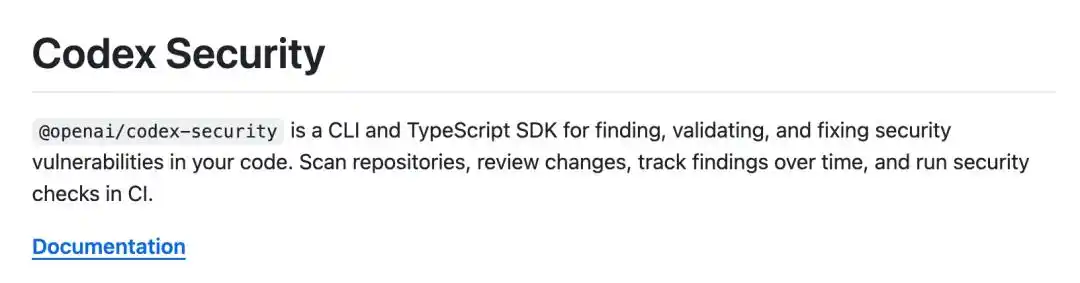
It's designed to be ready-to-use; the entire workflow can be run with just three lines of commands:

  • npm install @openai/codex-security
  • npx codex-security login
  • npx codex-security scan .

For CI runs, logging in isn't required; just configure an OPENAI_API_KEY.

The requirements are Node.js 22 or higher, Python 3.10 or higher, plus access to Codex Security.

1.2 Million Commits, 792 Critical Vulnerabilities

Strictly speaking, Codex Security isn't a completely "new species".

It evolved from the private beta project Aardvark in October 2025 and was renamed and launched as a research preview version on March 6th this year.

The most hardcore aspect of this tool lies in its positioning—an application security agent.
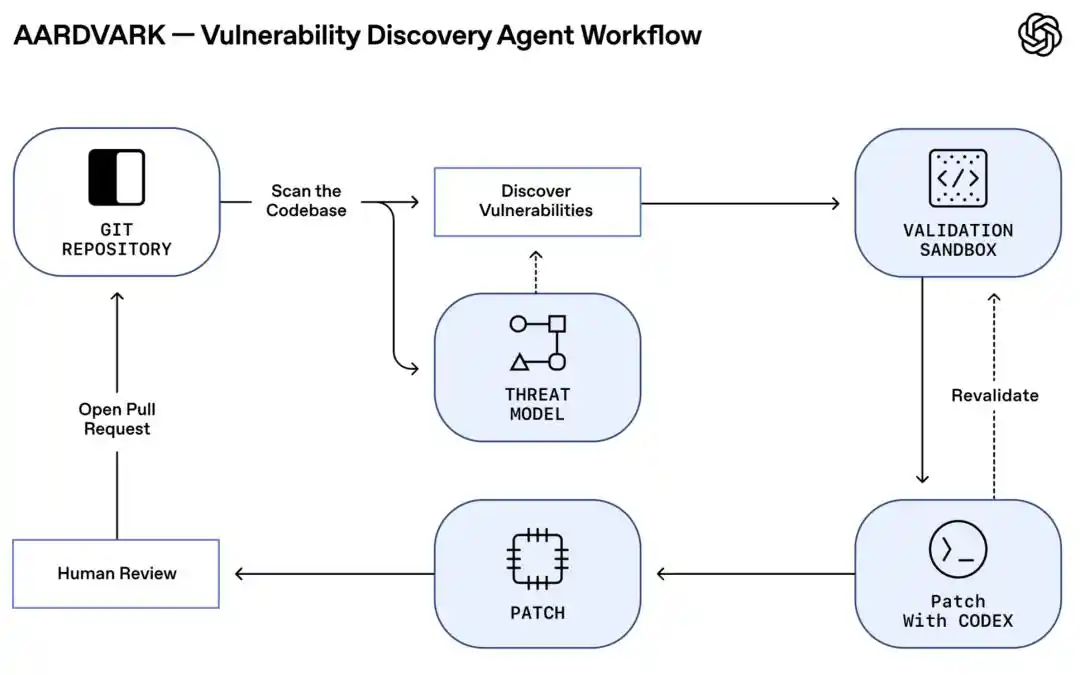
Codex Security truly dives deep into the underlying code to understand what your system is actually doing. Its workflow is divided into three steps:

First, it reads the entire repository to generate an editable threat model, figuring out what the project does and where it's most exposed;

Then, based on this context, it searches for vulnerabilities and ranks them by their real-world impact;

Finally, it throws suspicious issues into a sandbox for real stress testing, only reporting those that can be verified.

Looking at its track record, it's indeed quite formidable.

In its first 30 days online, it scanned over 1.2 million commits, uncovering 792 critical severity findings and 10,561 high severity findings.

OpenAI also mentioned that for the same batch of repositories scanned repeatedly, the false positive rate dropped by over 50%.

The First Batch of Early Adopters, Bills Exploded

No matter how grand the official promises are, they can't compare to the "real-world test disasters" that immediately surfaced among developers.

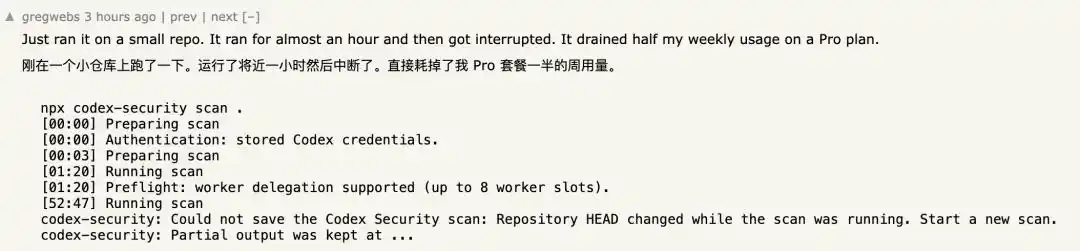
On HN, a developer named gregwebs tested it on a small repository and directly posted the utterly devastating terminal logs.

Preparation started at 0:03, scanning began at 1:20, ran all the way to 52:47, and finally, a line of red text popped up—the repository HEAD changed during scanning, please start over.

Not only did it waste an hour, but this single run also consumed half of his Pro plan's weekly quota.
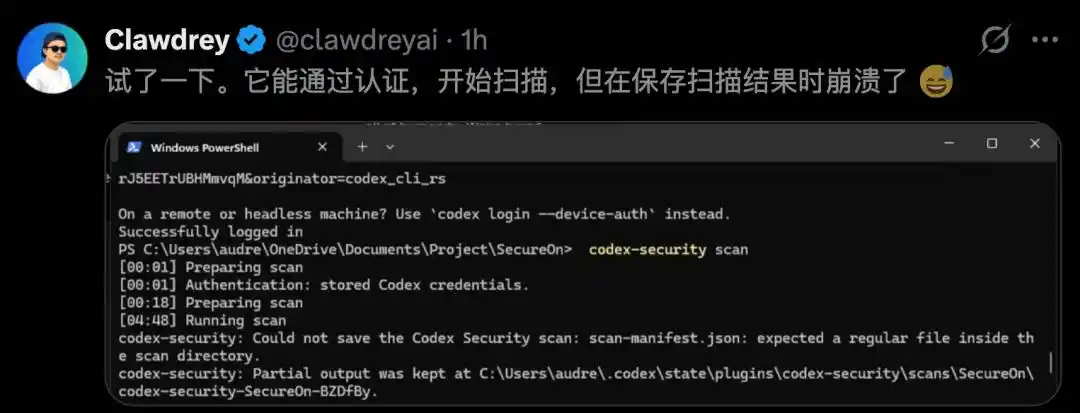
Another user, Quai, had it worse. The scan hit account rate limits right after starting, and the tool retried for a minute before giving up.

The tool did hint that "partial results have been preserved," but he couldn't find an obvious way to use them in the next scan. This failed run cost about $13.

Why is it so expensive? Just look at the default configuration and the answer becomes clear.

Codex Security defaults to calling gpt-5.6-sol and brutally cranks the "reasoning effort" up to extra-high.

It's important to know that Sol is the most "premium" tier in the GPT-5.6 family, with API pricing as high as $5 per 1M input tokens and $30 per 1M output tokens.
Huang Kicked Things Off, OpenAI Took a Step

Just after Jensen Huang publicly voiced strong support for open-source AI, OpenAI brought out Codex Security.

However, don't interpret this "open-source" move as too generous just yet.

OpenAI's step is quite calculated: they've open-sourced the application-layer shell, while the model layer is still tightly held in their own hands.

Regardless, the Pandora's box of agents taking over code security has been opened.

Next, it's up to developers to see how they can hack and modify this open-source artifact, using the magic of the community to counter OpenAI's own magic.

References:

https://x.com/gdb/status/2082235089539526690?s=20

https://x.com/OpenAI/status/2082263717916586117?s=20

This article is from WeChat public account "AI Era", author: ASI Revelations

Perguntas relacionadas

QWhat did OpenAI recently open-source, and what is its primary function?

AOpenAI recently open-sourced Codex Security CLI, a tool designed to automatically detect, validate, and fix security vulnerabilities in codebases.

QWhat commands are needed to run the basic workflow of the open-sourced tool?

AThe basic workflow requires three commands: `npm install @openai/codex-security`, `npx codex-security login`, and `npx codex-security scan .`.

QWhat were some of the early user complaints regarding the Codex Security tool?

AEarly users complained about high costs, slow scans, account rate-limiting, and the tool's default use of the expensive `gpt-5.6-sol` model with the `extra-high` reasoning setting.

QAccording to the article, what significant results did Codex Security achieve in its first 30 days?

AIn its first 30 days, Codex Security scanned over 1.2 million commits and identified 792 critical and 10,561 high-severity findings.

QHow does the article characterize the nature of OpenAI's 'open-sourcing' of Codex Security?

AThe article characterizes it as a strategic move where OpenAI open-sourced the application layer (the CLI/SDK) but keeps the core model layer proprietary and under its control.

Leituras Relacionadas

What's New in Ethereum's Roadmap: Privacy, Quantum Security, Native Rollup?

On August 10, 2024, Ethereum co-founder Vitalik Buterin revealed an updated technical roadmap, highlighting significant changes in priorities and new focus areas. Key new additions include: - **Strong Privacy Protection**: Elevated to a top-tier protocol concern. Proposals like EIP-8250 (keyed nonces for concurrency), EIP-8272 (recent roots for verification), and EIP-8182 (shared protocol-level privacy pools) aim to enable private transfers of ETH and ERC-20s, moving toward default private accounts. - **Quantum Resilience**: Priority increased. The plan addresses risks to ECDSA/BLS signatures, KZG commitments, and ZK systems, exploring solutions like leanSPHINCS signatures, STARK proofs (considered quantum-resistant), and streamlined verification processes. A full L1 upgrade is tentatively targeted for ~2029. - **Native Rollups**: A novel concept where rollups could reuse Ethereum's core validation infrastructure via a new EXECUTE precompile (EIP-8079 draft). This aims to reduce custom code and enhance security for certain L2s, while specialized chains will continue to exist. - **Protocol Simplification & Formal Verification**: Leveraging AI tools to make full-protocol formal verification feasible, aiming for more rigorous and machine-verifiable specifications. Other notable shifts: - State storage is evolving from Verkle trees to a Partitioned Binary Tree (PBT, EIP-8347 draft). - Some 2023 items like VDFs and certain EVM improvements were deprioritized. - Long-term discussions include blob/gas futures and non-EVM instruction sets (e.g., RISC-V). The "Strawmap" outlines potential upgrades through ~2029 but is a directional guide, not a firm timeline. Key milestones to watch include the Glamsterdam (Q4 2026) and Hegotá (2027) forks. Many proposals remain in draft or research phases.

marsbitHá 10m

What's New in Ethereum's Roadmap: Privacy, Quantum Security, Native Rollup?

marsbitHá 10m

Hyperliquid Trading Volume Soars, So Why Are Profits Falling?

Hyperliquid, a leading decentralized perpetuals trading platform, has seen its open interest surge to a record high above $11 billion, capturing roughly 9% of the global market share. Trading volume remains robust, nearing $178 billion over 30 days, driven largely by the explosive growth of third-party markets offering tokenized real-world assets (RWAs) like stocks and commodities. Despite this growth, the platform's protocol revenue has declined for four consecutive quarters, falling 43% from its Q3 2025 peak of $357 million to approximately $202 million in Q2 2026. This divergence is primarily attributed to the HIP-3 governance proposal, which allows external developers to launch their own markets and keep up to half of the generated fees. These third-party markets now account for nearly 50% of total volume. Consequently, the share of revenue redistributed to developers, market makers, and the treasury has tripled from 6% to 18% in a year. This directly reduces the funds allocated to the platform's buyback-and-burn mechanism for its native HYPE token, weakening a key price support. HYPE's price has fallen 28% from its all-time high. The platform's growth is also heavily concentrated, with a single entity, Trade.xyz, responsible for over 90% of HIP-3 open interest, introducing systemic risk. Additionally, the ecosystem lacks diversity beyond HYPE, faces ongoing token unlocks adding sell pressure, and is encountering increased regulatory scrutiny and new competition from platforms like Robinhood Chain. While still a major revenue generator in crypto, Hyperliquid's model of sharing fees to fuel expansion is currently compressing its own earnings and token economics.

marsbitHá 10m

Hyperliquid Trading Volume Soars, So Why Are Profits Falling?

marsbitHá 10m

Citi Research Report Analysis: U.S. Proposed Ban on Chinese Optical Modules Has No Substantial Progress, Short-term Enforcement Faces Supply Constraints

Citi Report Analysis: U.S. Proposed Ban on Chinese Optical Modules Lacks Substantive Progress, Faces Supply Bottlenecks in Short Term. Reuters reported on August 4th that the U.S. government and FCC are considering a ban on Chinese optical modules. Citi's August 9th report clarifies that optical modules are not listed on any effective FCC ban. The FCC's Order 26-50 established two restricted list mechanisms (based on manufacturer and production location), but optical modules were only mentioned once, as an example in a disclosure requirement, not as a restricted product. The reported ban remains at a proposal stage. Citi estimates Chinese suppliers provide 60-70% of high-speed optical modules for U.S. hyperscalers. Non-Chinese suppliers cannot fill this gap in the short term, making the immediate implementation of a genuine ban unlikely. Future regulatory paths could be manufacturer-based (least likely), location-based covering all offshore production (strictest), or location-based covering only China (more feasible but with unresolved definitions). A ban would pressure U.S. AI infrastructure, conflicting with stated policy goals. Citi sees low near-term implementation probability, with the issue potentially becoming a negotiation chip in bilateral talks. U.S. domestic capacity build-out is a key long-term variable. Among Chinese companies, XSENS and Dongshan Precision have the highest U.S. exposure, while Tianfu Communication, as a passive component supplier, is relatively insulated. Citi maintains Buy ratings on all three with respective price targets. The conclusion is that Chinese modules are currently irreplaceable in the U.S. AI supply chain, creating a longer timeline for potential restrictions than the market may expect.

marsbitHá 1h

Citi Research Report Analysis: U.S. Proposed Ban on Chinese Optical Modules Has No Substantial Progress, Short-term Enforcement Faces Supply Constraints

marsbitHá 1h

Trading

Spot
活动图片