One Piece of Content Attracts 150 Million Views, Revealing the Monetization Code of the Super Individual Business

比推Publicado em 2026-01-19Última atualização em 2026-01-19

Resumo

Dan Koe, a prominent creator in the "super individual" or one-person business space, gained massive attention with a viral post titled “How to fix your entire life in 1 day,” which reached 150 million views on X. Despite earning only $4,495 in platform revenue from the post, his actual income stems from a diversified business model that includes paid newsletters, books, and an AI tool called Eden. In 2024, he reported earning over $4 million annually. Koe’s content targets individuals seeking financial independence through personal branding and content creation. His success is built on years of consistent content output and a relatable narrative of failure and persistence. While his viral article served as a top-of-funnel audience builder, his real revenue comes from converting followers into paying customers through premium products. The article also discusses how platforms like X are incentivizing long-form content to compete with short-video platforms, offering financial rewards to boost creator engagement. However, the surge in AI-assisted content creation has led to widespread imitation of Koe’s style, though few achieve similar success due to the importance of trust, timing, and existing audience size. Ultimately, the "super individual" economy benefits a small number of established creators, while most followers remain consumers rather than successful practitioners.

Author: Curry, Deep Tide TechFlow

Original Title: 150 Million Views on a Single Post, Dan Koe and His Super Individual Business


What was the hottest article on X last week?

"How to fix your entire life in 1 day". Fix your entire life in one day.

Author Dan Koe, American, creates content about "super individuals", teaching people how to not work a 9-to-5 and support themselves by writing. A week after its release, this article's views had reached 150 million.
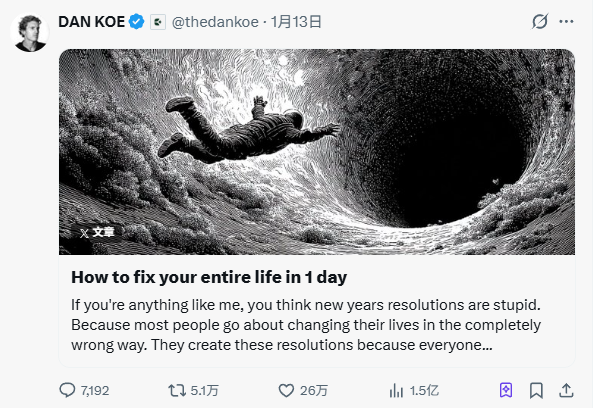
What does 150 million mean? X has just over 600 million monthly active users globally, meaning roughly one in four users has seen this article.

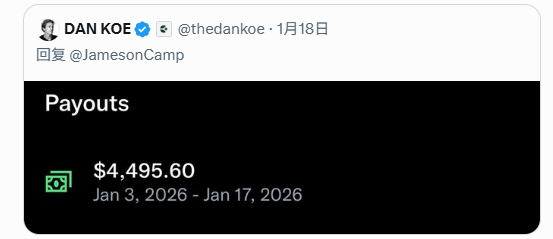
Some wonder how much money this can make. Dan Koe shared a screenshot of his earnings: in 14 days, the X platform shared $4,495 with him.

150 million views, $4,495. But Dan Koe actually earned over $4 million last year.

The money clearly doesn't come from platform revenue sharing.
You've definitely seen the term "super individual".

The general idea is, you don't need a job, you don't need a team, just put your ideas and creativity into content posted online to attract a group of people who identify with you, and then sell courses to them. In the US, this is called a One-Person Business.

Dan Koe is a top player in this field. 750k X followers, 1.2 million YouTube subscribers, 170k email subscribers.

His story is also standard. Studied design in college, became a freelancer after graduation, tried e-commerce, lost money. Started writing on Twitter in 2019, no one read it, persisted for two years before gaining traction.

These experiences are part of the content itself. Failure, struggle, persistence, counterattack—you can see this narrative structure on any successful motivational blogger.

Li Xiaolai talked about it, Luo Zhenyu talked about it, Fan Deng talked about it.

Americans package it as Philosophy and Productivity, Chinese package it as "cognitive upgrade", the skeleton is the same.

How does Dan Koe make money?

Open his official website, you can see several types of products: paid newsletter subscriptions, two books ("The Art of Focus" and "Purpose & Profit"), and an AI tool he co-founded called Eden.
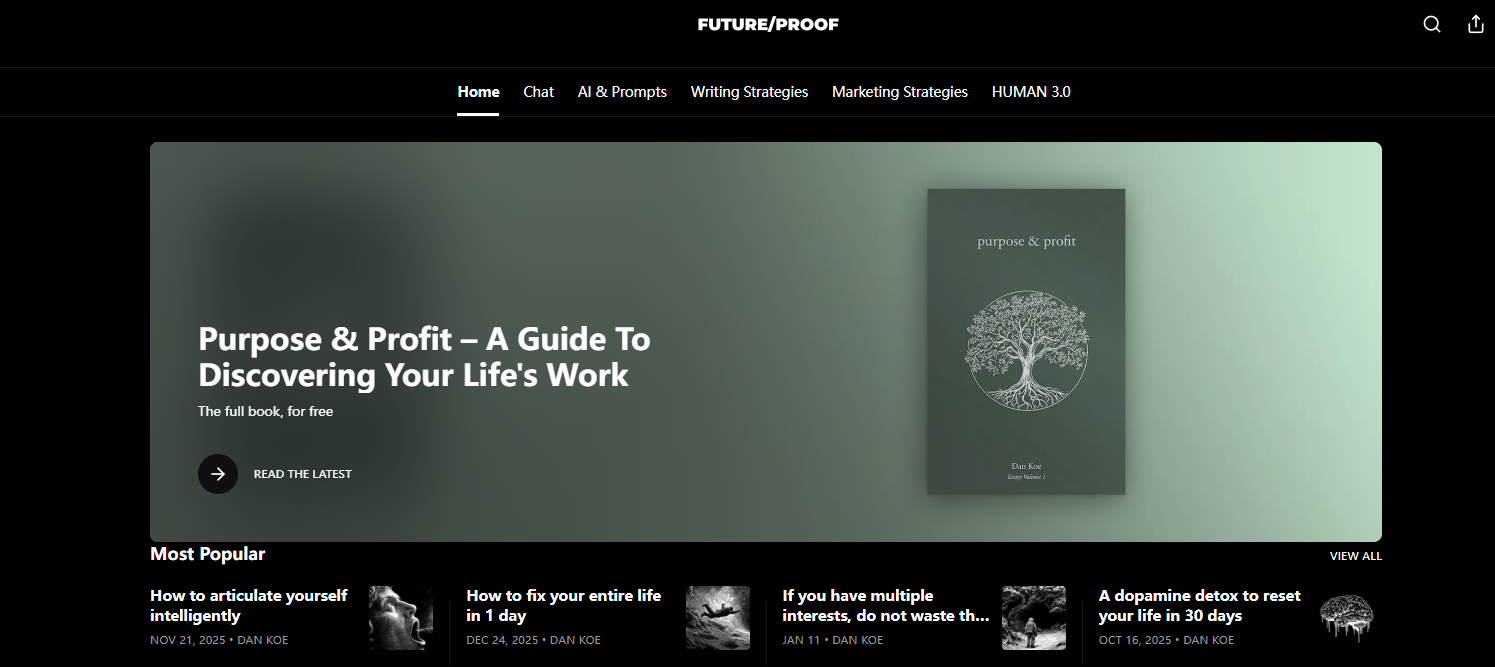
He used to sell writing courses and membership communities, which are no longer visible on the official website, maybe taken down, or merged into the paid subscriptions.

I didn't find official pricing data, but the logic of these products is similar:

Free content filters out people willing to pay, low-priced products filter out people willing to pay more.

How much does he earn? In 2023 he posted on Twitter saying his income that year was $2.5 million. In a 2024 interview with the subscription software beehiiv, Dan also revealed earning over $4 million annually.

But推算 from his follower size, it's not离谱. With nearly 200k email subscribers and millions of YouTube fans,假设 5% have bought paid products, that's nearly fifty thousand paying users.

So what is that 150 million views to him?

The traffic entry point at the top of the funnel. The $4,495 platform share on X is pocket change, more importantly it increases his brand awareness and spread, the real money is with those willing to pay later.

You might ask, who is buying these things?

The answer is definitely people who want to become the next Dan Koe.

The goals of students taking these courses are basically "build a personal brand", "monetize self-media", "escape the 9-to-5". What they are paying to learn is the very thing Dan Koe is doing.

For this model to work, there is one prerequisite: there are always new people wanting to enter the field.

Just like gym memberships always surge at the beginning of the year, the "super individual"赛道 always has people who believe they can become the next top player. Dan Koe published that article on January 12th,刚好是外国人新年决心最旺盛的时候.

The title is "Fix your entire life in one day", what do you think people clicking on it are thinking?

At the same time, X is also placing its bets.

On January 16th, a few days after Dan Koe's article went viral, X announced a new policy: the creator revenue pool doubled, increased weight for long-form articles, and an additional $1 million reward for the best performing original articles.
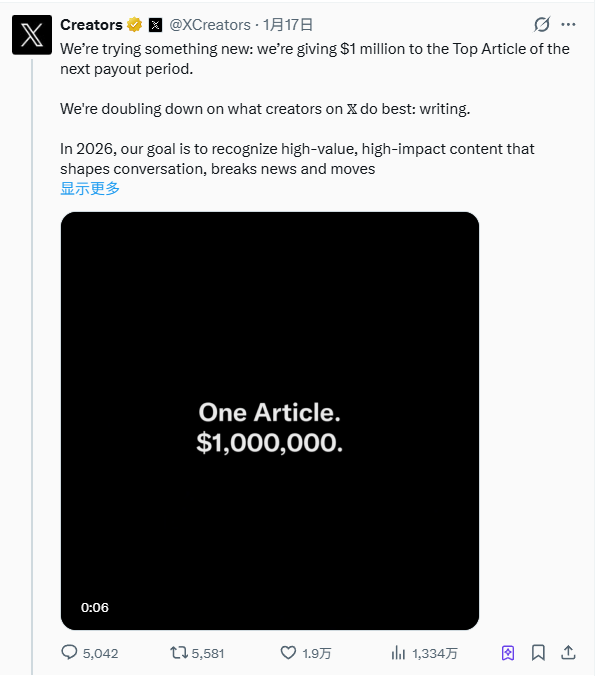
What Musk wants to do is obvious. TikTok has cut everyone's attention into 15-second fragments, X wants to go the opposite way, using long-form content to retain users. Dan Koe wrote a comment大意是短视频刷得太狠了,现在互联网有机会往回摆一摆.

X loves to hear that.

But what can $1 million buy?

Open X and search, there are already a lot of imitators. Various AI skill tutorials and inspirational鸡汤 articles are emerging, like "How to change your life in 2026", "The one skill you need", "Why most people will never succeed"...

The structure is the same, the image style is the same as Dan's viral post, even the "I'm here to tell you the truth" tone is the same.

This style of writing has even become a meme,引得大家争相模仿和尝试.

It's not really strange. Dan Koe himself said he uses AI to assist writing, the method is to have AI interview himself, extract ideas, and then format them into a high-spread content structure.

Anyone can learn this method. ChatGPT can generate a "life-changing" long article in ten minutes, grammatically correct, structurally complete,还能自动加上几个心理学术语显得有深度.

But it's Dan Koe who got popular, not the imitators.

Why?

One explanation is that trust takes time. Dan Koe has written for six years, has real failure experiences, has a traceable growth trajectory. AI can imitate his sentence patterns, but cannot复制 these.

Another explanation is, the super individual赛道 is too crowded.

When everyone is teaching "how to become a super individual", whether talking about AI tools, guide to getting started, life fixes or business tips, attention concentrates towards the top. Those who enter early eat meat, those who come later drink soup, and those even later get neither.

Another explanation is luck. Dan Koe hit the window of X adjusting its algorithm, the New Year emotional cycle, and the policy tailwind of Musk wanting to push long-form content. Three things叠加在一起, the 150 million appeared.

Change the person, change the time, the same quality article, might only get 1.5 million views.

An interesting point is, Dan Koe's article was published a few days too early, so it doesn't qualify for X's $1 million content reward selection.

But this doesn't matter to him. His business model doesn't rely on platform revenue sharing, the 150 million views have completed their mission, letting more people know the name Dan Koe, letting more people pour into the top of the funnel.

So who will X's $1 million eventually go to? According to the rules, it must be original long-form articles, at least 1000 words, calculated based on impressions on paying users' homepages.

Translation: you not only have to write well, but you also need to already have a large number of fans.

So most likely it will still be taken by the top players.

This is the structure of this game. The platform needs top creators to prove "long-form content has a future", top creators need platform traffic to feed their funnel, AI allows everyone to mass-produce "life-changing" content, but only a very few can actually make money from this.

What is the role of most people?

Readers.

After reading an article "Fix your entire life in one day", feel inspired to become a super individual, then share, like, bookmark, and then continue scrolling to the next one.


Twitter:https://twitter.com/BitpushNewsCN

Bitpush TG Discussion Group:https://t.me/BitPushCommunity

Bitpush TG Subscription: https://t.me/bitpush

Original link:https://www.bitpush.news/articles/7604151

Criptomoedas em alta

Perguntas relacionadas

QWhat was the title of Dan Koe's viral article that garnered 150 million views?

AThe title was 'How to fix your entire life in 1 day'.

QHow much revenue did Dan Koe report from X platform for his viral article, and what was his total annual income in 2024?

AHe reported $4,495 in platform revenue from X for the article, and his total annual income in 2024 was over $4 million.

QWhat is the core business model of a 'super individual' or 'one-person business' as described in the article?

AThe core business model involves creating free content to build an audience and personal brand, then monetizing through selling paid products like newsletters, books, or tools to that audience, rather than relying on platform ad shares.

QWhat key factor does the article suggest contributed to the massive success of Dan Koe's article beyond just the content quality?

AThe article suggests that timing played a crucial role, as it coincided with New Year's resolution periods, X's algorithm changes favoring long-form content, and policy shifts by the platform under Musk's leadership.

QAccording to the article, what role do most people play in the 'super individual' ecosystem, despite many aspiring to become one?

AMost people end up as readers or consumers of the content—clicking, sharing, and engaging—but do not successfully monetize their own efforts, effectively serving as the audience funnel for the top creators.

Leituras Relacionadas

The Changing Landscape: What Are Crypto VCs Experiencing?

Title: The Shifting Landscape of Crypto Venture Capital The era of dedicated crypto venture capital funds is undergoing a significant transformation. Once essential for navigating the sector's complexity and high risk, these specialized funds are now facing an identity crisis as the market matures. This shift mirrors historical patterns in other specialized investment classes like cleantech and SPACs, where initial information advantages dissipate as technologies become mainstream and integrated into existing industry frameworks. The article argues that crypto is reaching a critical inflection point, transitioning from a "building phase" to an "integration phase." Major players like Stripe, BlackRock, and Visa now engage with crypto not for its novel mechanics but as a foundational financial infrastructure. Their needs—regulatory compliance, banking partnerships, distribution channels—align with traditional fintech, a domain easily understood by large, generalist funds like Sequoia and Founders Fund. This evolution creates a "barbell effect" within the VC landscape. On one end are massive, diversified platforms that can incorporate crypto as one vertical among many. On the other are small, nimble funds focused on niche, experimental projects. The middle ground—medium-sized dedicated crypto funds—is being squeezed out. Their typical fund size makes it impossible to generate sufficient returns solely from early-stage crypto bets, yet they cannot compete with giants for later-stage deals. Consequently, leading crypto-native firms like Paradigm and Framework Ventures are expanding into AI, robotics, and other sectors, driven partly by LP pressure for better returns amid a broader VC DPI crisis. Others, like Dragonfly and a16z, have narrowed their crypto focus predominantly to financial infrastructure like stablecoins, reframing the sector's core narrative. For crypto entrepreneurs, this consolidation presents challenges. While generalist funds offer larger checks and broader resources, crypto projects now compete fiercely with AI for attention and capital within these firms. Furthermore, the long-term, non-commercial foundational work that built the ecosystem—funded by dedicated crypto VCs—is less likely to attract generalist capital focused on direct returns. The conclusion is that "crypto investor" as a standalone category is becoming obsolete, akin to "internet investor." Crypto is becoming a baseline infrastructure layer. The future will see a barbell structure: large-scale growth financing handled by generalist funds, while pioneering, speculative projects are funded by small, specialized vehicles. The dedicated crypto funds of the 2017-2021 boom, which incubated core infrastructure, are giving way to this new, bifurcated reality.

Foresight NewsHá 15m

The Changing Landscape: What Are Crypto VCs Experiencing?

Foresight NewsHá 15m

As Consensus Accelerates, What Are Young Investors Betting On?

Title: As Consensus Forms Faster, What Are Young Investors Betting On? In the rapid evolution of tech investment, a new generation of young investors is navigating a landscape where AI, robotics, commercial aerospace, and quantum computing are advancing simultaneously. Traditional investment logic based on financial models is giving way to a need for deep technical understanding and the ability to act before industry consensus forms. An analysis of trends from the "WAIC FUTURE TECH" list of young investment leaders reveals key shifts in focus. The first major trend is the movement of AI from the digital screen into the physical world. Investment is shifting from large language models and chatbots towards embodied AI, robotics, AI hardware, and edge computing. While demonstrations generate excitement, the real challenge lies in achieving scalable, reliable, and cost-effective delivery in complex real-world environments like factories and logistics. Success depends not just on algorithms but on the integration of sensors, actuators, and control systems. Second, the competitive focus for large models is moving beyond raw capability toward building an "intelligence flywheel." The goal is to create self-reinforcing systems where user interaction generates data, improving the model, which in turn enhances the user experience and attracts more engagement. Companies that successfully embed AI into workflows to create these closed-loop systems can build lasting value that isn't easily erased by the next model upgrade. Third, facing a potential bottleneck in high-quality human-generated data, investors are looking at new underlying technologies. Reinforcement learning and self-play, as demonstrated by AlphaGo Zero, offer paths for AI to generate its own experience. Scientific foundation models, which aim to build general AI capabilities for fields like life sciences and materials discovery, represent a non-consensus direction that could unlock new frontiers of knowledge and data. Finally, in deep-tech areas like quantum computing, commercial aerospace, and space-based infrastructure, patient capital is essential. These fields have long, uncertain development and validation cycles involving complex engineering, supply chains, and regulations. Investment here requires a long-term view, focusing on foundational team capabilities and the eventual emergence of market demand, even if commercial returns are distant. Collectively, these trends illustrate how young investors are adapting to a new era. They are learning to make earlier, technically-informed judgments, balance hype with real-world viability, and provide the patient capital needed to build the deep-tech foundations of the future.

marsbitHá 42m

As Consensus Accelerates, What Are Young Investors Betting On?

marsbitHá 42m

Can Japan Buy Growth with AI? Will the Bond Market Believe It?

Japan's cabinet has introduced the 2026 Basic Policy on Economic and Fiscal Management and Reform, shifting its primary fiscal target. The new framework moves away from the traditional annual primary balance goal and instead prioritizes a stable reduction of the debt-to-GDP ratio. This change is tied to a strategy of increased "responsible proactive fiscal" spending, aiming to boost long-term growth through investments in strategic sectors like AI, semiconductors, energy, and robotics. The government estimates total public and private investment in 62 key technologies could exceed 370 trillion yen by 2040. The market reaction has been mixed and cautious. While equity markets may respond to policy signals, bond markets are focused on fiscal credibility. Concerns center on whether the weakening of the clear primary balance anchor could lead to looser fiscal discipline. If investors doubt that these strategic investments will generate sufficient productivity gains, tax revenue, and nominal growth to outpace rising interest costs, they may demand higher yields on Japanese Government Bonds (JGBs). Recent volatility in the yen and JGB yields, with the 10-year yield briefly reaching 2.9%, reflects this skepticism. The success of this new framework hinges on two factors: whether Japan can achieve a nominal growth rate consistently higher than its long-term interest rates, and whether future budgets demonstrate disciplined control over bond issuance. The government's narrative is that strategic investment is essential to break Japan's cycle of low growth, aging, and labor shortages. However, the bond market will continuously assess the credibility of this plan, pricing the risk that it may represent fiscal expansion rather than a viable growth strategy.

marsbitHá 1h

Can Japan Buy Growth with AI? Will the Bond Market Believe It?

marsbitHá 1h

Trading

Spot

Artigos em Destaque

Como comprar ONE

Bem-vindo à HTX.com!Tornámos a compra de Harmony (ONE) simples e conveniente.Segue o nosso guia passo a passo para iniciar a tua jornada no mundo das criptos.Passo 1: cria a tua conta HTXUtiliza o teu e-mail ou número de telefone para te inscreveres numa conta gratuita na HTX.Desfruta de um processo de inscrição sem complicações e desbloqueia todas as funcionalidades.Obter a minha contaPasso 2: vai para Comprar Cripto e escolhe o teu método de pagamentoCartão de crédito/débito: usa o teu visa ou mastercard para comprar Harmony (ONE) instantaneamente.Saldo: usa os fundos da tua conta HTX para transacionar sem problemas.Terceiros: adicionamos métodos de pagamento populares, como Google Pay e Apple Pay, para aumentar a conveniência.P2P: transaciona diretamente com outros utilizadores na HTX.Mercado de balcão (OTC): oferecemos serviços personalizados e taxas de câmbio competitivas para os traders.Passo 3: armazena teu Harmony (ONE)Depois de comprar o teu Harmony (ONE), armazena-o na tua conta HTX.Alternativamente, podes enviá-lo para outro lugar através de transferência blockchain ou usá-lo para transacionar outras criptomoedas.Passo 4: transaciona Harmony (ONE)Transaciona facilmente Harmony (ONE) no mercado à vista da HTX.Acede simplesmente à tua conta, seleciona o teu par de trading, executa as tuas transações e monitoriza em tempo real.Oferecemos uma experiência de fácil utilização tanto para principiantes como para traders experientes.

348 Visualizações TotaisPublicado em {updateTime}Atualizado em 2026.06.02

Como comprar ONE

Discussões

Bem-vindo à Comunidade HTX. Aqui, pode manter-se informado sobre os mais recentes desenvolvimentos da plataforma e obter acesso a análises profissionais de mercado. As opiniões dos utilizadores sobre o preço de ONE (ONE) são apresentadas abaixo.

活动图片













