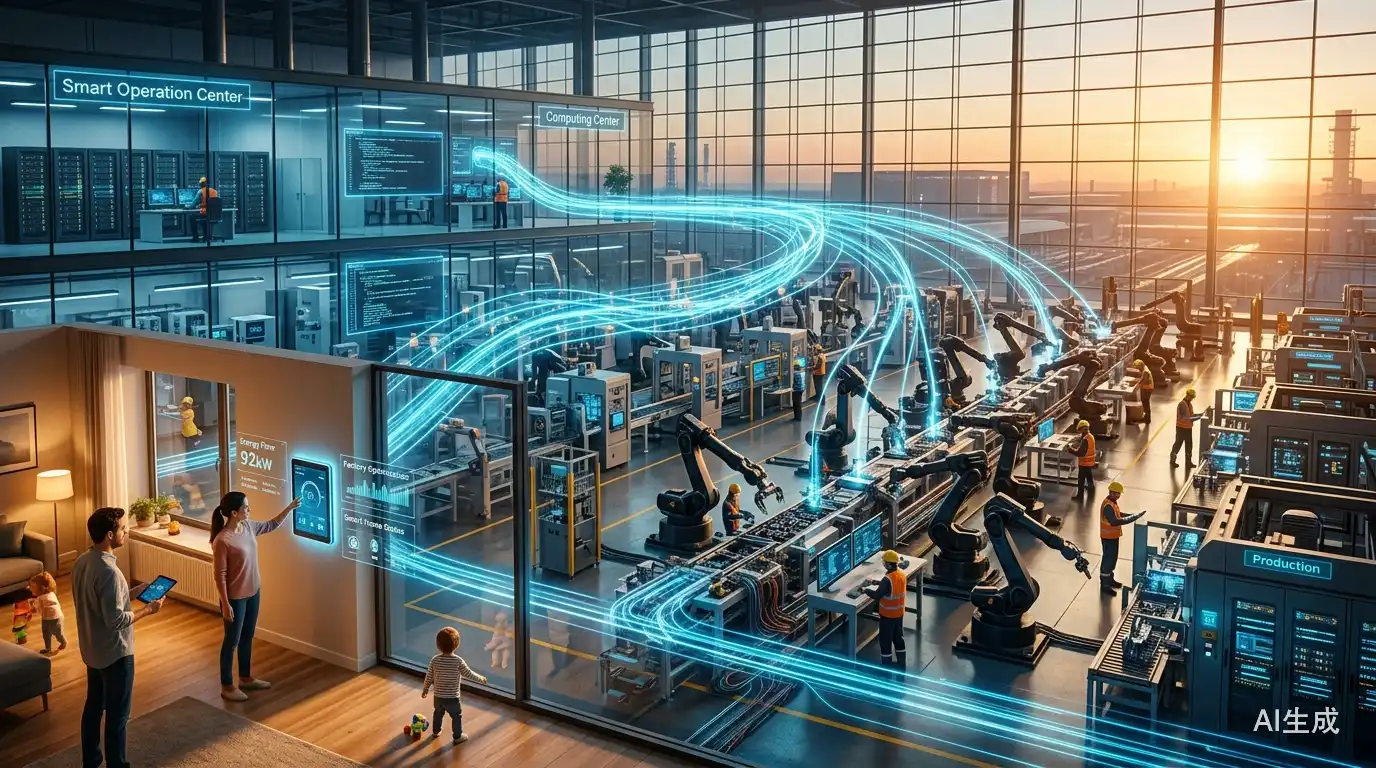
One Megawatt Sustains 60,000 Agents, NVIDIA GB300 Crushes Previous Generation by 20x

marsbitPublicado em 2026-07-06Última atualização em 2026-07-06

Resumo

NVIDIA's latest GB300 NVL72 system achieves a 20x improvement in AI agent throughput per megawatt compared to its predecessor, the H200, according to a new industry benchmark called AA-AgentPerf. Where the H200 could handle roughly 2,600 concurrent agents per megawatt, the GB300 NVL72 can support approximately 61,400. The significance lies less in raw chip performance and more in the new benchmark itself. AA-AgentPerf, created by the independent firm Artificial Analysis, is the first benchmark designed specifically for "AI agent" workloads. Traditional benchmarks measure single, fixed-length requests, but AI agents operate in long, complex chains involving dozens of model calls, tool use, and ever-growing context. These create unique system pressures that older tests cannot capture. AA-AgentPerf replays real programming agent trajectories with lengthy sessions and varying input lengths. Its key metric is "agents per megawatt," measured under strict Service Level Objectives (SLOs) that guarantee a minimum token output speed per agent. It also allows real-world optimizations like KV cache reuse and speculative decoding, which older benchmarks often disable. The results highlight two key trends: rack-scale systems like the 72-GPU GB300 NVL72 are inherently more efficient than single nodes, and the architectural leap from Hopper to Blackwell (H200 to GB300) represents a systemic, not just incremental, performance gain. The GB300's advantage stems from its high-bandwidth NVLink...

With the same one megawatt of power, NVIDIA's latest GB300 NVL72 can handle 61,400 agents simultaneously, while the previous generation H200 could only handle around 2,600.

That's a full 20 times difference.
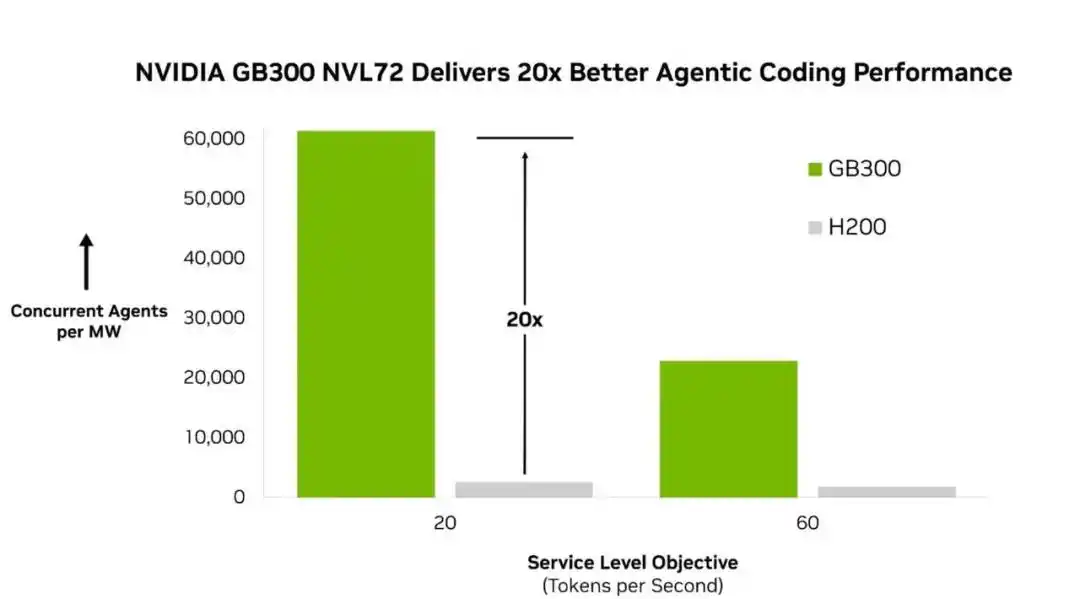
NVIDIA's announced AA-AgentPerf scores: Under two service standards of 20 and 60 tokens per second, the concurrent agent count per megawatt for the GB300 NVL72 is about 20 times that of the H200.

When NVIDIA released these figures on June 12th, the initial external reaction was another performance flex.

But what truly changed wasn't how powerful this generation of chips is, but the ruler used to measure compute power.

It is the new benchmark released by independent evaluation agency Artificial Analysis: AA-AgentPerf.

In its official blog, Artificial Analysis called it the industry's first inference benchmark specifically designed for "AI agents."
Its main metric is also different from before: not tokens per second, but "Agents per Megawatt."

More colloquially, it's how many agents the system can simultaneously "sustain" for every 1 megawatt of electricity supplied.

We've measured FLOPS for years, and tokens per second has been used just fine, so why introduce this new AA-AgentPerf benchmark?

The Old Ruler

Can't Measure Agents Anymore

To answer this, we first need to understand what the workload really is when an agent runs.

Artificial Analysis's judgment is clear: by 2026, the most mainstream AI workload is no longer the thing those old benchmarks were designed to target: old benchmarks measure fixed-length synthetic requests and conveniently turn off optimizations that are actually enabled in production environments.

NVIDIA also gave an apt analogy:

An ordinary conversation is a 100-meter dash; the model receives a question, spits out an answer, done. But an agent working is more like a relay race.

It breaks a goal into dozens or hundreds of steps: reading files, writing code, running commands, checking results, then deciding the next step, one baton pass after another, until the task is truly done.

Along this journey, dozens or even hundreds of large model calls are strung together, each passing an ever-growing context to the next, mixed with tool calls like compilation, database queries, and searches.

The complexity isn't simply additive; it's multiplicative.
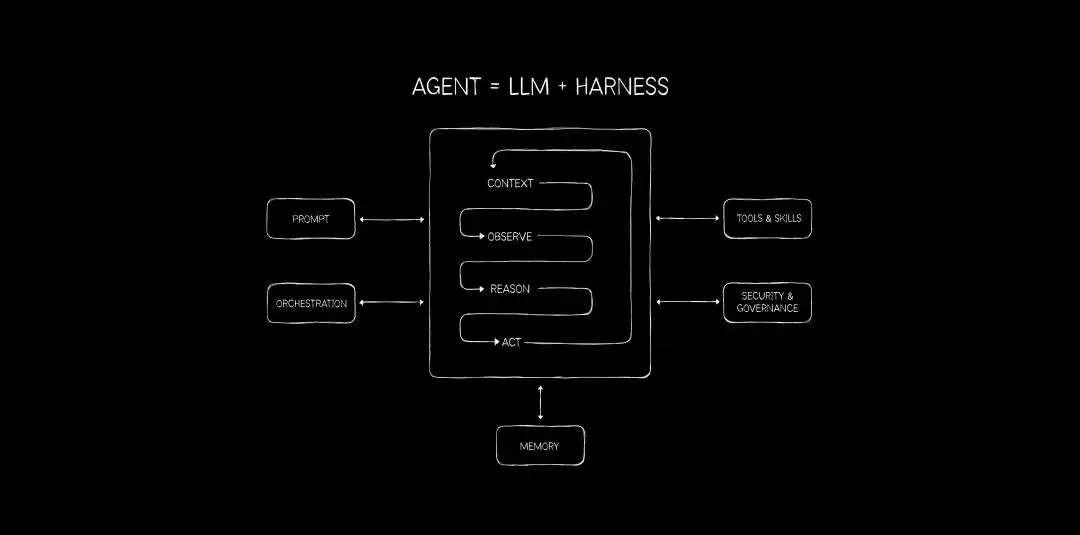
NVIDIA uses a "relay race" metaphor for agentic workloads. A goal is broken into dozens or hundreds of steps, with large model calls and tool calls passed like batons, forming a long, ever-lengthening chain.

The problem lies precisely here.

Existing inference benchmarks on the market measure single calls: how long one request takes to return, how many concurrent requests a machine can handle.

They weren't designed for agents. Chained calls, tool waiting, context inflation—the way these things stress a system is completely different from single requests.

Long sessions alone hide blind spots in old benchmarks: the same long prefix appears round after round; whoever can cache it, avoiding recomputation each time, saves a huge amount of compute.

Add to that tool outputs suddenly inflating the context, while outputs themselves are often only a few hundred tokens—whether the scheduler and memory hierarchy can handle this irregular rhythm directly determines whether a system runs smoothly or crashes.

This is precisely where fixed-length synthetic tests cannot reach.

For those spending real money on cards and building data centers, what they truly care about is how many working agents the system can sustain simultaneously, and how much useful output each kilowatt-hour and each GPU translates to.

Old benchmarks cannot answer these questions.

The First Ruler Built for Agents

AA-AgentPerf's approach differs from old benchmarks; it doesn't feed fixed-length synthetic prompts but replays real programming agent traces.
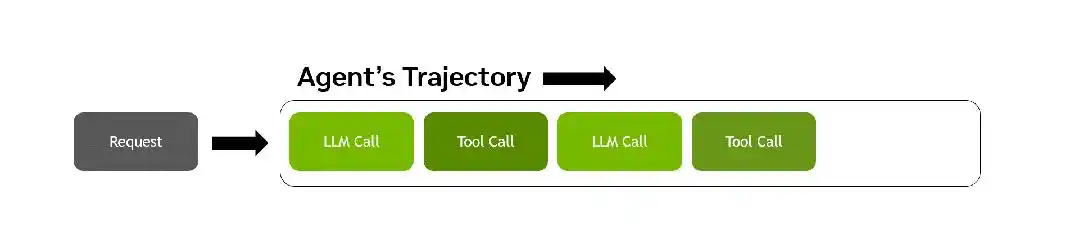
Illustration of an agent trace replayed by AA-AgentPerf. Starting from one request, LLM calls and tool calls alternate, advancing until the task is truly complete.

These traces are accumulated by having agents solve problems in real code repositories, covering over 12 programming languages. A single session can run up to 200 rounds, easily pushing context beyond 100,000 tokens.

Input lengths range from 5,000 to 130,000 tokens, averaging about 27,000. What truly inflates the length isn't the prompt itself, but the accumulated tool outputs and conversation history over multiple rounds.

More crucially, how it calculates the score.

It doesn't chase extreme concurrency. Once concurrency is stacked too high, each agent becomes slow as a crawl; high concurrency numbers are just for show, not practical.

AA-AgentPerf does the opposite: first, lock in a service standard—each agent's output speed and time-to-first-token (TTFT) must meet the target. Then see how many agents the system can sustain at most while maintaining that line.

This set of constraints has a name: Service Level Objective (SLO).

This standard is also divided into tiers, from a "good enough" tier of 20 tokens per second to a "very fast" tier of 180 tokens per second, each measuring the maximum concurrency separately, corresponding to several service levels that actually exist in the market.
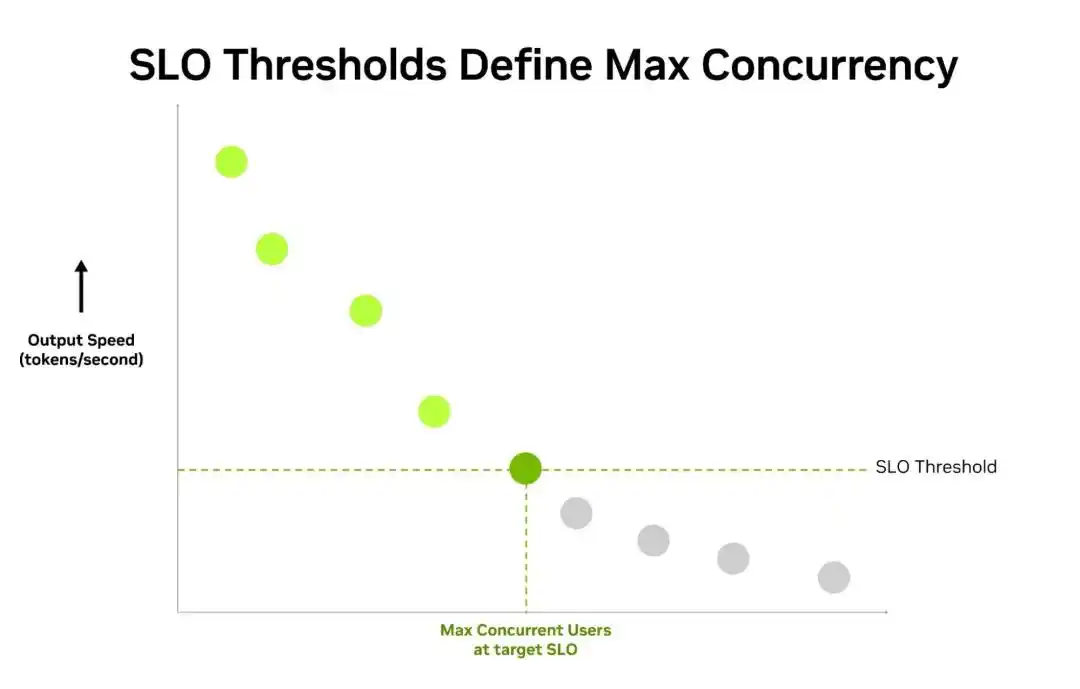
How the Service Level Objective (SLO) caps maximum concurrency. The green zone is the passing area. Once concurrency increases and speed falls below the threshold, the corresponding concurrency limit becomes that system's score.

It also does something other benchmarks often avoid: it allows all optimizations vendors truly enable in production.

KV cache reuse, speculative decoding, splitting prefill and decode across deployments—tricks often turned off by benchmarks—are all permitted this time.

The reason is simple: measurements taken with these optimizations turned off are meaningless.

Simultaneously, it monitors output quality, preventing any optimization from trading answer quality for concurrency. This way, every gain from hardware or software improvements can be accurately measured.

Finally, it boils down to a core metric: Agents per Megawatt. In a world where power is increasingly tight and energy consumption is cost, this metric is what buyers truly care about: from tokens per second to agents per megawatt.

20x Lead Per Megawatt

40x Lead Per GPU

In a test representing one of the strongest current frontier Mixture-of-Experts (MoE) models, the GB300 NVL72 can sustain 61,400 concurrent agents per megawatt, averaging 57.5 agents per GPU.

The control group, H200, manages about 2,600 per megawatt, with only 1.4 agents per GPU. That's about a 20x difference per megawatt and about a 40x difference per GPU.

The significance of these two numbers also differs.

Per megawatt measures how much agent capacity you get for the same unit of electricity, an efficiency calculation. Per GPU measures the service density of a single card, a hardware calculation.

Based on these numbers, you can directly calculate what scale of agent application your power budget can actually run.

The leaderboard isn't limited to NVIDIA's GB300; it includes AMD's MI355X. Single cards, whole systems, and entire racks are all put to the test.

The first batch of results revealed two clear patterns.

Pattern 1: Rack-scale systems are inherently cheaper. They can more fully split inference and spread it across more cards, surpassing single nodes in both raw compute and efficiency per megawatt.

Pattern 2: The leap from Hopper to Blackwell pushed the concurrent capacity of systems to a whole new level, not just minor tweaks.

From Single Card to Rack

A System-Level Victory

From H200 to GB300, this might look like a single-card performance leap, but in fact, it's a system-level victory.

More crucially, the GB300 NVL72 connects 72 GPUs via NVLink into a rack-scale whole.

For such massive MoE models, this is the key: the model can be fully spread out, with experts distributed across a whole fleet of GPUs for parallel execution, rather than all crammed into a single card, wasting resources.

CUDA cores made further optimizations underneath, overlapping communication and computation across experts, letting the overhead of coordinating various experts be quietly absorbed by compute power instead of piling up as latency.

TensorRT-LLM is responsible for maintaining efficiency as concurrent sessions keep increasing, such as splitting input processing and output generation into two separate tasks, each optimized individually.

Simply put, this test score is the result of hardware, interconnect, and software stack working together.
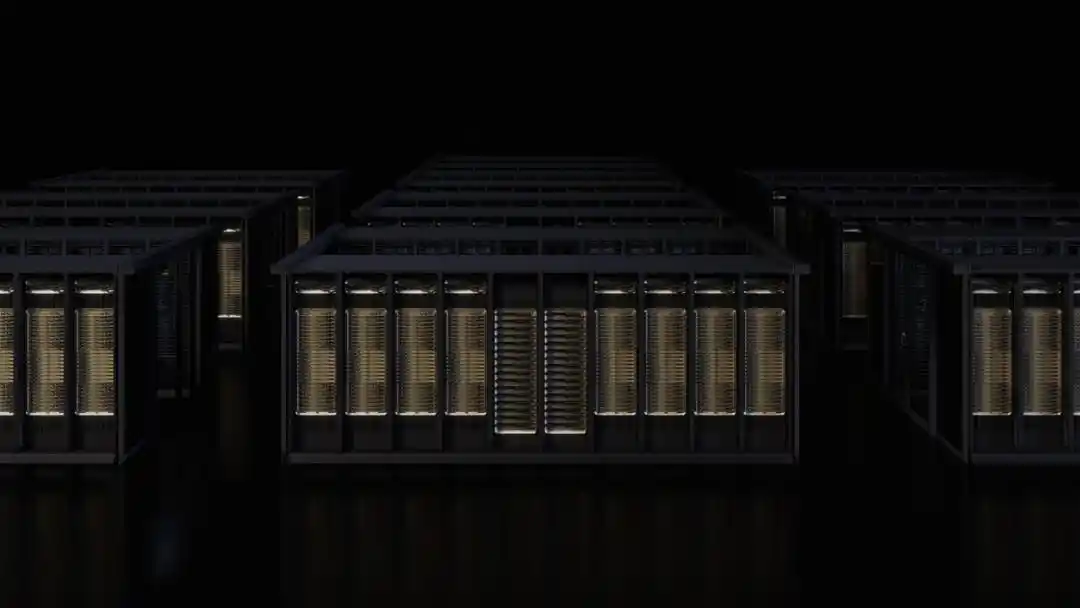
The GB300 NVL72 rack. 72 GPUs connected via NVLink into a single high-bandwidth whole—this is the hardware foundation enabling 60,000 agents to run cooperatively.

Welding 72 cards into a high-bandwidth whole, where each GPU can rapidly share parameters, KV cache, and intermediate results—this is the confidence enabling 60,000 agents to run cooperatively.

Some Boundaries That Cannot Be Overlooked

A few points need attention here; benchmark tests cannot be equated with production reality.

First, the number 60,000 does not mean one machine simultaneously runs 60,000 independent large models.

It's a simulation of concurrent sessions under the benchmark's definition. Each agent follows a pre-recorded trace; even tool calls aren't actually executed but simulated with a fixed CPU duration.

This design ensures the final result only reflects differences in compute power itself, but it cannot be directly equated with the actual service capacity deliverable in a real production environment.

Second, benchmark scores are not production service agreements.

Artificial Analysis itself states this is a snapshot of a rapidly evolving frontier; each system still has untapped potential, and scores will climb as software optimizations advance.

Third, AA-AgentPerf is currently a standard proposed by a single organization.

Whether it will eventually grow into an industry-wide accepted ruler like MLPerf is still too early to conclude.

References:

https://artificialanalysis.ai/articles/aa-agentperf

https://developer.nvidia.com/blog/nvidia-achieves-leading-agentic-coding-performance-on-first-agentic-ai-benchmark/

This article is from the WeChat public account "New Zhiyuan", author: ASI Revelation, editor: Yuanyu


Criptomoedas em alta

Perguntas relacionadas

QWhat is the key metric used in the new AA-AgentPerf benchmark, and why is it considered significant?

AThe key metric is 'Agents per Megawatt,' which measures how many AI agents a system can concurrently 'support' while consuming 1 megawatt of power. It is significant because it shifts the focus from raw performance (like tokens per second) to energy efficiency and practical service capacity, directly addressing the operational costs and scalability concerns in data centers running complex AI agent workloads.

QHow does the workload of an AI agent differ from a standard conversational AI request, according to the article?

AA standard conversational request is like a sprint—a single question and answer. In contrast, an AI agent's workload is like a relay race. It breaks a goal into dozens or hundreds of steps involving multiple LLM calls and tool calls (like reading files, writing code, executing commands). These steps chain together with growing context length and varying computational demands, creating a far more complex and sustained load on the system.

QWhat are two main factors that contribute to the reported 20x improvement in 'Agents per Megawatt' for NVIDIA's GB300 NVL72 over the H200?

AThe improvement stems from both a generational hardware leap and a system-level architecture. Firstly, the Blackwell-generation GB300 GPUs offer significant performance gains. Secondly, and crucially, the GB300 NVL72 system connects 72 GPUs into a single, high-bandwidth unit via NVLink. This allows large models (like MoE models) to be distributed efficiently across many GPUs, enabling superior parallelism, better cache sharing, and higher overall efficiency compared to a collection of individual nodes.

QWhat is the Service Level Objective (SLO) in the AA-AgentPerf benchmark, and how does it determine the final score?

AThe Service Level Objective (SLO) in AA-AgentPerf defines a performance threshold that must be maintained for each agent, such as a minimum tokens-per-second generation speed and a maximum Time-To-First-Token (TTFT). The benchmark does not maximize raw concurrency. Instead, it finds the maximum number of concurrent agents the system can handle while still meeting the predefined SLO. The point where adding more agents causes performance to drop below the SLO becomes the system's score for that service tier.

QWhat are two important caveats or limitations mentioned about the AA-AgentPerf benchmark results?

AFirst, the benchmark simulates agent workloads by replaying pre-recorded trajectories, including simulated (not real) tool execution times. This isolates hardware/software performance but does not perfectly mirror a live production environment's complexities. Second, AA-AgentPerf is a new benchmark from a single organization. It is a snapshot of rapidly evolving technology, and its status as a future industry-standard, like MLPerf, is not yet assured. The scores represent potential and are not service-level guarantees.

Leituras Relacionadas

DeepMind's Classic Masterpiece Crowned Again, ICML 2026 Awards Announced

ICML 2026 has announced its annual awards, with diffusion models and AI safety ethics taking center stage. The Outstanding Paper Award was shared by two diffusion model studies. One challenges a core assumption of diffusion language models (DLMs), arguing that their touted "arbitrary order generation" is a "flexibility trap" that harms performance. The other provides a high-accuracy sampling method, pushing the technical ceiling for diffusion models and log-concave distributions. A position paper winning the Outstanding Award raises a critical ethical concern: AI alignment research is unintentionally building a "censor's toolkit," where safety tools like RLHF can be repurposed for content control. Several papers received Honorable Mentions, spanning key areas: mapping where honesty emerges in RLHF-trained models, motion attribution in video generation, quantifying how much language models memorize, analyzing diffusion model consistency via random matrix theory, and providing a mathematical proof for the "grokking" phenomenon in a simple model. The Test of Time Award was given to DeepMind's 2016 seminal work "Asynchronous Methods for Deep Reinforcement Learning," recognizing the enduring impact of the A3C algorithm. Overall, the awards signal a shift in AI research from rapid expansion to deeper scrutiny—validating diffusion models as a major architectural contender while prompting serious ethical reflection within the safety community.

marsbitHá 14m

DeepMind's Classic Masterpiece Crowned Again, ICML 2026 Awards Announced

marsbitHá 14m

ARK's Massive Buying Spree in Crypto-Linked Stocks: Lower Risk, or Double the Pressure?

ARK Invest, led by Cathie Wood, significantly increased its holdings in crypto-related public stocks in June, purchasing $77 million worth of shares in Coinbase, Circle, and Bullish during Bitcoin's worst monthly performance in four years. The investment thesis is that these stocks offer regulated exposure to the crypto cycle without direct Bitcoin ownership. However, data analysis reveals significant downsides: these stocks exhibit nearly double the volatility of Bitcoin (68%-90% vs. 37.6% 30-day annualized volatility) and carry substantial company-specific risks like earnings, competition, and equity dilution, which account for much of their price movement. Only MicroStrategy closely tracks Bitcoin, acting as a leveraged proxy. Coinbase shows moderate correlation, while Circle and Robinhood have low correlation, being more influenced by stablecoin competition and diversified brokerage operations, respectively. Mining companies like RIOT and MARA have surged due to AI-related ventures, decoupling from Bitcoin's price. The case of Strategy highlights additional equity-structure risks, such as potential value erosion when its market value falls below its net asset value. Ultimately, investing in crypto stocks often means accepting amplified Bitcoin volatility or layering on unrelated business risks, rather than obtaining a safer alternative to direct cryptocurrency ownership.

Foresight NewsHá 18m

ARK's Massive Buying Spree in Crypto-Linked Stocks: Lower Risk, or Double the Pressure?

Foresight NewsHá 18m

Tsinghua University's Special Award Winner, Gu Yuxian, Joins DeepSeek

Tsinghua University's prestigious Graduate Special Scholarship recipient and 2021 Ph.D. candidate, Yuxian Gu, has officially joined DeepSeek. This news coincides with DeepSeek's major recruitment drive and the imminent launch of DeepSeek V4, on whose research paper Gu is listed as an author. A doctoral student in the Conversational AI group under Professor Minlie Huang at Tsinghua, Gu's research focuses on enhancing efficiency throughout the entire lifecycle of large language models. His key contributions span three areas: innovative methods for pre-training data selection (e.g., PDS), advanced knowledge distillation techniques for model compression (notably MiniLLM), and the development of efficient model architectures like Jet-Nemotron. His work has gained significant recognition, with nearly 5,000 citations on Google Scholar. Key publications include the highly cited surveys and papers on pre-trained models and the MiniLLM distillation method. As first author, he has presented at top-tier AI conferences including NeurIPS, ICLR, and ACL. One of his notable achievements is the Jet-Nemotron architecture, which combines Post-Neural Architecture Search (PostNAS) and a novel linear attention module called JetBlock. This model series demonstrates state-of-the-art performance rivaling larger models while achieving substantial efficiency gains in inference. Gu's expertise in creating powerful yet efficient AI systems aligns with industry needs, as evidenced by the adoption of his MiniLLM method by leading tech companies. His move to DeepSeek is anticipated to contribute further advancements in the field.

marsbitHá 44m

Tsinghua University's Special Award Winner, Gu Yuxian, Joins DeepSeek

marsbitHá 44m

Trading

Spot

Artigos em Destaque

Como comprar ONE

Bem-vindo à HTX.com!Tornámos a compra de Harmony (ONE) simples e conveniente.Segue o nosso guia passo a passo para iniciar a tua jornada no mundo das criptos.Passo 1: cria a tua conta HTXUtiliza o teu e-mail ou número de telefone para te inscreveres numa conta gratuita na HTX.Desfruta de um processo de inscrição sem complicações e desbloqueia todas as funcionalidades.Obter a minha contaPasso 2: vai para Comprar Cripto e escolhe o teu método de pagamentoCartão de crédito/débito: usa o teu visa ou mastercard para comprar Harmony (ONE) instantaneamente.Saldo: usa os fundos da tua conta HTX para transacionar sem problemas.Terceiros: adicionamos métodos de pagamento populares, como Google Pay e Apple Pay, para aumentar a conveniência.P2P: transaciona diretamente com outros utilizadores na HTX.Mercado de balcão (OTC): oferecemos serviços personalizados e taxas de câmbio competitivas para os traders.Passo 3: armazena teu Harmony (ONE)Depois de comprar o teu Harmony (ONE), armazena-o na tua conta HTX.Alternativamente, podes enviá-lo para outro lugar através de transferência blockchain ou usá-lo para transacionar outras criptomoedas.Passo 4: transaciona Harmony (ONE)Transaciona facilmente Harmony (ONE) no mercado à vista da HTX.Acede simplesmente à tua conta, seleciona o teu par de trading, executa as tuas transações e monitoriza em tempo real.Oferecemos uma experiência de fácil utilização tanto para principiantes como para traders experientes.

325 Visualizações TotaisPublicado em {updateTime}Atualizado em 2026.06.02

Como comprar ONE

Discussões

Bem-vindo à Comunidade HTX. Aqui, pode manter-se informado sobre os mais recentes desenvolvimentos da plataforma e obter acesso a análises profissionais de mercado. As opiniões dos utilizadores sobre o preço de ONE (ONE) são apresentadas abaixo.

活动图片