One Article to Understand $UORE: The V4 Hook Project That Packs Mining, Lottery, and NFT Into a Single Transaction

marsbitPublicado em 2026-05-09Última atualização em 2026-05-09

Resumo

An In-Depth Look at $UORE: The V4 Hook Project Packing Mining, Lotteries, and NFTs into a Single Transaction $UORE is the latest project leveraging the Uniswap V4 Hook mechanism, following in the footsteps of projects like SATO, uPEG, and Slonks. It distinguishes itself by integrating multiple functions—on-chain mining, a buy-to-enter lottery, auto-generated pixel NFTs (Orelings), and a deflationary burn mechanism—all within a single Uniswap V4 liquidity pool transaction. This complexity results in transaction gas fees that are 2-3 times higher than a standard swap. The project's tokenomics are intricate. Each whole $UORE token held automatically mints a corresponding Oreling NFT, a 32x32 pixel miner character with random traits determined by the next block's hash. Each Oreling has a Class (rarity) and Hash value, which combine to form its Mining Power for staking rewards. Rewards are distributed daily from an emission that decays by 1% daily, with an 80/20 split between stakers and a Motherlode lottery pool. A "refined-ore boost" mechanism taxes early reward claims, redistributing 10% to remaining stakers. The Motherlode lottery awards tickets for buys of ≥0.1 ETH, with winning chances scaling up to 1% for 1 ETH purchases. Wins split the pool 50% to the buyer and 50% to a random staker. A 1% buy tax is burned, and a 1% sell tax funds an automatic buyback-and-burn mechanism triggered at 0.1 ETH. The project's code is a fork of uPEG, with claimed fixes for NFT duplication ...

Author: Curry, Shenchao TechFlow

Still FOMOing over yesterday's trending on-chain Ethereum project Slonk? Actually, a new narrative has arrived:

V4 Hook.

Over the past two weeks, Uniswap V4's Hook mechanism suddenly became hot. SATO used Hooks to create an on-chain bonding curve, pushing its market cap to $40 million. uPEG, leveraging the viral story of Uniswap's discarded naming drafts, reached over $30 million in two weeks. Slonks embedded an AI model into a smart contract to mimic CryptoPunks, achieving 586 ETH in trading volume within six days of launch.

While these three projects have different gameplay, they all utilize Uniswap's V4 mechanism.

Now the fourth one is here.
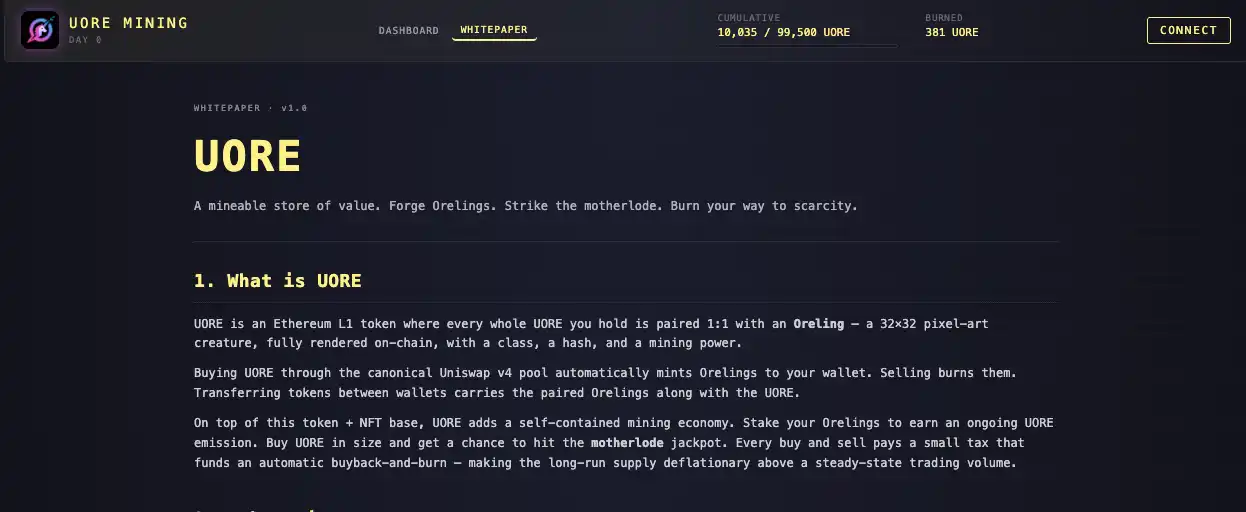
The new project is called $UORE, launched just yesterday. What it does can be summarized in one sentence: It packs on-chain mining, token-buying lottery, pixel NFT auto-generation, and deflationary burning mechanisms, all into a single Uniswap V4 trading pool.

Because buying tokens in this pool triggers the contract to simultaneously perform these six actions in the background, the gas fee for one transaction is two to three times that of a normal swap...

Currently on Crypto Twitter, you'll find everyone complaining about this high gas cost.

Regarding the token, according to GMGN data as of the time of writing, $UORE surged to a market cap of $1.2 million within hours of launch, then quickly dropped back to $440k. The pool liquidity is only $64k, but the 24-hour trading volume is $1.2 million, meaning the money in the pool has been turned over nearly twenty times.

However, there are only 741 holders, and the total supply is less than ten thousand tokens.
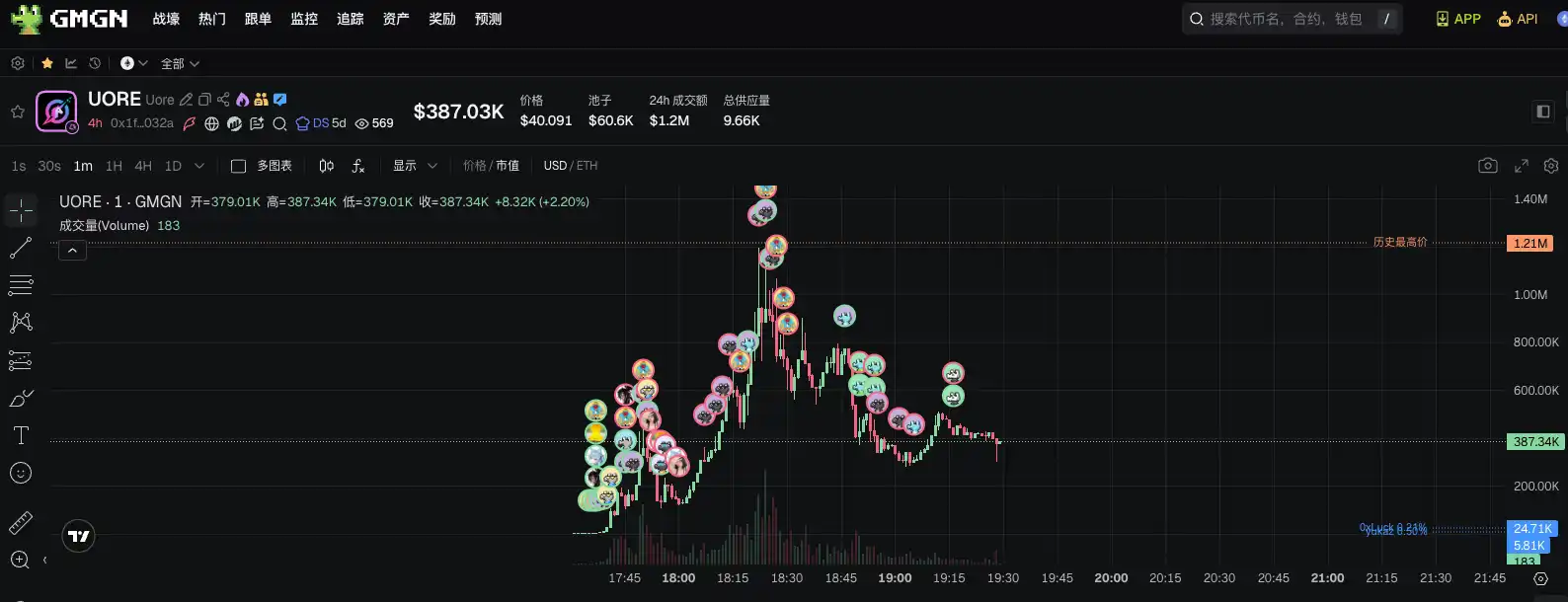
Currently, the risks appear extremely high. After a brief study, I personally think it's the most mechanically complex project in the V4 Hook ecosystem (this round of new on-chain plays tends to be confusing in terms of mechanics...).

It is simultaneously a token, an NFT collection, a staking mining farm, and a lottery system. Moreover, these four things are not independent; they are welded together.

The Four-in-One Mining Farm

In most NFT projects, the token and the NFT are two separate things, bought and sold independently.

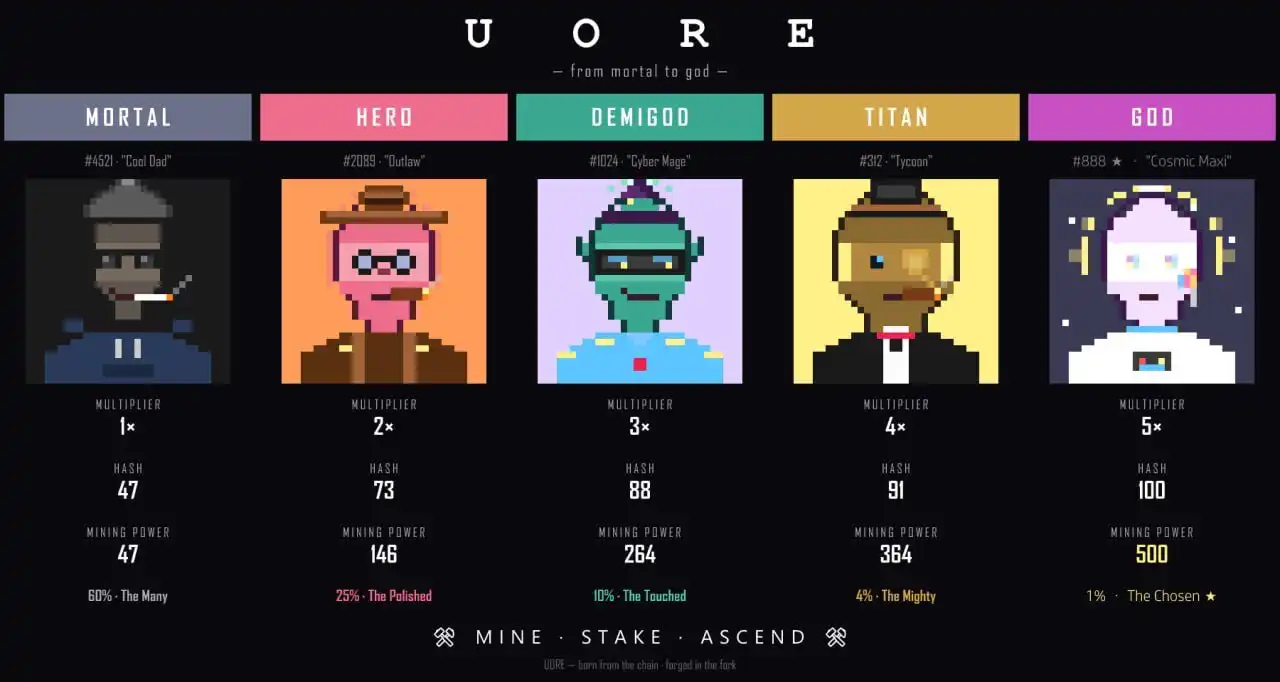
UORE is not. Its NFT is called Oreling, a 32×32 pixel miner character directly embedded into the token. For every full integer UORE you hold in your wallet, you automatically own one corresponding Oreling.
The contract mints it for you when you buy tokens, burns it when you sell tokens, and the Oreling moves with the UORE when you transfer. You cannot buy an Oreling separately, nor can you detach it from UORE.

Each Oreling's traits are determined by the hash of the next block the moment it is minted. This means you don't know what kind of character you'll get when you buy; not even the validator can see the result in advance.

The differences between these characters are not just about appearance.

Each Oreling has a Class (rarity) and a Hash (a random number from 1 to 100). Multiplying these two gives its Mining Power.

The most common Mortal class accounts for 60% with a 1x multiplier; the rarest God class has only a 1% probability with a 5x multiplier. If you're lucky and get a God with Hash 100, your mining power is 500, more than ten times that of an ordinary miner.

So what is mining power used for? Old-school play: staking.

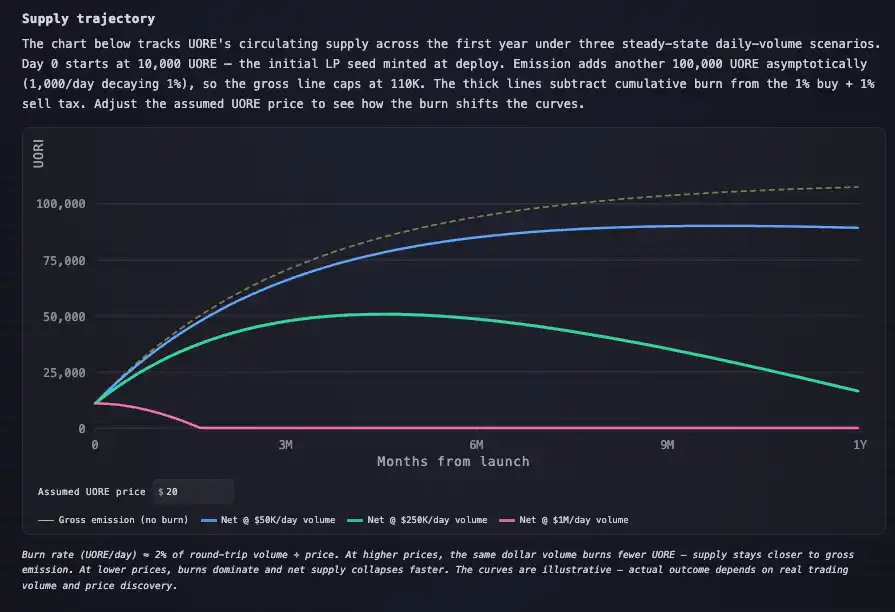
Stake your Oreling into the mining pool, and you start receiving a share of the daily UORE release based on your mining power proportion. According to the official whitepaper, 1000 UORE are released on the first day, decaying by 1% daily thereafter, with a half-life of approximately 69 days. 80% of the release is distributed to stakers, and 20% goes into the Motherlode prize pool.

This decay rate means that within a year, 97% of the total emission will be released. The earlier you enter to mine, the larger the slice you get.

A design worth noting when claiming rewards: a 10% "refining tax" is deducted and redistributed to all stakers who haven't claimed yet. The whitepaper calls this the refined-ore boost.

In plain language, those who claim later receive more of the taxes paid by others. Those in a hurry to claim are subsidizing the patient ones.
Then there's the Motherlode, translated as the "mineral vein jackpot."

Every time you buy ≥ 0.1 ETH worth of UORE through official channels, you automatically get a lottery ticket. The winning probability is tied to the purchase amount: ~1/600 for 0.1 ETH, ~1/200 for 0.5 ETH, and capped at ~1/100 for 1 ETH. Buying more than 1 ETH doesn't increase the probability, preventing whales from spamming.

If you win, the prize pool is split in two: 50% goes directly to the buyer, and 50% is randomly distributed to one staker (weighted by mining power). As of writing, there have only been 4 wins in history, with the largest prize being 6.4 UORE.

Finally, the deflationary flywheel.

A 1% tax on buys is directly burned, and a 1% tax on sells goes into a buyback treasury. When the treasury accumulates 0.1 ETH, anyone can trigger an automatic buyback, and all bought-back UORE are burned. As of writing, 58 buybacks have been executed, cumulatively burning 358 UORE.
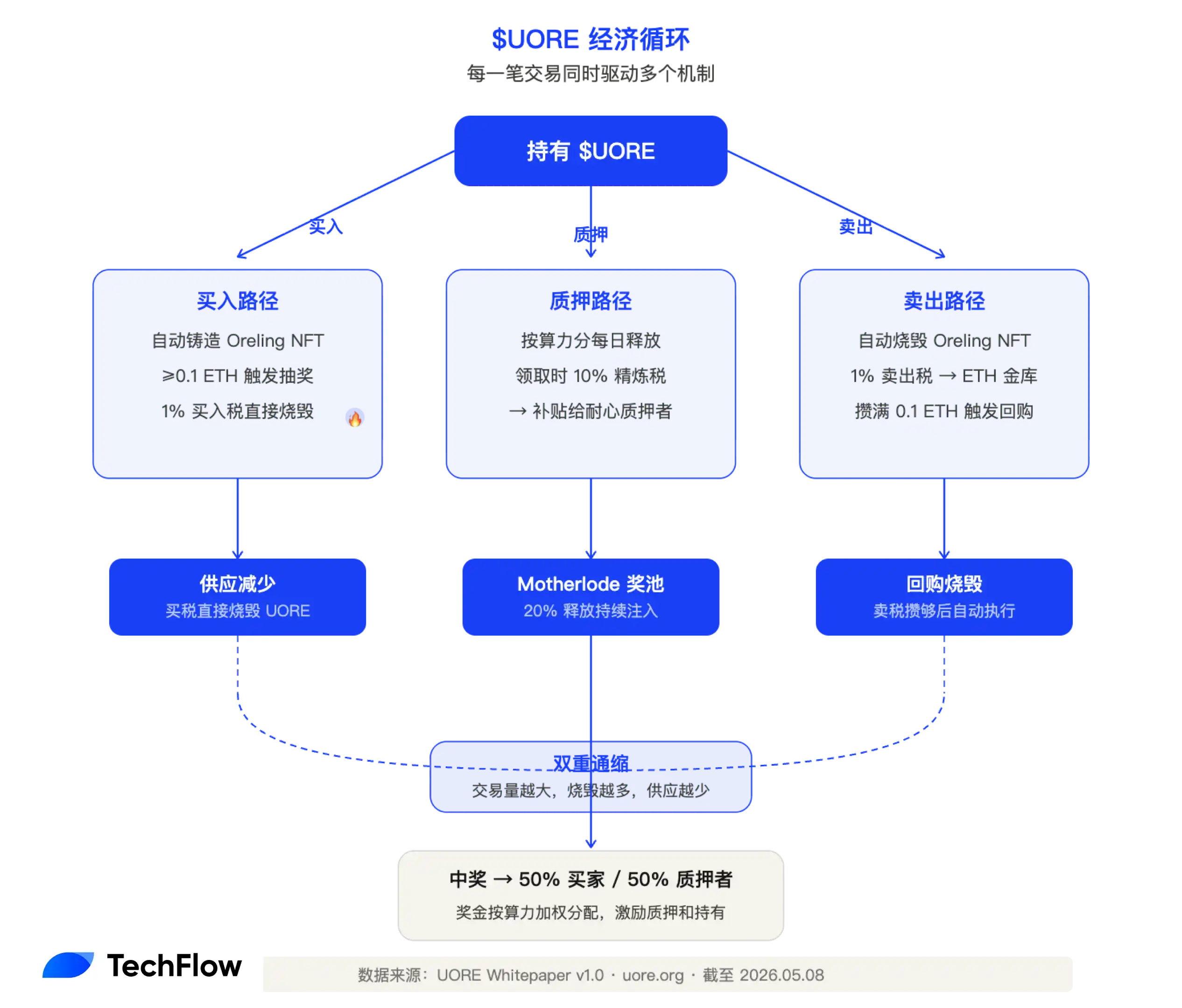
Looking at the overall design, it's a small innovation in token-NFT gameplay, an old trick for creating scarcity, yet another Ponzi in economic model design.

The Code is Forked, The Gameplay is Stitched

UORE wasn't written from scratch.

Someone in the community reviewed the source code and found a folder named `reference/unipeg-hook-source/`. The founder, Noah, hasn't hidden it either. He directly stated on Twitter that UORE's contract is forked from uPEG, and it fixed two known issues with uPEG: duplicate NFT generation and flash loan attacks to farm rarity.
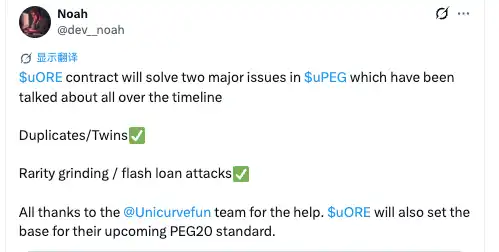
Checking out this founder's account, his bio reads "Ethereum dev & BAYC holder." On May 2nd, he posted his first tweet about UORE, saying the project combines the mining concept from Solana's ORE with the V4 Hook architecture of uPEG.

He also proactively @'ed Unicurvefun and Openpeg, asking if they could support Orelings trading after their marketplaces launch.

From this public information, UORE's project lineage is clear:

Solana ORE provided the "on-chain mining + lottery" gameplay template, uPEG provided the V4 Hook code skeleton, and Noah made improvements and assembly on these two foundations.

Forking itself isn't the issue. I think the current problems are:

  1. Gas. People on CT report that each UORE transaction needs to complete six steps within the Hook, consuming two to three times the gas of a normal swap. Swapping back and forth might leave little profit.
  2. Time Window. The V4 Hook narrative, affected by uPEG's decline, will have a lower ceiling for subsequent projects. UORE is the fourth project in this wave of Hook hype, and the heat for the first three is already cooling. The attention window for the track waits for no one.
  3. Complexity. UORE might be the most mechanically intricate of these four projects. For an average user to understand the whole set of rules—Oreling rarity, mining power calculation, staking decay, refining tax, Motherlode probability, buyback trigger conditions—the barrier is high, and the official website is cryptic.

Moreover, the project whitepaper is also interesting:

"Read the contracts and understand the mechanics before deploying capital."

Translated into Chinese, this roughly means "Understand it before you come; don't blame me if you don't."

Combining this with the previous Hook projects, we can see that this wave of on-chain trends features complex mechanism design + immense information asymmetry, having alpha potential, but the shelf life of that alpha is getting shorter and shorter.

SATO gave about a week, uPEG gave a few days, and by the time we get to UORE, the time left for you to understand the rules might be just a few hours...

By the time you understand, the market move might already be over.

Perguntas relacionadas

QWhat is the core concept of the $UORE project, and what makes it unique among other V4 Hook projects?

AThe $UORE project integrates multiple mechanisms into a single Uniswap V4 transaction. Its unique concept is bundling on-chain mining, a buy-to-enter lottery, dynamically generated pixel NFTs (Orelings), and a deflationary burn mechanism all within one trading pool. Each buy/sell transaction automatically handles token purchase, NFT minting/burning, lottery ticket allocation, and tax distribution.

QWhat is an Oreling, and how is it intrinsically linked to the $UORE token?

AAn Oreling is a 32x32 pixel miner NFT. It is directly embedded into the $UORE token: holding one full $UORE automatically grants one Oreling. You cannot buy, sell, or transfer an Oreling separately from its $UORE token. Its features, determined by the next block's hash, dictate its mining power for the staking reward system.

QExplain the staking and mining reward mechanism for $UORE/Orelings.

AUsers stake their Orelings in a mining pool. Each Oreling's mining power (calculated as Class rarity multiplier x Hash value from 1-100) determines the holder's share of daily $UORE emissions. Emission starts at 1,000 tokens per day, decaying by 1% daily. 80% of emissions go to stakers, and 20% goes to the Motherlode lottery pool. A "refined-ore boost" tax of 10% is deducted from claimed rewards and redistributed to unstaked participants, incentivizing delayed claims.

QWhat is the 'Motherlode', and how does the buy-to-enter lottery work?

AThe Motherlode is a lottery prize pool. Buying at least 0.1 ETH worth of $UORE via official channels grants one lottery ticket. The winning probability scales with the purchase amount, capped at a 1% chance for purchases of 1 ETH or more. Upon winning, the prize pool is split: 50% goes to the buyer, and 50% is randomly distributed to one staker (weighted by their mining power).

QWhat are the key risks and challenges mentioned about the $UORE project?

AThe article highlights several risks: 1) High gas fees (2-3x normal swaps) due to complex contract execution. 2) A short attention window as it's the fourth project in a potentially fading V4 Hook narrative trend. 3) High complexity and information asymmetry, making it difficult for average users to understand the full mechanics quickly. 4) Its code is a fork of the uPEG project, raising questions about novelty, though it claims to fix some of uPEG's vulnerabilities.

Leituras Relacionadas

Who Funds the Agents?

**Summary: Who Funds AI Agents?** OpenAI recently shut down a feature allowing AI agents to shop for users, highlighting the challenge of creating a secure and regulated environment for agent-driven transactions. While payment infrastructure exists, a crucial governance layer—defining spending limits, fraud detection, tax handling, and return policies—is largely missing. The potential is enormous: AI agents already processed $73M across 176M transactions last year, with McKinsey forecasting this could grow to $3-5T in global consumer commerce by 2030. The core competition isn't just about processing payments, which can be very cheap (especially with crypto-based settlement), but about controlling the rules that govern agent spending. Key players like Stripe and Coinbase are racing to dominate this governance layer. Stripe's acquisition of wallet provider Privy allows it to set spending policies, identity checks, and human-in-the-loop approvals directly at the wallet level. Similarly, Coinbase's stack, including its x402 protocol and AgentKit, embeds governance rules. This vertical integration across settlement, wallet, and governance layers is becoming the dominant strategy. Control over the governance layer is where significant future value lies. If agents handle trillions in transactions, even a small fee for managing compliance, fraud prevention, and policy enforcement could generate billions in annual revenue. The companies that successfully integrate across the payment stack will capture value from idle agent balances, transaction fees, and governance services, positioning themselves as the foundational banks of the AI agent economy.

marsbitHá 19m

Who Funds the Agents?

marsbitHá 19m

A Nation Blocks Chips, a Giant Buys a Nuclear Power Plant: Why It's Time to Seriously Consider DeAI

**Title: Great Powers Blockade Chips, Giants Buy Nuclear Plants: Why It's Time to Seriously Consider DeAI** In May 2026, the US closed loopholes for Chinese firms to acquire advanced NVIDIA chips via overseas subsidiaries. That same month, Kenya halted a $1B geothermal data center project involving Microsoft, fearing its immense energy consumption. Meanwhile, Huawei announced mass production of its Ascend AI chip. These disparate events underscore a new reality: the competition for computing power ("compute") has escalated beyond the tech industry, becoming a geopolitical and infrastructural battleground. A new era of oligopoly is forming, with control over the AI stack—from GPU chips (NVIDIA) and cloud platforms (AWS, Azure, Google Cloud) to foundational models (OpenAI, Anthropic)—concentrating in a few Western "AI Octopus" corporations. This centralization creates systemic risks: pricing power and platform lock-in for users, infrastructure fragility, and a widening "compute divide" that threatens to marginalize nations without independent AI capacity. An "AI Iron Curtain" is deepening through export controls. In response, some nations like Saudi Arabia and the UAE are investing heavily to buy compute power, aiming to transition from oil to AI economies. The EU seeks to triple its compute capacity by 2030 to reduce dependency. However, the spending gap is vast, with four US tech giants alone planning ~$750B in AI capex for 2026. The race is increasingly constrained by energy, with AI tasks consuming up to 1000x more power than web searches, pushing firms to even acquire nuclear plants. This landscape is fueling interest in Decentralized AI (DeAI). It proposes a third way: using open protocols to coordinate a global network of idle GPUs, independent developers, and data centers, creating an AI infrastructure without a single controlling entity. Leveraging blockchain and cryptographic verification, DeAI aims to break market concentration, disperse energy demands, reduce geopolitical dependencies, and enhance transparency. While still nascent in performance and stability, DeAI's core promise is not immediate superiority but providing a crucial alternative architecture to resist monopoly, censorship, and centralized power. As specialized AI hardware costs fall and open-source models flourish, the window to build this foundation is open. The very existence of such competition serves as a vital check against the inevitable abuse of concentrated power.

marsbitHá 1h

A Nation Blocks Chips, a Giant Buys a Nuclear Power Plant: Why It's Time to Seriously Consider DeAI

marsbitHá 1h

Trading

Spot
Futuros

Artigos em Destaque

Como comprar ONE

Bem-vindo à HTX.com!Tornámos a compra de Harmony (ONE) simples e conveniente.Segue o nosso guia passo a passo para iniciar a tua jornada no mundo das criptos.Passo 1: cria a tua conta HTXUtiliza o teu e-mail ou número de telefone para te inscreveres numa conta gratuita na HTX.Desfruta de um processo de inscrição sem complicações e desbloqueia todas as funcionalidades.Obter a minha contaPasso 2: vai para Comprar Cripto e escolhe o teu método de pagamentoCartão de crédito/débito: usa o teu visa ou mastercard para comprar Harmony (ONE) instantaneamente.Saldo: usa os fundos da tua conta HTX para transacionar sem problemas.Terceiros: adicionamos métodos de pagamento populares, como Google Pay e Apple Pay, para aumentar a conveniência.P2P: transaciona diretamente com outros utilizadores na HTX.Mercado de balcão (OTC): oferecemos serviços personalizados e taxas de câmbio competitivas para os traders.Passo 3: armazena teu Harmony (ONE)Depois de comprar o teu Harmony (ONE), armazena-o na tua conta HTX.Alternativamente, podes enviá-lo para outro lugar através de transferência blockchain ou usá-lo para transacionar outras criptomoedas.Passo 4: transaciona Harmony (ONE)Transaciona facilmente Harmony (ONE) no mercado à vista da HTX.Acede simplesmente à tua conta, seleciona o teu par de trading, executa as tuas transações e monitoriza em tempo real.Oferecemos uma experiência de fácil utilização tanto para principiantes como para traders experientes.

295 Visualizações TotaisPublicado em {updateTime}Atualizado em 2026.06.02

Como comprar ONE

Discussões

Bem-vindo à Comunidade HTX. Aqui, pode manter-se informado sobre os mais recentes desenvolvimentos da plataforma e obter acesso a análises profissionais de mercado. As opiniões dos utilizadores sobre o preço de ONE (ONE) são apresentadas abaixo.

活动图片













