On the Eve of Fed Policy: The Dual Test of "Trillion-Dollar Tariff Ruling" and "Non-Farm Payroll Report"

marsbitPublicado em 2026-01-09Última atualização em 2026-01-09

Resumo

Key events this week are set to reshape U.S. markets, with major implications for stocks, bonds, and metals. The Supreme Court may rule on the legality of Trump-era tariffs, potentially requiring refunds of up to $133 billion. A ruling against tariffs could boost S&P 500 profits but worsen the deficit, complicating Fed policy. Separately, the U.S. may decide on metals tariffs under Section 232 by January 10, affecting silver, platinum, and palladium. Meanwhile, the Bloomberg Commodity Index rebalancing is forcing significant sell-offs in gold and silver, adding volatility. Finally, the December nonfarm payrolls report on January 9 will be a critical data point for the Fed’s upcoming policy decision. Investors should brace for heightened market swings.

Written by: Wall Street Insights

This weekend is bound to be eventful.

The market is holding its breath for a true "major test." From the Supreme Court's "trillion-dollar tariff ruling" to the "tariff stick" targeting metals, and the "forced selling" by passive funds, the market is in the midst of multiple storm eyes this week.

The outcomes of these three key events, erupting in quick succession, will profoundly reshape market trends and directly impact the pricing logic of U.S. stocks, U.S. bonds, and precious metals markets.

Additionally, at 21:30 Beijing time on January 9 (Friday), the U.S. Bureau of Labor Statistics (BLS) will release the December non-farm payroll report.

After weeks of data vacuum caused by the government shutdown, this report will serve as a "reliable reading" for the economy's health and the most decisive reference before the Fed's January policy meeting, directly influencing its choice between "standing pat" or "continuing rate cuts."

At this "major test" juncture, fastening your seatbelt and guarding against volatility risks might be the best strategy.

Below, we break down these heavyweight changes one by one.

01 1,000 Companies "Besiege" the White House: Will the Trillion-Dollar Tariffs Be Refunded?

An unprecedented legal "siege" is underway in Washington.

According to the latest statistics, over 1,000 companies have officially filed lawsuits attempting to overturn the current tariff policies and demanding refunds totaling up to a hundred billion dollars in tariffs.

This includes listed giants like Costco and Goodyear Tire & Rubber Co. Dozens of entities joined the fray just in the first few days of 2026.

The focus of this lawsuit is the final ruling by the U.S. Supreme Court on the legality of the comprehensive tariff plan introduced by Trump.

According to CCTV News, the Supreme Court has set this Friday (U.S. Eastern Time) as the opinion release day. Although it is not yet confirmed whether it includes the tariff case, the market widely expects the ruling to be announced as early as this week.

What happens if the court rules the tariffs illegal?

  • Bullish for U.S. Stocks: Wells Fargo chief equity strategist Ohsung Kwon estimates that if tariffs are overturned, the EBIT of S&P 500 component companies in 2026 could increase by about 2.4% compared to last year. Canceling tariffs would directly improve corporate profits, benefiting the stock market.
  • Bearish for U.S. Bonds: The flip side of the coin is that canceling tariffs would削弱 an important source of government revenue, exacerbating federal deficit concerns and potentially triggering a sell-off in U.S. bonds.
  • Policy Complication: If refunds form additional economic stimulus, the Fed's rate-cutting path will become more complex.

Even if the Supreme Court rules it illegal, the specific refund process (involving approximately $133 billion) may still need to be handled by lower courts, and the White House might invoke other laws to re-impose restrictions, meaning policy uncertainty will persist long-term.

02 Critical Minerals Tariff Countdown: Silver, Platinum Face "Nerve-Wracking Moment"

Besides the comprehensive tariff case, the results of the U.S. "Section 232" investigation on critical minerals are expected to be announced this Saturday (January 10). This decision directly affects the fate of Comex silver and platinum group metals.

The Citi research team provided a detailed scenario analysis:

If tariffs are imposed: The market will have an implementation window of about 15 days, triggering a short-term "rush to ship to the U.S." behavior. This will push up domestic U.S. benchmark pricing and the Exchange for Physical (EFP) premium.

As of January 7, EFP pricing indicates the market expects a platinum tariff of about 12.5%, palladium about 7%, and silver about 5.5%. These implied tariff rates reflect market uncertainty amidst high volatility.
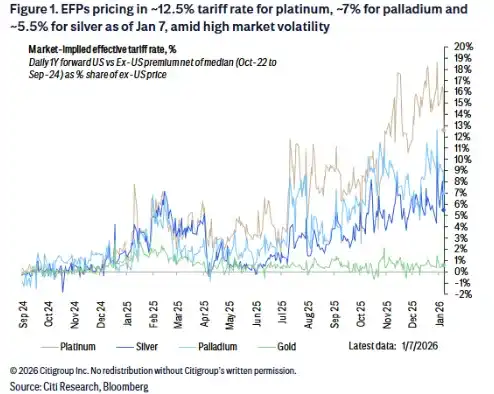
(Expected Tariff Rates from EFP Pricing)

If no tariffs are imposed: Metals will flow out of the U.S. to other global regions, easing pressure on London spot prices and potentially causing a price pullback.

What's the view on specific varieties?

  • Silver (Likely Safe): Due to heavy U.S. reliance on silver imports, Citi believes no tariff is the base case, and even if imposed, Canada and Mexico might be exempt. However, in a "no tariff" scenario, silver prices could face temporary downward pressure.
  • Palladium (High Risk): Most likely to face tariffs (e.g., 50%). If imposed, U.S. domestic import costs would rise sharply, pushing up futures prices.
  • Platinum (A Coin Toss): Whether tariffs will be imposed is currently extremely uncertain.

The investigation results were originally due on October 12, 2025, and President Trump has 90 days to take action, meaning the deadline is around January 10 (this Saturday). However, Citi believes that given the large number of commodities involved, President Trump's action might be indefinitely delayed, in which case silver and PGM prices are likely to continue rising during this period.

03 Technical Sell-off Approaches: The "Bloody Week" of Commodity Index Rebalancing

Beyond fundamental news, a "passive storm" on the funding side has already begun.

The highly anticipated annual weight rebalancing of the Bloomberg Commodity Index (BCOM) started after the close on January 8 and will continue until January 14. To maintain the diversification rule that no single commodity weight exceeds 15%, this adjustment poses significant selling pressure on the precious metals sector.

Gold: Weight reduced from 20.4% to 14.9%, facing selling pressure equivalent to 3% of total holdings.

Silver: Faces particularly huge pressure! Weight will be drastically cut from 9.6% to 3.94%, with expected selling volume reaching up to 9% of total holdings.

This "non-fundamental" selling triggered by index rules forces speculative funds to stay on the sidelines, exacerbating short-term volatility.
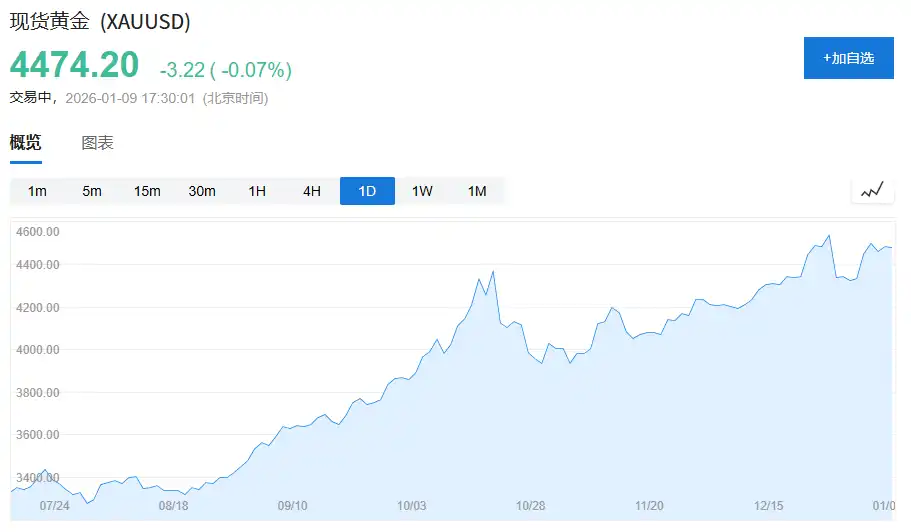
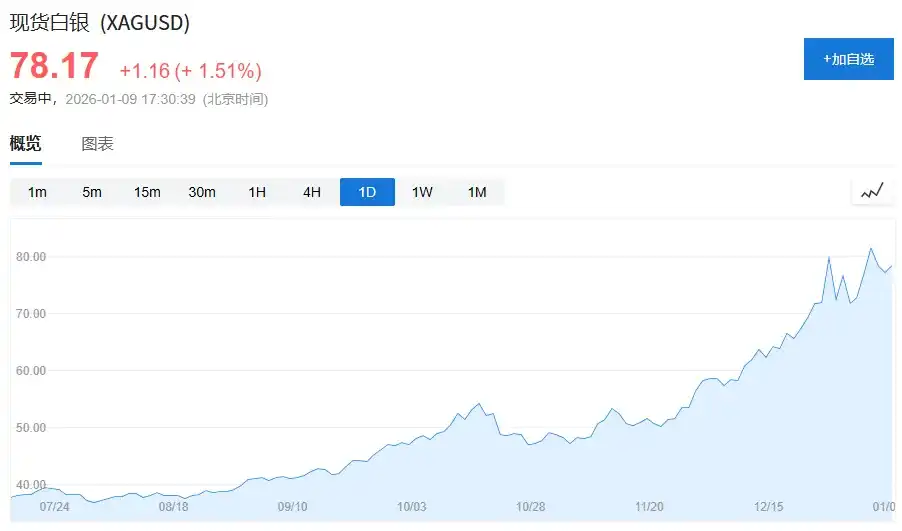
It's worth noting that the decline in gold, silver, and other precious metals comes after a rare epic rally. Spot gold surged over 70% throughout 2025, and silver gains once reached about 150%, entering a frenzy mode from December 23 last year and continuously hitting record highs. Such massive short-term profit accumulation makes the market extremely fragile when facing liquidity events.

Although Goldman Sachs analysts believe that as long as the tight London inventory situation persists, liquidity is the key determinant of prices, in the short term, investors' nerves must be strained in the face of such large-scale passive fund "repositioning."


Perguntas relacionadas

QWhat are the three major events that are creating a 'storm' for the markets this week, according to the article?

AThe three major events are: 1) The U.S. Supreme Court's ruling on the legality of the 'trillion-dollar tariff' policy. 2) The expected announcement of the 'Section 232' investigation results on critical minerals, which could impose new tariffs. 3) The technical selling pressure from the Bloomberg Commodity Index (BCOM) annual rebalancing.

QWhy is the upcoming U.S. non-farm payrolls report on January 9th considered so crucial for the Federal Reserve?

AThe non-farm payrolls report is considered a 'reliable reading' of the economy's health after a data vacuum caused by the government shutdown. It is the most decisive reference point for the Fed's January policy meeting, directly influencing its choice to either 'stand pat' or 'continue with interest rate cuts'.

QWhat are the potential market impacts if the Supreme Court rules the broad tariff policy is illegal?

AA ruling that the tariffs are illegal could: 1) Boost U.S. stocks (e.g., lift S&P 500 companies' EBIT by ~2.4% by improving corporate profits). 2) Be negative for U.S. Treasuries by reducing a key government revenue source and worsening deficit concerns. 3) Complicate the Fed's rate-cutting path if refunds act as an additional economic stimulus.

QAccording to Citigroup's analysis, which metal is at the highest risk of having new tariffs imposed, and which is least likely?

AAccording to Citigroup: Palladium is at the highest risk, with a high probability of a significant tariff (e.g., 50%) being imposed. Silver is the least likely ('low probability') to see tariffs, as the U.S. heavily relies on imports and any potential tariffs would likely exempt Canada and Mexico.

QWhat is causing the significant technical selling pressure on gold and silver this week?

AThe selling pressure is caused by the annual rebalancing of the Bloomberg Commodity Index (BCOM). To maintain its diversification rule that no single commodity can exceed a 15% weight, the index is forced to sell significant amounts of gold (reducing its weight from 20.4% to 14.9%) and silver (reducing its weight drastically from 9.6% to 3.94%), creating non-fundamental, passive fund-driven selling.

Leituras Relacionadas

As Consensus Accelerates, What Are Young Investors Betting On?

Title: As Consensus Forms Faster, What Are Young Investors Betting On? In the rapid evolution of tech investment, a new generation of young investors is navigating a landscape where AI, robotics, commercial aerospace, and quantum computing are advancing simultaneously. Traditional investment logic based on financial models is giving way to a need for deep technical understanding and the ability to act before industry consensus forms. An analysis of trends from the "WAIC FUTURE TECH" list of young investment leaders reveals key shifts in focus. The first major trend is the movement of AI from the digital screen into the physical world. Investment is shifting from large language models and chatbots towards embodied AI, robotics, AI hardware, and edge computing. While demonstrations generate excitement, the real challenge lies in achieving scalable, reliable, and cost-effective delivery in complex real-world environments like factories and logistics. Success depends not just on algorithms but on the integration of sensors, actuators, and control systems. Second, the competitive focus for large models is moving beyond raw capability toward building an "intelligence flywheel." The goal is to create self-reinforcing systems where user interaction generates data, improving the model, which in turn enhances the user experience and attracts more engagement. Companies that successfully embed AI into workflows to create these closed-loop systems can build lasting value that isn't easily erased by the next model upgrade. Third, facing a potential bottleneck in high-quality human-generated data, investors are looking at new underlying technologies. Reinforcement learning and self-play, as demonstrated by AlphaGo Zero, offer paths for AI to generate its own experience. Scientific foundation models, which aim to build general AI capabilities for fields like life sciences and materials discovery, represent a non-consensus direction that could unlock new frontiers of knowledge and data. Finally, in deep-tech areas like quantum computing, commercial aerospace, and space-based infrastructure, patient capital is essential. These fields have long, uncertain development and validation cycles involving complex engineering, supply chains, and regulations. Investment here requires a long-term view, focusing on foundational team capabilities and the eventual emergence of market demand, even if commercial returns are distant. Collectively, these trends illustrate how young investors are adapting to a new era. They are learning to make earlier, technically-informed judgments, balance hype with real-world viability, and provide the patient capital needed to build the deep-tech foundations of the future.

marsbitHá 29m

As Consensus Accelerates, What Are Young Investors Betting On?

marsbitHá 29m

Can Japan Buy Growth with AI? Will the Bond Market Believe It?

Japan's cabinet has introduced the 2026 Basic Policy on Economic and Fiscal Management and Reform, shifting its primary fiscal target. The new framework moves away from the traditional annual primary balance goal and instead prioritizes a stable reduction of the debt-to-GDP ratio. This change is tied to a strategy of increased "responsible proactive fiscal" spending, aiming to boost long-term growth through investments in strategic sectors like AI, semiconductors, energy, and robotics. The government estimates total public and private investment in 62 key technologies could exceed 370 trillion yen by 2040. The market reaction has been mixed and cautious. While equity markets may respond to policy signals, bond markets are focused on fiscal credibility. Concerns center on whether the weakening of the clear primary balance anchor could lead to looser fiscal discipline. If investors doubt that these strategic investments will generate sufficient productivity gains, tax revenue, and nominal growth to outpace rising interest costs, they may demand higher yields on Japanese Government Bonds (JGBs). Recent volatility in the yen and JGB yields, with the 10-year yield briefly reaching 2.9%, reflects this skepticism. The success of this new framework hinges on two factors: whether Japan can achieve a nominal growth rate consistently higher than its long-term interest rates, and whether future budgets demonstrate disciplined control over bond issuance. The government's narrative is that strategic investment is essential to break Japan's cycle of low growth, aging, and labor shortages. However, the bond market will continuously assess the credibility of this plan, pricing the risk that it may represent fiscal expansion rather than a viable growth strategy.

marsbitHá 1h

Can Japan Buy Growth with AI? Will the Bond Market Believe It?

marsbitHá 1h

Misjudged A-Shares: Resilience, Expectations, and Confidence

China's A-share market recently faced selling pressure, especially in tech sectors, initially triggered by a global tech sell-off that began in South Korea. However, the article argues this is a case of "mistaken injury" and highlights the market's underlying resilience. This resilience stems from three main pillars: **1) Tech Sector Fundamentals:** Unlike Korea's market dominated by a few memory chip stocks, China's tech sector is diversified across computing, communications, electronics, and semiconductors, supported by dual narratives of global AI supply chains and domestic substitution. Core areas like optical modules and fiber optics continue to show strong earnings growth. **2) "National Team" Support:** State-backed institutions and large corporations have made significant market purchases and announced buybacks, providing liquidity and signaling confidence. This is seen as a stabilizing policy signal, often associated with market bottoms. **3) Broader Market Pillars:** Other major sectors are showing endogenous recovery momentum. Consumer stocks benefit from stabilizing CPI and signs of sector recovery (e.g., liquor price hikes). Cyclical sectors like aluminum have high earnings, potential price increases due to tight supply, and low valuations. The financial sector offers stable dividends and low valuations. The conclusion is that the sell-off was driven by external contagion, not a collapse in fundamentals. With strong policy support and recovering momentum across key sectors, the A-share market possesses the toughness to regain stability.

marsbitHá 1h

Misjudged A-Shares: Resilience, Expectations, and Confidence

marsbitHá 1h

Trading

Spot
活动图片




