On-chain Analyst: Why Are Most Zcash Transactions Still Traceable?

marsbitPublicado em 2026-05-26Última atualização em 2026-05-26

Resumo

Title: Why Most Zcash Transactions Remain Traceable Zcash, a privacy-focused cryptocurrency launched in 2016, was designed to offer anonymity by hiding transaction details like sender, receiver, and amount using zero-knowledge proof technology (zk-SNARKs). However, in practice, a significant portion of ZEC transactions are still traceable on-chain. The key reason is Zcash's dual-address system. It features transparent addresses (t-addresses), which work like standard Bitcoin addresses with all data public, and shielded addresses (z-addresses) that encrypt transaction details. There are four transaction types with varying privacy levels: fully transparent (t→t), partially shielded (t→z and z→t), and fully private (z→z). Despite its privacy capabilities, most real-world Zcash activity involves transparent addresses, primarily because major exchanges and institutions use them for regulatory compliance. As a result, blockchain analytics platforms like Arkham can track and attribute a substantial volume of Zcash transactions. Arkham reports it has identified entities behind over $420 billion in ZEC transaction volume. Case studies highlight this traceability: the U.S. government holds seized Zcash from a dark web case, visible via its transparent wallet, and individual traders' profitable moves are trackable from purchase to exchange deposit. In conclusion, Zcash's privacy is not inherent but user-dependent. While purely shielded (z→z) transactions remain cryptographically pr...

Author: Willo, Arkham

Compiled by: Yuliya, PANews

Editor's Note: Zcash, a cryptocurrency launched in 2016 focused on privacy protection, is built on the codebase of Bitcoin. Despite its core vision of concealing transaction information, in practical application, the majority of ZEC transactions can still be traced on-chain. This article will analyze how Zcash works and explore why most ZEC on-chain transactions are still traceable, illustrating that the actual degree of privacy protection Zcash can provide depends entirely on how users choose to use it.
Zcash is a digital currency built on Bitcoin's underlying technology, but its design goal was to address what its creators saw as Bitcoin's biggest flaw: the complete transparency of transaction information. Like Bitcoin, Zcash has a hard cap of 21 million coins, halves its block reward every four years, and operates on a Proof-of-Work (PoW) consensus mechanism. At the underlying architectural level, it also shares Bitcoin's UTXO transaction model. In most cases, Zcash transactions look identical to Bitcoin transactions. The difference is that part of Zcash's transactions are designed to be completely invisible.

In the current crypto cycle, privacy is one of the most emblematic themes. As global regulatory pressure intensifies and on-chain monitoring tools become increasingly powerful, more retail and institutional users are beginning to question whether public blockchains expose too much information about users and their transactions? In this context, privacy coins have leaped from a niche area of the market to a high-profile focal category. Because of this, Zcash has become one of the best-performing assets of 2025.

History and Evolution

Zcash was launched in October 2016 by the Electric Coin Company (ECC), founded by cryptographer Zooko Wilcox-O'Hearn, and co-developed by an experienced team of academic cryptographers. The project's origins can be traced back to a 2014 paper introducing the Zerocash protocol, co-authored by researchers from MIT, Johns Hopkins University, and Tel Aviv University. The paper theoretically proposed a protocol that would allow users to make private payments while maintaining processing speeds comparable to Bitcoin.

The core zk-SNARK cryptography technology of Zcash did not originate with cryptocurrency but stems from decades of theoretical research in computer science. The contribution of the Electric Coin Company was to transform this theory into practical technology capable of running efficiently on a real blockchain. In 2016, the team held a cryptographic setup ceremony to generate system parameters; subsequently, in 2018, a second ceremony called Sapling was held. This upgrade significantly improved the efficiency of shielded transactions, making them practical for everyday use.

Zcash's governance system consists of two organizations: the Electric Coin Company, responsible for protocol development and maintenance, and the independent non-profit Zcash Foundation, responsible for overseeing the broader ecosystem development. A portion of newly mined ZEC coins is allocated as funding for these two organizations, ensuring the project's continued development without relying on external investment.

Zero-Knowledge Proofs

The core technology enabling Zcash's privacy protection is called "zero-knowledge proofs." Specifically, Zcash employs a derivative technology known as zk-SNARKs (Zero-Knowledge Succinct Non-Interactive Argument of Knowledge).

This concept may sound abstract, but its core idea is actually very easy to understand. A zero-knowledge proof allows one party to prove to another that something is true without revealing any specific information. In the case of Zcash, network nodes can verify whether a transaction is legal and valid (e.g., confirming that the sender indeed has sufficient funds and did not forge coins out of thin air) without needing to know who the sender is, who the recipient is, or the specific transaction amount.

This technology is a major breakthrough in cryptography. Bitcoin's transparent nature, while beneficial for auditing and tracing, is a major pain point for users who desire financial privacy. The Zcash development team cleverly layered zk-SNARK technology on top of Bitcoin's codebase, providing users with an optional layer of privacy protection.

Transaction Types

The Zcash system includes two types of addresses: transparent addresses (t-addresses) and shielded addresses (z-addresses).

  • Transparent addresses operate exactly like Bitcoin addresses; all transaction activity is publicly visible on the blockchain.

  • Shielded addresses exist in an encrypted pool of funds, where the sender, recipient, and transaction amount are hidden from external observers.

The combination of these two address types produces four different transaction types, each with different levels of privacy protection:

  • t → t (Transparent to Transparent): Completely Public. The sender, recipient, and amount are clearly visible on the blockchain. This is indistinguishable from a standard Bitcoin transaction.

  • t → z (Transparent to Shielded): The amount of funds entering the shielded pool is public, but the recipient is hidden. It's like watching money go through a door: you can see it went in, but you don't know into whose hands it ultimately went.

  • z → t (Shielded to Transparent): The recipient and amount are public, but the sender is hidden. The funds flow out of the encrypted pool, but their ultimate origin cannot be traced by outsiders.

  • z → z (Shielded to Shielded): Completely Private. The only publicly visible data on the blockchain is the transaction fee. The sender, recipient, and amount are all thoroughly hidden through cryptography.

In practical application, historically, the vast majority of Zcash transaction activity remains transparent. Due to compliance requirements, most cryptocurrency exchanges and institutional participants default to using transparent addresses (t-addresses). This means the proportion of publicly readable data in Zcash's transaction history is far greater than one might expect from a "privacy coin."
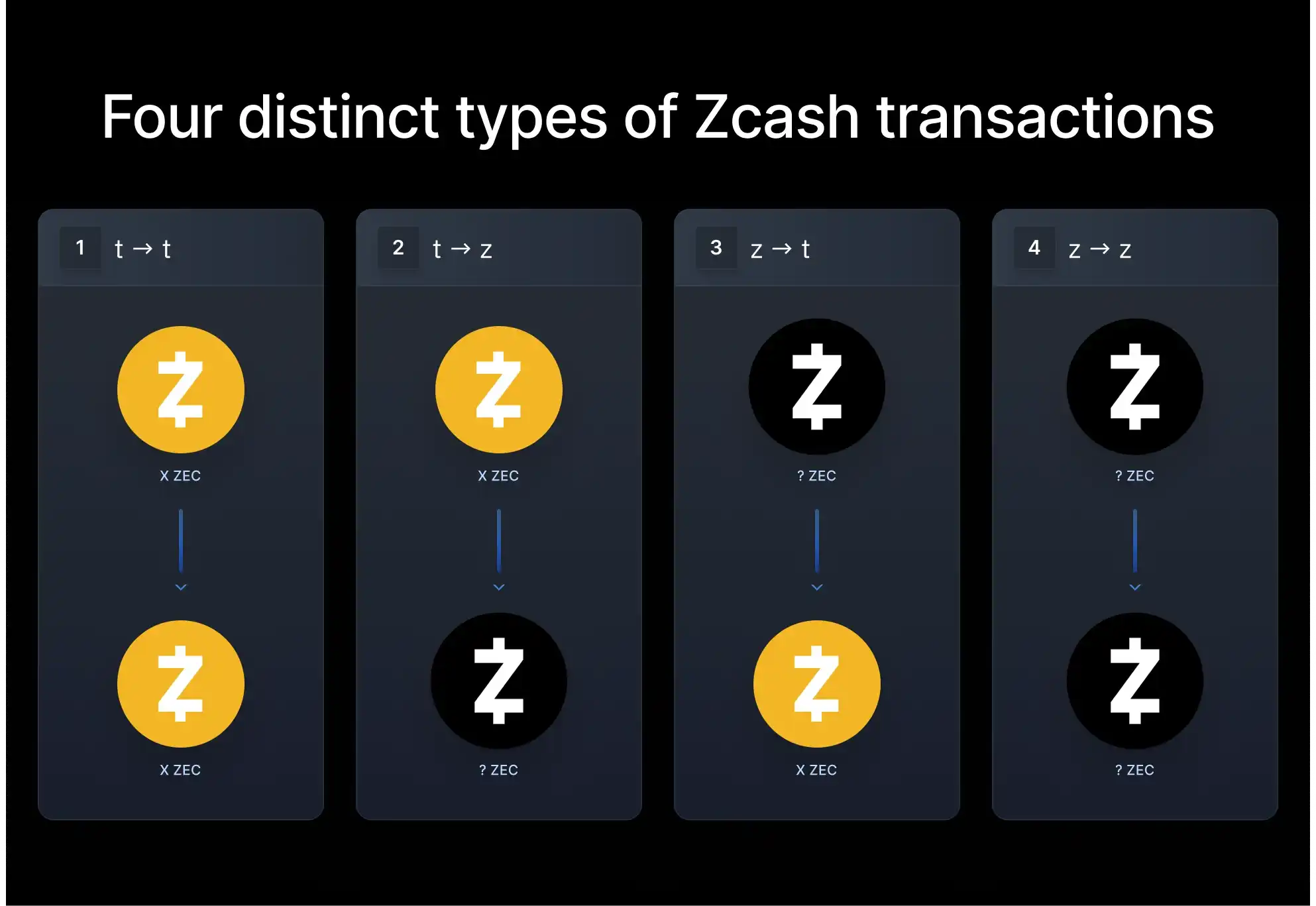
ZEC Transaction Types

Tracking Zcash with Arkham

Conventional wisdom holds that privacy coins are untraceable, but the reality of Zcash challenges this perception.

Currently, the blockchain data analytics platform Arkham has successfully labeled over half of Zcash's on-chain activity and identified the individuals and institutions behind a staggering $420 billion in transaction volume. This is a shocking statistic for a blockchain network specifically designed to hide transaction data. This tracing is possible fundamentally because most Zcash transactions still use the transparent mode. Furthermore, as gateways for funds entering and exiting the system, cryptocurrency exchanges, custodians, and major financial institutions typically retain and use transparent addresses for ease of fund transfer and management.

Of course, shielded transactions themselves remain highly opaque: z→z (shielded to shielded) transaction activity is untraceable; such shielded addresses are simply labeled as "SHIELDED" on the Arkham platform. However, the points where funds enter and leave the encrypted pool are often publicly visible, and this is the breakthrough point for data intelligence analysis.
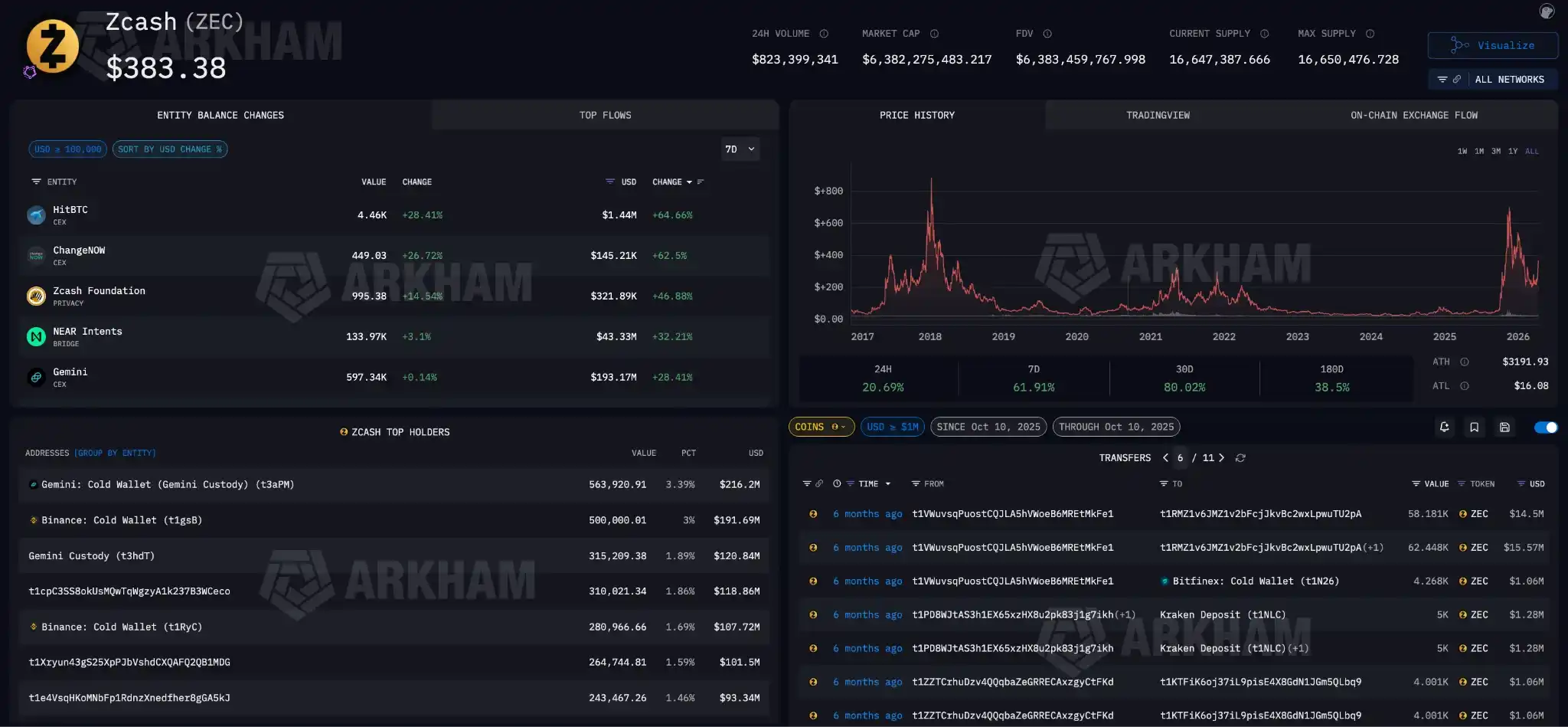
Zcash on Arkham

Case Study: The U.S. Government's Zcash Holdings

In Arkham's Zcash data records, one particularly notable entity is the United States Government. The U.S. government's wallet holds Zcash seized from Alexandre Cazes, the founder of the darknet marketplace AlphaBay, who was arrested in 2017. At the time of seizure, this Zcash was worth approximately $737,000. For eight years, this asset remained unmoved, and its market value has since doubled. The public can track this wallet's activity in real-time on the Arkham platform.

Case Study: A $6.6 Million Profit Trade

Arkham's data can also reveal large fund movements by individual traders. For example, an address purchased $4.49 million worth of Zcash during the market crash on October 10th. After holding for five and a half weeks, this address transferred the tokens to the Gemini exchange. Assuming the trader immediately sold upon depositing the tokens to the exchange, this trade would have generated a net profit of $6.6 million, meaning their initial investment more than doubled. On the Arkham platform, the complete history of this trade is clearly visible, including the specific times of each fund transfer and the name of the exchange where the tokens ultimately flowed.
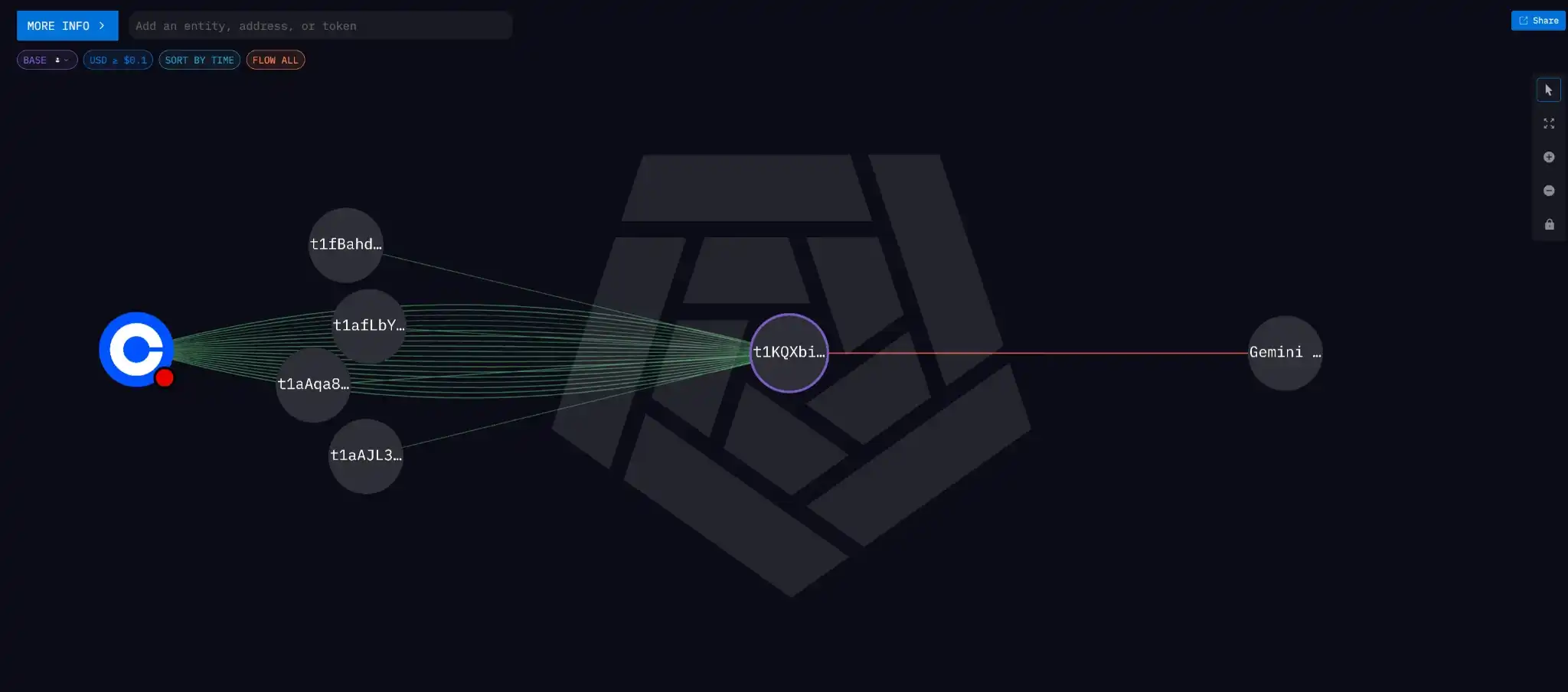
Arkham Visualization Tool

Conclusion

Zcash occupies a very unique position. It is one of the most technologically complex privacy tools in the cryptocurrency space, yet also one of the most misunderstood projects. People often assume that privacy coins are completely untraceable by default, but this is not accurate. In practice, the vast majority of Zcash fund flows pass through transparent addresses; to comply with regulations, major exchanges also default to using public, transparent addresses. It is precisely because of this that blockchain intelligence platforms like Arkham can successfully associate over $420 billion in transaction volume with known entities on a blockchain explicitly designed to resist data analysis.

This does not mean Zcash's privacy capabilities are flawed. Pure shielded transactions (z to z) remain cryptographically impregnable and unobservable. All of this shows that the actual degree of privacy protection Zcash can provide depends entirely on how users choose to use it.

For any user wishing to explore Zcash's on-chain activity firsthand, Arkham's extensive data coverage provides the most comprehensive information picture available today. Users can use it to track ZEC transaction history, entity identities, and account balances, set alerts for significant fund movements, and leverage Arkham's AI technology to deeply mine potential information across the entire blockchain network.


Perguntas relacionadas

QWhat are the two types of addresses in the Zcash network and how do they differ?

AZcash has two types of addresses: transparent addresses (t-addresses) and shielded addresses (z-addresses). Transparent addresses function exactly like Bitcoin addresses, with all transaction details (sender, receiver, amount) publicly visible on the blockchain. Shielded addresses exist within an encrypted pool, hiding the sender, receiver, and transaction amount from external observers.

QWhy can a significant portion of Zcash transactions be tracked on-chain, according to the article?

AMost Zcash transactions can be tracked because the majority of transaction activity is conducted using transparent addresses (t-addresses). Furthermore, key on-ramps and off-ramps like cryptocurrency exchanges and financial institutions default to using transparent addresses for compliance and operational reasons, creating visible entry and exit points for funds.

QWhat is the core cryptographic technology that enables Zcash's privacy features?

AThe core technology enabling Zcash's privacy features is a form of zero-knowledge proof called zk-SNARKs (Zero-Knowledge Succinct Non-Interactive Argument of Knowledge). This allows network nodes to verify that a transaction is valid without learning the sender, receiver, or transaction amount.

QWhich Zcash transaction type provides complete privacy, and what information remains public?

AThe z→z (shielded to shielded) transaction type provides complete privacy. In these transactions, the sender, receiver, and amount are all cryptographically hidden. The only information that remains publicly visible on the blockchain is the transaction fee.

QWhat key point does the article make about the effectiveness of Zcash's privacy protection?

AThe article concludes that the actual privacy protection Zcash provides is not inherent or default but is entirely dependent on how users choose to use it. While pure shielded (z→z) transactions are cryptographically secure and untraceable, the prevalence of transparent address usage means much of the network's activity is visible.

Leituras Relacionadas

Must-Watch Events Next Week|CLARITY Act Could Face Senate Vote; SpaceX, Circle to Report Earnings (8.3-8.9)

**Summary: Key Events and Developments to Watch (August 3-9)** The upcoming week is marked by significant financial disclosures, key legislative deadlines, and notable product updates. **Major Financial Events:** Several companies are scheduled to release their Q2 2026 earnings. American Bitcoin (ABTC) will report on August 3, followed by SpaceX and Hut 8 Mining Corp. on August 4, and Circle on August 5. Notably, a significant portion of SpaceX shares (up to 12% of total shares) will be unlocked on August 6 following their earnings release. **Key Legislative Deadline:** The U.S. Senate faces an August 7 deadline to secure 60 votes for the CLARITY Act, a bipartisan bill aiming to establish a federal regulatory framework for cryptocurrencies. The Senate may hold a full vote on the bill during the week. **Economic Data:** The U.S. July Non-Farm Payrolls report will be released on August 7, providing crucial labor market data. **Technology & Product Updates:** * **Shutdowns:** DeFi portfolio tracker Zapper and wallet app Ctrl Wallet will cease operations on August 3. * **Upgrades:** LayerZero will deprecate its v1 relayers on August 3. XRP Ledger's new version 3.3.0, featuring five new functions, is expected next week. * **AI:** Elon Musk announced that the advanced Grok 4.6 AI model is set for release around August 7. * **Bitcoin:** The BIP-110 forced signaling for a potential Bitcoin network change is scheduled to begin around August 8. **Other Notable Events:** Chinese robotics firm Unitree Tech has set its preliminary price inquiry for its IPO for August 5. South Korean exchange Upbit will delist AQT and AERGO tokens on August 3.

marsbitHá 41m

Must-Watch Events Next Week|CLARITY Act Could Face Senate Vote; SpaceX, Circle to Report Earnings (8.3-8.9)

marsbitHá 41m

Stocks Are Plummeting More Sharply Than Cryptocurrencies. Where Has the Money Gone?

Stock Markets Plunge Deeper Than Cryptocurrencies: Where Did the Money Go? In late July, Seoul's Kospi index triggered circuit breakers for two consecutive days, plummeting over 40% from its June high. The collapse was led by heavyweight stocks like SK Hynix, whose record profits still disappointed investors, and devastating leveraged ETFs, with one major product losing over 83% of its value. This signaled a global, forced deleveraging targeting the most crowded trades. Interestingly, while stocks exhibited extreme volatility akin to crypto markets, Bitcoin rose nearly 15% in July after a prior steep drop. Analysis shows the money fleeing equities did not flow into Bitcoin. Instead, Bitcoin had already absorbed its sell-off in May-June, when U.S. spot Bitcoin ETFs saw historic outflows. The true safe-haven beneficiary was gold, whose price rose over 20% year-on-year, highlighting a decoupling between Bitcoin and gold as "digital gold." The sell-off was a targeted unwinding of leveraged positions in tech and semiconductors, accelerated by broker-dealer risk management and shifts in the AI narrative, including new competition from Chinese memory chipmakers. The retreat path was clear: from high-valuation tech stocks to cash and U.S. Treasuries, then to gold. For Bitcoin to attract sustained institutional inflows, conditions like eased global liquidity pressure, a "soft-landing" Fed rate cut, and U.S. regulatory clarity via legislation like the stalled CLARITY Act are needed. Currently, Bitcoin is not a safe haven but an already-cleared asset. Its low correlation with tech stocks, however, makes it a potential diversification play for institutional portfolios once the storm passes. The money isn't here yet, but the positioning is underway.

marsbitHá 41m

Stocks Are Plummeting More Sharply Than Cryptocurrencies. Where Has the Money Gone?

marsbitHá 41m

In Conversation with Ray Dalio: We Are Currently in an AI Bubble, with 1% of My Portfolio in Bitcoin

Ray Dalio, founder of Bridgewater Associates, warns in an interview that the current AI boom shows classic bubble characteristics, which could lead to significant economic downturns as seen in past cycles like 1929 or 2000. He explains that speculative enthusiasm, fueled by debt and overvaluation, often precedes a crash when rising rates or taxation force asset sales, causing widespread losses and recession. Dalio also outlines his "Big Cycle" theory, describing an approximate 80-year pattern where widening wealth gaps, massive government deficits, and shifting geopolitical power (like China's rise) create internal conflict and global instability. He emphasizes that we are in a late-cycle, transitional phase where traditional powers like the US and UK face decline. For personal wealth protection, Dalio advises diversification beyond cash into assets like stocks, bonds, real estate, and particularly gold, which he prefers over Bitcoin. While he holds about 1% of his portfolio in Bitcoin as a non-printable hard asset, he views gold as more secure from technological or governmental threats. Regarding AI's impact, Dalio believes it will disproportionately benefit capital owners, worsening inequality by replacing both physical and cognitive labor. He suggests that human intuition and emotional intelligence, combined with AI, will be key for future workers. On taxation, Dalio argues that wealth taxes are impractical and risk triggering asset sell-offs, reducing productive investment. He points to the UK as a cautionary example of debt, low productivity, and political strife. Geopolitically, Dalio foresees a more regionalized world, with the US showing weakness in prolonged conflicts like with Iran, akin to past imperial declines. The ideal outcome, he suggests, is coexisting powerful blocs (e.g., Americas, China-Asia Pacific) without major war.

marsbitHá 4h

In Conversation with Ray Dalio: We Are Currently in an AI Bubble, with 1% of My Portfolio in Bitcoin

marsbitHá 4h

Daily 7.2 Trillion KRW: Foreign Capital's Record Net Buying on Friday! Wall Street Says Headwinds for Korean Stock Fund Flows Have Subsided

South Korean stock market sees a dramatic shift in fund flows. On July 31, foreign investors made a record net purchase of approximately KRW 7.2 trillion in KOSPI stocks, marking a fundamental reversal from the persistent large-scale net outflows seen in previous months. This contributed to a significant narrowing of foreign net selling in July to KRW 9.8 trillion, down sharply from KRW 48.4 trillion in June and KRW 44.5 trillion in May. Simultaneously, domestic institutional pressure eased. South Korean pension funds and asset managers turned to a net buying position in July, purchasing KRW 1.0 trillion worth of KOSPI shares, contrasting with net sales in May and June. Market volatility is expected to be dampened by new financial regulations. Effective July 31, the Financial Services Commission tightened access for retail investors to single-stock leveraged ETFs by raising the minimum cash deposit requirement. Trading volumes for these products subsequently dropped to about 50% of their monthly average. Citigroup Research maintains its year-end KOSPI target of 10,000 points. The firm cites several supportive factors: the substantial easing of headwinds from capital outflows, a robust fundamental outlook for the semiconductor sector, historically low market valuations, strong economic fundamentals, and the potential for policy support from financial authorities if needed.

marsbitHá 4h

Daily 7.2 Trillion KRW: Foreign Capital's Record Net Buying on Friday! Wall Street Says Headwinds for Korean Stock Fund Flows Have Subsided

marsbitHá 4h

Trading

Spot
活动图片




