Oil Prices Are Approaching a Tipping Point, What Will Happen in Mid-April?

marsbitPublicado em 2026-04-05Última atualização em 2026-04-05

Resumo

Oil prices are approaching a critical inflection point, with mid-April identified as a key threshold. The ongoing disruption in the Strait of Hormuz has halted oil tanker traffic, resulting in a production loss of nearly 11 million barrels per day from key producers including Iraq, Kuwait, the UAE, Saudi Arabia, and Bahrain. The release of 400 million barrels from strategic petroleum reserves (SPR) has provided a temporary buffer, delaying immediate price spikes but not resolving the structural supply deficit. If the conflict ends before mid-April, Brent crude could retreat to the $80–90 range. However, if disruptions persist beyond mid-April, the market faces a cumulative inventory drawdown of 210 million barrels or more, pushing prices toward $110–120 or even demand-destructive levels above $200. The conflict has shifted from a cycle of escalation and de-escalation to a test of market endurance. Iran appears incentivized to prolong the situation until the market reaches a breaking point, strengthening its negotiating position. Even if resolved soon, supply losses have already altered long-term oil balances, suggesting a structurally higher price floor ahead.

Editor's Note: This article argues that what truly drives oil prices is not just whether the conflict ends, but "when the tipping point is crossed".

In the Iran conflict, now in its fourth week, the oil market is experiencing a classic case of "time-based pricing." The release of strategic reserves has delayed the impact but cannot eliminate the supply gap; disruptions in tanker transport and lagging production recovery are causing inventory pressures to accumulate into the future. Once the key node in mid-April is passed, the pricing mechanism will shift from "buffered volatility" to "re-pricing dominated by the gap."

More notably, the structure of the game itself is changing. The conflict no longer follows an "escalate to de-escalate" path but has turned into an endurance test against the market's tipping point. Whoever can hold out until the supply-demand imbalance is priced in by the market gains the initiative in negotiations. This means that even if the conflict ends shortly, oil prices will struggle to return to their previous range. The supply losses occurring now are reshaping the global oil balance for the foreseeable future.

The original text follows:

In this article, I will break down the possible scenarios. With the Iran conflict now in its fourth week, how will this situation affect the oil market?

On March 9, we published a public article titled "My Latest Assessment of the Oil and Gas Market Under the Iran Conflict," which stated:

Below is the impact on oil prices under different scenarios ("barrels lost" already includes the time required for production recovery):

Scenario 1: Tanker transport resumes the next day

→ Brent crude annual average will be in the high $70s to low $80s range (approx. 210 million barrels lost)

Scenario 2: Tanker transport resumes by March 15

→ Brent annual average will be in the mid-to-high $80s (approx. 290 million barrels lost)

Scenario 3: Tanker transport resumes by March 22

→ Brent annual average will be in the low $90s (approx. 370 million barrels lost)

Scenario 4: Tanker transport resumes by March 29

→ Brent annual average will be in the mid-to-high $90s (approx. 450 million barrels lost)

If tanker transport cannot return to normal by March 29, the situation the oil market will face is almost unthinkable. The only way out would be forced demand contraction, pushing prices to extreme levels.

Shortly after the report was published, the International Energy Agency (IEA) announced a coordinated release of a total of 400 million barrels from global strategic petroleum reserves (SPR). This will somewhat mitigate the impact of the supply loss. But as we pointed out in a subsequent article, "IEA's Coordinated SPR Release is the Biggest Gift for the Bulls":

From a trading perspective, traders are in no rush to push oil prices higher until this "cushion" is depleted. The concentrated SPR release does ease short-term supply anxiety, but it is only a temporary solution. The market will remain tense; as long as tanker transport remains disrupted, oil prices will gradually rise.

On the other hand, if the situation eases quickly—for example, with an immediate ceasefire or agreement—oil prices will fall rapidly. For instance, if a peace deal is reached before March 15, global inventories would see an net increase of 110 million barrels (400 million released - 290 million lost).

This could push Brent prices back down to the mid-$70s range.

Conversely, without a peace deal and with the supply disruption lasting until the end of March, global inventories would see a net reduction of 50 million barrels, and the gap would widen by about 80 million barrels for each additional week.

Therefore, the SPR's role is merely to "buy time" and does not solve the core problem. Tanker transport must return to normal. However, it does prevent a catastrophic price spike in the short term, thereby avoiding a large-scale demand collapse.

Fast forward to now, we have entered the "March 29 scenario" set at the beginning of the month. Next, we assess the oil market's direction based on the latest facts.

Facts

Total production shutdowns from Saudi Arabia, UAE, Kuwait, Iraq, and Bahrain have reached 10.98 million barrels per day:

Iraq: -3.6 million bpd

Kuwait: -2.35 million bpd

UAE: -1.8 million bpd

Saudi Arabia: -3.05 million bpd

Bahrain: -0.18 million bpd

Saudi Arabia has maxed out the capacity of its East-West pipeline, currently exporting about 4 million bpd via the Red Sea. The UAE is also using bypass transport via the Abu Dhabi pipeline (Habshan-Fujairah), whose capacity of about 1.8 million bpd is also at its limit. Tanker traffic through the Strait of Hormuz remains completely interrupted. In fact, even if the war ended tomorrow, it would take months to restore production and rebuild normal transport.

Scenario Projections

I will outline three possible paths:

1) The war ends this week, transport resumes by the weekend

2) The war ends in mid-April

3) The war ends at the end of April

It is important to note that the release of 400 million barrels of SPR, compared to our initial assessment on March 9, has bought the market more time. The oil price scenarios below already reflect this change.

Scenario 1: Ends this week

Impact on global inventory: -50 million barrels (SPR already factored in)

Impact on Brent: Short-term pullback to low $80s, annual average in the mid-to-high $80s

Scenario 2: Ends in mid-April

Impact on global inventory: -210 million barrels

Impact on Brent: Short-term pullback to low $90s, annual average in the mid-to-high $90s

Scenario 3: Ends at the end of April

Impact on global inventory: -370 million barrels

Impact on Brent: Short-term spike to the $110 range, annual average at $110–$120

Key Inflection Point: Mid-April

For the oil market, there is a clear "tipping point." The current market consensus expects the conflict to end before mid-April, and this expectation is crucial for oil price pricing.

Oil prices are a product of "marginal pricing." As long as the market believes supply is "just about sufficient," panic will not ensue. This is precisely the current state of the oil market—a lack of panic.

Policy statements from the Trump administration, the relaxation of sanctions on Iranian and Russian crude, and the SPR release have collectively suppressed oil prices.

But once this tipping point is crossed, these factors will become ineffective.
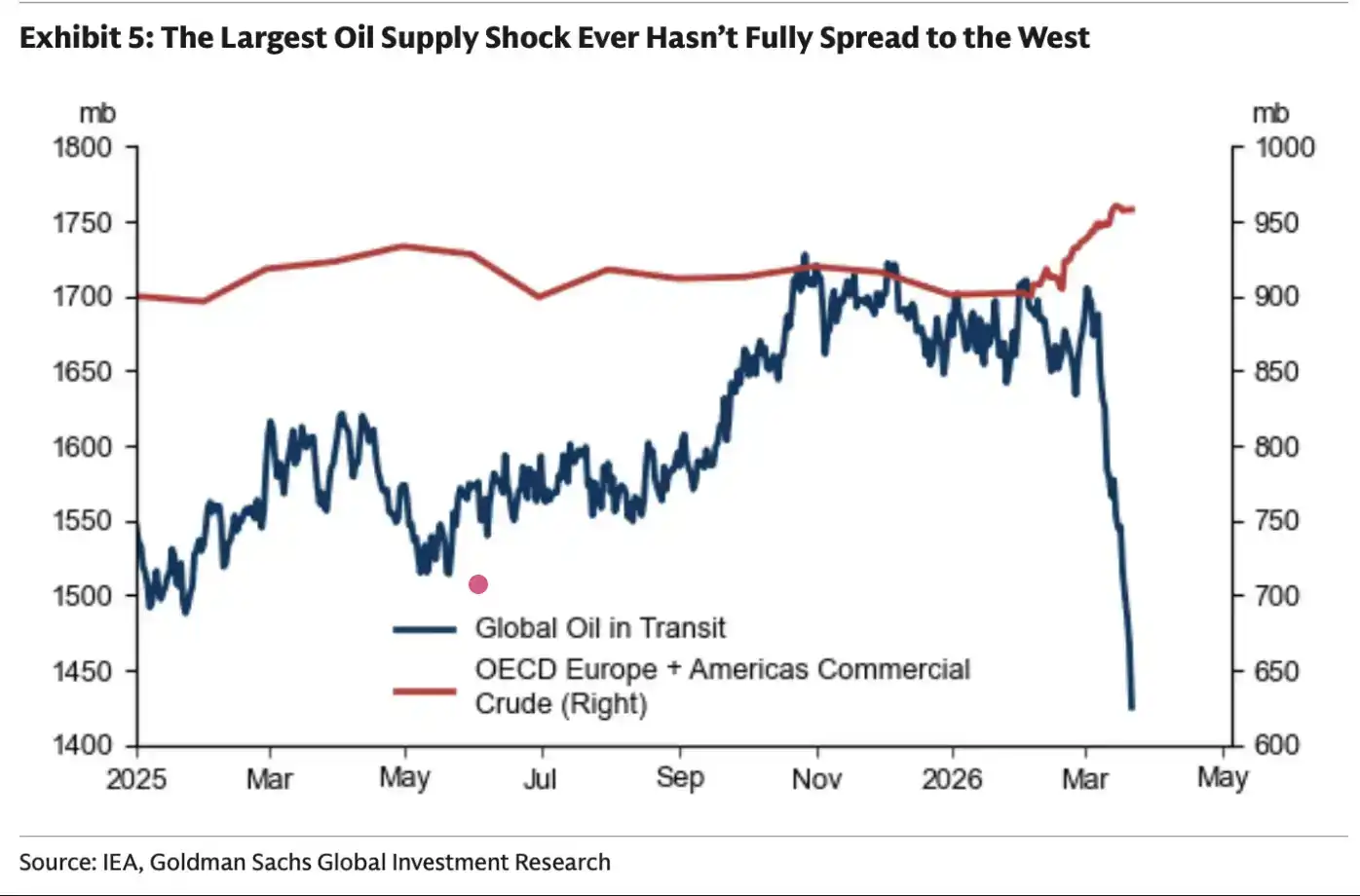
Currently, the evaporation effect of global "oil in transit" has not yet fully transmitted to onshore inventories. But our judgment is that by mid-April, this impact will become fully evident.

If the conflict remains unresolved by mid-April, the International Energy Agency (IEA) will have to coordinate another release of approximately 400 million barrels of strategic petroleum reserves (SPR). Otherwise, oil prices will surge into the "demand destruction" range ($200+).

Long-Term Impact

In Energy Aspect's latest weekly report, their estimate of the market's cumulative supply loss is about 930 million barrels. Among this, the cumulative production loss from May to December is about 340 million barrels.

This assessment is significantly more aggressive than ours. In our inventory sensitivity analysis, we did not fully account for the reality that countries like Iraq and Kuwait might need 3 to 4 months to restore production capacity. This means our previous estimates might have been too conservative.

For Goldman Sachs, the conclusion is straightforward: the longer the conflict lasts, the longer high oil prices will persist.
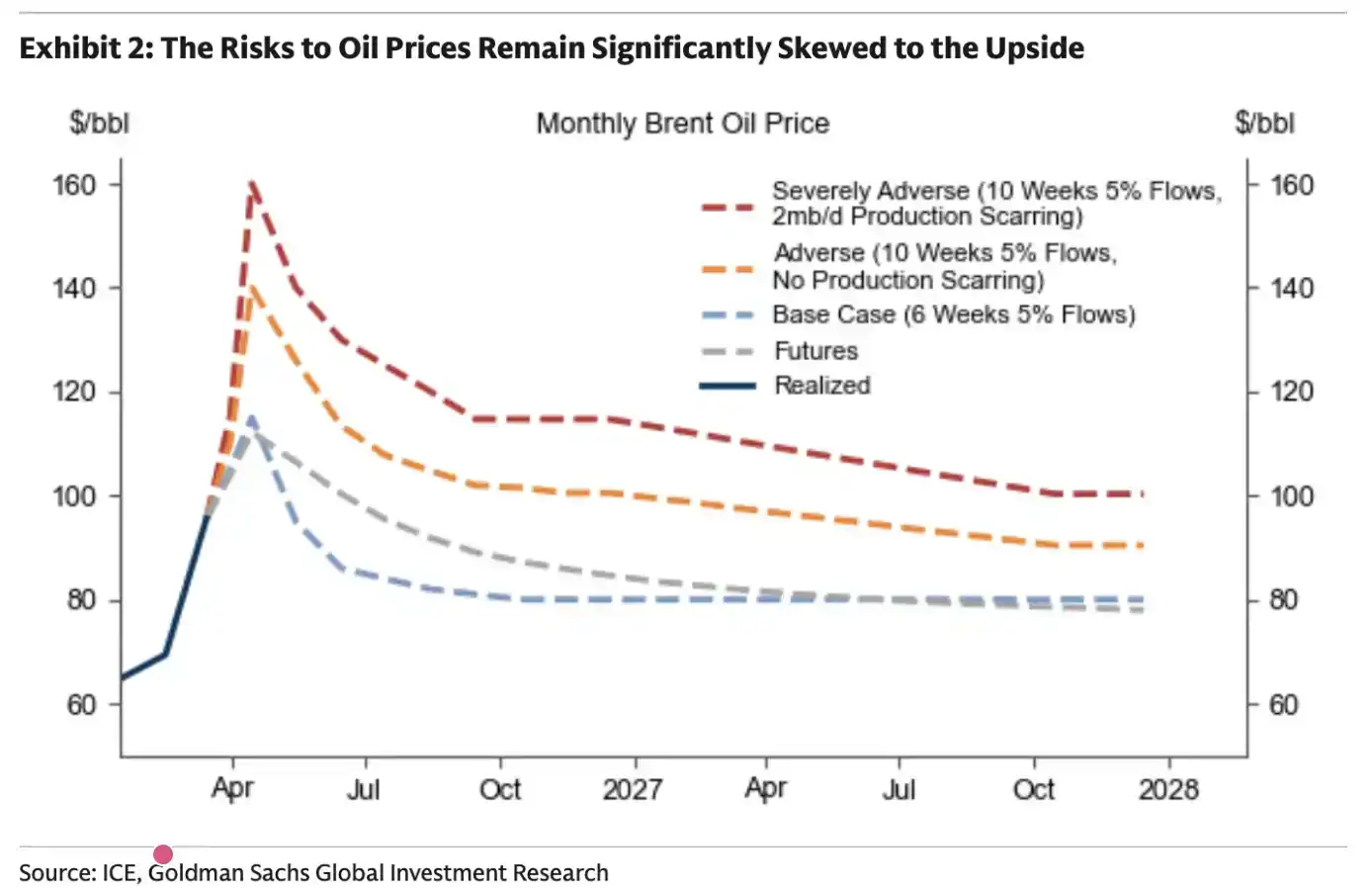
Under the above scenarios, Goldman Sachs also provided a hypothesis: what the market would look like if the conflict lasted another 10 weeks. Their judgment is largely consistent with our earlier projections.

In essence, the oil market has a "tipping point." Once this line is crossed, there is no turning back.

Readers should be prepared for expectations: future oil prices will be structurally higher. Even if the war ends this week, the supply losses that have already occurred will have a substantive impact on the future global oil supply-demand balance.

How long will it last?

Until now, I have avoided making judgments on "when this conflict will end." On one hand, I don't want to "tempt fate," and on the other hand, it is truly unpredictable.

But one thing is clear: this time is different from past conflicts. The common strategy of "escalate to de-escalate" is not evident this time.

Retaliatory strikes occurred without warning; Iran's strike range also seems to have expanded beyond Israel to include Gulf countries. It was this pattern of response that made me realize from the beginning—this time, it's different.
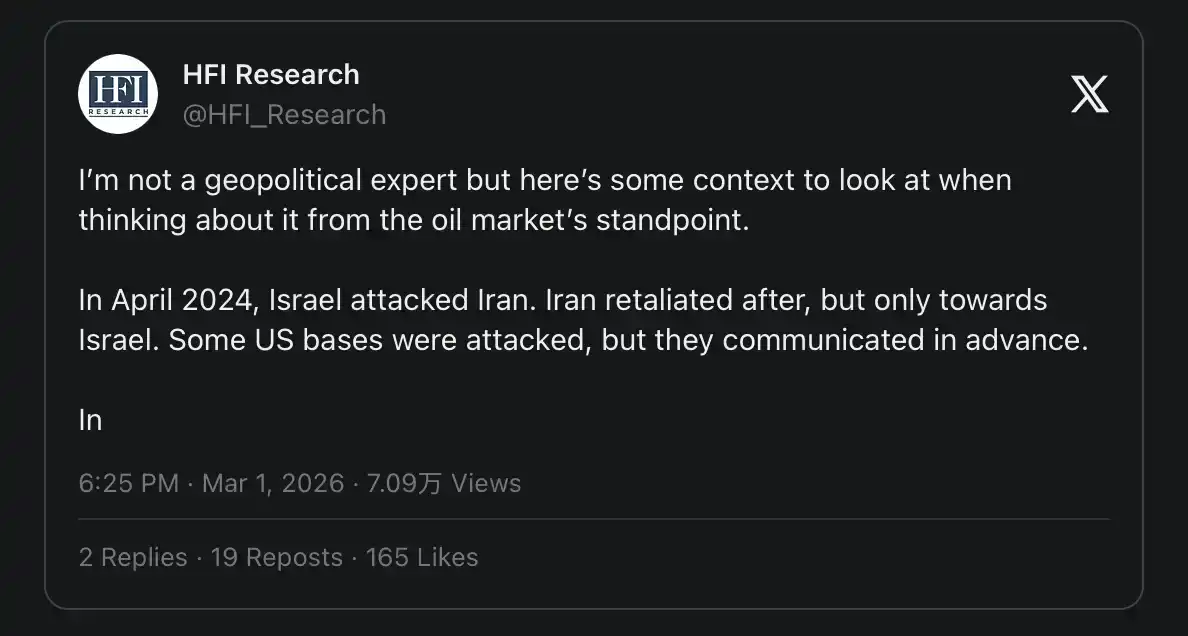
As the conflict has lasted nearly four weeks, I am increasingly concerned: with an agreement迟迟无法达成, each day of delay significantly reduces the probability of reaching a deal. As we analyzed in "Time is Running Out," Iran understands the operating logic of the oil market very well. It only needs to wait for the market to hit that "tipping point" to secure the maximum concessions from the US in negotiations. From a tactical perspective, reaching an agreement now offers no advantage. The Strait of Hormuz card has been played and cannot be easily reused in the future.

For the Gulf countries, if the current Iranian regime is not overthrown, this situation of being "strangled" will recur in the future. Even if some kind of "toll" mechanism is established, this uncertainty would still be hard to accept.

Therefore, logically, the initiative does not lie with the US but with Iran. In this case, Iran has more incentive to push the situation towards the oil market's "tipping point" to test US endurance. All it needs to do is "hold on" for another three weeks, until the market begins to crack.

However, it must be emphasized that I am not a geopolitical expert and have no absolute certainty about such judgments. What I can provide is an assessment of the current situation based on fundamental analysis.


Perguntas relacionadas

QWhat is the critical point in the oil market mentioned in the article, and why is mid-April significant?

AThe critical point refers to the threshold where the oil market shifts from 'buffered volatility' to a 'gap-driven repricing.' Mid-April is significant because, by that time, the evaporation effect of global 'crude oil in transit' will fully manifest in onshore inventories. If the conflict is not resolved by then, the market could face severe supply shortages, potentially driving prices to extreme levels unless another strategic petroleum reserve (SPR) release is coordinated.

QHow does the release of strategic petroleum reserves (SPR) affect the oil market according to the article?

AThe release of SPRs, such as the 4 billion barrels coordinated by the IEA, acts as a temporary buffer that delays the impact of supply disruptions. It prevents immediate catastrophic price spikes and demand destruction but does not solve the core issue of supply gaps. Once the SPR buffer is depleted, the market must confront the underlying supply deficit, leading to potential price surges if normal tanker transport is not restored.

QWhat are the three scenarios for the conflict's resolution and their respective impacts on Brent crude prices?

A1) If the conflict ends this week with transport restored by the weekend: Brent crude would fall to the low $80s short-term, with an annual average in the mid-to-high $80s. 2) If it ends in mid-April: Short-term prices would drop to the low $90s, with an annual average in the mid-to-high $90s. 3) If it ends in late April: Short-term prices could spike to around $110, with an annual average of $110-$120.

QWhy does the article suggest that Iran has an incentive to push the conflict towards the oil market's critical point?

AIran understands the oil market's mechanics and recognizes that reaching the critical point (where supply gaps become acute) would strengthen its negotiating position. By prolonging the conflict until mid-April, Iran could force the U.S. into making greater concessions, as the U.S. and its allies would face severe economic pressure from soaring oil prices and supply shortages.

QWhat long-term impact does the article predict for global oil supply and demand, even if the conflict ends soon?

AEven if the conflict ends immediately, the supply losses already sustained (e.g., prolonged production recovery times in countries like Iraq and Kuwait) will structurally elevate oil prices and reshape global oil balance. The cumulative supply loss, estimated at up to 9.3 billion barrels by some analysts, implies that high oil prices will persist longer, affecting future供需平衡.

Leituras Relacionadas

Claude Opus 4.8 Finds a $4.5 Billion Bug: The AI Era is Mass-Producing Hackers

A researcher discovered a critical "infinite mint" vulnerability in the Zcash cryptocurrency's Orchard protocol using Claude Opus 4.8, leading to a swift fix but also a 50% market drop, erasing billions in value. This incident highlights a new era where powerful, accessible AI models are dramatically lowering the barrier to finding software vulnerabilities. Previously, the security community feared specialized models like Claude Mythos Preview, capable of finding decades-old zero-day exploits. The Zcash case, however, involved a publicly available, general-purpose model. This shift makes advanced security auditing—and attack capabilities—accessible to far more people, not just experts. The mass democratization of vulnerability discovery brings a dual challenge: a flood of low-quality, AI-generated false reports that overwhelm maintainers, and the real, rapid uncovering of deep, dangerous bugs. Open-source projects, often understaffed and unfunded, are particularly vulnerable to this "attention DDoS." The article cites examples like curl shutting down its bug bounty program due to the unsustainable workload. Our perceived digital safety has often been luck, relying on the high cost and effort required to find deeply hidden flaws in complex systems, as seen with historical vulnerabilities like Heartbleed or Baron Samedit. AI changes this cost structure, effectively "mass-producing flashlights" to illuminate every corner of our codebase. While large companies operate extensive security chains involving external white-hat hackers and massive defensive operations, the global cybersecurity workforce faces a severe shortage, especially of experienced personnel capable of analyzing complex threats and coordinating fixes. The core dilemma emerges: AI makes *finding* bugs cheap and scalable, but *fixing* them remains a slow, expensive, and human-intensive process. The article concludes that AI won't destroy the internet but acts as a bright light, revealing that our digital existence is not inherently secure but is precariously maintained by ongoing human effort. The true cost in the AI era may not be discovery, but whether there will be enough people left willing and able to do the hard work of repair.

marsbitHá 2m

Claude Opus 4.8 Finds a $4.5 Billion Bug: The AI Era is Mass-Producing Hackers

marsbitHá 2m

Codex Goal Mode Usage Guide: How to Make AI Continuously Pursue a Specific Objective

"Codex Goal Mode: How to Make AI Work Continuously Toward a Specific Goal" OpenAI's Codex "goal mode" (/goal) transforms the AI from a reactive code assistant into a proactive execution agent capable of working autonomously for hours or even days to achieve a defined objective. To maximize its effectiveness, follow these key principles: 1. **Define Clear, Verifiable Exit Criteria:** The goal prompt should be a concise, measurable success condition, not a lengthy specification. Use quantifiable metrics like "reduce build time by 30%" or "achieve 100% test parity." 2. **Provide Initial Guidance and Tools:** Direct Codex toward likely problem areas and specify available tools (e.g., browsers, testing environments) to prevent it from exploring unproductive paths. 3. **Enable Progress Measurement:** Equip Codex with ways to track advancement, such as creating comparison tools for visual tasks or evaluation sets, ensuring it can gauge its own progress. 4. **Use a Realistic Execution Environment:** For tasks like performance optimization, provide access to environments that closely mimic production (e.g., similar configs, databases) to yield valid results. 5. **Be Cautious with Visual Goals:** Avoid vague "pixel-perfect" instructions. Instead, supplement visual references with functional checklists or design system specifications to prevent Codex from obsessing over minor details. 6. **Implement Progress Tracking:** For long-running tasks, have Codex commit code to draft PRs, update progress documents, or send Slack updates to maintain visibility into its work. 7. **Review and Consolidate Results:** Once the goal is met, instruct Codex to review its work, clean up ineffective experimental code, and reflect on what strategies succeeded or failed. Ultimately, using goal mode shifts the developer's role from writing prompts to managing a persistent engineering agent—defining objectives, establishing metrics, configuring environments, and conducting final reviews.

marsbitHá 1h

Codex Goal Mode Usage Guide: How to Make AI Continuously Pursue a Specific Objective

marsbitHá 1h

From Ethereum to AI's 'CROPS': What Exactly Is This 'Slow Variable' That Vitalik Has Repeatedly Emphasized?

Recently, Vitalik Buterin has frequently emphasized the concept of "CROPS," first outlined in the Ethereum Foundation's March mandate as core principles guiding its focus: Censorship Resistance, Capture Resistance, Open Source, Privacy, and Security. CROPS represents Ethereum's commitment to providing foundational capabilities for user sovereignty—enabling asset ownership, identity expression, and coordination without reliance on centralized platforms or surrendering ultimate control. This framework is gaining new urgency with the rise of AI, particularly AI agents managing digital assets and automating transactions. While AI offers convenience, it risks centralizing user data, intent, and control if dependent on opaque, centralized services. Vitalik argues for "CROPS AI"—AI that is open, privacy-preserving, secure, and capable of local execution to maintain user agency. He highlights convergence between "CROPS Ethereum access layers" and "CROPS AI," such as using zero-knowledge proofs for private remote LLM calls and Ethereum RPC reads, ensuring users can access services without exposing sensitive information. Ultimately, CROPS is not just an abstract ideal but a practical guide for Ethereum's development and AI integration. It addresses the critical long-term question: as digital systems grow more powerful, how can users retain control over their privacy, assets, and autonomy? In an AI-driven era, these principles may define Ethereum's enduring value—prioritizing verifiable, secure, and user-centric design over short-term optimizations like speed and cost alone.

marsbitHá 1h

From Ethereum to AI's 'CROPS': What Exactly Is This 'Slow Variable' That Vitalik Has Repeatedly Emphasized?

marsbitHá 1h

Trading

Spot
Futuros
活动图片




