Numerical Analysis of Asset Performance Since 2026: Bitcoin Performs Worst, Crude Oil Best

marsbitPublicado em 2026-03-16Última atualização em 2026-03-16

Resumo

Analysis of asset performance from 2026 to date shows crude oil as the top performer, with prices surging to $119.48 due to escalating Middle East tensions and supply shortages. In contrast, Bitcoin has been the worst-performing asset, declining significantly and finding recent support between $65,000 and $75,000. Cryptocurrency's correlation with the S&P 500 remains moderately positive (0.49), while its correlation with gold has turned moderately negative (-0.69), suggesting a potential decoupling from traditional risk assets. For context, Bitcoin was the best-performing asset in 2024 with a 129% return, significantly outperforming gold (32.2%) and the S&P 500 (28.3%). Over a 10-year period, Bitcoin's growth reached 26,931.1%, though it exhibited high volatility, with prices ranging from extreme lows to highs above $100,000.

Author: Coingecko

Compiled by: Felix, PANews

After a turbulent end to 2025, Bitcoin continued to fluctuate and decline in early 2026. Meanwhile, geopolitical and macroeconomic events have driven up the prices of gold, silver, and recently, crude oil. As cryptocurrencies continue to gain mainstream acceptance as an asset class, many Wall Street investors may be experiencing their first crypto bear market. Coingecko examines the performance of cryptocurrencies relative to other traditional asset classes at the beginning of 2026.

With the outbreak of war in Iran, crude oil prices have surged faster than all other asset classes in 2026.
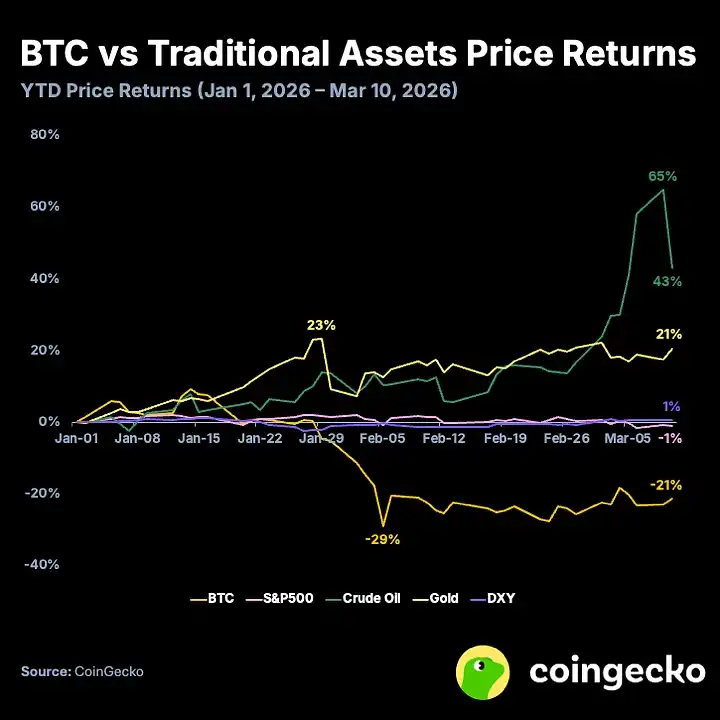
Since the beginning of 2026, crude oil prices have been rising slowly due to escalating tensions in the Middle East and supply shortages in key markets. However, the situation reached a peak with the latest attacks on Iran by the United States and Israel on February 28. Crude oil prices reached a high of $119.48 during intraday trading, compared to a price of just $57.41 at the start of the year.

Meanwhile, Bitcoin's price continued to decline in 2026, making it the worst-performing asset class so far. However, since early March, Bitcoin appears to have found support between $65,000 and $75,000, after hitting a low of $62,800 in early February. U.S. spot Bitcoin ETFs have seen strong inflows since the end of February (net inflows of $1.9 billion since February 20, but still outflows of $828.9 million year-to-date), while Strategy has maintained its consistent buying pace, investing $5.6 billion since the beginning of the year.
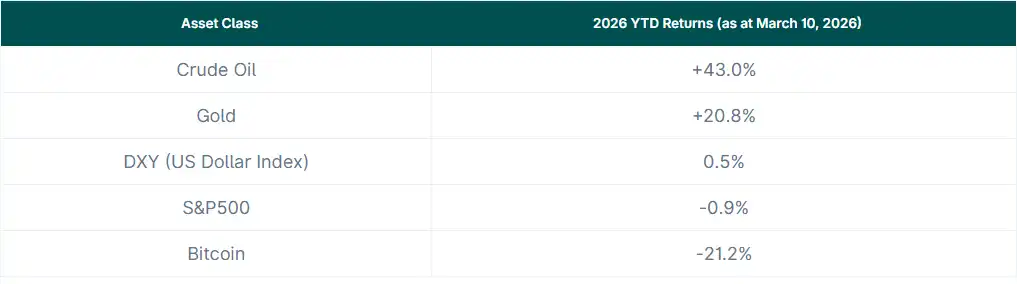
Year-to-date in 2026, cryptocurrencies have shown only moderate correlation with the S&P 500 and gold, perhaps a signal that the asset class is finally beginning to "decouple."
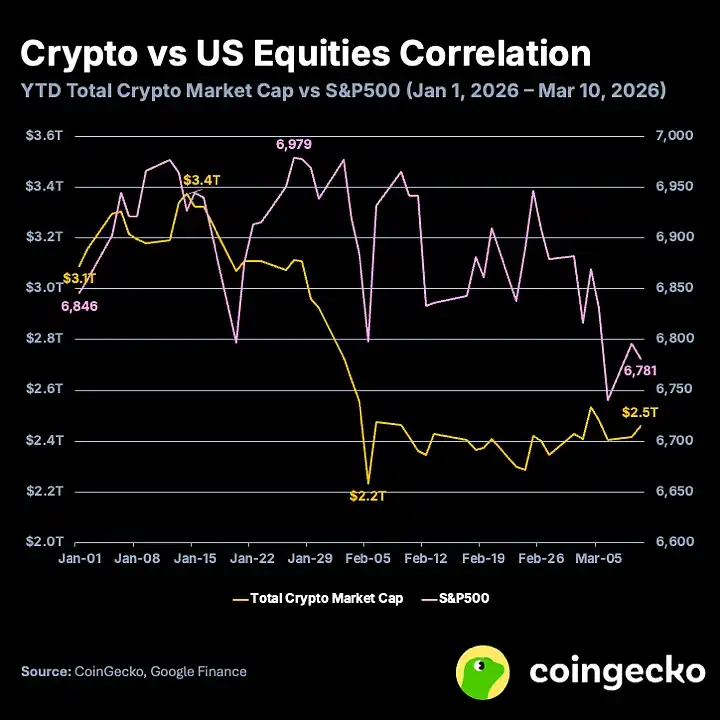
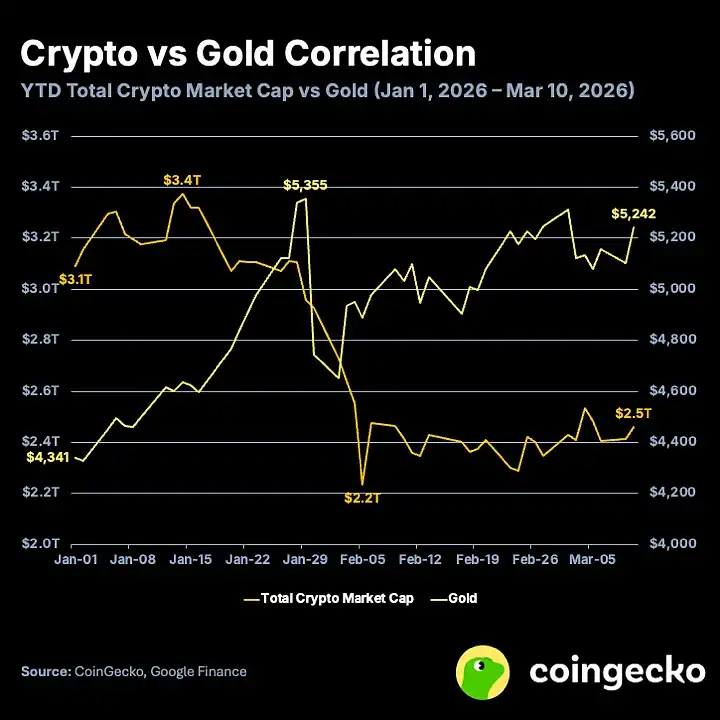
Since the beginning of the year, the correlation between the total cryptocurrency market capitalization and the S&P 500 index has been 0.49, indicating a moderate positive correlation, similar to the situation in 2025 (annual correlation of 0.46 that year). On the other hand, the year-to-date correlation between cryptocurrencies and gold has turned to -0.69, indicating a moderate negative correlation. In 2025, the correlation between cryptocurrencies and gold was only 0.19, showing a weak or no correlation. Overall, as an asset class, cryptocurrencies are shedding their long-held perception as purely risk assets as they decouple from U.S. stocks.

U.S. stocks, represented by the S&P 500 index, have faced significant headwinds in 2026 as well. Despite increasing investment in the AI sector and generally strong economic and earnings data, the index has actually declined since the beginning of the year. Geopolitical tensions have undoubtedly played a role, but ongoing uncertainty about the impact of AI on the future economy and labor force has also triggered a "SaaS apocalypse." Since the beginning of the year, the market capitalization of listed software and SaaS companies has evaporated by $1.3 trillion to $1.5 trillion, accompanied by a sharp decline in forward P/E ratios and revenue multiples.

Furthermore, gold has continued its strong momentum since 2024, with a year-to-date increase of over 20%. Gold is typically seen as a solid store of value and a safe-haven asset, but due to soaring prices, it is currently exhibiting higher volatility. Continued geopolitical and macroeconomic pressures are driving its upward momentum, with retail traders and sovereign nations buying in droves.

Related reading: BTC Options Insight: Why is March 20 a key turning point for volatility?

Performance in 2026 is starkly different from 2024. For reference, below is the performance of Bitcoin versus other asset classes in 2024 (published in December 2024).

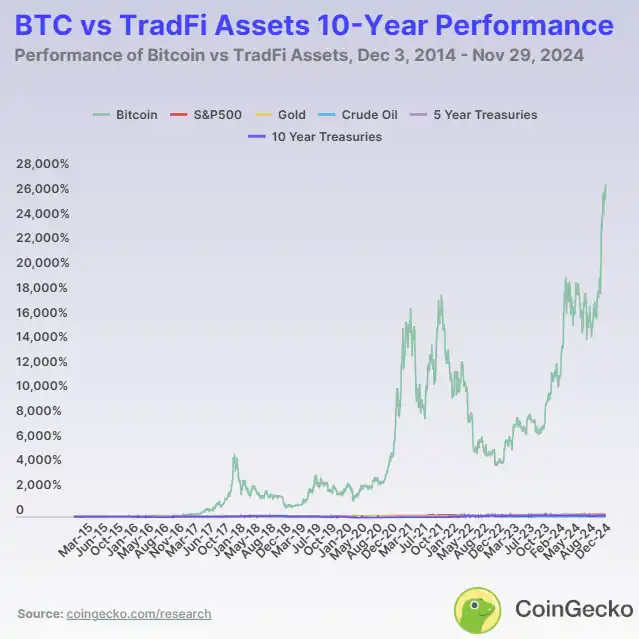
Dubbed "magic internet money," Bitcoin may have become a legitimate investment asset alongside traditional assets like stocks, commodities, and bonds. Looking at 10-year returns, Bitcoin's impressive yield of 26,931.1% is astounding. Imagine $100 invested in 2014 being worth $26,931.1 today. While these numbers are staggering, it is equally important to examine its performance relative to other assets over both short and long terms.

Which asset performed best across year-to-date, 1-year, 3-year, 5-year, and 10-year time spans?
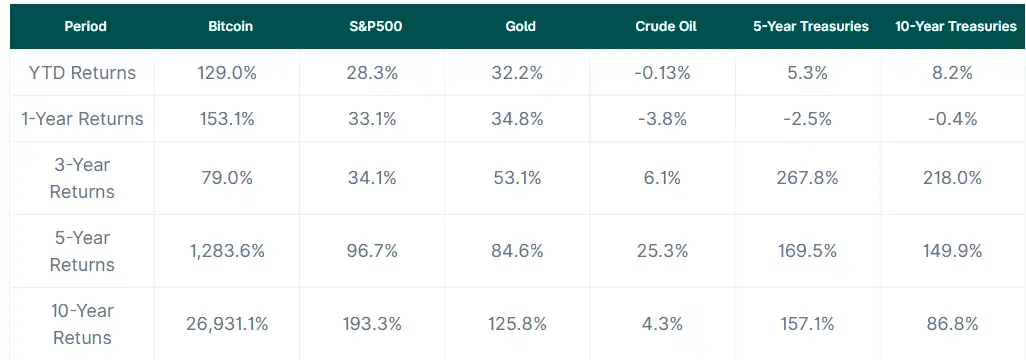
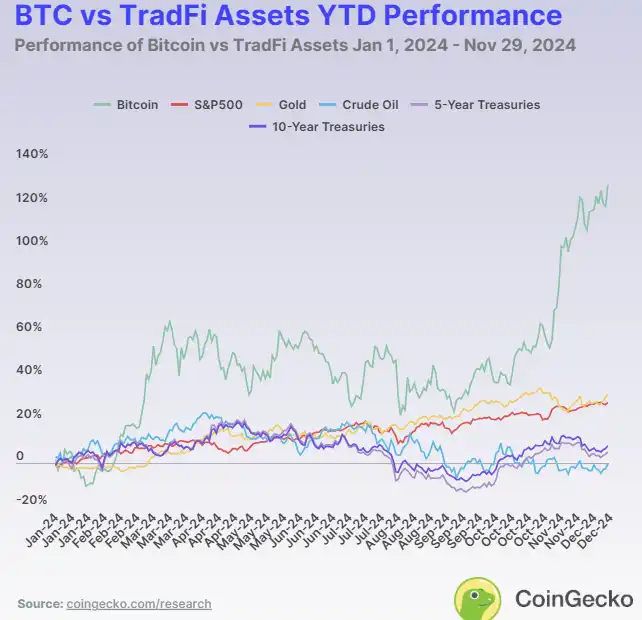
Performance across different time spans reveals the strengths and weaknesses of each asset. In 2024, Bitcoin was the best-performing asset, with a return of 129.0%. Gold followed closely with a year-to-date return of 32.2%, demonstrating its reliability as a traditional store of value. The S&P 500 remained strong with a return of 28.3%. However, crude oil prices fell, with a return of -0.13%, while U.S. Treasuries provided modest returns, with the 5-year Treasury at 5.3% and the 10-year Treasury slightly higher at 8.2%.
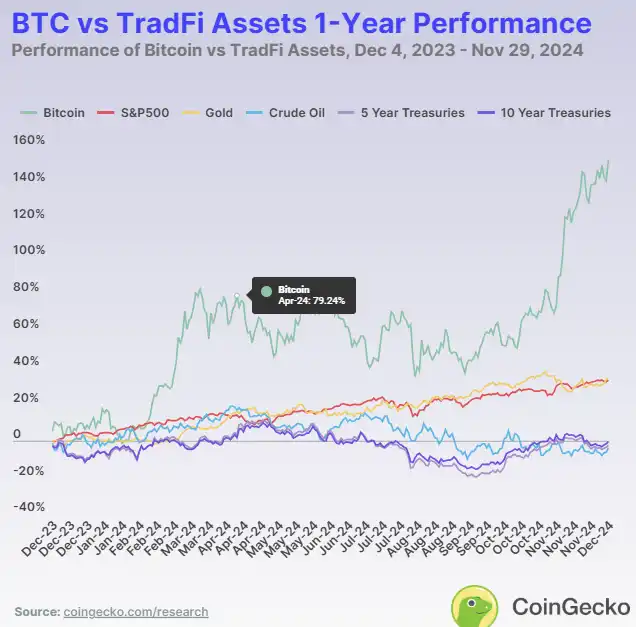
On a 1-year basis, Bitcoin's performance continued to outperform other assets, with a return of 153.1%. Gold returned 34.8%, followed by the S&P 500's 33.1%. The strong performance of these three assets shows the market stability over the past year. However, Treasuries were more sensitive to economic changes, with returns of -4.3% for the 5-year and -2.6% for the 10-year bonds. These figures reveal how bonds fluctuate with interest rates and fiscal policy.
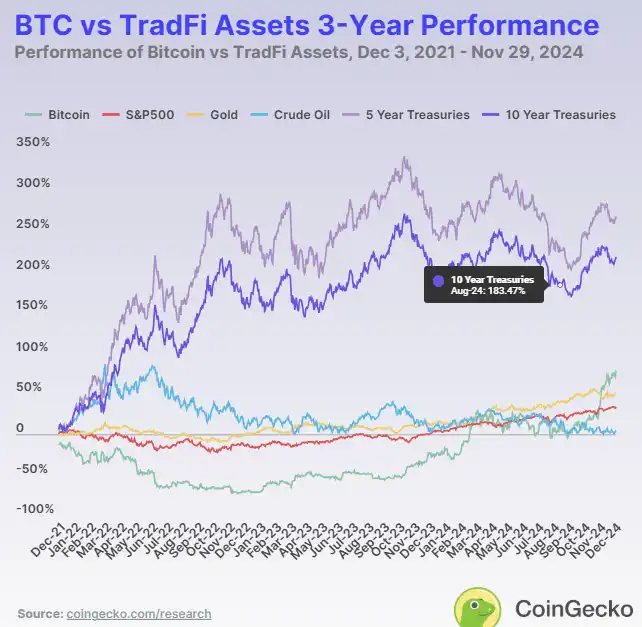
In the three-year range, the performance landscape changed, with bonds favored as economic stability became more important. U.S. Treasuries led the way, with the 5-year Treasury yielding 267.8% and the 10-year Treasury following closely with a yield of 218%. Bitcoin also performed excellently during the same period, with a yield of 79%, while gold came in second with a solid yield of 53.1%, providing some security amid market uncertainty. Crude oil was the only asset that underperformed others during this period, with a yield of just 6.1%.
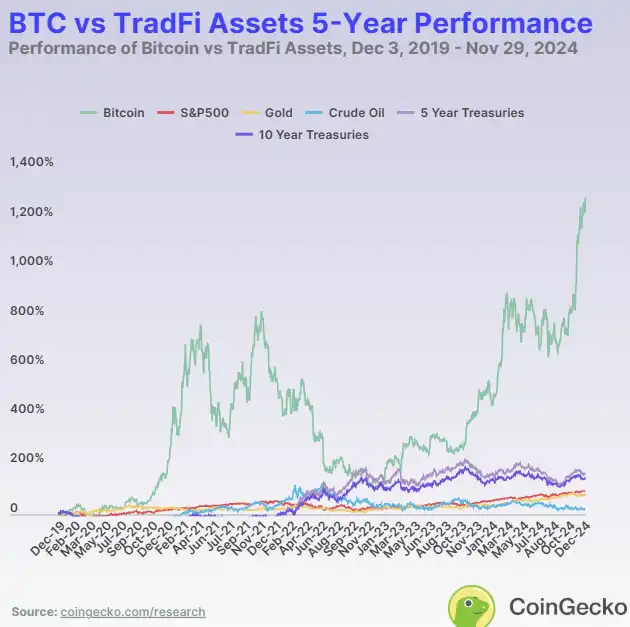
Five-year data shows Bitcoin had the strongest performance, with a yield of 1283.6%. The S&P 500 and gold remained stable, with yields of 96.7% and 84.6%, respectively. U.S. Treasuries also performed well, with the 5-year Treasury yielding 157.1% and the 10-year Treasury yielding 149.9%. Crude oil rose only 25.3%, making it relatively less attractive for long-term investment. Data from this period suggests that Bitcoin has significant potential returns for medium-term investments, while the steady growth of stocks and gold provides balance.
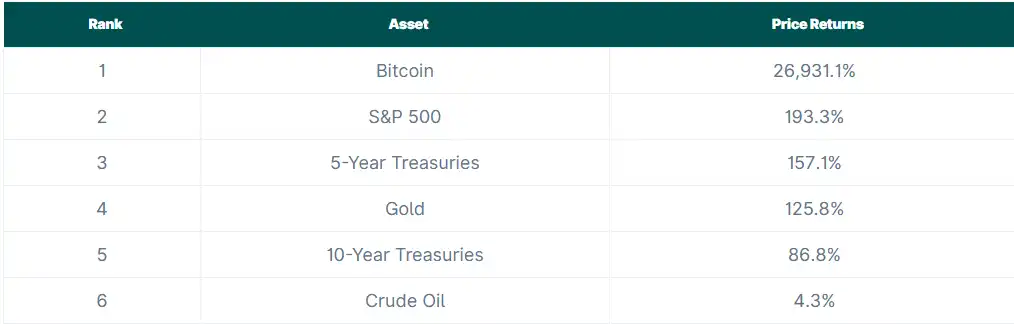
Over a ten-year span, Bitcoin's growth rate of 26,931.1% is unmatched, a testament to its enormous investment potential for early investors. Although other assets' returns pale in comparison to Bitcoin's, they still provide stable returns, such as the S&P 500's 193.3% and gold's 125.8%. U.S. Treasuries also maintain value, with the 5-year Treasury returning 157.1% and the 10-year Treasury returning 86.8%. However, crude oil returned only 4.3%, performing far worse than other assets.

This decade of observation shows that Bitcoin is the ultimate high-growth asset, while gold, bonds, and stocks offer safer, lower-return alternatives for risk-averse investors. However, Bitcoin was still a relatively new asset at the time, with a market capitalization much smaller than other assets. It was precisely its smaller base that allowed it to grow at a faster rate.
Has Bitcoin been volatile over the past decade?

Bitcoin's huge gains over the past decade have been accompanied by significant volatility. Bitcoin's price has fallen as low as $172.15 and reached as high as $103,679. The chart below clearly shows Bitcoin's cycles, which coincidentally occur every four years after halvings. Over this decade, Bitcoin has experienced two "bull market" cycles, in 2017-2018 and 2020-2021, and is currently in one of these bull cycles. At the end of the cycles, Bitcoin's price tends to plummet by more than 70% from its peak, making Bitcoin highly volatile. This extreme volatility highlights its high-risk, high-reward nature, which is very attractive to growth-seeking investors but challenging for those seeking stability.

Is Bitcoin's performance correlated with other assets?

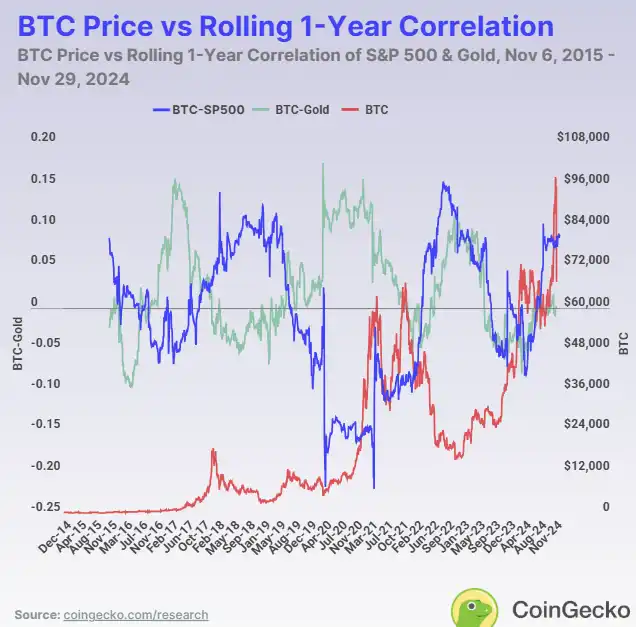
Beyond volatility, Bitcoin's relationship with other major assets like the S&P 500 and gold can further reveal its unique behavior. Correlation analysis reveals how Bitcoin keeps pace with or diverges from traditional markets:
Bitcoin and the S&P 500

Over the years, the correlation between Bitcoin and the S&P 500 (shown by the blue line) has been unstable, typically close to zero before 2018. This low correlation indicates that Bitcoin's behavior was largely independent of the stock market during this period. However, since 2020, this correlation has strengthened, with Bitcoin moving more in line with stocks during major economic events like the COVID-19 pandemic. Price correlations also coincided with Bitcoin's rallies in 2018, 2020, and 2024.

Bitcoin and Gold

Regarding gold, Bitcoin's correlation has an inverse relationship with its correlation to the S&P 500. This indicates that although both are considered alternative investments, Bitcoin and gold (shown by the green line) typically move independently of each other. Furthermore, the correlation moves inversely to the Bitcoin price. When the price rises, correlation decreases, and vice versa. This suggests that when Bitcoin performs poorly, investors tend to turn to gold. However, during macroeconomic events, correlations typically spike briefly, reflecting both assets' reactions to similar market conditions. Nonetheless, Bitcoin has not yet fully established itself as "digital gold."

A comparison of the ten-year price returns of Bitcoin and traditional assets is as follows:
Perguntas relacionadas

QWhich asset performed the worst in the beginning of 2026 according to the article?

ABitcoin performed the worst among the asset classes at the beginning of 2026.

QWhat was the main reason for the surge in crude oil prices in early 2026?

AThe surge in crude oil prices was primarily driven by escalating tensions in the Middle East, culminating in attacks by the US and Israel on Iran on February 28th.

QHow did the correlation between the total cryptocurrency market cap and the S&P 500 change in early 2026 compared to 2025?

AThe correlation between the total cryptocurrency market cap and the S&P 500 was 0.49 in early 2026, showing a moderate positive correlation, which was similar to the 2025 annual correlation of 0.46.

QWhat was Bitcoin's 10-year return as referenced in the article from the 2024 data?

ABitcoin's 10-year return, as referenced from the 2024 data, was 26,931.1%.

QWhat term does the article use to describe the significant sell-off in software and SaaS companies in 2026?

AThe article refers to the significant sell-off in software and SaaS companies as the 'SaaS末日' or 'SaaS apocalypse'.

Leituras Relacionadas

Not Speculation but a Necessity: The 4 Unique Values of Prediction Markets

Polymarket's recent $4 billion funding round and soaring valuation of $15 billion highlight the explosive growth of prediction markets, with trading volume reaching $25.7 billion in March 2026—a 10.6% monthly increase. This analysis argues that prediction markets serve critical non-speculative functions, positioning them as essential tools rather than mere gambling platforms. Prediction markets offer four unique values: entertainment consumption, insurance-like protection, risk hedging, and truth discovery. Firstly, they stimulate economic activity by engaging users in event-based betting, similar to the broader sports industry. Secondly, they act as a form of decentralized insurance, allowing users to hedge against specific, well-defined risks (e.g., weather events) transparently and without traditional overhead costs. Thirdly, institutions and individuals use these markets to hedge against geopolitical and commodity price risks, as demonstrated during the U.S.-Iran conflict and the launch of 24/7 commodity markets on platforms like Kalshi. Finally, prediction markets counter media bias by aggregating crowd-sourced information, often achieving 30% higher accuracy than surveys due to users' vested interests. Experts like Bitwise’s Jeff Park and SIG’s Jeff Yass emphasize the markets' role in risk transfer and financial innovation. As these platforms evolve, they are poised to become trillion-dollar markets, offering more reliable, decentralized mechanisms for information pricing and risk management.

marsbitHá 2h

Not Speculation but a Necessity: The 4 Unique Values of Prediction Markets

marsbitHá 2h

Trading

Spot
Futuros

Artigos em Destaque

O que é BITCOIN

Compreender o HarryPotterObamaSonic10Inu (ERC-20) e a Sua Posição no Espaço Cripto Nos últimos anos, o mercado de criptomoedas assistiu a um aumento na popularidade das moedas meme, cativando não apenas os traders, mas também aqueles que procuram envolvimento comunitário e valor de entretenimento. Entre estes tokens únicos está o HarryPotterObamaSonic10Inu (ERC-20), um projeto intrigante que mistura referências culturais no tecido das criptomoedas. Este artigo explora os principais aspetos do HarryPotterObamaSonic10Inu, examinando os seus mecanismos, a sua ética orientada pela comunidade e o seu envolvimento com o vasto panorama cripto. O que é o HarryPotterObamaSonic10Inu (ERC-20)? Como o nome sugere, o HarryPotterObamaSonic10Inu é uma moeda meme construída na blockchain Ethereum, classificada sob o padrão ERC-20. Ao contrário das criptomoedas tradicionais, que podem enfatizar a utilidade prática ou o potencial de investimento, este token prospera no valor de entretenimento e na força da sua comunidade. O projeto visa promover um ambiente onde utilizadores envolvidos possam reunir-se, partilhar ideias e participar em atividades inspiradas por diversos fenómenos culturais. Uma característica notável do HarryPotterObamaSonic10Inu é a zero taxa sobre transações. Este elemento atraente visa encorajar a negociação e o envolvimento da comunidade, isento de encargos adicionais que podem desencorajar os traders de pequena escala. A oferta total da moeda está fixada em mil milhões de tokens, uma cifra que marca a sua intenção de manter uma circulação substancial dentro da comunidade. Criador do HarryPotterObamaSonic10Inu (ERC-20) As origens do HarryPotterObamaSonic10Inu estão um pouco envoltas em mistério; os detalhes sobre o criador permanecem desconhecidos. O desenvolvimento deste token carece de uma equipa identificável ou de um plano explícito, o que não é raro no setor das moedas meme. Em vez disso, o projeto surgiu de forma orgânica, com o seu progresso a depender fortemente do entusiasmo e da participação da sua comunidade. Investidores do HarryPotterObamaSonic10Inu (ERC-20) No que diz respeito a investimentos externos e apoios, o HarryPotterObamaSonic10Inu também permanece ambíguo. O token não lista quaisquer fundações de investimento conhecidas ou apoio organizacional significativo. Em vez disso, o “sangue vital” do projeto é a sua comunidade de base, que informa o seu crescimento e sustentabilidade através da ação coletiva e do envolvimento no espaço cripto. Como Funciona o HarryPotterObamaSonic10Inu (ERC-20)? Como uma moeda meme, o HarryPotterObamaSonic10Inu opera principalmente fora dos quadros tradicionais que muitas vezes governam o valor dos ativos. Existem vários aspetos distintivos que definem como o projeto funciona: Transações Sem Taxas: Sem taxas sobre transações, os utilizadores podem comprar e vender o token livremente, sem a preocupação de custos ocultos. Envolvimento da Comunidade: O projeto prospera na interação da comunidade, aproveitando plataformas de redes sociais para criar entusiasmo e facilitar a participação. Discussões, partilha de conteúdo e envolvimento são elementos cruciais que ajudam a expandir o seu alcance e a fomentar a lealdade entre os apoiantes. Sem Utilidade Prática: Deve ser notado que o HarryPotterObamaSonic10Inu não oferece utilidade concreta dentro do ecossistema financeiro. Em vez disso, é classificado como um token principalmente para entretenimento e atividades comunitárias. Referência Cultural: O token incorpora de forma inteligente elementos da cultura popular para atrair interesse, conectando-se tanto com entusiastas de memes como com seguidores de criptomoedas. HarryPotterObamaSonic10Inu exemplifica como as moedas meme operam de forma diferente de projetos de criptomoedas mais tradicionais, entrando no mercado como construções sociais inovadoras em vez de ativos utilitários. Linha do Tempo do HarryPotterObamaSonic10Inu (ERC-20) A história do HarryPotterObamaSonic10Inu é marcada por vários marcos notáveis: Criação: O token surgiu de um meme viral, capturando a imaginação de muitos entusiastas de criptomoedas. Datas específicas de criação não estão disponíveis, sublinhando a sua ascensão orgânica. Listagem em Exchanges: O HarryPotterObamaSonic10Inu conseguiu entrar em várias exchanges, permitindo um acesso e negociação mais fáceis pela comunidade. Iniciativas de Envolvimento da Comunidade: Atividades contínuas direcionadas a melhorar a interação comunitária, incluindo concursos, campanhas em redes sociais e geração de conteúdo por fãs e defensores. Planos de Expansão Futura: O roteiro do projeto inclui o lançamento de uma coleção de NFTs, mercadorias e um site de eCommerce relacionado aos seus temas culturais, envolvendo ainda mais a comunidade e tentando adicionar mais dimensões ao seu ecossistema. Pontos-Chave sobre o HarryPotterObamaSonic10Inu (ERC-20) Natureza Orientada pela Comunidade: O projeto prioriza a contribuição coletiva e a criatividade, assegurando que o envolvimento dos utilizadores está na vanguarda do seu desenvolvimento. Classificação como Moeda Meme: Representa o epítome da criptomoeda baseada em entretenimento, destacando-se dos veículos de investimento tradicionais. Sem Afiliação Direta com o Bitcoin: Apesar da semelhança no nome do ticker, o HarryPotterObamaSonic10Inu é distinto e não tem qualquer relação com o Bitcoin ou outras criptomoedas estabelecidas. Foco na Colaboração: O HarryPotterObamaSonic10Inu é projetado para criar um espaço de colaboração e partilha de histórias entre os seus detentores, proporcionando uma via para a criatividade e o fortalecimento da comunidade. Perspectivas Futuras: A ambição de expandir além da sua premissa inicial para NFTs e mercadorias delineia um caminho para o projeto potencialmente entrar em avenidas mais mainstream dentro da cultura digital. À medida que as moedas meme continuam a capturar a imaginação da comunidade cripto, HarryPotterObamaSonic10Inu (ERC-20) destaca-se devido aos seus laços culturais e abordagem centrada na comunidade. Embora possa não se encaixar no molde típico de um token orientado para utilidade, a sua essência reside na alegria e camaradagem fomentadas entre os seus apoiantes, destacando a natureza em evolução das criptomoedas em uma era cada vez mais digital. À medida que o projeto continua a desenvolver-se, será importante observar como as dinâmicas comunitárias influenciam a sua trajetória no panorama em constante mudança da tecnologia blockchain.

1.2k Visualizações TotaisPublicado em {updateTime}Atualizado em 2024.12.03

O que é BITCOIN

Como comprar BTC

Bem-vindo à HTX.com!Tornámos a compra de Bitcoin (BTC) simples e conveniente.Segue o nosso guia passo a passo para iniciar a tua jornada no mundo das criptos.Passo 1: cria a tua conta HTXUtiliza o teu e-mail ou número de telefone para te inscreveres numa conta gratuita na HTX.Desfruta de um processo de inscrição sem complicações e desbloqueia todas as funcionalidades.Obter a minha contaPasso 2: vai para Comprar Cripto e escolhe o teu método de pagamentoCartão de crédito/débito: usa o teu visa ou mastercard para comprar Bitcoin (BTC) instantaneamente.Saldo: usa os fundos da tua conta HTX para transacionar sem problemas.Terceiros: adicionamos métodos de pagamento populares, como Google Pay e Apple Pay, para aumentar a conveniência.P2P: transaciona diretamente com outros utilizadores na HTX.Mercado de balcão (OTC): oferecemos serviços personalizados e taxas de câmbio competitivas para os traders.Passo 3: armazena teu Bitcoin (BTC)Depois de comprar o teu Bitcoin (BTC), armazena-o na tua conta HTX.Alternativamente, podes enviá-lo para outro lugar através de transferência blockchain ou usá-lo para transacionar outras criptomoedas.Passo 4: transaciona Bitcoin (BTC)Transaciona facilmente Bitcoin (BTC) no mercado à vista da HTX.Acede simplesmente à tua conta, seleciona o teu par de trading, executa as tuas transações e monitoriza em tempo real.Oferecemos uma experiência de fácil utilização tanto para principiantes como para traders experientes.

3.8k Visualizações TotaisPublicado em {updateTime}Atualizado em 2025.03.21

Como comprar BTC

O que é $BITCOIN

OURO DIGITAL ($BITCOIN): Uma Análise Abrangente Introdução ao OURO DIGITAL ($BITCOIN) OURO DIGITAL ($BITCOIN) é um projeto baseado em blockchain que opera na rede Solana, com o objetivo de combinar as características dos metais preciosos tradicionais com a inovação das tecnologias descentralizadas. Embora partilhe um nome com o Bitcoin, frequentemente referido como “ouro digital” devido à sua percepção como uma reserva de valor, o OURO DIGITAL é um token separado projetado para criar um ecossistema único dentro da paisagem Web3. O seu objetivo é posicionar-se como um ativo digital alternativo viável, embora os detalhes sobre as suas aplicações e funcionalidades ainda estejam em desenvolvimento. O que é o OURO DIGITAL ($BITCOIN)? OURO DIGITAL ($BITCOIN) é um token de criptomoeda explicitamente projetado para uso na blockchain Solana. Em contraste com o Bitcoin, que fornece um papel amplamente reconhecido como armazenamento de valor, este token parece focar em aplicações e características mais amplas. Aspectos notáveis incluem: Infraestrutura Blockchain: O token é construído na blockchain Solana, conhecida pela sua capacidade de lidar com transações de alta velocidade e baixo custo. Dinâmicas de Oferta: O OURO DIGITAL tem um fornecimento máximo limitado a 100 quatrilhões de tokens (100P $BITCOIN), embora os detalhes sobre o seu fornecimento circulante ainda não tenham sido divulgados. Utilidade: Embora as funcionalidades precisas não estejam explicitamente delineadas, existem indicações de que o token poderia ser utilizado para várias aplicações, potencialmente envolvendo aplicações descentralizadas (dApps) ou estratégias de tokenização de ativos. Quem é o Criador do OURO DIGITAL ($BITCOIN)? Neste momento, a identidade dos criadores e da equipa de desenvolvimento por trás do OURO DIGITAL ($BITCOIN) permanece desconhecida. Esta situação é típica entre muitos projetos inovadores no espaço da blockchain, particularmente aqueles alinhados com finanças descentralizadas e fenómenos de moedas meme. Embora tal anonimato possa fomentar uma cultura orientada pela comunidade, intensifica as preocupações sobre governança e responsabilidade. Quem são os Investidores do OURO DIGITAL ($BITCOIN)? As informações disponíveis indicam que o OURO DIGITAL ($BITCOIN) não tem apoiantes institucionais conhecidos ou investimentos proeminentes de capital de risco. O projeto parece operar num modelo peer-to-peer focado no apoio e adoção da comunidade, em vez de rotas de financiamento tradicionais. A sua atividade e liquidez estão principalmente situadas em exchanges descentralizadas (DEXs), como a PumpSwap, em vez de plataformas de negociação centralizadas estabelecidas, destacando ainda mais a sua abordagem de base. Como Funciona o OURO DIGITAL ($BITCOIN) A mecânica operacional do OURO DIGITAL ($BITCOIN) pode ser elaborada com base no seu design de blockchain e nas características da rede: Mecanismo de Consenso: Ao aproveitar o exclusivo proof-of-history (PoH) da Solana combinado com um modelo de proof-of-stake (PoS), o projeto assegura uma validação eficiente das transações, contribuindo para o alto desempenho da rede. Tokenomics: Embora mecanismos deflacionários específicos não tenham sido extensivamente detalhados, o vasto fornecimento máximo de tokens implica que pode atender a microtransações ou casos de uso de nicho que ainda estão por definir. Interoperabilidade: Existe o potencial para integração com o ecossistema mais amplo da Solana, incluindo várias plataformas de finanças descentralizadas (DeFi). No entanto, os detalhes sobre integrações específicas permanecem não especificados. Cronologia de Eventos Chave Aqui está uma cronologia que destaca marcos significativos relacionados ao OURO DIGITAL ($BITCOIN): 2023: O lançamento inicial do token ocorre na blockchain Solana, marcado pelo seu endereço de contrato. 2024: O OURO DIGITAL ganha visibilidade ao tornar-se disponível para negociação em exchanges descentralizadas como a PumpSwap, permitindo que os utilizadores o negociem contra SOL. 2025: O projeto testemunha atividade de negociação esporádica e potencial interesse em envolvimentos liderados pela comunidade, embora não tenham sido documentadas parcerias ou avanços técnicos notáveis até ao momento. Análise Crítica Forças Escalabilidade: A infraestrutura subjacente da Solana suporta altos volumes de transações, o que pode aumentar a utilidade do $BITCOIN em vários cenários de transação. Acessibilidade: O potencial preço de negociação baixo por token pode atrair investidores de retalho, facilitando uma participação mais ampla devido a oportunidades de propriedade fracionada. Riscos Falta de Transparência: A ausência de apoiantes, desenvolvedores ou um processo de auditoria publicamente conhecidos pode gerar ceticismo em relação à sustentabilidade e confiabilidade do projeto. Volatilidade do Mercado: A atividade de negociação depende fortemente do comportamento especulativo, o que pode resultar em volatilidade significativa dos preços e incerteza para os investidores. Conclusão O OURO DIGITAL ($BITCOIN) surge como um projeto intrigante, mas ambíguo, dentro do ecossistema em rápida evolução da Solana. Embora tente aproveitar a narrativa do “ouro digital”, a sua divergência do papel estabelecido do Bitcoin como reserva de valor sublinha a necessidade de uma diferenciação mais clara da sua utilidade pretendida e estrutura de governança. A aceitação e adoção futuras dependerão provavelmente da abordagem da atual opacidade e da definição mais explícita das suas estratégias operacionais e económicas. Nota: Este relatório abrange informações sintetizadas disponíveis até outubro de 2023, e desenvolvimentos podem ter ocorrido além do período de pesquisa.

92 Visualizações TotaisPublicado em {updateTime}Atualizado em 2025.05.13

O que é $BITCOIN

Discussões

Bem-vindo à Comunidade HTX. Aqui, pode manter-se informado sobre os mais recentes desenvolvimentos da plataforma e obter acesso a análises profissionais de mercado. As opiniões dos utilizadores sobre o preço de BTC (BTC) são apresentadas abaixo.

活动图片