Number of Active XRP Addresses Reaches Two-Month High Amid Worsening Market Sentiment

cryptonews.ruPublicado em 2026-08-16Última atualização em 2026-08-16

Resumo

On August 14th, activity on the XRP Ledger surged to a two-month high, with 49,929 active addresses recorded in a 24-hour period. This spike occurred despite market sentiment towards XRP hitting a three-month low, as the token traded below $1, highlighting a sharp divergence between on-chain activity and retail investor mood. The data from Santiment shows that average daily active addresses had already risen to around 35,700 by August 12th, up from approximately 26,400 in July—a nearly 35% increase. However, the number of new addresses remained flat, suggesting the surge was driven by existing addresses becoming more active rather than an influx of new users. Analysts caution that while high address activity indicates increased network participation, it doesn't specify whether the activity stems from new investors, institutional moves, exchange transactions, or existing holders. Concurrently, the bearish sentiment, tracked from social platforms like X and Reddit, reflects crowd psychology rather than fundamental network health. The report notes that the XRP Ledger's validator-based consensus allows for such on-chain activity to grow independently of short-term price pessimism. Furthermore, broader ecosystem development, including Ripple's reported $550 million in investments since 2017 into grants and institutional infrastructure for tokenized assets, provides a long-term context separate from current price trends. The key question is whether the elevated address activity...

On August 14th, activity on the $XRP Ledger surged to a two-month high: analytics firm Santiment recorded 49,929 active addresses in 24 hours, despite sentiment towards $XRP reaching a three-month low. This increase occurred as $XRP traded below the $1 mark, leading to a sharp divergence between on-chain activity and retail investor sentiment.

Santiment stated:

"Throughout this week, negative sentiment towards $XRP has intensified sharply as prices (so far) have failed to rise. User sentiment is now at a three-month low on X, Reddit, Telegram, and other crypto channels."

The latest spike continued an upward trend observed earlier in August, when the average number of daily active addresses was around 35,700 as of August 12th, compared to roughly 26,400 in July. The number of active $XRP addresses increased by nearly 35%, while new addresses averaged about 2,260 per day, virtually unchanged from July's figure of 2,270, indicating more active use of existing addresses rather than clear evidence of rapid user growth.

Santiment reported:

"The $XRP Ledger, on the other hand, is not so inactive. $XRP just recorded 49,929 active addresses in a single 24-hour period – the highest level of activity in over 2 months, after activity fell to near 2026 lows earlier in July."
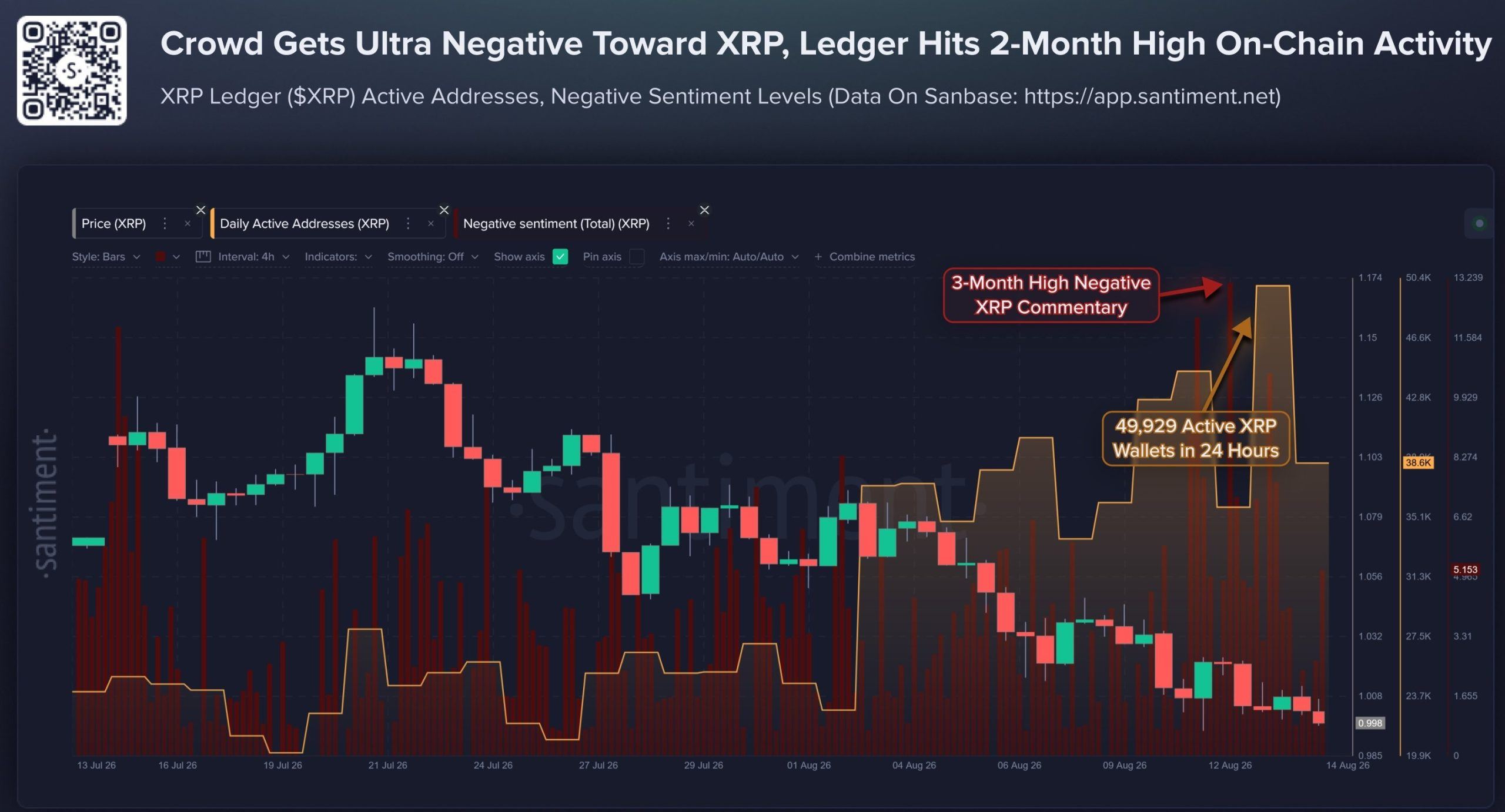
Santiment data shows activity on the $XRP Ledger increased to 49,929 active addresses in a 24-hour period, while sentiment for $XRP reached a three-month low.

This distinction is important to consider when interpreting on-chain activity. A blockchain address does not necessarily correspond to a single individual user, as wallets can generate and manage multiple addresses. Therefore, a higher number of active addresses indicates increased network participation but does not clarify whether this activity was related to new investors, institutional transfers, exchange movements, or repeated transactions by existing participants.

Bearish Comments Contrast with On-Chain Activity

The sentiment metric from Santiment tracks discussions on X, Reddit, Telegram, and other crypto channels, so the three-month sentiment low is more an indicator of crowd psychology than network fundamentals. Sentiment analysis can factor in social media, news, and other signals to assess trader attitudes, which can differ significantly from blockchain activity or long-term adoption trends.

Bearish sentiment also does not mean $XRP has entered or will remain in a definitive market phase. Bear markets are typically characterized by falling prices and weakening confidence, while individual sentiment indicators can change faster than overall price trends. Thus, the current signal for $XRP reflects unusually negative commentary, not a prediction of a reversal or a confirmation of future price direction.

The $XRP Ledger itself operates independently of these social signals. The $XRP Ledger uses a validator-based consensus process instead of proof-of-work mining, where validators agree on the order and validity of transactions before finalizing new ledger versions. This architecture allows activity to increase even when market participants maintain pessimistic outlooks on $XRP's short-term price dynamics.

XRPL Development Provides Broader Network Context

Network development represents another metric to consider separately from short-term price and market sentiment data. Ripple has reported investing over $550 million into $XRP Ledger ecosystem initiatives since 2017, including grants, incentives, partnership programs, and development programs aimed at supporting payments, tokenization, decentralized finance, and other applications.

Ripple has also expanded its institutional strategy for tokenized assets, stablecoins, custody, trading, and credit infrastructure. Its expanded institutional XRPL stack connects tokenized assets with settlement, liquidity, and collateral systems, although available data does not point to these initiatives as the cause of the August 14th activity spike.

Strategic investments have extended these efforts into regulated fund management and tokenized capital market infrastructure. Ripple's investments in Zilo and Licuido target issuance, trading, settlement, and collateral functions, serving as further evidence of XRPL's development, though not establishing a direct link to the recent rise in active addresses.

Santiment noted:

"If $XRP holds its structure and demand recovers, today's negativity could be tomorrow's story of a favorable market entry."

This statement reflects a conditional market interpretation, not proof of a price recovery beginning. The next test will be whether active address levels remain elevated following the one-day spike amidst ongoing bearish sentiment, showing whether this divergence extends beyond a short-term network activity surge.

end-content

Criptomoedas em alta

Perguntas relacionadas

QAccording to the article, what is the key contradiction reported regarding XRP on August 14th?

AOn August 14th, the number of active addresses on the XRP Ledger surged to a two-month high of 49,929, while market sentiment towards XRP hit a three-month low. This created a sharp divergence between on-chain activity and investor mood.

QWhat does the article suggest is the likely reason for the increase in active XRP addresses, based on the data about new addresses?

AThe increase in active addresses is likely due to more intensive use of existing addresses rather than an influx of new users. Data shows the number of new addresses created daily remained virtually unchanged from July to August, while active addresses rose significantly.

QHow does the XRP Ledger's consensus mechanism differ from Bitcoin's, and why is this relevant to the reported activity?

AThe XRP Ledger uses a validator-based consensus mechanism, not Bitcoin's proof-of-work mining. This architecture allows network activity to grow independently of short-term market sentiment and price predictions, which explains why activity can increase even when traders are pessimistic.

QWhat broader ecosystem development efforts by Ripple are mentioned in the article, and how are they characterized in relation to the recent activity spike?

AThe article mentions Ripple has invested over $550 million since 2017 into the XRPL ecosystem, including grants and development programs for payments, tokenization, and DeFi. It also details Ripple's expanded strategy in tokenized assets and institutional infrastructure. However, the article states these initiatives are not directly linked as the cause of the August 14th activity spike.

QWhat does the Santiment statement quoted at the end of the article imply about the current market situation for XRP?

ASantiment's statement implies that the current negative sentiment could represent a potential buying opportunity if XRP's underlying structure holds and demand recovers. However, the article clarifies this is a conditional market interpretation, not proof of an imminent price recovery. The key test will be whether the high activity levels persist.

Leituras Relacionadas

Media: Anthropic Aims for Revenue Up to $200 Billion by 2028 Ahead of IPO

Anthropic, the AI company behind Claude, is reportedly projecting its revenue could reach between $190 billion and $200 billion by 2028, according to sources cited by Reuters. This forecast, significantly higher than its reported $47 billion annual run-rate in May 2026, is being used by investors and bankers to value the company ahead of a potential IPO. Anthropic has confidentially filed with the SEC, with listing details dependent on market conditions and regulatory approval. The valuation reportedly applies a revenue multiple (EV/Revenue) to these future 2028 figures, an approach common for high-growth tech firms but unusual for a forecast two years ahead of an IPO. This reflects confidence in Anthropic's rapid scaling; its annual run-rate grew tenfold yearly for three years leading into 2026, jumping from ~$9B in late 2025 to over $47B by May 2026. Investors are betting the company's massive spending on GPUs, model training, and infrastructure will eventually outpace costs, leading to expanding margins. Public companies like Palantir, Cloudflare, and SpaceX, valued at high multiples of their forward revenue, serve as benchmarks. While this forward-looking method has precedents, some analysts question the sustainability of such valuations and the actual productivity gains from AI. Despite these concerns, earlier reports suggested Anthropic could be valued at over $1 trillion for its IPO.

cryptonews.ruHá 19m

Media: Anthropic Aims for Revenue Up to $200 Billion by 2028 Ahead of IPO

cryptonews.ruHá 19m

Open Blockchain Business: Who Gets the Fees and Why a Foundation is Needed

Business of Open Blockchain: Who Gets the Fees and Why a Foundation is Needed In public blockchains, user transaction fees do not simply become "revenue" for a single entity. The flow of money is complex and protocol-dependent. In Ethereum, fees consist of a base fee (burned, permanently removing ETH from circulation) and a priority tip (paid to the validator). In Solana, half the base fee is burned and half goes to the validator, while priority fees go entirely to validators. Thus, "fees" are not synonymous with "project revenue"; they may go to network operators or be destroyed. Foundations like the Ethereum Foundation do not take a cut of user fees. They are funded by their own treasuries, which can generate income (e.g., from staking rewards) and finance ecosystem development, research, and security. Their role is to fund public goods that are hard to monetize directly. Developers of open-source blockchain code can monetize through services, not the code itself. For example, Optimism provides its technology freely but sells enterprise support and managed services (OP Enterprise). Additionally, networks built on Optimism's tech, like Coinbase's Base, share a portion of their revenue with the Optimism ecosystem via agreements, creating an economic link. Token holders do not automatically receive fees as dividends. In Optimism, a portion of protocol revenue is now used to buy back and treasury-lock OP tokens, creating an indirect link between network usage and token economics. In Ethereum, fee burning reduces ETH supply but doesn't distribute funds to all holders; stakers and validators receive direct rewards. For evaluation, analysts should look beyond total fee figures. Key questions are: Who paid and for what? Where did the money go (to validators, operators, treasury, or burning)? What were the recipient's costs? Is there a mechanism linking this income to the token? The same fee amount impacts different blockchain economies in vastly different ways depending on these factors.

cryptonews.ruHá 20m

Open Blockchain Business: Who Gets the Fees and Why a Foundation is Needed

cryptonews.ruHá 20m

Trading

Spot

Artigos em Destaque

O que é XRP 2.0

XRP 2.0: Uma Nova Fronteira no Landscape das Criptomoedas Introdução ao XRP 2.0 No reino em constante evolução das criptomoedas, novos projetos surgem continuamente, lutando por atenção e adoção. Uma dessas iniciativas promissoras é o XRP 2.0, um novo projeto de criptomoeda concebido para aproveitar a tecnologia de blockchain avançada e as metodologias de criptografia robustas. Embora o nome tenha paralelos com o XRP da Ripple, é crucial notar que o XRP 2.0 opera de forma independente, focando em melhorar a segurança das transações, a privacidade e a escalabilidade. À medida que o panorama financeiro digital abraça cada vez mais soluções descentralizadas, o XRP 2.0 visa contribuir de forma significativa para a web3 e a expansão global dos projetos de criptomoedas. O que é o XRP 2.0? No seu núcleo, o XRP 2.0 é um projeto de criptomoeda que visa criar um ecossistema de moeda digital seguro e descentralizado. Sua tecnologia fundamental integra princípios de blockchain sofisticados com técnicas de criptografia de ponta. O objetivo abrangente do XRP 2.0 é estabelecer-se como uma plataforma confiável e eficiente que possibilita a execução rápida de transações, priorizando a proteção de privacidade aprimorada para os seus usuários. O projeto é promovido como uma solução para muitas limitações enfrentadas pelas criptomoedas existentes, propondo um sistema que pode lidar com um volume maior de transações com velocidade e privacidade melhoradas. Esta versatilidade posiciona o XRP 2.0 como um concorrente significativo em um mercado repleto de várias moedas digitais. Quem é o Criador do XRP 2.0? A identidade do criador por trás do XRP 2.0 foi identificada como 'Wilbur.' No entanto, detalhes abrangentes sobre Wilbur ou a sua entidade associada permanecem elusivos. O anonimato de muitos criadores de criptomoedas não é um fenômeno incomum na indústria, muitas vezes concebido para manter um grau de privacidade e segurança. Quem são os Investidores do XRP 2.0? Até agora, informações específicas relacionadas às fundações ou organizações de investimento que apoiam o XRP 2.0 não estão disponíveis publicamente. No setor das criptomoedas, o apoio de investidores reputados pode influenciar significativamente a credibilidade e o sucesso de um projeto, no entanto, a transparência em relação aos apoiantes financeiros do XRP 2.0 não foi estabelecida. Como Funciona o XRP 2.0? O XRP 2.0 destaca-se por empregar uma combinação de tecnologia blockchain e algoritmos de criptografia avançados que asseguram transações seguras e descentralizadas. Sua estrutura inovadora inclui características únicas projetadas para fomentar o envolvimento dos usuários e ampliar as funcionalidades além das transações convencionais de criptomoedas. Entre essas características, o XRP 2.0 incorpora capacidades potenciadas por IA, como funcionalidades de texto-para-imagem e texto-para-fala. Estas adições são projetadas para melhorar a experiência interativa dos usuários, promovendo uma maior aplicabilidade em vários setores. Ao unir avanços tecnológicos com um design centrado no utilizador, o XRP 2.0 pretende captar a atenção de uma diversa gama de indivíduos e empresas que procuram integrar soluções de criptomoedas em suas estruturas operacionais. Cronologia do XRP 2.0 Compreender o XRP 2.0 requer examinar os marcos que definiram sua jornada até agora: 23 de Julho de 2023: O XRP 2.0 é apresentado como um novo projeto de criptomoeda, visando revolucionar as capacidades de transação seguras e descentralizadas no domínio do blockchain. 8 de Setembro de 2023: O lançamento de outro projeto, XRP20, ocorre, marcando o surgimento de um token ERC-20 na blockchain Ethereum que permanece não relacionado ao XRP 2.0. 13 de Novembro de 2023: O XRP Ledger passa por uma atualização significativa com o lançamento da versão 2.0.0 do software do servidor rippled. É importante notar que este desenvolvimento está desconectado do projeto de criptomoeda XRP 2.0. Pontos-chave sobre o XRP 2.0 Para destilar a essência do XRP 2.0, vários fatores críticos emergem: Características Únicas: A inclusão de características como texto-para-imagem e texto-para-fala potenciadas por IA diversifica ainda mais as aplicações potenciais do XRP 2.0. Tecnologia Blockchain: A estrutura utiliza mecanismos de blockchain avançados e protocolos de criptografia, assegurando um ambiente seguro e descentralizado para transações. Escalabilidade e Privacidade: O XRP 2.0 prioriza proteção de privacidade aprimorada nos processos de transação e a escalabilidade necessária para acomodar uma base de utilizadores crescente. Sem Afiliação com a Ripple: Importante, apesar do seu nome, o XRP 2.0 não tem qualquer lealdade ou colaboração com o XRP da Ripple, distinguindo sua estrutura operacional e objetivos dentro do ecossistema das criptomoedas. Conclusão O XRP 2.0 representa uma empreitada ambiciosa no domínio das criptomoedas, visando oferecer uma combinação de segurança, privacidade e eficiência em transações digitais. Ao integrar tecnologias sofisticadas e características amigáveis ao utilizador, o projeto propõe-se a ampliar os horizontes do que as criptomoedas podem alcançar na economia digital atual. Embora o anonimato do seu criador e a falta de investidores divulgados possam levantar questões para alguns, o foco do XRP 2.0 em funcionalidades avançadas e descentralização aumenta seu apelo num mercado de criptomoedas cada vez mais congestionado. À medida que o panorama das criptomoedas continua a evoluir, o XRP 2.0 pode ainda emergir como um jogador crucial na expansão de soluções de blockchain seguras e escaláveis.

229 Visualizações TotaisPublicado em {updateTime}Atualizado em 2024.12.03

O que é XRP 2.0

Como comprar XRP

Bem-vindo à HTX.com!Tornámos a compra de XRP (XRP) simples e conveniente.Segue o nosso guia passo a passo para iniciar a tua jornada no mundo das criptos.Passo 1: cria a tua conta HTXUtiliza o teu e-mail ou número de telefone para te inscreveres numa conta gratuita na HTX.Desfruta de um processo de inscrição sem complicações e desbloqueia todas as funcionalidades.Obter a minha contaPasso 2: vai para Comprar Cripto e escolhe o teu método de pagamentoCartão de crédito/débito: usa o teu visa ou mastercard para comprar XRP (XRP) instantaneamente.Saldo: usa os fundos da tua conta HTX para transacionar sem problemas.Terceiros: adicionamos métodos de pagamento populares, como Google Pay e Apple Pay, para aumentar a conveniência.P2P: transaciona diretamente com outros utilizadores na HTX.Mercado de balcão (OTC): oferecemos serviços personalizados e taxas de câmbio competitivas para os traders.Passo 3: armazena teu XRP (XRP)Depois de comprar o teu XRP (XRP), armazena-o na tua conta HTX.Alternativamente, podes enviá-lo para outro lugar através de transferência blockchain ou usá-lo para transacionar outras criptomoedas.Passo 4: transaciona XRP (XRP)Transaciona facilmente XRP (XRP) no mercado à vista da HTX.Acede simplesmente à tua conta, seleciona o teu par de trading, executa as tuas transações e monitoriza em tempo real.Oferecemos uma experiência de fácil utilização tanto para principiantes como para traders experientes.

1.9k Visualizações TotaisPublicado em {updateTime}Atualizado em 2026.06.02

Como comprar XRP

Discussões

Bem-vindo à Comunidade HTX. Aqui, pode manter-se informado sobre os mais recentes desenvolvimentos da plataforma e obter acesso a análises profissionais de mercado. As opiniões dos utilizadores sobre o preço de XRP (XRP) são apresentadas abaixo.

活动图片