‘No Token Issuance’ Statement Fails to Curb Frenzy, ClawdBot Trapped in Crypto Kidnapping Dilemma

比推Publicado em 2026-01-27Última atualização em 2026-01-27

Resumo

ClawdBot, an open-source AI assistant, gained massive traction with over 40,000 GitHub stars and a rapidly growing Discord community. Despite its technical success, it became the center of an unsolicited meme coin frenzy when a token named CLAWD was launched without authorization, reaching a market cap of $16 million. The founder, Peter Steinberger, explicitly stated he would never issue a token and condemned the harassment and scams targeting the project. His account was even hijacked by crypto scammers attempting to force a token launch. Steinberger, a retired entrepreneur whose previous company received a €100 million investment, has no financial incentive to engage in crypto speculation. The incident highlights a shift in meme coin culture from seeking legitimacy through technical projects to aggressively “adopting” viral trends through coercion and scams, potentially harming genuine open-source development.

Author: Curry, Deep Tide TechFlow

Original Title: ClawdBot Founder Says Never Issuing Tokens, Meme Trenches Go Crazy


On January 25th, an open-source AI assistant called ClawdBot went viral.

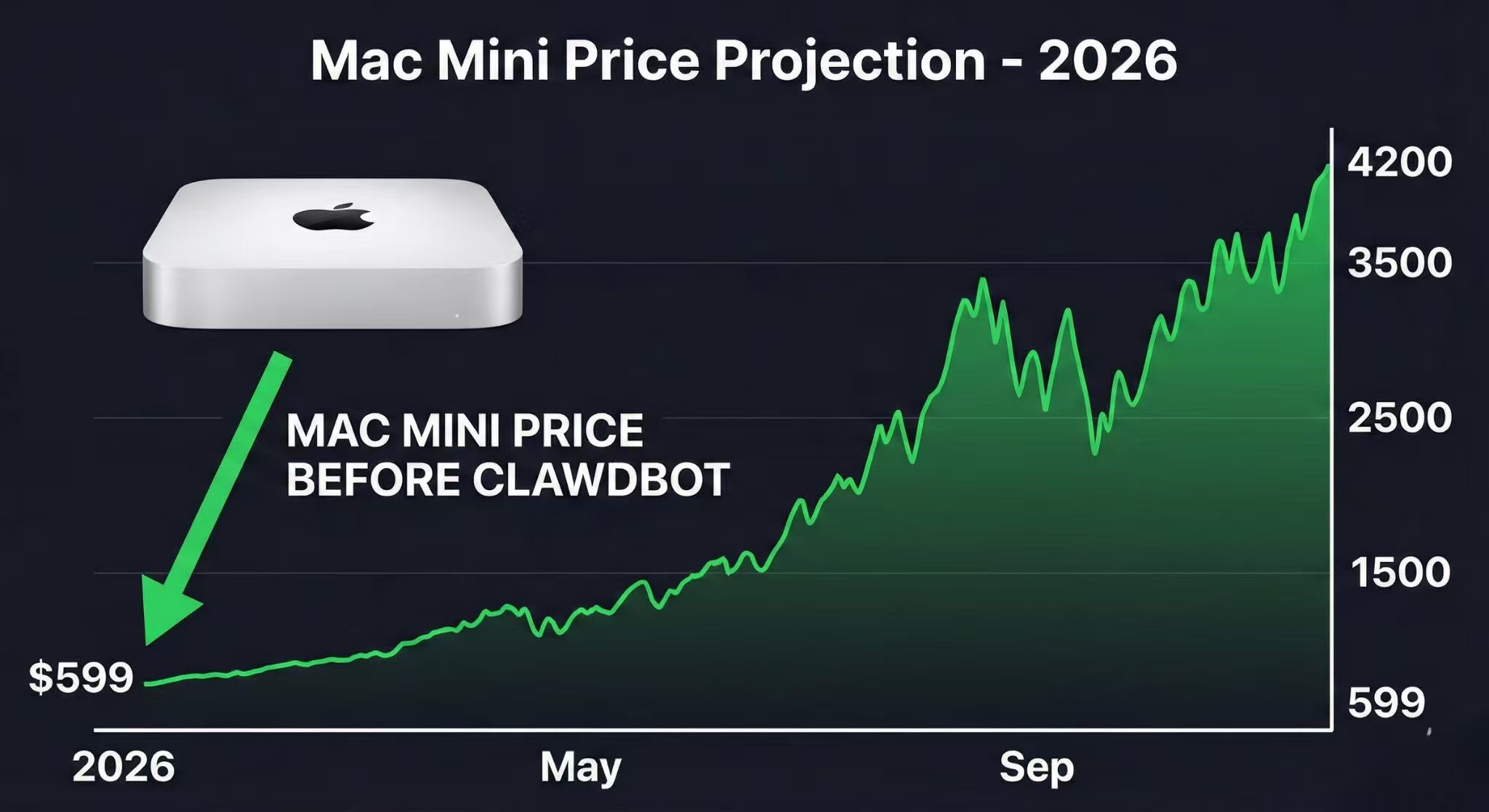
You might have seen it extensively on Twitter and various media platforms at home and abroad over the past couple of days. The project's GitHub stars surpassed 40,000, and foreigners joked that Mac minis would sell out because of it, as it needs to run 24/7, and a brand new Mac, free of other tasks, versatile and capable, is a good choice.
Simultaneously, nearly ten thousand people flooded into the project's Discord community.

ClawdBot founder Peter Steinberger also tweeted, saying he hardly looks at code anymore, letting AI write it all;

This sparked another phenomenon-level technical topic on Twitter after Dan Koe's viral inspirational piece "How to Fix Your Life in a Day" – "How to Quickly Deploy ClawdBot".

Naturally, attention brings liquidity, and the crypto friends smelled it and came.

The同名 Meme token CLAWD was actually launched on the 25th, with its market cap once soaring to $16 million. Everything looked familiar: a trending AI project, a同名 token, early players getting rich. The only problem was:

The founder said he wouldn't issue a token.

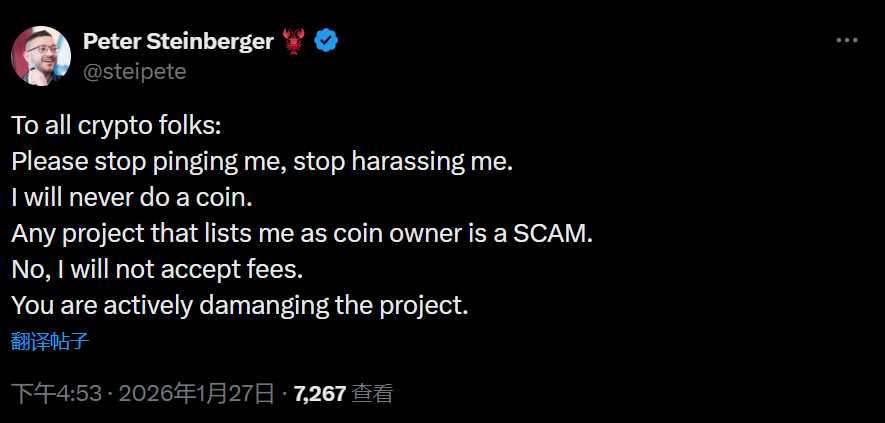
On January 27th, Peter Steinberger posted a statement on Twitter:

"Stop DMing me. Stop harassing me. I will never issue a token. Any project listing me as a token owner is a scam. No, I don't accept any fees. You are damaging the project".
On the same day, he posted another tweet:

Any GitHub folks who can help me get my account back? It's been hijacked by crypto scammers.

You won't issue a token, I'll DM you to issue it. You still won't, then I'll hijack your account and issue it for you.

Unlike the poor devs in the Meme trenches desperately waiting for an official move, this developer who created ClawdBot doesn't seem to be short of money.

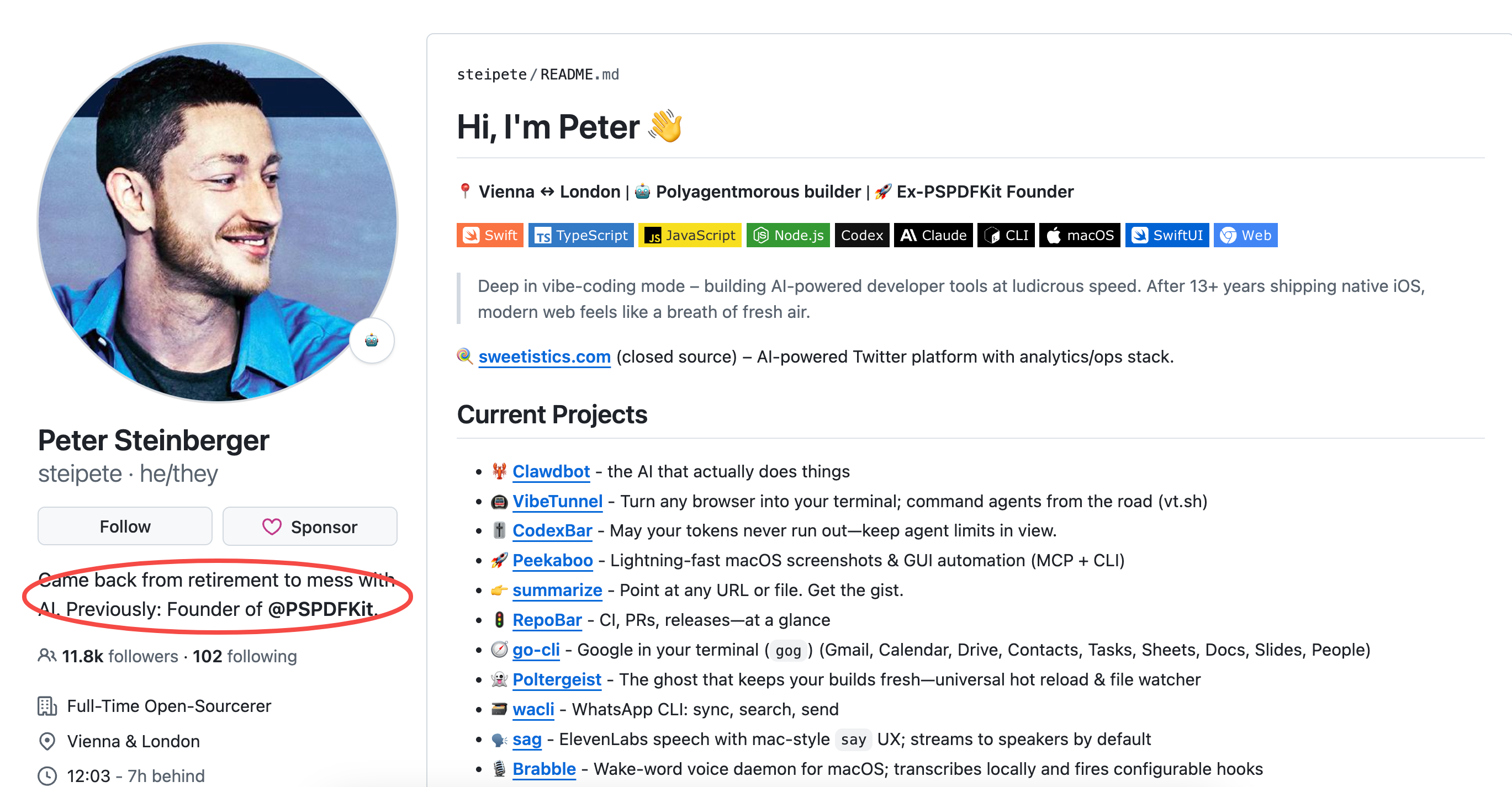
I looked into his background. Peter previously founded a company called PSPDFKit, developing PDF tools.

In 2021, Insight Partners invested €100 million in this company, which at the exchange rate then was roughly:

$116 million.

After the investment was completed, Peter and his co-founder retired. In his own words, he "came back from retirement to mess with AI", now returning from retirement to fiddle with AI.
A person who retired by making products really doesn't need your token profits.

But the brothers in the Meme trenches need it.

This is the most interesting part of the story. In the crypto world's perception, "who wouldn't want to make money" is the first principle. A project goes viral, issuing a token is a matter of course.

If you don't issue, you're either pretending or waiting for a better time, even if the project has little to do with crypto.

So people will DM, harass, even hijack accounts to issue tokens through scams.

Remember when AI Meme first got hot the year before last and last year, the routine was like this:

First, have a technical project or product prototype, then the team announces they will issue a token, the community follows up, the narrative is self-consistent. This is called "technical legitimacy": you have something, so you qualify to issue.

Now it's changed.

Now, upon seeing the hype, first抢注 a同名 token, then wait for "official adoption". If adopted, everyone is happy; if not, keep speculating. Anyway, retail investors can't tell which is real.

In the Meme trenches, this "forced adoption" model is becoming the norm.

Whether it's Chinese Meme or overseas Meme, seeking mention,暗示, or endorsement from an official role in a hot topic is an action that will never stop.

It's just that this initiative is a bit too wolf-like.

Before, Meme was about "creating gods", finding a founder with a technical background, packaging them as the next Vitalik; later it was "蹭神" (rubbing against gods), naming projects after Elon, Trump.

Now it's "绑神" (kidnapping gods), if you don't cooperate, I'll hijack your account.

From active god-making to passive kidnapping, the narrative cycle of AI Meme might really be at its end.

Peter Steinberger said something in the tweet statement above that is truly worth pondering: you are damaging the project.

An open-source, free AI assistant that anyone can use is being forced to spend energy dealing with this nonsense because of harassment from the crypto circle.

I wonder if he will shut down the project because of this, or simply make the code private. Only know that if it really comes to that, the ones who lose the most certainly won't be those speculating on tokens.

The ones who lose the most are the ordinary developers who actually want to use this tool.

But does that matter?

In the crypto world, making money is what matters.


Twitter:https://twitter.com/BitpushNewsCN

BitPush TG Discussion Group:https://t.me/BitPushCommunity

BitPush TG Subscription: https://t.me/bitpush

Original link:https://www.bitpush.news/articles/7606372

Perguntas relacionadas

QWhat is the founder of ClawdBot and what is his background?

AThe founder of ClawdBot is Peter Steinberger. He previously co-founded a company called PSPDFKit, which developed PDF tools. In 2021, the company received a €100 million (approximately $116 million at the time) investment from Insight Partners, after which Peter retired. He has since returned from retirement to work on AI projects like ClawdBot.

QWhy did the ClawdBot project gain significant attention on January 25th?

AClawdBot, an open-source AI assistant, gained significant attention because its GitHub repository surpassed 40,000 stars, and its Discord community grew to nearly 10,000 members. It became a trending topic on Twitter, with discussions on how to quickly deploy it, and it was humorously suggested that Mac minis might sell out due to the project's requirement to run 24/7.

QHow did the cryptocurrency community react to the popularity of ClawdBot?

AThe cryptocurrency community quickly capitalized on ClawdBot's popularity by launching a meme token named CLAWD on the same day it went viral. The token's market capitalization briefly reached $16 million. Despite the founder's clear statement that he would never issue a token, some individuals resorted to harassing him and even hijacking his social media accounts in an attempt to force or fake an official endorsement.

QWhat was Peter Steinberger's response to the token and the harassment from the crypto community?

APeter Steinberger explicitly stated on Twitter that he would never issue a token and denounced any projects listing him as a token owner as scams. He expressed frustration over the harassment, stating that such actions were damaging the project. He also reported that his GitHub account was hijacked by crypto scammers.

QWhat does the article suggest about the current state of AI-related meme tokens?

AThe article suggests that the narrative cycle for AI-related meme tokens may be ending. It describes a shift from projects building legitimacy through technology and official token launches ('造神' or 'making a god') to simply蹭神' or 'rubbing against a god' by using famous names, and now to '绑神' or 'kidnapping a god,' where communities harass or hijack accounts of legitimate projects to force association. This behavior risks harming genuine open-source projects and their communities.

Leituras Relacionadas

Must-Watch Events Next Week|CLARITY Act Could Face Senate Vote; SpaceX, Circle to Report Earnings (8.3-8.9)

**Summary: Key Events and Developments to Watch (August 3-9)** The upcoming week is marked by significant financial disclosures, key legislative deadlines, and notable product updates. **Major Financial Events:** Several companies are scheduled to release their Q2 2026 earnings. American Bitcoin (ABTC) will report on August 3, followed by SpaceX and Hut 8 Mining Corp. on August 4, and Circle on August 5. Notably, a significant portion of SpaceX shares (up to 12% of total shares) will be unlocked on August 6 following their earnings release. **Key Legislative Deadline:** The U.S. Senate faces an August 7 deadline to secure 60 votes for the CLARITY Act, a bipartisan bill aiming to establish a federal regulatory framework for cryptocurrencies. The Senate may hold a full vote on the bill during the week. **Economic Data:** The U.S. July Non-Farm Payrolls report will be released on August 7, providing crucial labor market data. **Technology & Product Updates:** * **Shutdowns:** DeFi portfolio tracker Zapper and wallet app Ctrl Wallet will cease operations on August 3. * **Upgrades:** LayerZero will deprecate its v1 relayers on August 3. XRP Ledger's new version 3.3.0, featuring five new functions, is expected next week. * **AI:** Elon Musk announced that the advanced Grok 4.6 AI model is set for release around August 7. * **Bitcoin:** The BIP-110 forced signaling for a potential Bitcoin network change is scheduled to begin around August 8. **Other Notable Events:** Chinese robotics firm Unitree Tech has set its preliminary price inquiry for its IPO for August 5. South Korean exchange Upbit will delist AQT and AERGO tokens on August 3.

marsbitHá 22m

Must-Watch Events Next Week|CLARITY Act Could Face Senate Vote; SpaceX, Circle to Report Earnings (8.3-8.9)

marsbitHá 22m

Stocks Are Plummeting More Sharply Than Cryptocurrencies. Where Has the Money Gone?

Stock Markets Plunge Deeper Than Cryptocurrencies: Where Did the Money Go? In late July, Seoul's Kospi index triggered circuit breakers for two consecutive days, plummeting over 40% from its June high. The collapse was led by heavyweight stocks like SK Hynix, whose record profits still disappointed investors, and devastating leveraged ETFs, with one major product losing over 83% of its value. This signaled a global, forced deleveraging targeting the most crowded trades. Interestingly, while stocks exhibited extreme volatility akin to crypto markets, Bitcoin rose nearly 15% in July after a prior steep drop. Analysis shows the money fleeing equities did not flow into Bitcoin. Instead, Bitcoin had already absorbed its sell-off in May-June, when U.S. spot Bitcoin ETFs saw historic outflows. The true safe-haven beneficiary was gold, whose price rose over 20% year-on-year, highlighting a decoupling between Bitcoin and gold as "digital gold." The sell-off was a targeted unwinding of leveraged positions in tech and semiconductors, accelerated by broker-dealer risk management and shifts in the AI narrative, including new competition from Chinese memory chipmakers. The retreat path was clear: from high-valuation tech stocks to cash and U.S. Treasuries, then to gold. For Bitcoin to attract sustained institutional inflows, conditions like eased global liquidity pressure, a "soft-landing" Fed rate cut, and U.S. regulatory clarity via legislation like the stalled CLARITY Act are needed. Currently, Bitcoin is not a safe haven but an already-cleared asset. Its low correlation with tech stocks, however, makes it a potential diversification play for institutional portfolios once the storm passes. The money isn't here yet, but the positioning is underway.

marsbitHá 22m

Stocks Are Plummeting More Sharply Than Cryptocurrencies. Where Has the Money Gone?

marsbitHá 22m

In Conversation with Ray Dalio: We Are Currently in an AI Bubble, with 1% of My Portfolio in Bitcoin

Ray Dalio, founder of Bridgewater Associates, warns in an interview that the current AI boom shows classic bubble characteristics, which could lead to significant economic downturns as seen in past cycles like 1929 or 2000. He explains that speculative enthusiasm, fueled by debt and overvaluation, often precedes a crash when rising rates or taxation force asset sales, causing widespread losses and recession. Dalio also outlines his "Big Cycle" theory, describing an approximate 80-year pattern where widening wealth gaps, massive government deficits, and shifting geopolitical power (like China's rise) create internal conflict and global instability. He emphasizes that we are in a late-cycle, transitional phase where traditional powers like the US and UK face decline. For personal wealth protection, Dalio advises diversification beyond cash into assets like stocks, bonds, real estate, and particularly gold, which he prefers over Bitcoin. While he holds about 1% of his portfolio in Bitcoin as a non-printable hard asset, he views gold as more secure from technological or governmental threats. Regarding AI's impact, Dalio believes it will disproportionately benefit capital owners, worsening inequality by replacing both physical and cognitive labor. He suggests that human intuition and emotional intelligence, combined with AI, will be key for future workers. On taxation, Dalio argues that wealth taxes are impractical and risk triggering asset sell-offs, reducing productive investment. He points to the UK as a cautionary example of debt, low productivity, and political strife. Geopolitically, Dalio foresees a more regionalized world, with the US showing weakness in prolonged conflicts like with Iran, akin to past imperial declines. The ideal outcome, he suggests, is coexisting powerful blocs (e.g., Americas, China-Asia Pacific) without major war.

marsbitHá 4h

In Conversation with Ray Dalio: We Are Currently in an AI Bubble, with 1% of My Portfolio in Bitcoin

marsbitHá 4h

Daily 7.2 Trillion KRW: Foreign Capital's Record Net Buying on Friday! Wall Street Says Headwinds for Korean Stock Fund Flows Have Subsided

South Korean stock market sees a dramatic shift in fund flows. On July 31, foreign investors made a record net purchase of approximately KRW 7.2 trillion in KOSPI stocks, marking a fundamental reversal from the persistent large-scale net outflows seen in previous months. This contributed to a significant narrowing of foreign net selling in July to KRW 9.8 trillion, down sharply from KRW 48.4 trillion in June and KRW 44.5 trillion in May. Simultaneously, domestic institutional pressure eased. South Korean pension funds and asset managers turned to a net buying position in July, purchasing KRW 1.0 trillion worth of KOSPI shares, contrasting with net sales in May and June. Market volatility is expected to be dampened by new financial regulations. Effective July 31, the Financial Services Commission tightened access for retail investors to single-stock leveraged ETFs by raising the minimum cash deposit requirement. Trading volumes for these products subsequently dropped to about 50% of their monthly average. Citigroup Research maintains its year-end KOSPI target of 10,000 points. The firm cites several supportive factors: the substantial easing of headwinds from capital outflows, a robust fundamental outlook for the semiconductor sector, historically low market valuations, strong economic fundamentals, and the potential for policy support from financial authorities if needed.

marsbitHá 4h

Daily 7.2 Trillion KRW: Foreign Capital's Record Net Buying on Friday! Wall Street Says Headwinds for Korean Stock Fund Flows Have Subsided

marsbitHá 4h

Trading

Spot
活动图片





