No Agreement Reached In White House Meeting Between Banks And The Crypto Industry

bitcoinistPublicado em 2026-02-12Última atualização em 2026-02-12

A second White House meeting between major U.S. banks and leading crypto firms ended without a deal on stablecoin yield, leaving one of the most contentious issues in U.S. digital asset regulation unresolved.

The February 10 session, led by Patrick Witt, Executive Director of the President’s Crypto Council, focused on whether stablecoin issuers should be allowed to offer yield or rewards to holders.

While participants described the talks as more detailed than previous discussions, no compromise was reached. The outcome keeps the proposed Digital Asset Market Clarity Act of 2025, known as the CLARITY Act, stalled in the Senate Banking Committee.
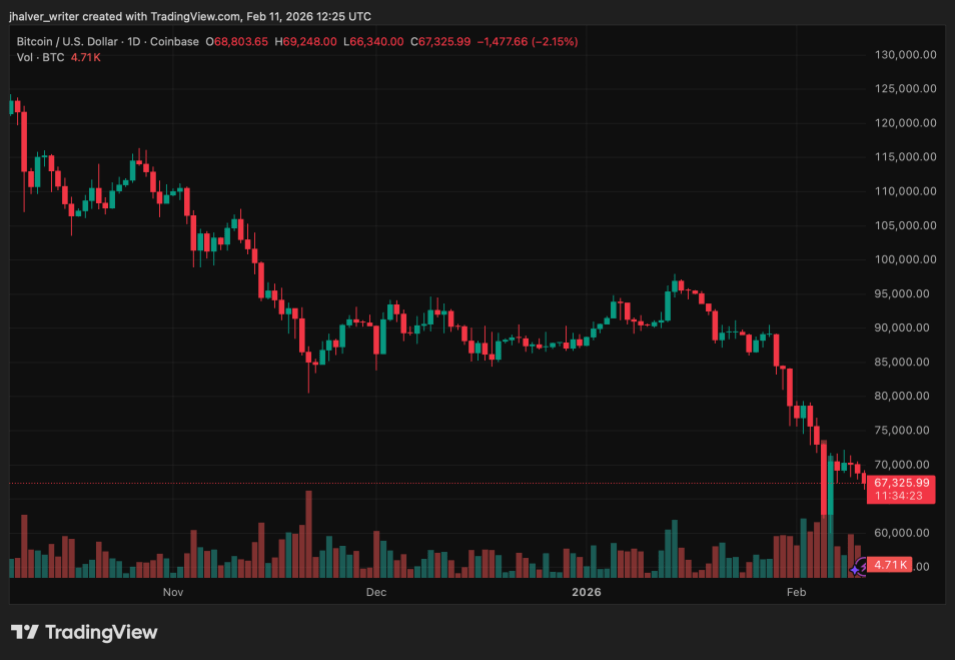
BTC's price trends to the downside on the daily chart. Source: BTCUSD on Tradingview

Stablecoin Yield at the Center of the Dispute

At the heart of the disagreement is whether stablecoin rewards resemble bank interest and, if so, should face similar restrictions.

Banking representatives from Goldman Sachs, JPMorgan, Bank of America, Wells Fargo, Citi, PNC, and U.S. Bank argued that yield-bearing stablecoins could trigger large-scale deposit outflows from traditional banks.

Banks presented a written set of “prohibition principles” calling for a ban on “any form of financial or non-financial consideration” offered to stablecoin holders. They contend that allowing such rewards could undermine lending capacity and disrupt the traditional deposit model.

Crypto firms, including Coinbase, Ripple, a16z, Paxos, and the Blockchain Association, pushed back. They argue that stablecoin rewards are a core feature of on-chain finance and necessary for fair competition with traditional financial products.

Industry representatives also said overly restrictive rules could slow innovation or drive activity outside the United States.

CLARITY Act Remains in Limbo

The debate over stablecoin yield has become a key obstacle for the CLARITY Act, which aims to define regulatory oversight for digital assets and clarify the roles of the SEC and the CFTC. The bill passed the House in 2025 but has not advanced in the Senate due to unresolved concerns around stablecoin regulation.

Although banks maintained a firm stance, participants noted a shift in tone. For the first time, banking representatives signaled limited openness to discussing potential exemptions for transaction-based rewards. However, disagreements over what qualifies as “permissible activities” remain unresolved.

The White House has urged both sides to reach an agreement by March 1 to preserve legislative momentum. Further discussions are expected in the coming days, though it is unclear whether another full-scale meeting will be held before the deadline.

Until a compromise is reached, stablecoin regulation and broader reform of the U.S. crypto market structure remain in a holding pattern.

Cover image in ChatGPT, BTCUSD chart on Tradingview

Perguntas relacionadas

QWhat was the main topic of disagreement in the White House meeting between banks and crypto firms?

AThe main topic was whether stablecoin issuers should be allowed to offer yield or rewards to holders.

QWhich major financial institutions argued against yield-bearing stablecoins?

ARepresentatives from Goldman Sachs, JPMorgan, Bank of America, Wells Fargo, Citi, PNC, and U.S. Bank argued against them.

QWhat is the name of the proposed legislation that is currently stalled due to this disagreement?

AThe proposed legislation is called the Digital Asset Market Clarity Act of 2025, also known as the CLARITY Act.

QWhat was the primary concern expressed by the banking representatives regarding stablecoin rewards?

AThey argued that yield-bearing stablecoins could trigger large-scale deposit outflows from traditional banks and undermine their lending capacity.

QWhat was the deadline given by the White House for the two sides to reach an agreement?

AThe White House urged both sides to reach an agreement by March 1 to preserve legislative momentum.

Leituras Relacionadas

Will the Next Crypto Bull Run Start with On-Chain Trading of SpaceX?

This article presents a scenario-based forecast for the crypto industry from 2026 to 2029, arguing that the next major cycle will be driven not by technological narratives but by legal access to real-world assets. The author predicts that by mid-2026, pre-IPO perpetual contracts for top private companies like SpaceX, OpenAI, and Anthropic on platforms like Hyperliquid will become the primary gateway for accessing quality assets, as most crypto-native tokens fail to capture real value. The much-hyped AI x Crypto intersection largely fails except for prediction markets, which thrive on betting on AI model supremacy. By 2027, public blockchain foundations are forced to choose between catering to retail speculation or building compliant infrastructure for institutions, with many opting for the latter. Growth in stablecoins and tokenized private credit/equity hits a "triple ceiling" due to regulatory and political uncertainty rather than market demand. The pivotal shift is forecast for 2028. A major liquidation event in pre-IPO perpetuals exposes the structural flaw of synthetic markets lacking a real underlying asset anchor. In response, regulatory changes finally allow the public solicitation of private securities resales to verified accredited investors. This creates a legitimate secondary market for real company equity, which then becomes the core asset class of the new bull market, relegating synthetic perps to a niche role. By 2029, the industry becomes "boring" but foundational. Tokens without claims on real cash flows or assets cease trading. Stablecoin growth is steady but politically capped. Crypto infrastructure fades from view as it gets absorbed into traditional finance backends. The article's central thesis is that the key bottleneck for crypto's next phase is legal and regulatory channels for real asset ownership, not technology.

marsbitHá 1h

Will the Next Crypto Bull Run Start with On-Chain Trading of SpaceX?

marsbitHá 1h

The Value Distribution of Stablecoins

**Summary: The Value Distribution of Stablecoins** The article argues that stablecoins are evolving from mere trading tools into broader channels for dollar access. It divides the stablecoin ecosystem into four layers to analyze how value is distributed: 1. **Issuance Layer:** Mints stablecoins, holds reserve assets, and captures the spread between reserve yield and user costs (e.g., Tether, Circle). This layer currently earns the largest profit margin. 2. **Infrastructure Layer:** Connects stablecoins to the traditional financial system, handling fiat on/off-ramps, banking integration, compliance (KYC/AML), and asset management (e.g., Bridge, BVNK). This is the "unglamorous" but critical work, building the essential bridges between crypto and real-world finance. 3. **Acquiring/Distribution Layer:** Integrates stablecoins into merchant systems, manages payment flows, and provides enterprise financial software (e.g., Stripe, Coinbase). They act as the access point for businesses. 4. **Application Layer:** The end-users and businesses that ultimately use stablecoins for payments, settlements, or as a store of value. They benefit from convenience but have little pricing power. The core thesis is that while the issuance layer currently dominates profits, the often-overlooked **infrastructure layer holds significant long-term potential**. The real challenge and barrier to mass adoption is not the on-chain transfer of stablecoins (which is simple), but the complex "last mile" integration into existing business workflows, banking systems, and regulatory frameworks across different countries. Companies in this layer are currently in a "land grab" phase, investing heavily to build networks, secure bank partnerships, and establish compliance pathways. While their position is currently pressured by the profitable issuers above and distribution platforms below, the article suggests that if stablecoins become a default financial rail for businesses, the infrastructure providers who have done the hard work of integration will ultimately gain strong pricing power and become entrenched, essential players.

marsbitHá 7h

The Value Distribution of Stablecoins

marsbitHá 7h

The Value Distribution of Stablecoins

The Value Distribution of Stablecoins The article argues that stablecoins are evolving from a mere trading tool into a broad "dollar channel." It analyzes the industry's value chain through four layers: 1. **Issuance Layer (e.g., Tether, Circle):** The top layer that mints stablecoins, holds reserve assets, and captures the thickest interest rate spread. 2. **Infrastructure Layer (e.g., Bridge, BVNK):** Connects stablecoins to the traditional financial system, handling critical but complex "dirty work" like fiat on/off-ramps, banking integration, compliance (KYC/AML), and cross-border settlement. 3. **Acquiring/Distribution Layer (e.g., Stripe, Coinbase):** Embeds stablecoins into merchant systems, manages payment flows, and integrates with enterprise software. 4. **Application Layer:** End-users and businesses that ultimately use stablecoins for payments, settlement, or storing value. The author posits that while the issuance layer currently captures the most profit, the most overlooked and potentially critical layer is infrastructure. The core challenge for stablecoin adoption isn't the on-chain transfer (which is simple), but bridging the gap between blockchain and the real-world financial system. This involves solving practical problems for businesses: fiat conversion, reconciliation, tax handling, and user onboarding. Infrastructure companies are currently in a difficult "land-grab" phase—building networks, securing banking relationships, and achieving compliance country-by-country. They face pressure from both the profitable issuance layer above and distribution platforms below. However, the author suggests this layer is building a crucial moat. Once stablecoins become a default business rail, the infrastructure players who have done the hard work of integration may gain significant, durable value and pricing power.

链捕手Há 7h

The Value Distribution of Stablecoins

链捕手Há 7h

Trading

Spot
Futuros

Artigos em Destaque

Como comprar HOUSE

Bem-vindo à HTX.com!Tornámos a compra de Housecoin (HOUSE) simples e conveniente.Segue o nosso guia passo a passo para iniciar a tua jornada no mundo das criptos.Passo 1: cria a tua conta HTXUtiliza o teu e-mail ou número de telefone para te inscreveres numa conta gratuita na HTX.Desfruta de um processo de inscrição sem complicações e desbloqueia todas as funcionalidades.Obter a minha contaPasso 2: vai para Comprar Cripto e escolhe o teu método de pagamentoCartão de crédito/débito: usa o teu visa ou mastercard para comprar Housecoin (HOUSE) instantaneamente.Saldo: usa os fundos da tua conta HTX para transacionar sem problemas.Terceiros: adicionamos métodos de pagamento populares, como Google Pay e Apple Pay, para aumentar a conveniência.P2P: transaciona diretamente com outros utilizadores na HTX.Mercado de balcão (OTC): oferecemos serviços personalizados e taxas de câmbio competitivas para os traders.Passo 3: armazena teu Housecoin (HOUSE)Depois de comprar o teu Housecoin (HOUSE), armazena-o na tua conta HTX.Alternativamente, podes enviá-lo para outro lugar através de transferência blockchain ou usá-lo para transacionar outras criptomoedas.Passo 4: transaciona Housecoin (HOUSE)Transaciona facilmente Housecoin (HOUSE) no mercado à vista da HTX.Acede simplesmente à tua conta, seleciona o teu par de trading, executa as tuas transações e monitoriza em tempo real.Oferecemos uma experiência de fácil utilização tanto para principiantes como para traders experientes.

287 Visualizações TotaisPublicado em {updateTime}Atualizado em 2026.06.02

Como comprar HOUSE

Discussões

Bem-vindo à Comunidade HTX. Aqui, pode manter-se informado sobre os mais recentes desenvolvimentos da plataforma e obter acesso a análises profissionais de mercado. As opiniões dos utilizadores sobre o preço de HOUSE (HOUSE) são apresentadas abaixo.

活动图片