NIGHT, with a Daily Trading Volume of Nearly $10 Billion, Actually Comes from the 'Outdated' Cardano?

marsbitPublicado em 2025-12-24Última atualização em 2025-12-24

Resumo

The NIGHT token, associated with Cardano's privacy-focused sidechain Midnight, recently achieved a 24-hour trading volume of nearly $10 billion shortly after its listing on major exchanges like Binance, OKX, and Bybit. Its price surged over 3x from around $0.025 to approximately $0.114 within two weeks, though it later corrected to about $0.08. Developed by Cardano’s parent company IOG, Midnight emphasizes "programmable data protection" using zero-knowledge proofs (ZKPs) accessible via TypeScript APIs, targeting enterprise adoption with optional privacy features. The project employs a dual-token model: NIGHT for governance and generating DUST, which serves as gas and privacy fees. A significant airdrop to 37 million addresses across multiple blockchains and partnerships with exchanges distributed nearly 30% of the total 24 billion NIGHT supply, fueling market excitement. Cardano plans to boost its ecosystem in 2026 with scalability upgrades, Midnight’s mainnet launch, native stablecoin integrations, and enhanced interoperability—all supported by increased funding for marketing, investments, and DeFi liquidity.

Recently, a token called NIGHT, which was listed for spot or contract trading on Bitget, Binance, OKX, and Bybit at the beginning of the month, saw its 24-hour global trading volume exceed $9 billion, approaching $10 billion. Bybit even surpassed Binance in 24-hour spot trading volume thanks to NIGHT.

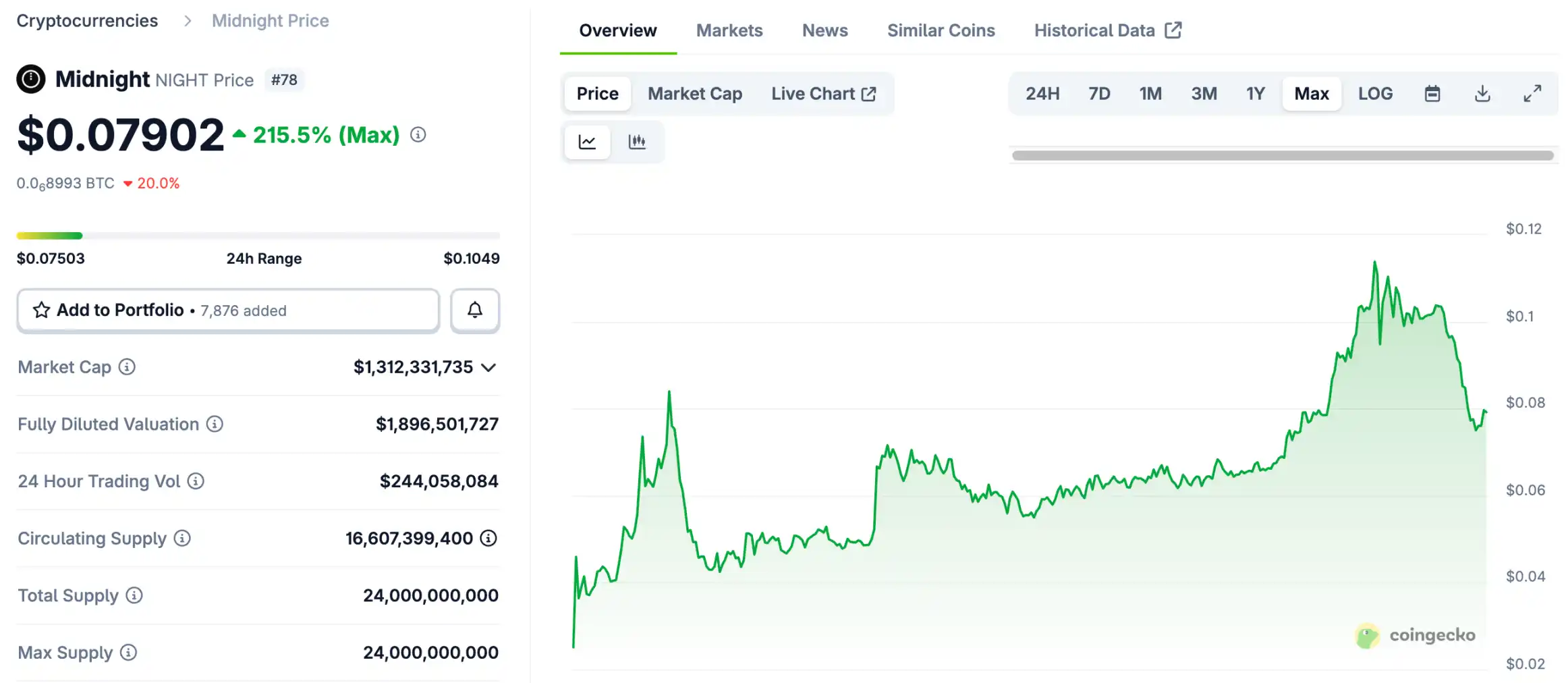
NIGHT was officially launched on December 9. According to CoinGecko data, the token's price rose from around $0.025 to nearly $0.114 in less than two weeks, a increase of over 3 times. Its FDV also once exceeded $2.5 billion, which could rank it within the top 50 by market capitalization. As of the time of writing, the price of NIGHT has retreated to around $0.08.
Such performance from a token simultaneously listed on several major exchanges is not entirely unexpected, but what's interesting is that NIGHT is the token of Midnight, a privacy sidechain of Cardano. A project labeled with both "Cardano" and "privacy" having such explosive power truly surprising to most.

What Makes Midnight "Valuable"?

Midnight is a sidechain developed by Input Output Global (IOG, the parent company of Cardano) with "programmable data protection" as its core selling point. It packages zero-knowledge proofs (ZKP) into a ready-to-use TypeScript API, allowing Web2 developers to implement "selective disclosure" on-chain without needing to learn cryptography. The entire network uses Cardano as its consensus foundation and Halo2 as its ZK backend, adopting a dual-token model (NIGHT+DUST). Its goal is to first implement the "data availability without visibility" that enterprises care about most, and then gradually expand to scenarios like DeFi, RWA, and on-chain compliant identity.

Overall, it doesn't seem particularly unique. It uses ZKP for privacy technology, but it doesn't natively protect privacy; instead, it makes privacy features optional to meet practical needs.

IOG first publicly announced the plan to develop Midnight in November 2022, but it wasn't until nearly two years later, in October 2024, that the testnet was launched. This is indeed IOG's style—it took almost 5 years from announcing that Cardano would introduce smart contracts to actually implementing them, finally gaining smart contract functionality in September 2021, long after the bull market had cooled.

In May of this year, Midnight established a foundation, with Fahmi Syed, former CFO of the Polkadot development team Parity, as its chairman, indicating that the first step towards TGE had been taken. Just two days after announcing the foundation's establishment, Cardano founder Charles Hoskinson revealed plans to airdrop tokens to 37 million addresses on 8 major blockchains, stating that the airdrop would only target retail investors, with no VC participation in the project.

Perhaps what truly ignited market sentiment was Midnight's "massive airdrop." In addition to the airdrop, Midnight also distributed nearly 3 billion NIGHT tokens in cooperation with Binance, OKX, and Bybit. This large-scale approach, which contrasts sharply with the recent popular ICO models, has garnered a positive market response.
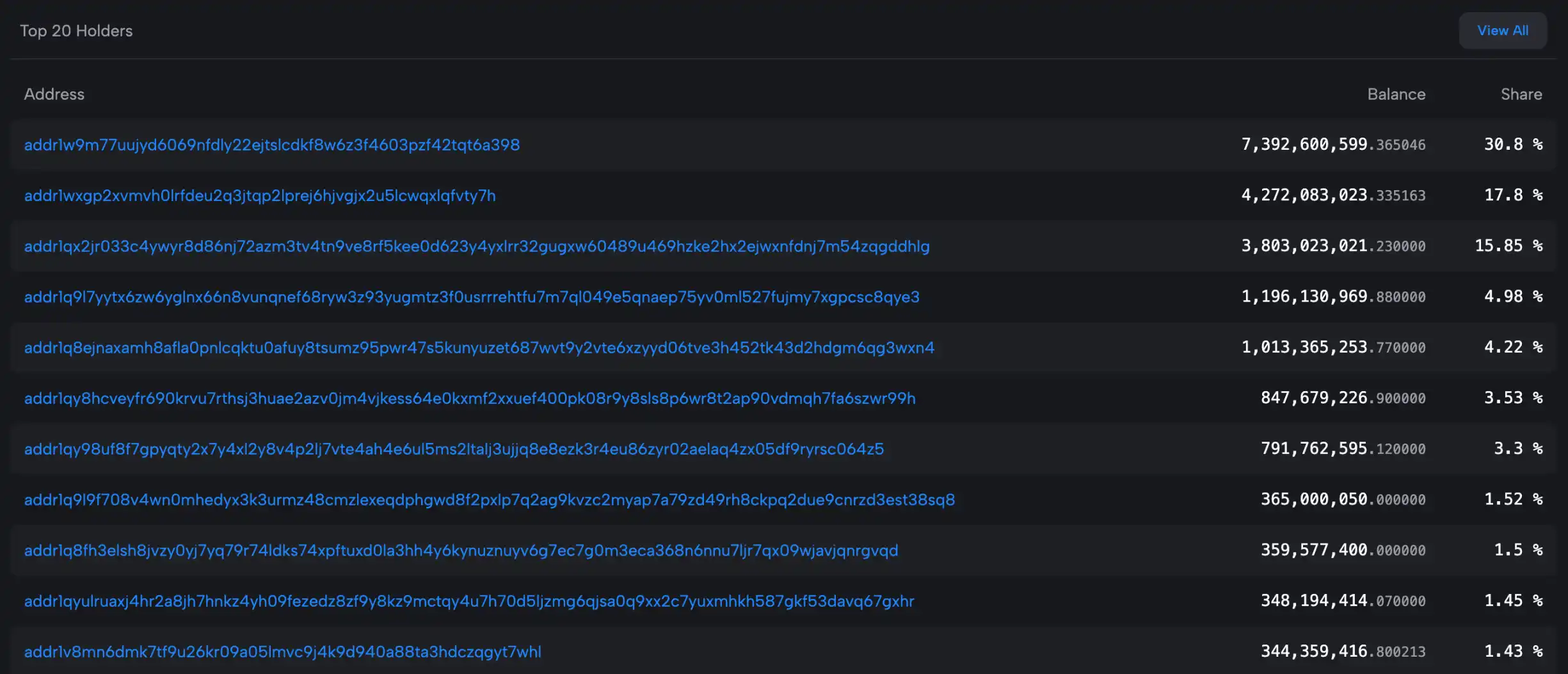
According to the block explorer, aside from the top three addresses which likely belong to IOG or the Midnight Foundation, the remaining top NIGHT holding addresses are relatively decentralized. Based on data provided on the official website, the author estimates that the tokens distributed through NIGHT's own airdrop and cooperative activities with exchanges amount to nearly one-third of the total supply (24 billion tokens), which can indeed be considered a massive effort.

Midnight's tokens are not limited to NIGHT; it uses a dual-token model of "NIGHT+DUST." This rare design is not due to some whimsical idea but rather to ensure compliance with regulatory requirements. NIGHT can be used for network governance, incentives, and generating another token, DUST. NIGHT itself is not related to privacy and supports on-chain auditing.

DUST, generated by holding NIGHT, is used to pay transaction fees, similar to Gas. Additionally, DUST will be used to pay for privacy fees—if one wants to add optional privacy features to on-chain transactions, they must pay DUST as a fee. DUST is automatically distributed to NIGHT holders' accounts as blocks are produced and "decays" over time to prevent malicious hoarding and network attacks.

Thus, Midnight's "equity" token, NIGHT, does not participate in paying on-chain transaction fees but exists solely as a governance token and for generating DUST, the actual on-chain fuel. DUST itself, as a "renewable resource" generated by NIGHT and decreasing over time, would be considered a resource rather than an asset under regulatory policies, meeting regulatory requirements in various regions.

Cardano to Heavily Invest in On-Chain Ecosystem Next Year

According to Cardano's roadmap, next year will be all about boosting on-chain activity.

First and foremost, as a foundation, Cardano will undergo a network upgrade to increase throughput to 1,000–10,000 TPS through parallel block processing and a layered structure for vertical scaling, while maintaining security and decentralization. Next is the mainnet launch of the protagonist of this article, Midnight. Cardano believes that Midnight's launch will bring more DeFi activity and TVL through its optional privacy features. Additionally, the Cardano Treasury will allocate funds to support the native issuance of major stablecoins like USDT and USDC on Cardano.

The last point, which the author finds most important, is that Cardano plans to focus on interoperability—not simple cross-chain functionality, but allowing users from other chains to interact directly with DApps on Cardano by consuming the Gas token of the source chain.

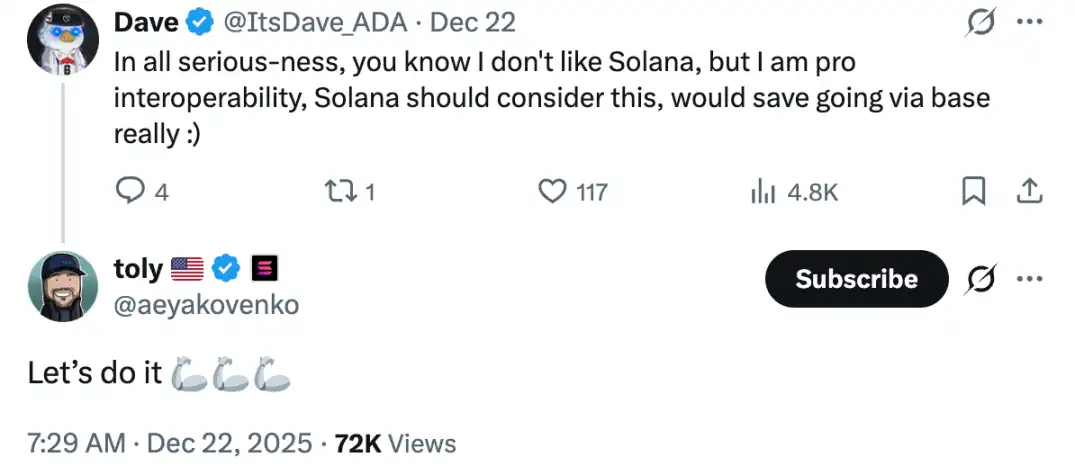
Last week, Cardano achieved atomic swaps between BTC and ADA through Fluid, not via cross-chain bridges, wrapped tokens, or centralized custody, but directly through underlying script-to-script transactions, which also somewhat benefits from Cardano's own UTXO ledger model. Two days ago, interactions between Cardano's stake pool operators and a Solana co-founder on X confirmed this development direction.
Accompanying the strategic and product plans is financial investment. The Cardano Foundation plans to increase its marketing budget by 12% and "make an appearance" at events like TOKEN2049 and Consensus. Venture Hub will also invest 2 million ADA to support startups and ecosystem projects. Furthermore, the Cardano Foundation plans to inject tens of millions of ADA into on-chain DeFi to improve liquidity and attract institutional participation.

From this perspective, driving up the price of NIGHT might just be the appetizer Cardano is serving for a series of plans. Perhaps in 2026, it's worth keeping an eye on this project, which launched its mainnet back in 2017 and has been almost forgotten by the mainstream Web3 market.


Criptomoedas em alta

Perguntas relacionadas

QWhat is the 24-hour trading volume of the NIGHT token and on which major exchanges was it recently listed?

AThe NIGHT token had a 24-hour trading volume of nearly $10 billion. It was recently listed on major exchanges including Bitget, Binance, OKX, and Bybit for spot or perpetual trading.

QWhich blockchain is the NIGHT token associated with, and what is the core feature of its parent project, Midnight?

AThe NIGHT token is the native token of Midnight, which is a privacy-focused sidechain of Cardano. The core feature of Midnight is 'programmable data protection' using zero-knowledge proofs (ZKPs) to enable selective data disclosure.

QWhat is the unique dual-token model used by the Midnight network and what are the roles of each token?

AMidnight uses a dual-token model consisting of NIGHT and DUST. NIGHT is the governance token used for staking and generating DUST. DUST acts as the gas token for paying transaction fees and for optional privacy features on the network.

QWhat was a major market event that significantly boosted interest in the NIGHT token?

AA major event that boosted market interest was a large-scale airdrop of NIGHT tokens to 37 million addresses across 8 major blockchains, specifically targeting retail users with no VC participation. Additionally, nearly 3 billion NIGHT were distributed through collaborations with Binance, OKX, and Bybit.

QAccording to the article, what are some of Cardano's key plans for improving its ecosystem in the coming year?

ACardano's key plans for the coming year include a network upgrade to increase throughput to 1,000-10,000 TPS, the mainnet launch of Midnight, treasury funding for the native issuance of major stablecoins like USDT and USDC on Cardano, and a focus on interoperability to allow users from other chains to interact with Cardano dApps directly.

Leituras Relacionadas

Within Strategy's Framework, STRC's Dividend Yield Remains at 12% as Share Price Stays Below Par Value

Michael Saylor, Executive Chairman of Strategy (MSTR), confirmed that the dividend rate for its STRC perpetual preferred shares will remain at 12.00% through August 2026. The rate has increased from 9% at its July 2025 launch to the current high via a "ratchet" mechanism, which permanently raises the rate by 0.5% whenever the share price falls below $95. This mechanism is intended to push the price back toward its $100 par value and support Strategy's "at-the-market" (ATM) program for issuing new shares to fund Bitcoin purchases. However, the mechanism has not worked as intended. STRC shares closed at $89.46 on July 31, remaining about 10-11% below par value despite the record-high dividend. Competition from rival Strive's higher-yielding SATA securities has pressured demand. The persistent discount has forced Strategy to suspend new STRC issuances via its ATM program, limiting this funding channel for Bitcoin acquisitions. STRC's struggles reflect Bitcoin's own volatility, as the preferred shares historically move in tandem. Analysts have warned the ratchet structure carries long-term, one-way risk. A law firm is investigating Strategy's ability to maintain dividend payments if Bitcoin's price stays low. Retail investors own roughly 83% of outstanding STRC shares, a group seen as prone to panic selling during downturns. In response, Strategy has established financial reserves, including a liquidity cushion covering about 26 months of dividend/interest obligations, and a $2 billion share buyback program alongside a Bitcoin monetization framework, though the company emphasized it is not obligated to sell any Bitcoin.

cryptonews.ruHá 27m

Within Strategy's Framework, STRC's Dividend Yield Remains at 12% as Share Price Stays Below Par Value

cryptonews.ruHá 27m

Analyst: Bitcoin's Price Will Drop to $60k in August, Then Rebound to $70k

Financial analyst Andrey Poroshin has provided a new forecast for Bitcoin's price dynamics in August. Poroshin, an analyst at the Bitbanker exchange, expects the cryptocurrency market to experience a downturn this month, with prices retesting the $60,000 level due to a lack of supportive macroeconomic catalysts. He noted that the recent US Federal Reserve decision to hold interest rates did not significantly impact the market, while inflation remains above the 2% target. Poroshin stated that Bitcoin is ending July under pressure from moderate volatility and a lack of new macroeconomic stimuli, leading to continued market caution. According to his base scenario, Bitcoin will drop to a range of $60,000 to $62,000 before recovering to $70,000. He pointed out that even $70,000 remains below the cost of mining in the US, which has prompted some miners to shift towards AI data center operations. Poroshin cited the winding down of BitMEX's operations as a potential catalyst for a price rebound, suggesting the exit of weaker players often coincides with market reversals and reduced short-term selling pressure. He believes Bitcoin is currently less susceptible to geopolitical shocks, such as the Iran-US conflict, and does not expect significant market changes in August related to the pending CLARITY Act. Looking ahead, Poroshin forecasts that September will bring more active price fluctuations driven by potential Fed rate decisions and possible discussions or approval of the CLARITY Act.

cryptonews.ruHá 28m

Analyst: Bitcoin's Price Will Drop to $60k in August, Then Rebound to $70k

cryptonews.ruHá 28m

Trading

Spot

Artigos em Destaque

Como comprar O

Bem-vindo à HTX.com!Tornámos a compra de O1 exchange (O) simples e conveniente.Segue o nosso guia passo a passo para iniciar a tua jornada no mundo das criptos.Passo 1: cria a tua conta HTXUtiliza o teu e-mail ou número de telefone para te inscreveres numa conta gratuita na HTX.Desfruta de um processo de inscrição sem complicações e desbloqueia todas as funcionalidades.Obter a minha contaPasso 2: vai para Comprar Cripto e escolhe o teu método de pagamentoCartão de crédito/débito: usa o teu visa ou mastercard para comprar O1 exchange (O) instantaneamente.Saldo: usa os fundos da tua conta HTX para transacionar sem problemas.Terceiros: adicionamos métodos de pagamento populares, como Google Pay e Apple Pay, para aumentar a conveniência.P2P: transaciona diretamente com outros utilizadores na HTX.Mercado de balcão (OTC): oferecemos serviços personalizados e taxas de câmbio competitivas para os traders.Passo 3: armazena teu O1 exchange (O)Depois de comprar o teu O1 exchange (O), armazena-o na tua conta HTX.Alternativamente, podes enviá-lo para outro lugar através de transferência blockchain ou usá-lo para transacionar outras criptomoedas.Passo 4: transaciona O1 exchange (O)Transaciona facilmente O1 exchange (O) no mercado à vista da HTX.Acede simplesmente à tua conta, seleciona o teu par de trading, executa as tuas transações e monitoriza em tempo real.Oferecemos uma experiência de fácil utilização tanto para principiantes como para traders experientes.

459 Visualizações TotaisPublicado em {updateTime}Atualizado em 2026.06.29

Como comprar O

Como comprar PROS

Bem-vindo à HTX.com!Tornámos a compra de Pharos (PROS) simples e conveniente.Segue o nosso guia passo a passo para iniciar a tua jornada no mundo das criptos.Passo 1: cria a tua conta HTXUtiliza o teu e-mail ou número de telefone para te inscreveres numa conta gratuita na HTX.Desfruta de um processo de inscrição sem complicações e desbloqueia todas as funcionalidades.Obter a minha contaPasso 2: vai para Comprar Cripto e escolhe o teu método de pagamentoCartão de crédito/débito: usa o teu visa ou mastercard para comprar Pharos (PROS) instantaneamente.Saldo: usa os fundos da tua conta HTX para transacionar sem problemas.Terceiros: adicionamos métodos de pagamento populares, como Google Pay e Apple Pay, para aumentar a conveniência.P2P: transaciona diretamente com outros utilizadores na HTX.Mercado de balcão (OTC): oferecemos serviços personalizados e taxas de câmbio competitivas para os traders.Passo 3: armazena teu Pharos (PROS)Depois de comprar o teu Pharos (PROS), armazena-o na tua conta HTX.Alternativamente, podes enviá-lo para outro lugar através de transferência blockchain ou usá-lo para transacionar outras criptomoedas.Passo 4: transaciona Pharos (PROS)Transaciona facilmente Pharos (PROS) no mercado à vista da HTX.Acede simplesmente à tua conta, seleciona o teu par de trading, executa as tuas transações e monitoriza em tempo real.Oferecemos uma experiência de fácil utilização tanto para principiantes como para traders experientes.

483 Visualizações TotaisPublicado em {updateTime}Atualizado em 2026.06.29

Como comprar PROS

O que é VERONA

I. Introdução ao Projeto VERONA é uma blockchain construída para todos, em todo o lado, através da abstração da cadeia. Utilizando a sua camada de Abstração Generalizada, a VERONA distingue-se por integrar funcionalidades complexas de blockchain, como contas, assinaturas e interoperabilidade, diretamente ao nível do protocolo. Esta abordagem permite a interação com aplicações de blockchain sem a necessidade de compreender as tecnologias subjacentes.1) Informação Básica Nome: VERONA (VERONA)III. Links Relacionados Link do site oficial: https://xion.burnt.com/ Whitepaper: https://xion.burnt.com/whitepaper.pdf Exploradores: https://explorer.burnt.com/ Mídias Sociais: https://x.com/burnt_xion Nota: A introdução ao projeto provém dos materiais publicados ou fornecidos pela equipa oficial do projeto, que é apenas para referência e não constitui aconselhamento de investimento. A HTX não se responsabiliza por quaisquer perdas diretas ou indiretas resultantes.

1.2k Visualizações TotaisPublicado em {updateTime}Atualizado em 2026.06.22

O que é VERONA

Discussões

Bem-vindo à Comunidade HTX. Aqui, pode manter-se informado sobre os mais recentes desenvolvimentos da plataforma e obter acesso a análises profissionais de mercado. As opiniões dos utilizadores sobre o preço de A (A) são apresentadas abaixo.

活动图片













