New protocol targets redemption delays in $20B tokenized market

cointelegraphPublicado em 2025-12-17Última atualização em 2025-12-17

Resumo

Uniform Labs, a blockchain infrastructure firm founded by Standard Chartered veterans, has launched Multiliquid, a protocol designed to solve liquidity issues in the $20 billion tokenized real-world asset (RWA) market. The system enables 24/7 conversions between tokenized money market funds and major stablecoins like USDC and USDT, allowing institutional investors to access on-demand liquidity instead of being limited by traditional redemption windows. The protocol responds to the U.S. GENIUS Act, which prohibits stablecoin issuers from paying yield directly. Multiliquid instead facilitates yield generation through regulated tokenized funds. The launch comes as tokenized money market funds have grown rapidly—from $770 million to nearly $9 billion in two years—but face liquidity risks, especially if on-chain redemptions exceed off-chain liquidity during market stress. The Bank for International Settlements has warned that these funds, often used as crypto collateral, could introduce operational risks if not properly managed.

Uniform Labs, a blockchain infrastructure company founded by veterans of Standard Chartered, has launched a new protocol designed to address persistent liquidity constraints in the emerging tokenization market.

Announced on Wednesday, Uniform Labs unveiled Multiliquid, a protocol designed to enable 24/7 conversions between tokenized money market funds and major stablecoins, including USDC (USDC) and USDt (USDT).

At launch, Multiliquid supports integrations with tokenized Treasury assets issued by Wellington Management and other asset managers, allowing institutional holders to access on-demand liquidity rather than relying on issuer-controlled redemption windows.

The launch comes as tokenized real-world assets (RWAs) continue to expand, with the market currently valued at around $20 billion, according to industry data. While that figure is below a peak of over $30 billion earlier this year, growth has remained steady, particularly in tokenized Treasury products.
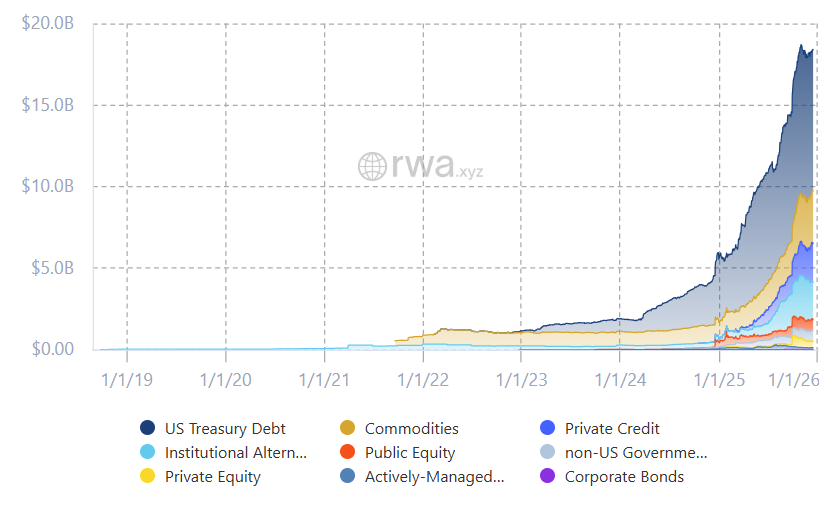
Total RWA market size, excluding stablecoins. Source: RWA.xyz

Uniform Labs said the protocol was developed in response to the GENIUS Act, recent US stablecoin legislation that establishes a regulatory framework for payment stablecoins but prohibits issuers from paying yield directly to holders.

In that regulatory environment, the company said, Multiliquid is designed to keep stablecoins as pure payment instruments while enabling yield to be generated through regulated tokenized money market funds and other RWAs connected via its swap layer.

Related: US banks could soon issue stablecoins under FDIC plan to implement GENIUS Act

Liquidity risks shadow the rapid growth of tokenized money market funds

Tokenized money market funds have emerged as one of the fastest-growing segments of the RWA landscape, alongside private credit and tokenized US Treasury bonds. However, their rapid growth has also exposed a persistent weakness: Liquidity often remains constrained by traditional redemption processes, limiting their usefulness in round-the-clock onchain markets.

That concern was recently highlighted by the Bank for International Settlements (BIS), which acknowledged the expansion of tokenized money market funds — from $770 million to nearly $9 billion in assets in about two years — but warned that the sector faces material liquidity risks.

As these funds increasingly serve as a source of collateral in crypto markets, the BIS noted that they could introduce operational and liquidity risks if onchain demand for redemptions outpaces the availability of offchain liquidity, particularly during periods of market stress.
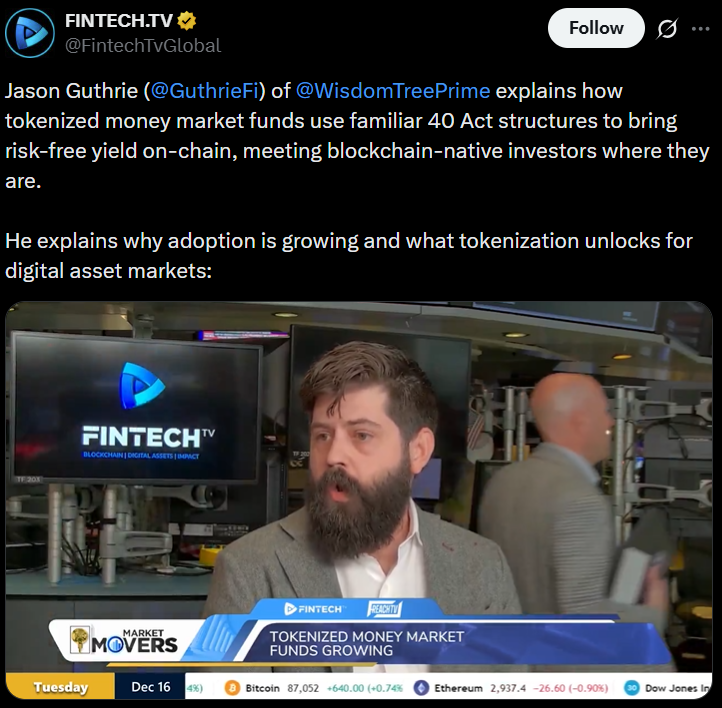
Source: Fintech.TV

Their use as collateral could expand as more financial institutions begin to view tokenized funds as a form of “cash as an asset,” potentially offsetting growth in stablecoins, according to JPMorgan strategist Teresa Ho.

Magazine: The one thing these 6 global crypto hubs all have in common...

Criptomoedas em alta

Leituras Relacionadas

Chainlink Adds 6,100 Wallets In Two Days In Strongest Growth Burst Of 2026

Chainlink experienced its strongest wallet growth burst of 2026, adding approximately 6,100 new addresses in just two days. This notable increase in network participation occurred despite LINK's price trading in a difficult market environment alongside other altcoins. The surge in new wallets is seen as a positive signal for user and investor interest, suggesting the ecosystem continues to attract attention even when price action is weak. Wallet growth is considered a useful metric as it measures real participation rather than just price speculation. For an infrastructure project like Chainlink, whose value is tied to oracle services, data, and real-world assets, such growth indicates ongoing engagement with its core technology. However, the article notes that this data point, while constructive, is not conclusive on its own. The nature of the new wallets—whether they belong to small holders, new users, or exchange-related entities—remains unclear. The report maintains a balanced perspective, stating that while this wallet growth is a positive adoption signal for LINK bulls, it does not guarantee a price increase. Skeptics may question whether this user growth translates into value capture for the token. The key takeaway is that this burst of activity should be monitored alongside other factors like transaction volume, price structure, and broader market trends for a more complete picture. The signal requires follow-through in price and demand to be fully validated.

bitcoinistHá 40m

Chainlink Adds 6,100 Wallets In Two Days In Strongest Growth Burst Of 2026

bitcoinistHá 40m

In the AI Era, What's Left for Bitcoin?

As Bitcoin falls below $60,000, the author reflects on the relationship between AI and Bitcoin, seeing them as two sides of the same coin. In the AI era, the cost of generating content has plummeted, making fake text, images, and videos increasingly easy and cheap to produce. This has led to a fundamental shift: while AI dramatically lowers the cost of information production, it also undermines trust and authenticity online. What becomes truly valuable is not more content, but the ability to verify what is real—"verifiability." This perspective offers a new lens for Bitcoin. Its massive energy consumption, often criticized as wasteful, is reinterpreted. While AI burns energy to enhance "capability" and efficiency, Bitcoin burns energy to produce "verifiability." Its purpose is not to be trusted but to enable a system where no trust in intermediaries—banks, platforms, or developers—is needed. Every transaction and the entire ledger's history is secured by cryptography and a decentralized network of nodes, making it independently verifiable. AI cannot forge a transaction on the Bitcoin network because the system is designed for proof, not generation. The author draws a historical parallel to the Renaissance: the printing press drastically reduced the cost of copying knowledge, while double-entry bookkeeping reduced the cost of trust in commerce. Today, AI is the new printing press, reducing content creation costs to near zero. Blockchain, and Bitcoin as its pioneer, may be the modern equivalent of double-entry bookkeeping—a foundational technology for verifying digital asset ownership and historical records without centralized authorities. Thus, AI and blockchain are not competitors. AI lowers the cost of creation; blockchain lowers the cost of verification. In an age where AI can generate anything, true scarcity may lie not in more content, but in independently verifiable facts. Whether the market will reprice Bitcoin accordingly remains uncertain, but its core value proposition as a "machine for producing verifiability" becomes strikingly relevant.

marsbitHá 2h

In the AI Era, What's Left for Bitcoin?

marsbitHá 2h

In the Age of AI, What's Left for Bitcoin?

Author: Sevclub, Seven Research Amid Bitcoin's recent drop below $60k, the author reflects on a growing sense that AI and Bitcoin are two sides of the same coin. Today, encountering any content triggers a new default question: "Was this made by AI?" The cost of generating convincing text, images, and video is now negligible. While the internet lowered information *distribution* costs, AI is crashing information *production* costs to near zero. The consequence is a flood of content where truth and falsehood are increasingly indistinguishable. In this environment, what becomes truly valuable is not more information, but the ability to verify what is real—"verifiability." This reframes the common criticism that Bitcoin "wastes electricity." AI consumes power to produce "capability" (e.g., more powerful models). Bitcoin consumes power to produce something else: "verifiability." Bitcoin's core purpose isn't about belief or trust in any institution, developer, or even its creator. It's about enabling independent verification. Every bitcoin's origin, every transaction, and the integrity of the entire ledger are secured by mathematics, cryptography, and a global network of nodes. AI can fabricate convincing media, but it cannot falsify a transaction on the Bitcoin network. The expended energy makes篡改历史 (tampering with history) prohibitively expensive, purchasing a globally verifiable ledger. The author draws a historical parallel to the Renaissance. The printing press drastically reduced the cost of copying knowledge, while double-entry bookkeeping reduced the cost of trust in commerce—one enabled creation, the other verification. Today, AI is the new printing press, driving content production costs toward zero. The question becomes: what is this era's "double-entry bookkeeping"? Blockchain appears to be the leading candidate. It doesn't verify which news is true or which image is real, but it provides a foundational layer for independently verifying asset ownership and historical records in the digital realm without centralized authorities. Therefore, AI and blockchain are not in competition. AI lowers the cost of *generation*. Blockchain (and Bitcoin as a prime example) lowers the cost of *verification*. One creates, the other proves. Whether Bitcoin ultimately succeeds remains uncertain, facing potential challenges from quantum computing, regulation, and technical evolution. However, the author now sees it less as a "machine for making bitcoin" and more as a "machine for making verifiability." In an age where AI can generate anything, true scarcity may no longer be "more content," but "more independently verifiable facts." Whether the market will price this accordingly is a separate question.

链捕手Há 2h

In the Age of AI, What's Left for Bitcoin?

链捕手Há 2h

Trading

Spot

Artigos em Destaque

Como comprar NASDAQ100

Bem-vindo à HTX.com!Tornámos a compra de Nasdaq-100 Index (NASDAQ100) simples e conveniente.Segue o nosso guia passo a passo para iniciar a tua jornada no mundo das criptos.Passo 1: cria a tua conta HTXUtiliza o teu e-mail ou número de telefone para te inscreveres numa conta gratuita na HTX.Desfruta de um processo de inscrição sem complicações e desbloqueia todas as funcionalidades.Obter a minha contaPasso 2: vai para Comprar Cripto e escolhe o teu método de pagamentoCartão de crédito/débito: usa o teu visa ou mastercard para comprar Nasdaq-100 Index (NASDAQ100) instantaneamente.Saldo: usa os fundos da tua conta HTX para transacionar sem problemas.Terceiros: adicionamos métodos de pagamento populares, como Google Pay e Apple Pay, para aumentar a conveniência.P2P: transaciona diretamente com outros utilizadores na HTX.Mercado de balcão (OTC): oferecemos serviços personalizados e taxas de câmbio competitivas para os traders.Passo 3: armazena teu Nasdaq-100 Index (NASDAQ100)Depois de comprar o teu Nasdaq-100 Index (NASDAQ100), armazena-o na tua conta HTX.Alternativamente, podes enviá-lo para outro lugar através de transferência blockchain ou usá-lo para transacionar outras criptomoedas.Passo 4: transaciona Nasdaq-100 Index (NASDAQ100)Transaciona facilmente Nasdaq-100 Index (NASDAQ100) no mercado à vista da HTX.Acede simplesmente à tua conta, seleciona o teu par de trading, executa as tuas transações e monitoriza em tempo real.Oferecemos uma experiência de fácil utilização tanto para principiantes como para traders experientes.

29 Visualizações TotaisPublicado em {updateTime}Atualizado em 2026.06.18

Como comprar NASDAQ100

O que é RE

I. Introdução ao Projeto1. O Que É o Re Protocol?O Re Protocol é um protocolo de resseguro descentralizado que conecta capital em stablecoin a mercados de resseguro regulamentados no mundo real. Os utilizadores depositam stablecoins no contrato inteligente da Insurance Capital Layer (ICL). Os fundos depositados são utilizados para apoiar contratos de resseguro totalmente colateralizados, e os depositantes recebem recompensas em troca. O rendimento é derivado de fontes tanto on-chain como off-chain, além de spreads específicos de tokens. O protocolo opera em várias cadeias, incluindo Ethereum, Avalanche e Arbitrum.2. Como Funciona o Re Protocol?Os utilizadores depositam ativos aprovados (como USDC, USDe, sUSDe) em contratos inteligentes ICL para cunhar um de dois tokens que geram rendimento. Os fundos são agregados diariamente em um cofre de custódia Fireblocks, mantido sob controle de múltiplas assinaturas, com saldos publicados diariamente para oráculos Chainlink. Quando os resseguradores licenciados retiram fundos de acordo com uma Surplus Note, uma parte do capital é transferida para contas de confiança de resseguro §114 domiciliadas nos EUA, servindo como colateral em conformidade para as apólices do ressegurador. À medida que os contratos de resseguro vencem e a equipe atuarial libera capital, a liquidez flui de volta para o protocolo, apoiando os resgates de reUSD e acumulando rendimento para ambos os tokens.O protocolo oferece dois tokens correspondentes a diferentes tranches na estrutura de capital:reUSD (Basis-Plus, Tranche Sênior): O rendimento é uma taxa misturada (média ponderada da taxa SOFR e da taxa sUSDe de 7 dias) mais um spread de 250 pontos base. Oferece maior liquidez e suporta resgates instantâneos quando há capacidade disponível.reUSDe (Insurance Alpha, Tranche Júnior): O rendimento é a mesma taxa misturada mais um spread de 850 pontos base, em troca de absorver perdas antes da tranche sênior. Os resgates são trimestrais. O reUSDe tem um período mínimo de detenção de pelo menos 40 dias.Camadas de Proteção de Capital: O próprio capital do ressegurador absorve as perdas primeiro, seguido pelo reUSDe, com o reUSD como a tranche mais sênior protegida pelas duas camadas abaixo dela.3. Quem Fundou o Re Protocol?Karn Saroya, Co-Fundador e CEO, graduou-se no MIT. Anteriormente, fundou a plataforma insurtech apoiada por capital de risco Cover (uma corretora licenciada, que mais tarde cessou operações) e anteriormente fundou o aplicativo de moda Stylekick (adquirido pela Shopify em 2015). Ele também trabalhou anteriormente em consultoria de serviços financeiros.Detalhes de Financiamento:Setembro de 2022: O Re completou uma rodada de Seed de $14 milhões liderada pela Tribe Capital (incubada através do seu Tribe Crypto Labs), com participação da Framework Ventures, Morgan Creek Digital, Defy VC, Stratos, Exor, SiriusPoint, entre outros.Maio de 2024: Completou uma rodada de financiamento de $7 milhões liderada pela Electric Capital.4. Tokenomics do Re ProtocolRE é o token de governança do Re Protocol com um fornecimento total fixo de 1 bilhão de tokens, sem mecanismo inflacionário e sem plano de cunhagem contínua. O token é utilizado para governança através de um modelo de stake-to-vote, cobrindo acesso ao mercado, orçamentos de incentivos, staking e delegação, comitês, atualizações do protocolo e capital de resiliência compartilhado.Distribuição de tokens:Ecosistema (50%): Usado para recompensas de staking, participação na governança, liquidez, integrações, subsídios, expansão de mercado e crescimento do ecossistema. 159,6 milhões de tokens estão em circulação no TGE, com o restante sujeito a um vesting linear ao longo de 48 meses.Contribuidores Principais (20%): Inclui contribuintes principais e consultores que constroem o protocolo, sistemas de governança, integrações, estruturas de risco e infraestrutura de mercado; 12 meses de cliff mais 36 meses de vesting linear.Investidores (17%): Apoios estratégicos; 12 meses de cliff mais 36 meses de vesting linear.Reserva para Desenvolvimento do Ecossistema (13%): Reserva de longo prazo para futuras contribuições e contribuintes.5. Cronograma de Principais MarcosSetembro de 2022: O Re completou uma rodada de Seed de $14 milhões, estreou publicamente e se posicionou como o primeiro protocolo de resseguro alimentado por blockchain, inicialmente construído na Avalanche.Maio de 2024: Completou uma rodada de financiamento de $7 milhões liderada pela Electric Capital.18 de junho de 2026: O token $RE foi oficialmente lançado.​II. Informação sobre o TokenNome do token: RE(Re)III. Links RelacionadosWebsite:https://re.xyz/Exploradores:https://etherscan.io/token/0x526526528f35ac738177003b8773b402b8df8143Twitter:https://twitter.com/reNota: A introdução ao projeto provém dos materiais publicados ou fornecidos pela equipa oficial do projeto, que é apenas para referência e não constitui aconselhamento de investimento. A HTX não se responsabiliza por quaisquer perdas diretas ou indiretas resultantes.

270 Visualizações TotaisPublicado em {updateTime}Atualizado em 2026.06.29

O que é RE

Como comprar RE

Bem-vindo à HTX.com!Tornámos a compra de Re (RE) simples e conveniente.Segue o nosso guia passo a passo para iniciar a tua jornada no mundo das criptos.Passo 1: cria a tua conta HTXUtiliza o teu e-mail ou número de telefone para te inscreveres numa conta gratuita na HTX.Desfruta de um processo de inscrição sem complicações e desbloqueia todas as funcionalidades.Obter a minha contaPasso 2: vai para Comprar Cripto e escolhe o teu método de pagamentoCartão de crédito/débito: usa o teu visa ou mastercard para comprar Re (RE) instantaneamente.Saldo: usa os fundos da tua conta HTX para transacionar sem problemas.Terceiros: adicionamos métodos de pagamento populares, como Google Pay e Apple Pay, para aumentar a conveniência.P2P: transaciona diretamente com outros utilizadores na HTX.Mercado de balcão (OTC): oferecemos serviços personalizados e taxas de câmbio competitivas para os traders.Passo 3: armazena teu Re (RE)Depois de comprar o teu Re (RE), armazena-o na tua conta HTX.Alternativamente, podes enviá-lo para outro lugar através de transferência blockchain ou usá-lo para transacionar outras criptomoedas.Passo 4: transaciona Re (RE)Transaciona facilmente Re (RE) no mercado à vista da HTX.Acede simplesmente à tua conta, seleciona o teu par de trading, executa as tuas transações e monitoriza em tempo real.Oferecemos uma experiência de fácil utilização tanto para principiantes como para traders experientes.

83 Visualizações TotaisPublicado em {updateTime}Atualizado em 2026.06.29

Como comprar RE

Discussões

Bem-vindo à Comunidade HTX. Aqui, pode manter-se informado sobre os mais recentes desenvolvimentos da plataforma e obter acesso a análises profissionais de mercado. As opiniões dos utilizadores sobre o preço de A (A) são apresentadas abaixo.

活动图片