New Crypto Market Structure Bill Draft Could Be Ready By Week’s End, Senator Scott Says

bitcoinistPublicado em 2026-03-19Última atualização em 2026-03-19

Resumo

Senator Tim Scott announced that a new draft of the crypto market structure bill (CLARITY Act) could be ready by the end of this week. Speaking at the DC Blockchain Summit 2026, Scott highlighted progress made over the past month, crediting White House involvement for breaking a two-month deadlock. Key issues include controversial policies around DeFi restrictions and stablecoin yield payments, which have caused tension between the banking and crypto industries. The bill previously stalled due to opposition to prohibiting interest payments to passive token holders. Scott expressed optimism, stating that bipartisan efforts are addressing remaining challenges, including DeFi, ethics, and AML regulations. He emphasized the importance of clear legislation and artificial deadlines to maintain momentum.

Senator Tim Scott discussed the impact of digital asset legislation and the progress on the highly anticipated crypto market structure bill on Tuesday, revealing that a fresh draft could be ready by the end of the week.

Crypto Market Structure Bill Sees Progress

Speaking at the DC Blockchain Summit 2026, Senate Banking Committee Chairman Tim Scott highlighted the “powerful impact for good” that the landmark stablecoin legislation, the GENIUS Act, has already had in the market.

Scott emphasized the importance of clear legislation, noting that politicians and bureaucrats often act arbitrarily without any rules of the road. “The market structure gives us the rules of the road for what I believe is going to be the most powerful force for good for kids like me growing up in poverty in a single-parent household,” he stated.

When asked about the status of the crypto market structure bill, known as the CLARITY Act, he humorously said, “Let us pray,” before revealing that significant progress has been made over the past month, largely due to the White House’s involvement.

For context, the crypto market structure bill has been stalled for two months since the Senate Banking Committee published its draft in mid-January. The text included several controversial policies, including significant restrictions for DeFi and the payment of interest on stablecoins.

The latter has become a major point of contention between the banking and crypto industries. As reported by Bitcoinist, the banking side has criticized the GENIUS Act for loopholes that could put the financial system at risk, arguing that allowing interest payments on stablecoins could distort market dynamics.

To address this issue, banks urged lawmakers to include language in the CLARITY Act to ban yield on stablecoins from crypto exchanges, brokers, and related entities, rather than only issuers.

The Senate Banking Committee’s draft proposed that issuers offer rewards for specific actions, such as account openings and cashback. However, it also prohibited interest payments to passive token holders, which ultimately delayed the bill’s January markup session due to backlash.

After weeks of negotiation, the US President’s Council of Advisors on Digital Assets stepped in, holding multiple meetings to negotiate key issues that have stalled the crypto market structure bill.

“I tell you, we have made a lot of progress over the last 30 days. Thank God for the White House getting involved. Patrick Witt has been incredibly helpful,” he told the DC Blockchain Summit.

Following the recent negotiations, Scott explained, lawmakers now have a bipartisan coalition working on “the more important issues that remain undone,” but added that they are making progress “on all the other parts that we don’t hear about,” including issues related to DeFi, ethics, and Anti-Money Laundering (AML).

CLARITY Could Come Soon

Speaking about the proposed deadlines that have not been met throughout the past two months, Scott shared that he had “some artificial deadlines (...) put in place to kind of force the conversation because it had been languishing for too long.”

“We missed lots of my artificial deadlines, but I put them in place so that we would actually have the conversation and create a sense of urgency because I do believe that at some point, politics takes over everything,” he affirmed.

The senator called the stablecoin yield compromise the “largest publicly celebrated challenge” lawmakers and crypto legislation have faced, but affirmed that “big Mo’ momentum is finally on our side, and we are heading in the right direction,” with a new, amended draft for the crypto bill potentially being completed this week.

“I believe that this week we will have the first proposal in my hands to take a look at. And if that actually happens before the end of this week, and I think that it will, we’ll at least know that the sketch looks like the person. And if that’s the case, I think we’re going to be in much better shape”, he concluded.
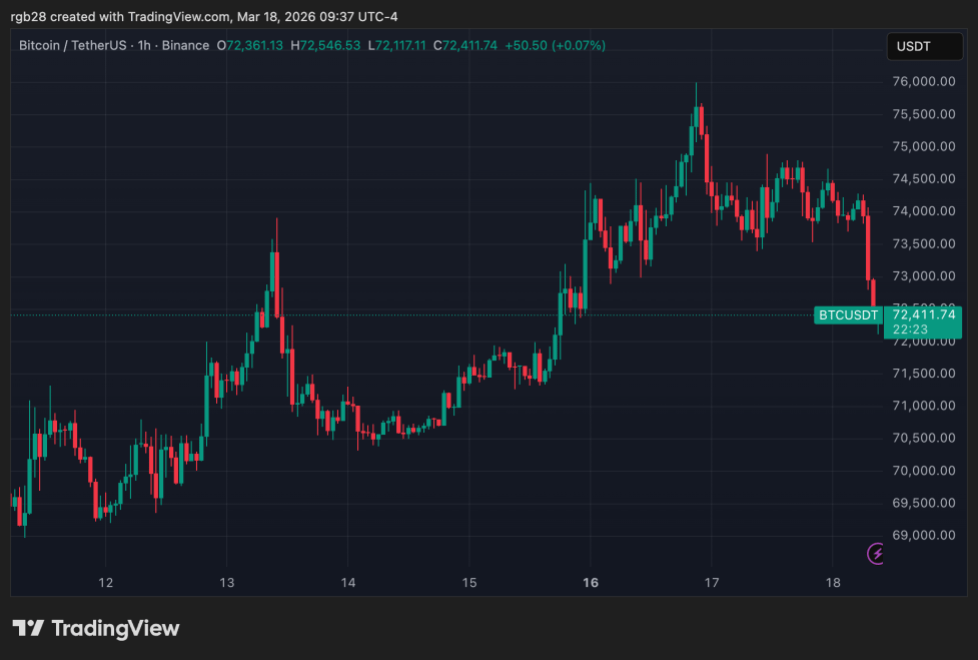
Bitcoin (BTC) trades at $72,411 in the one-week chart. Source: BTCUSDT on TradingView


Perguntas relacionadas

QWhat is the expected timeline for the new draft of the crypto market structure bill according to Senator Tim Scott?

ASenator Tim Scott stated that a fresh draft of the crypto market structure bill could be ready by the end of the week.

QWhat is the name of the stablecoin legislation mentioned in the article and what impact has it had?

AThe stablecoin legislation mentioned is the GENIUS Act, which has had a 'powerful impact for good' in the market according to Senator Scott.

QWhat was a major point of contention between the banking and crypto industries regarding the CLARITY Act?

AA major point of contention was the payment of interest on stablecoins. The banking industry criticized the GENIUS Act for loopholes and urged lawmakers to ban yield on stablecoins from crypto exchanges, brokers, and related entities, not just issuers.

QWhich key entity stepped in to help negotiate the stalled issues in the crypto market structure bill?

AThe US President’s Council of Advisors on Digital Assets stepped in, holding multiple meetings to negotiate key issues that had stalled the bill.

QWhat did Senator Scott call the 'largest publicly celebrated challenge' for lawmakers and crypto legislation?

ASenator Scott called the stablecoin yield compromise the 'largest publicly celebrated challenge' they have faced.

Leituras Relacionadas

Bitcoin Withdrawals Continue: 8 Years of Storage in a Coldcard Cold Wallet Ended in Zero

Coldcard Hardware Wallet Hacked: Losses Mount Due to Vulnerable Seed Generation A critical vulnerability in Coldcard hardware wallets has led to a continued wave of fund thefts. According to Galaxy Research, the total stolen has reached 1,367.05 BTC (approx. $88.6 million) from 4,585 addresses, a significant increase from the initial 594.5 BTC reported on July 30, 2026. Most of the stolen funds remain on the attackers' addresses. The issue is not with the current firmware, which Coinkite has updated, but with seed phrases generated on vulnerable devices between March 2021 and the release of fixed firmware versions. Due to a programmer error, devices switched from using a hardware random number generator to the software-based Yasmarang generator, which was initialized with publicly accessible data like the chip's serial number. This made the seed phrases predictable through offline brute-force attacks, meaning wallets remain at risk until funds are moved to a new wallet generated with the patched firmware. Affected devices include Mk2/Mk3 with firmware 4.0.1–4.1.9 (and up to 5.0.3), Mk4/Mk5 up to version 5.6.0, and Q models up to 1.5.0Q. The only exceptions are seeds created with a high-entropy method like at least 50 independent dice rolls or a strong unique BIP-39 passphrase. All other owners must generate a new seed on the fixed firmware and transfer their assets. A case highlighting the human impact involves a 39-year-old long-term investor who lost 2 BTC (approx. $130,000) in minutes. He had accumulated the Bitcoin over eight years through physical labor, viewing it as a financial lifeline and a retirement plan in a country suffering from hyperinflation. His story underscores that even conservative "buy and hold in cold storage" strategies can be compromised by such underlying technical flaws. From a technical perspective, this incident echoes historical failures where weak random number generators undermined cryptographic security, challenging the assumption that offline storage is automatically foolproof.

cryptonews.ruHá 4h

Bitcoin Withdrawals Continue: 8 Years of Storage in a Coldcard Cold Wallet Ended in Zero

cryptonews.ruHá 4h

Trading

Spot
活动图片




