New Capital Favors 'Old Altcoins'

marsbitPublicado em 2026-01-21Última atualização em 2026-01-21

Resumo

New capital is increasingly flowing towards established "old guard" cryptocurrencies, leading to a significant market structure shift. Bitcoin's dominance has surged to 65%, its highest since 2021, driven by institutional adoption via ETFs which attracted over $150 billion. Stablecoins and on-chain derivatives now represent 12.5% of the total crypto market cap, further squeezing altcoins. Within the altcoin sector, capital is concentrating heavily. The top 10 altcoins now constitute 82% of the altcoin market cap, up from 64% in 2021. The number of altcoins with a market cap over $1 billion has nearly halved, indicating a focus on larger, more mature assets with clear use cases and regulatory paths. Performance data confirms this trend. Since January 2023, large-cap assets have significantly outperformed mid and small-caps, with returns of ~365% compared to ~70% and ~55%, respectively. This highlights a investor preference for liquidity and lower volatility, a trend likely reinforced by recent market sell-offs. The market is maturing, with capital becoming highly selective and favoring established players and critical infrastructure.

The landscape of crypto investment continues to expand. Hundreds of new tokens are launched each year, the number of equity stocks related to digital asset businesses is increasing, and tokenization technology is gradually bringing traditional assets like stocks and commodities on-chain. While investment choices are becoming more abundant, market capital is also becoming more selective.

Bitcoin's market dominance has rebounded to around 65%, reaching its highest level since early 2021; at the same time, the combined market capitalization of stablecoins and on-chain derivatives (such as wrapped tokens, staked tokens, cross-chain bridge tokens, etc.) now accounts for nearly 12.5% of the total crypto market cap. As a result, altcoins are facing a double squeeze—despite the growing number of tokens, their overall market share is shrinking.

This issue of the "State of the Network Market" report explores whether the crypto market is undergoing a structural shift towards capital concentration. We will analyze trends in market dominance and returns across assets of different market cap tiers and sectors to investigate whether capital is consistently aggregating towards fewer, larger, and more mature tokens, or if investment opportunities remain widely distributed.

Evolution of Market Cap Dominance

First, we begin our analysis from market cap dominance. Bitcoin's market dominance (i.e., Bitcoin's market cap as a percentage of the total crypto market cap) climbed to 65% in 2025, hitting a new high since 2021. Notably, this growth is not a short-term spike but a long-term, steady upward trend since its trough in 2022.

The launch of Bitcoin spot ETFs has deepened institutionalization, attracting over $150 billion in long-term capital, further driving the sustained rise in its market dominance. This trend solidifies Bitcoin's position as a "safe-haven asset" in the crypto market and makes it a highly liquid, standardized entry point for traditional institutional investors. Compared to previous bull markets where "altcoin seasons" quickly diluted Bitcoin's market share, Bitcoin's dominance in this cycle is more enduring.
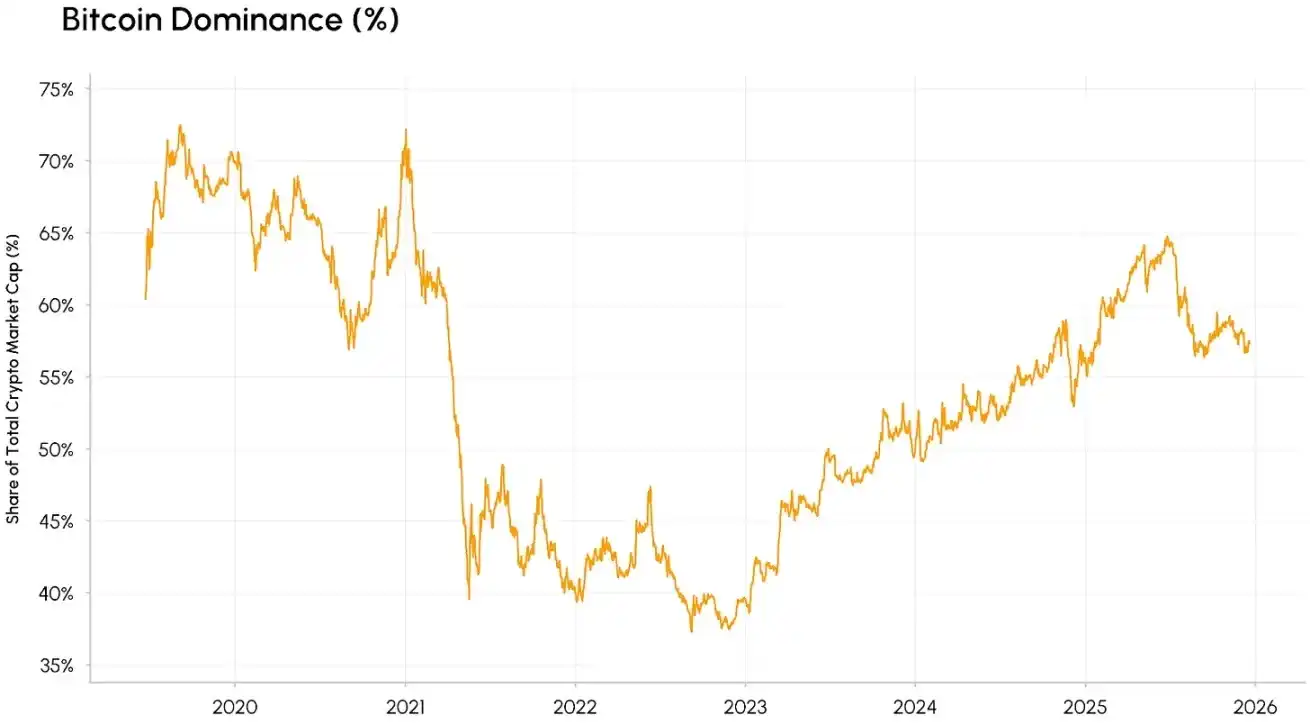
Bitcoin Dominance, Data Source: Coin Metrics

The structure of other assets in the crypto market is also changing. Stablecoins, with a current market cap exceeding $300 billion, and on-chain derivatives are increasingly accounting for a larger share of the total market capitalization. These tokens serve different functions within the crypto ecosystem: stablecoins are the primary medium of exchange in the market, while on-chain derivatives provide investors with claims on the returns of underlying assets or channels for generating yield.
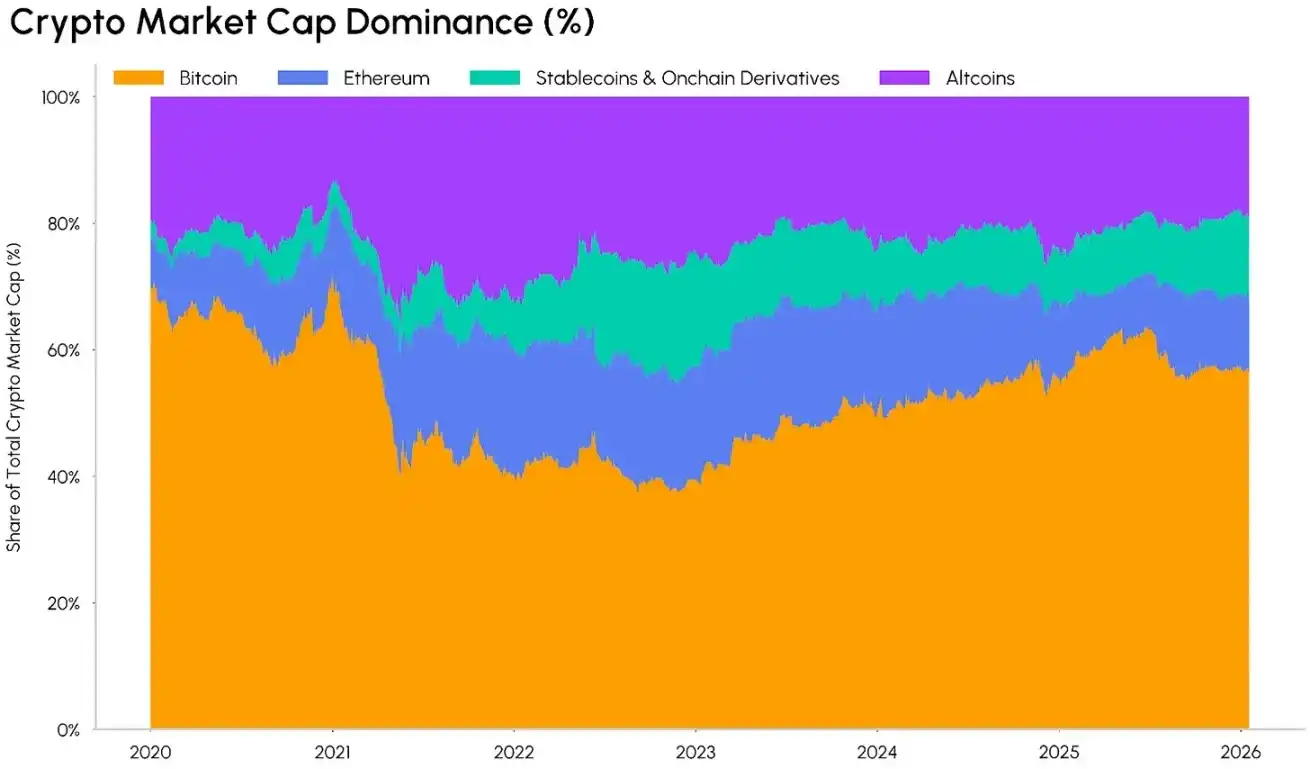
Crypto Market Dominance Distribution, Data Source: Coin Metrics

As a result, the altcoin market is facing a dilemma. The range of investable targets is continuously narrowing, and the concentration effect at the top is becoming more pronounced: market value is consistently aggregating towards more liquid and mature assets, which often have clear use cases, defined regulatory development paths, and can fully benefit from the growth waves of stablecoins, decentralized finance (DeFi), and asset tokenization.

Unlike previous market cycles, the speed of capital rotation from major coins to altcoins has significantly slowed in this cycle. ETFs and various institutional investment tools have locked market liquidity firmly in top-tier assets. However, this market structure may change with the implementation of universal listing standards, the launch of altcoin and multi-asset ETFs broadening investment channels for more large-cap altcoins, and the advancement of market structure-related legislation.

The 'Giant Monopoly' Trend Within the Altcoin Sector

Even within the altcoin sector itself, the trend of capital concentration is intensifying. The current top 10 altcoins by market cap (excluding Bitcoin) account for about 82% of the sector's total market value, a significant increase from 64% during the 2021 bull market. In the previous bull cycle, a large number of small-cap altcoins that briefly created value have gradually exited the market, replaced by a sector structure with stronger top-heavy effects, and the lifecycle of various short-term market narratives has shortened, making it difficult to sustain the continued rise in asset value.
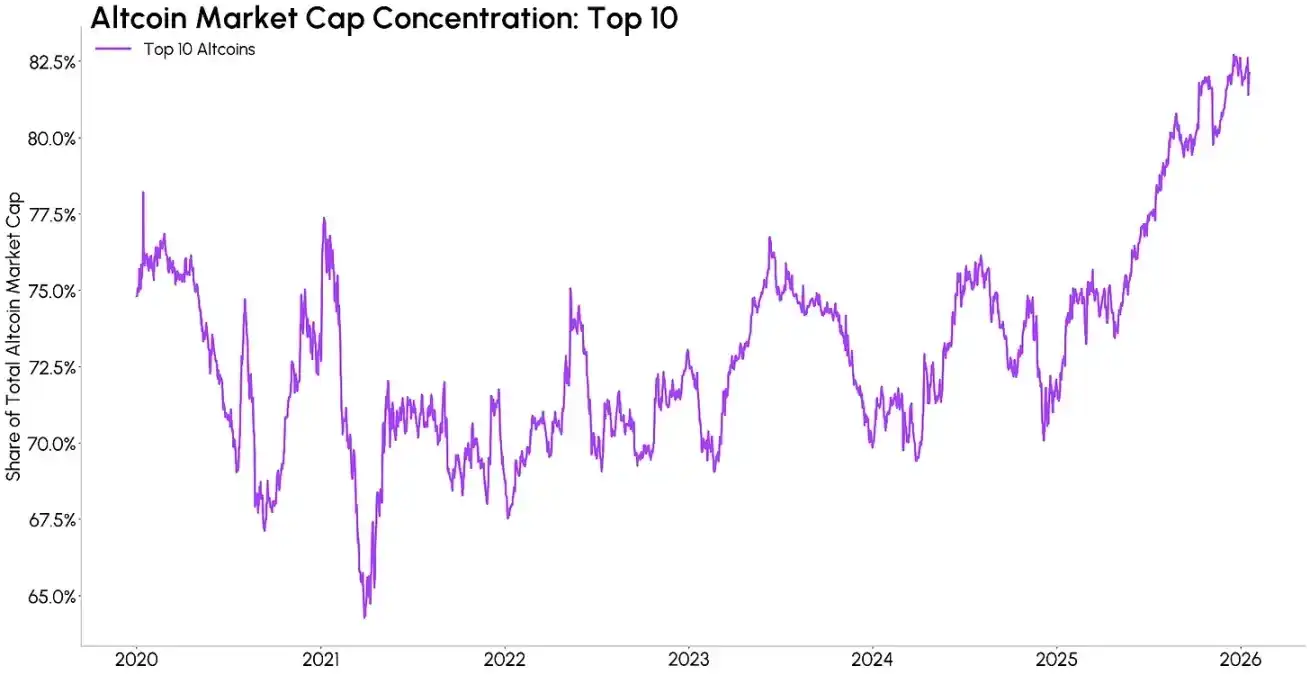
Top 10 Altcoin Market Cap Share, Data Source: Coin Metrics

We can also observe this concentration trend by looking at the number of tokens breaking through specific market cap thresholds. Although the total crypto market cap has repeatedly reached new all-time highs, the number of altcoins with a market cap exceeding $1 billion has shrunk from about 105 at the peak in 2021 to about 58 currently. This means that even as the total number of assets in the market increases, the number of truly "investable" altcoins is decreasing. While this does not necessarily mean the altcoin sector is declining, the focus of market funds may further aggregate towards targets with solid fundamentals and stronger risk resistance.
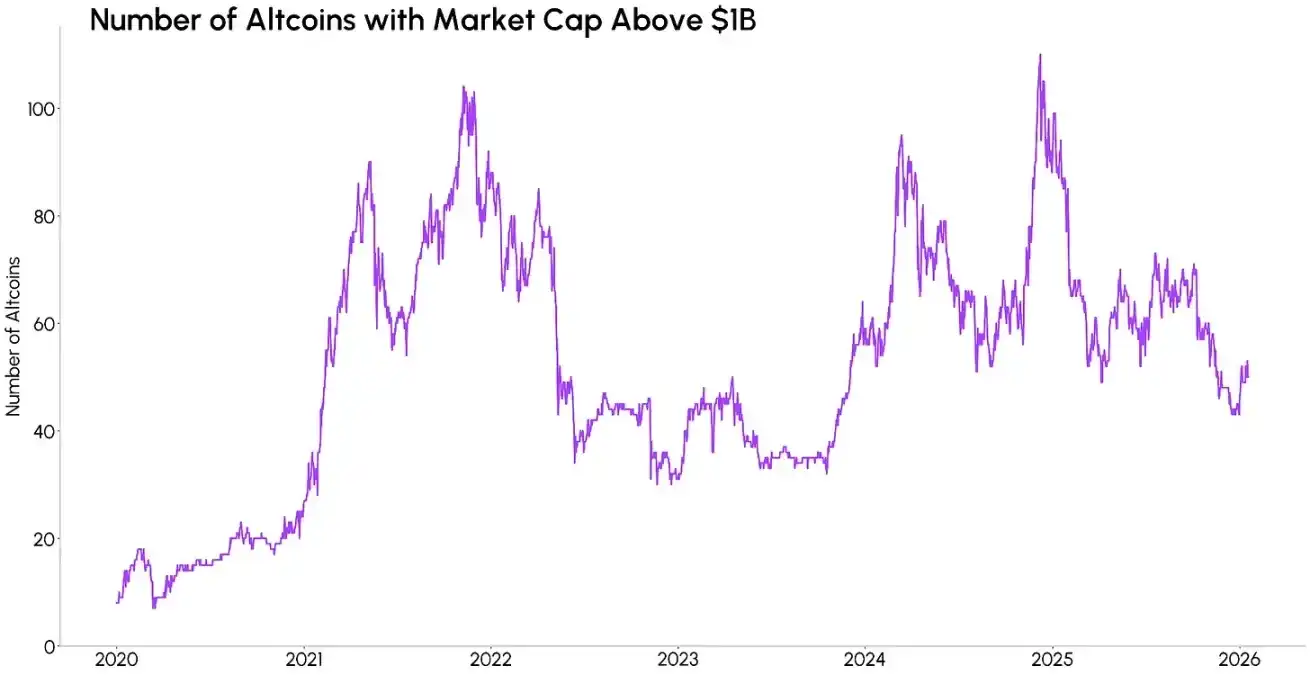
Number of Altcoins with Market Cap Over $1 Billion, Data Source: Coin Metrics

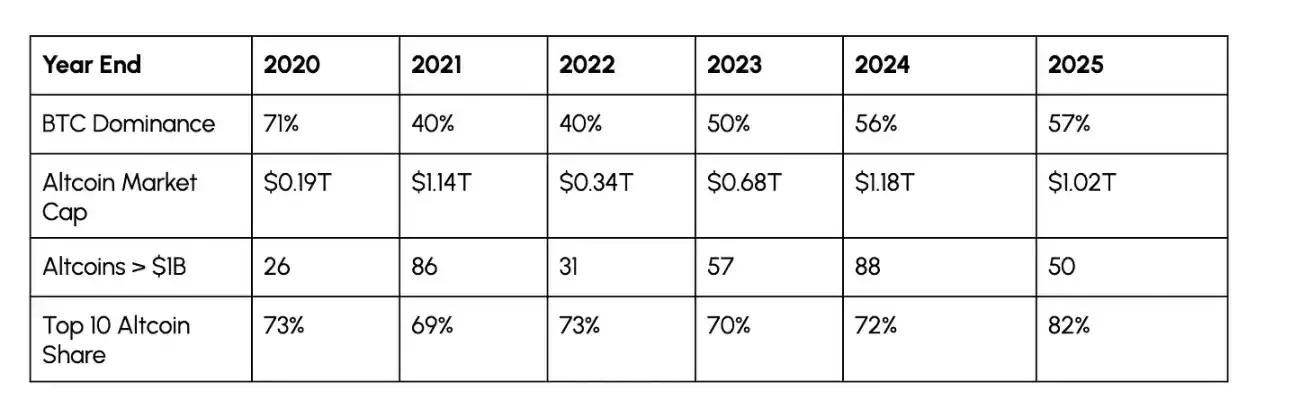
The table below summarizes the annual evolution characteristics of the aforementioned market trends. Some indicators still show cyclical features, such as Bitcoin's market dominance falling in bull markets and rising in bear markets, but the market share of the top 10 altcoins has shown a different trend: from 2020 to 2024, regardless of market conditions, this ratio remained stable between 69%-73%, but it surged to 82% in 2025. This change indicates a structural shift tilting towards mature leading assets, rather than merely short-term "chasing quality assets" behavior.
Data Source: Coin Metrics

Capital Flows to Major Coins

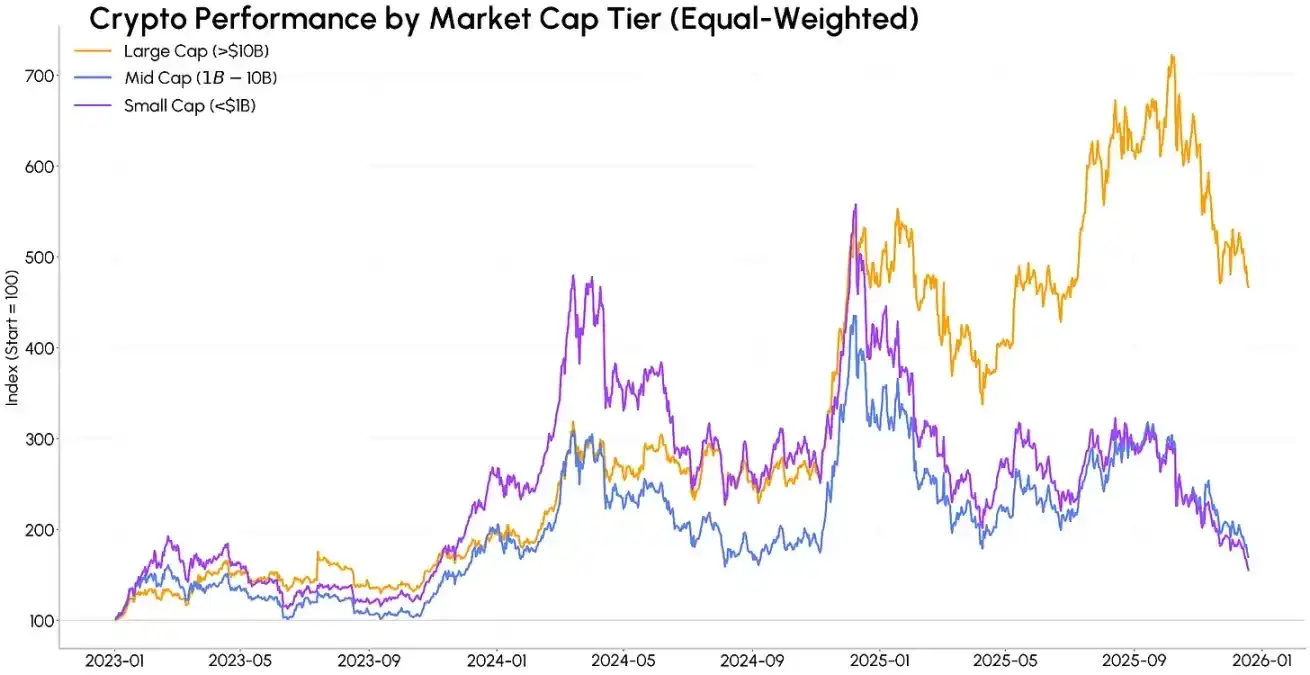
This capital concentration trend is also reflected in asset return performance. Since 2023, mid-cap coins (market cap $1B - $10B) and especially small-cap coins (market cap < $1B) had outperformed large-cap coins (market cap > $10B) during early and late phases of 2024, but this trend reversed sharply in 2025, driven by a rapid fading of market sentiment towards Meme coins and other short-term narrative rotations.

Calculated on an equal-weight basis, from January 2023 to the present, the overall return of crypto large-cap coins is approximately 365%, while the returns of mid-cap and small-cap coins are only about 70% and 55% respectively, with most of the earlier gains being given back. This divergence in returns fully demonstrates that market performance is increasingly tilting towards developed, liquid assets, and the gains of small-cap tokens are unlikely to replicate the sustainability seen in previous cycles.
Market Performance of Tokens by Market Cap Sizes, Data Source: Coin Metrics

On October 10, 2025, the market experienced a large-scale liquidation event triggered by high leverage and liquidity drying up. This event may further strengthen the trend of capital shifting towards defensive assets, with investors increasingly favoring highly liquid assets over significantly more volatile small-cap assets.

Conclusion

Various data indicate that the crypto market is in a stage of structural change, gradual maturation, and consolidation. Although the number of crypto assets continues to increase, and as underlying infrastructure, the types of traditional assets being onboarded are becoming richer, the overall liquidity of the market is limited. Furthermore, within multi-asset portfolios, crypto assets must also compete for space with popular investment themes in the stock market and traditional safe-haven assets like gold.

Currently, capital is continuously aggregating towards crypto large-cap coins and the infrastructure sectors supporting stablecoins, tokenized assets, and decentralized finance. The importance of liquidity and scale has increased further compared to the past, and the threshold for altcoins to attract long-term capital has risen significantly.

Of course, if market structure-related rules become clearer, altcoin and multi-asset ETFs continue to gain popularity, coupled with improved market liquidity conditions, a new altcoin season could still be catalyzed. However, it is foreseeable that the beneficiaries among altcoins in this cycle will be more concentrated, and capital's choices will be more selective than in any previous cycle.


Perguntas relacionadas

QWhat is the main trend observed in the cryptocurrency market regarding capital allocation, according to the article?

ACapital is increasingly concentrating towards larger, more established assets like Bitcoin and top-tier altcoins, rather than being widely distributed across newer or smaller tokens.

QHow has Bitcoin's market dominance changed recently, and what contributed to this trend?

ABitcoin's market dominance has risen to around 65%, its highest level since early 2021, driven by institutional adoption via Bitcoin ETFs, which attracted over $150 billion in long-term capital.

QWhat impact have stablecoins and on-chain derivatives had on the altcoin market?

AStablecoins and on-chain derivatives now account for nearly 12.5% of the total crypto market capitalization, squeezing the altcoin market by reducing the share of investable altcoins and intensifying competition for capital.

QHow has the concentration of capital within the altcoin sector itself evolved?

AThe top 10 altcoins now represent about 82% of the total altcoin market cap, up from 64% during the 2021 bull market, indicating stronger capital concentration towards mature, high-liquidity assets.

QWhat does the performance data reveal about returns for large-cap vs. small-cap cryptocurrencies since January 2023?

ALarge-cap cryptocurrencies have significantly outperformed, with returns of about 365%, while mid-cap and small-cap tokens returned only approximately 70% and 55%, respectively, highlighting a shift towards safer, more liquid assets.

Leituras Relacionadas

ETH Bull and Bear Views Compilation: Can Ethereum's Value Flow Back to ETH?

Titled "ETH Bull and Bear Views: Can Ethereum's Value Flow Back to ETH?", this article synthesizes the current heated debate around Ethereum's native token, ETH, following Bankless co-founder David Hoffman's decision to sell his entire ETH holdings. The **bullish case**, represented by figures like Tom Lee (BitMine CEO) and Raoul Pal, argues that ETH's core thesis remains intact. They contend Ethereum is the essential, secure, and neutral foundational layer for future finance—encompassing stablecoins, RWA, DeFi, L2s, and Agentic AI. Bulls bet on ETH's long-term revaluation as institutional adoption of on-chain finance grows, with significant buying activity from entities like BitMine and Consensys cited as evidence. Conversely, the **bearish perspective**, led by Hoffman and analysts like Markus Thielen, questions ETH's value capture mechanism. They acknowledge Ethereum's network success but argue that the value created by L2s, DeFi, and applications does not sufficiently accrue to the ETH token itself. Bears point to ETH's prolonged underperformance versus the broader crypto market, lack of traditional cash flows, weakening "ultrasound money" narrative, and apparent institutional retreat (e.g., Harvard Management Company exiting its ETH ETF position) as key concerns. The debate highlights a pivotal shift: ETH is no longer just a community belief asset. The central question is whether ETH can transition from being a "**used infrastructure**" to a "**continuously bought and held core asset**" as more value enters the Ethereum ecosystem. The market is now critically examining the direct link between network growth and ETH's value.

marsbitHá 45m

ETH Bull and Bear Views Compilation: Can Ethereum's Value Flow Back to ETH?

marsbitHá 45m

Crypto is dead, Perps are forever

The crypto industry is shifting from a focus on creating native assets (like altcoins and protocol tokens) to becoming a "global asset pipeline." Native cryptocurrencies, except for Bitcoin, are seen as failing in their value storage and utility promises, with demand driven largely by speculation. Attention and liquidity are now moving toward real-world assets (RWAs) like U.S. stocks, bonds, gold, and oil traded on-chain via perpetual contracts (Perps). Stablecoins like USDT and USDC set the precedent, proving blockchain's core strength is efficient global settlement and transfer, not inventing new monetary systems. Meanwhile, assets like Ethereum and many DeFi tokens struggle as their narratives weaken against tangible traditional assets and the rapid real-world progress of AI. Perpetual contracts have emerged as a pivotal innovation. They simplify trading by offering pure price exposure to any asset, bypassing complexities of ownership, custody, and traditional market hours. Projects like Hyperliquid gained traction by combining CEX-like efficiency with on-chain transparency, capitalizing on post-FTX distrust, macroeconomic volatility, and the surge in demand for 24/7 stock trading. In conclusion, while the era of speculative native "crypto assets" may be over, perpetual contracts persist as the industry's most potent financial instrument—transforming all assets into globally accessible, constantly tradable instruments centered on price speculation.

marsbitHá 51m

Crypto is dead, Perps are forever

marsbitHá 51m

Tencent, Alibaba, ByteDance in a Battle for the Skill Store

Skill is becoming a key concept in the AI field, essentially serving as a structured "instruction manual" for AI Agents that specifies tool calls, decision logic, and output standards. This allows Agents to execute predefined tasks. As the number of Skills grows, distribution platforms have emerged. Major tech companies are swiftly entering this space. In March, Tencent, Alibaba, and ByteDance launched Skill stores within their respective Agent platforms. Subsequently, players like Zhipu AI, Meituan, and Xiaohongshu joined the fray. This competition for the "Skill store" is fundamentally a battle for the AI-era user entry point; whoever controls distribution controls the users. While ByteDance's Coze has experimented with paid Skills, most platforms offer them for free. The real value lies not in the stores themselves but in using them to attract and retain users within an ecosystem, driving revenue from services like cloud computing, model calls, or advertising. The landscape features three main player types: 1) **Internet giants** (e.g., Alibaba, ByteDance, Tencent, Meituan), leveraging Skills to drive traffic and monetize through their broader ecosystems (cloud services, transactions, ads). 2) **Large model companies** (e.g., Zhipu AI, Moonshot AI), using Skill stores to increase user engagement and monetize model API calls. 3) **Content platforms** (e.g., Xiaohongshu), treating Skills as a new content format to generate traffic and ad revenue. However, transforming Skill stores into a sustainable business faces significant hurdles. Key challenges include: the **difficulty in pricing Skills** due to inconsistent outputs across different models and contexts; **lack of cost transparency** (varying token consumption); **security risks** like Skill poisoning; and the **absence of standardized protocols** for development and evaluation. Unlike standardized mobile apps, Skills are often personalized workflows resistant to uniformity, which hinders the establishment of a reliable review and monetization system akin to the App Store. While there is genuine user demand for paid Skills—particularly in enterprise (e.g., contract review) and certain personal productivity scenarios—current platforms offer developers limited and unpredictable distribution. The future of Skill stores depends on overcoming these standardization, evaluation, and safety challenges to make acquiring a Skill as straightforward as downloading an app. For now, the stores function more as display shelves than robust marketplaces.

marsbitHá 51m

Tencent, Alibaba, ByteDance in a Battle for the Skill Store

marsbitHá 51m

The Crypto Scene Is Dead, Perpetual Swaps Are Eternal

The crypto industry is undergoing a fundamental shift. The era defined by minting novel, native digital assets (altcoins) is fading. These assets, lacking real-world cash flows or clear value, are losing relevance as attention and capital flow elsewhere. Two powerful external forces are reshaping the space. First, traditional assets like U.S. stocks, bonds, gold, and oil are being tokenized and traded on-chain. Second, the explosive growth of AI, with its tangible products, has overshadowed crypto's once-dominant "future narrative." This marks a critical pivot: crypto is transitioning from being a "factory for new assets" to becoming a "global conduit for existing assets." Its validated utility is not complex financial reinvention but efficient global settlement, transfer, and trading—the original promise of blockchain. Stablecoins like USDT and USDC exemplify this, offering faster dollar movement rather than replacing it. Consequently, native ecosystems like Ethereum face profound challenges. While still crucial infrastructure, ETH struggles to capture value as users interact with Layer 2s or trade traditional assets without needing to hold it. DeFi's grand narrative of rebuilding finance has narrowed to core needs like cheap transfers and deep liquidity. The true breakout innovation is the perpetual contract (Perp). It brilliantly bypasses the complexities of direct asset ownership (custody, compliance, dividends) by creating pure price exposure. Users can speculate on the price movement of *any* asset—NVIDIA, gold, oil—24/7, globally, and with leverage. This "price casino" model, while risky and ethically fraught, delivers unmatched liquidity and accessibility. Projects like Hyperliquid succeeded not by inventing new mechanics but by perfecting the timing and execution of this model. Key drivers included making on-chain Perps feel like centralized exchanges, post-FTX trust migration towards transparency, and rising demand to trade macro assets and equities round-the-clock. In conclusion, the crypto world's most enduring successes are the dollar (via stablecoins), Bitcoin, and trading. Its new frontier is not creating alternative assets but providing a seamless, perpetual trading layer—a new API—for the world's existing financial system. The age of native altcoins is over; the age of perpetual synthetic exposure has begun.

Odaily星球日报Há 1h

The Crypto Scene Is Dead, Perpetual Swaps Are Eternal

Odaily星球日报Há 1h

Trading

Spot
Futuros
活动图片




