Network School's Balaji Srinivasan Acquires Farcaster

cryptonews.ruPublished on 2026-10-16Last updated on 2026-10-16

Abstract

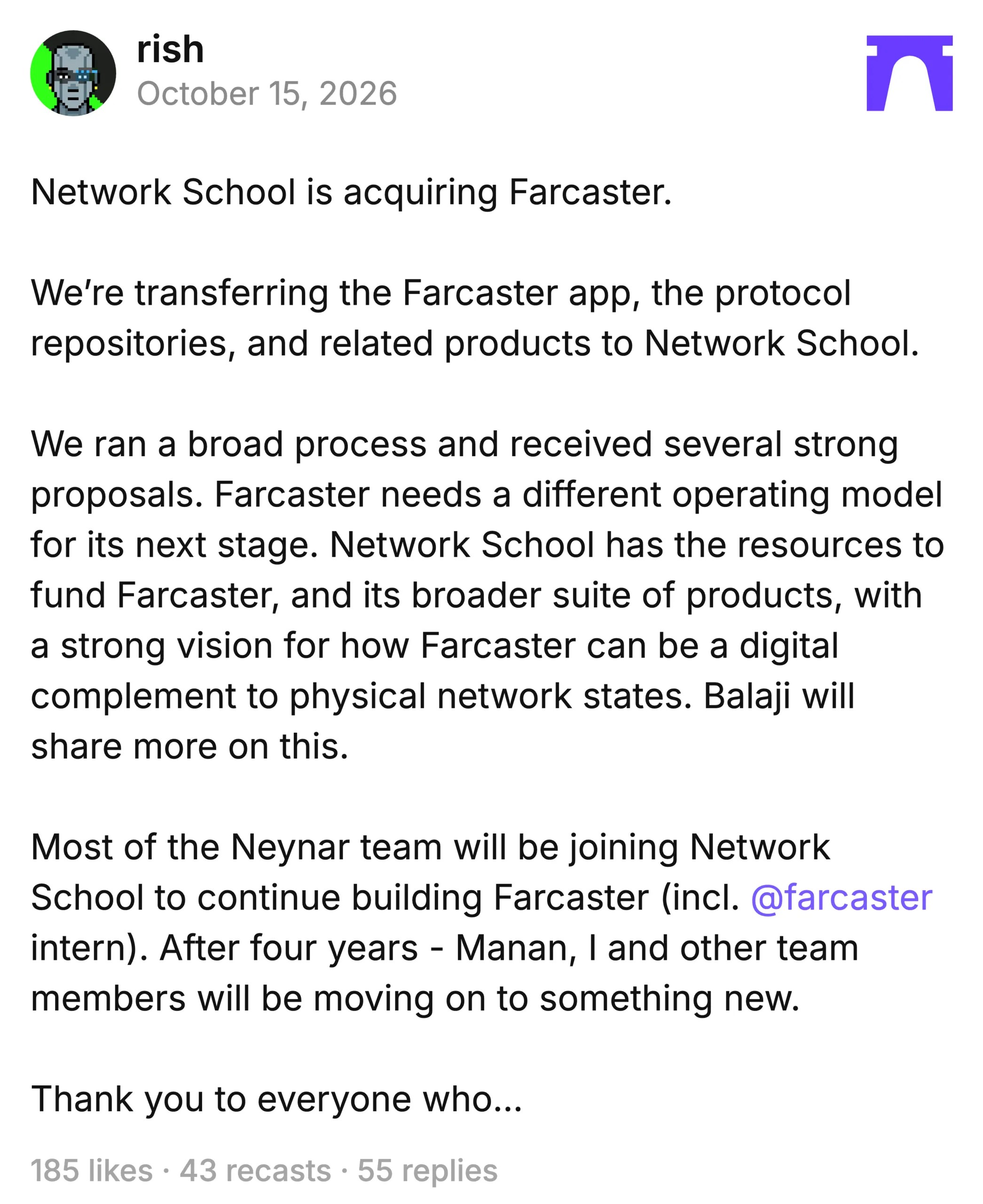
Balaji Srinivasan's Network School, led by the former Coinbase CTO, has acquired the decentralized social platform Farcaster from the company Neynar. This announcement was made by Neynar co-founder Rish Mhakerji. According to the announcement, Network School will take over the Farcaster application, the protocol's repositories, and related products.

Network School, founded by former Coinbase CTO Balaji Srinivasan, has acquired the decentralized social platform Farcaster from Neynar. This was announced by the latter's co-founder, Rish Mukerji.

Mukerji's announcement about the Farcaster acquisition. Source: Farcaster.

According to him, Network School will take over the Farcaster application, protocol repositories, and related products.

Trending Cryptos

Related Questions

QWho acquired the decentralized social platform Farcaster and from which company?

ANetwork School, associated with former Coinbase CTO Balaji Srinivasan, acquired Farcaster from the company Neynar.

QWho announced the acquisition of Farcaster according to the article?

AThe acquisition was announced by Rish Mukerjee, the co-founder of Neynar.

QWhat does the acquisition deal include according to Rish Mukerjee's statement?

AThe deal includes transferring the Farcaster application, protocol repositories, and related products to Network School.

QWhat is the professional background of Balaji Srinivasan mentioned in the article?

ABalaji Srinivasan is the former Chief Technology Officer (CTO) of Coinbase.

QWhat is Farcaster according to the text?

AFarcaster is a decentralized social platform.

Related Reads

After Jensen Huang's Departure, 14 Investment Banks Rush to Interpret: No One Can Fill His Leather Jacket, Bottom Consensus Around $150

Nvidia announced that co-founder and CEO Jensen Huang has resigned immediately, along with his board seat. CFO Colette Kress becomes interim CEO, with Harvey Jones as chairman and a permanent CEO search underway. Shares fell about 10% premarket to around $156, below the 52-week low, wiping out roughly $420 billion in market value; the stock is down about a third over the past month. Of 14 banks issuing research, three downgraded the stock (Bernstein, KeyBanc, William Blair) and six cut targets (Bernstein, JPMorgan, RBC, Cantor, Goldman, Citi), though most kept Buy ratings. The average target is about $260, implying roughly 50% upside. The consensus: earnings estimates are unchanged, but the multiple is compressed—Goldman cut its target from $300 to $220, keeping $10 EPS but lowering the multiple from 30x to 22x, likening the situation to Apple after Steve Jobs (though noting Apple had a succession plan and no investigations). Bulls argue orders are sold out through 2028, with the roadmap set beyond that, so fundamentals are safe near-term; RBC sees demand exceeding supply by ~50%. Bernstein's Stacy Rasgon downgraded to Market Perform, cutting his target from $400 to $200, warning that "if you see two ants in the kitchen," there are likely more issues. Key concerns: organizational structure, with ~60 executives reporting directly to Huang and no clear successor—"no one can fill Jensen's leather jacket." Ian Buck is the most-mentioned internal candidate. Another worry is Nvidia's role as the AI ecosystem's financier, injecting $50-60 billion in quarterly free cash flow into OpenAI, Anthropic, CoreWeave and suppliers; UBS warns of a possible "pause" that could pull $50 billion from the system. Regulatory scrutiny continues (DOJ, House, Senate). Most banks see a bottom around $150, with RBC's bear case at $100. Competitors AMD and Broadcom are seen as beneficiaries.

marsbit10m ago
After Jensen Huang's Departure, 14 Investment Banks Rush to Interpret: No One Can Fill His Leather Jacket, Bottom Consensus Around $150

marsbit10m ago

Nobel Laureate Hassabis Delivers Another Masterpiece: AlphaGenome 2 Deciphers 98% of Human DNA 'Dark Matter'

DeepMind has unveiled AlphaGenome 2, a next-generation DNA foundation model led by Nobel laureate Demis Hassabis. While AlphaFold decoded only the 2% of the human genome that encodes proteins, AlphaGenome 2 targets the remaining 98% of non-coding "dark matter," which harbors gene-regulatory switches and over 90% of disease-causing mutations. Released alongside a 78-page technical report, the model delivers four major breakthroughs. First, it achieves single-cell resolution, trained on over 107 million single cells across 68 human tissues, doubling the rate at which it identifies pathogenic mutations—raising detection from 16% to 30% and directional accuracy from 23% to 43% on the TenK10K immune-cell benchmark. Second, it reproduces years of Nature-published research purely through computation: with zero wet-lab experiments, it correctly identified a distant regulatory mutation that over-activates ETS2 across 290,000 bases to cause inflammatory bowel disease, and precisely located the regulatory site and GATAA core sequence targeted by approved sickle-cell CRISPR therapy. Third, a new cell encoder lets the model interpret previously unseen diseases from just dozens of patient cells without retraining—identifying 41% of pathogenic mutations in unseen Parkinson's brain samples versus 17% for a specialized model, and uncovering a hidden severe-COVID mutation active only in immune-activated T cells. Finally, DeepMind released free databases covering 640 real human cell types and impact scores for nearly 7 million genetic variants across 510 cell states, with APIs and Colab tutorials open for non-commercial research. The model will soon be packaged as Skills and integrated into Google Antigravity for direct use by Gemini 4, promising to dramatically shorten the cycle of disease investigation and drug discovery.

marsbit1h ago

Nobel Laureate Hassabis Delivers Another Masterpiece: AlphaGenome 2 Deciphers 98% of Human DNA 'Dark Matter'

marsbit1h ago

Midterm Elections Settled, What Lies Ahead for the CLARITY Act?

The CLARITY Act (Digital Asset Market Clarity Act), which had already struggled before the election, now faces dim prospects after Democrats swept both chambers in the midterms. On September 15, a Senate cloture motion on the House-passed bill failed 49-50, eleven votes short of the 60-vote threshold. All 49 yes votes came from Republicans; the opposition included all Democrats present, two independents, and four Republicans (Collins, Hawley, Moran, Tillis). Even if absentee Democrat Coons had voted yes and the four Republicans had flipped, the tally would have reached only 54—still short. The bill's core compromise would make the CFTC the primary regulator for digital commodities and trading platforms while preserving clear SEC authority; jurisdictional division and added ethics provisions are the main disputes. Democrats will control both chambers when the new Congress opens January 3, 2027, leaving little incentive to cooperate during the lame-duck session. Only two theoretical paths remain before the 119th Congress ends: renegotiate the text and hold another cloture vote via Tillis's reconsideration motion, or attach crypto market structure provisions to must-pass December legislation such as government funding (expiring December 11) or the NDAA. Both are unlikely, given the tight legislative calendar and Democratic leverage. Stablecoin oversight continues separately under the GENIUS Act and OCC rulemaking. If the bill dies, it must be reintroduced in the 120th Congress, where Democrats—likely led by Elizabeth Warren and Maxine Waters—are expected to draft a very different framework expanding SEC authority and narrowing the CFTC's role. Key things to watch before January 3: any new cloture vote or revised text, any attempt to attach provisions to funding or defense bills, outstanding vote counts in Alaska, Mississippi, and House districts, and the incoming committee chair selections. Absent such developments, the CLARITY Act is effectively finished as a 2026 legislative project.

marsbit1h ago

Midterm Elections Settled, What Lies Ahead for the CLARITY Act?

marsbit1h ago

4.8 Billion Dollars: Tether's Hand Has Reached Into 13 U.S. Public Companies

Tether, the world's largest stablecoin issuer, holds roughly $4.8 billion in public-market exposure across 13 U.S.-listed companies, according to a Protos review of regulatory filings. Its holdings span a controversial video platform, gold royalty companies, a satellite firm, bitcoin miners, and a bitcoin treasury project. Key positions include a 50.3% stake (including warrants) in Rumble (RUM), though voting power is capped below 9.9%; Rumble has also acquired Tether's Northern Data and counts Tether as its most important advertising client, committed to $50 million annually for two years. Tether and Bitfinex are controlling shareholders of Twenty One Capital (XXI), with rights to nominate four of seven directors, including Tether CEO Paolo Ardoino; the company trades at about 60% of its bitcoin value. In gold, Tether holds about 27% of Elemental Royalty (ELE), 12.6% of Gold.com (GOLD), 12.6% of Versamet Royalties (VMET), 14.6% of Metalla (MTA), 14.4% of Gold Royalty (GROY), 12% of Aurelion (AURE), and about 8% of Antalpha (ANTA). It also holds 19.7% of Bitdeer (BTDR) and a stake in Adecoagro (AGRO), plus shares in Satellogic (SATL), 9.9% of SDEV (down about 99%), and a stake in VCI Global (VCIG) via Oobit. Powerlaw Corp (PWRL) claims roughly $20 million in Tether equity. The exposure is concentrated in a few large holdings—Twenty One, Rumble, and Adecoagro—showing Tether's growing role as a multi-sector financial institution that also places executives in key positions.

marsbit1h ago

4.8 Billion Dollars: Tether's Hand Has Reached Into 13 U.S. Public Companies

marsbit1h ago

Trading

Spot

Hot Articles

How to Buy T

Welcome to HTX.com! We've made purchasing Threshold Network Token (T) simple and convenient. Follow our step-by-step guide to embark on your crypto journey.Step 1: Create Your HTX AccountUse your email or phone number to sign up for a free account on HTX. Experience a hassle-free registration journey and unlock all features.Get My AccountStep 2: Go to Buy Crypto and Choose Your Payment MethodCredit/Debit Card: Use your Visa or Mastercard to buy Threshold Network Token (T) instantly.Balance: Use funds from your HTX account balance to trade seamlessly.Third Parties: We've added popular payment methods such as Google Pay and Apple Pay to enhance convenience.P2P: Trade directly with other users on HTX.Over-the-Counter (OTC): We offer tailor-made services and competitive exchange rates for traders.Step 3: Store Your Threshold Network Token (T)After purchasing your Threshold Network Token (T), store it in your HTX account. Alternatively, you can send it elsewhere via blockchain transfer or use it to trade other cryptocurrencies.Step 4: Trade Threshold Network Token (T)Easily trade Threshold Network Token (T) on HTX's spot market. Simply access your account, select your trading pair, execute your trades, and monitor in real-time. We offer a user-friendly experience for both beginners and seasoned traders.

15.1k Total ViewsPublished 2024.03.29Updated 2026.06.02

How to Buy T

Discussions

Welcome to the HTX Community. Here, you can stay informed about the latest platform developments and gain access to professional market insights. Users' opinions on the price of T (T) are presented below.

活动图片