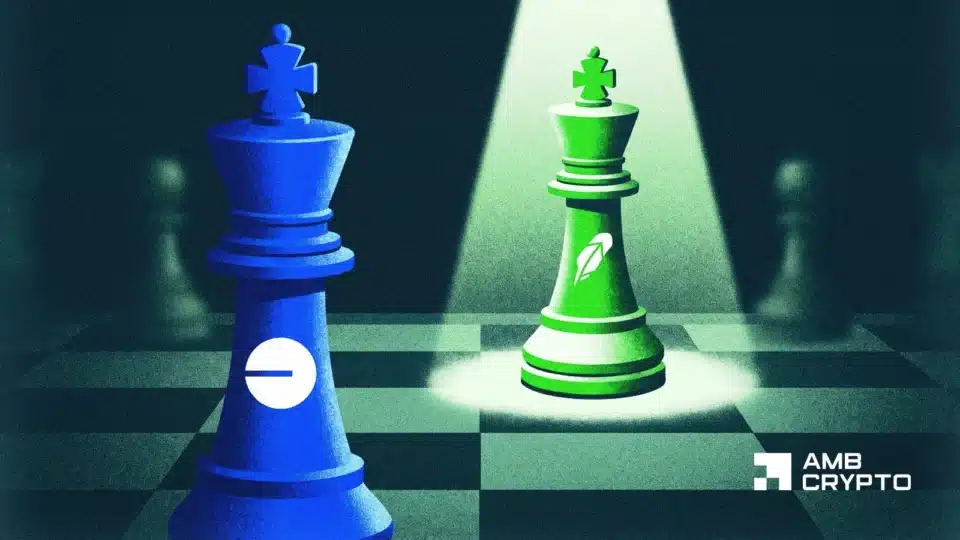
NEAR Introduces Near.com Super App Targeting AI Integration and Secure Crypto Payments

TheNewsCryptoPublicado em 2026-02-24Última atualização em 2026-02-24

Resumo

NEAR has launched the near.com super app, a crypto wallet and consumer application designed to simplify blockchain usage by removing technical barriers like gas fees, private keys, and multi-chain complexities. It supports various digital assets—including Bitcoin, stablecoins, and NFTs—in one place, allowing users to transact without deep blockchain knowledge. The platform emphasizes AI integration, envisioning an "Agentic Era" where AI systems act on users’ behalf for tasks like travel booking and online purchases, requiring seamless crypto payments. NEAR also introduced a "confidential mode" to enhance privacy for financial transactions. This release marks NEAR’s effort to expand its user base and drive global adoption.

NEAR, a blockchain platform, has launched the near.com super app, a crypto wallet and consumer app designed to make blockchain as easy to use as a regular financial app. The company states that the product aims to integrate crypto and AI into a user-friendly platform. Illia Polosukhin, co-founder of NEAR, has described this move as an “Agentic Era,” meaning AI systems don’t just give information; instead, they work on behalf of the users.

What this platform brings to users

The platform Near.com is built to remove the technical challenges faced by users during crypto transactions. With the new app, users do not need to worry about gas fees, private keys, and switching between different blockchains because the app manages various digital assets like Bitcoin, stablecoins, NFTs, and other tokens in one place. Polosukhin says that users can use their wallet in Near.com without the need to understand how the blockchain works.

NEAR believes that the next major growth in crypto is from AI. They expect the AI to handle tasks such as travel booking, managing emails, and making online purchases. To perform these tasks, AI needs the ability to send and receive payments. NEAR argues that blockchain can serve as a financial system. Polosukhin says that AI systems could become economic actors, which means they pay, trade, and make decisions on their own.

NEAR adds a new feature

The blockchain’s key feature is its transparency, which increases trust but also exposes sensitive financial information. To address this issue, NEAR introduced a “confidential mode” that allows the feature to keep its unbalanced trading activities private while still using the secure blockchain network. The firm says this makes the app more useful for everyday users who prefer privacy.

This launch from NEAR shows the firm is now focusing on expanding its user base and believes that the technology, which it built, is no longer needed and is ready to scale adoption worldwide. However, this success depends on how quickly the users and developers are adopting the platform.

Highlighted Crypto News:

Crypto.com Secures Conditional OCC Approval to Launch National Trust Bank

TagsCryptoNEARNEAR Protocol

Perguntas relacionadas

QWhat is the main purpose of the new near.com super app launched by NEAR?

AThe near.com super app is designed to make blockchain as easy to use as a regular financial app by integrating crypto and AI into a user-friendly platform, removing technical challenges like gas fees and private keys, and managing various digital assets in one place.

QHow does NEAR's 'Agentic Era' concept, as described by co-founder Illia Polosukhin, change the role of AI systems?

AThe 'Agentic Era' means that AI systems don't just provide information but actively work on behalf of users, handling tasks such as travel booking, managing emails, and making online purchases, and potentially becoming economic actors that pay, trade, and make decisions autonomously.

QWhat problem does the 'confidential mode' feature in the NEAR app address?

AThe 'confidential mode' addresses the issue of blockchain transparency exposing sensitive financial information by allowing users to keep their trading activities private while still utilizing the secure blockchain network, enhancing privacy for everyday users.

QWhy does NEAR believe that blockchain can serve as a financial system for AI?

ANEAR argues that blockchain can serve as a financial system for AI because AI systems require the ability to send and receive payments to perform tasks autonomously, and blockchain provides a secure and transparent framework for these financial transactions.

QWhat does NEAR's launch of the near.com app indicate about the company's current focus?

AThe launch indicates that NEAR is focusing on expanding its user base and scaling adoption worldwide, believing that its technology is now mature enough to be accessible without users needing to understand underlying blockchain mechanics.

Leituras Relacionadas

Agents Take Over Traffic Distribution Power: What Are Tencent, ByteDance, and Alibaba Competing For?

In the race to dominate the AI era's entry point, China's tech giants—Tencent, ByteDance, and Alibaba—are aggressively deploying AI Agents to control the future of traffic distribution. Alibaba is pursuing a dual-track "closed loop + openness" strategy. Its Qianwen app is evolving into a super-Agent integrated across its ecosystem (Taobao, Alipay, etc.) to handle complex tasks like travel planning. Concurrently, it is opening its platform to external brands (Luckin Coffee, KFC) and has launched a B2B Agent platform, "Wukong," targeting enterprise automation. Its other flagship, Quark, aims to be an "AI super search box" for information and tasks. ByteDance is executing an omnipresent "sprawl strategy." Its Doubao app boasts over 300 million monthly active users and is evolving into a default AI entry point for daily life, with plans for paid versions and e-commerce integration. Its core weapon is the Kouzi platform, a visual "AI assembly factory" for developers to build custom Agents. ByteDance is also pushing hardware integration, collaborating on AI phones and developing smart glasses to embed Doubao everywhere. Tencent is playing its long-held "ultimate card" by quietly embedding an AI Agent directly into WeChat. This Agent, accessible via a swipe, can understand user commands and automatically execute tasks by calling upon WeChat's millions of mini-programs (e.g., finding and ordering coffee). This leverages WeChat's unparalleled 1.4-billion-user ecosystem to position the app as an AI-powered "service operating system," a move that could dramatically reshape the competitive landscape. The core battleground is shifting from competing for "user screen time" to competing to be the "default execution layer" for user intent. The business model is evolving from an "attention economy" to an "intent economy," where the Agent that can most efficiently fulfill a user's need gains control over service access and token flow. This represents a fundamental change in how users connect with digital services, making the fight for the Agent入口 (entry point) a pivotal moment for redefining industry leadership in the AI age.

marsbitHá 54m

Agents Take Over Traffic Distribution Power: What Are Tencent, ByteDance, and Alibaba Competing For?

marsbitHá 54m

From Banning Doubao to Embracing Honor: Why Did WeChat Suddenly 'Change Its Face'?

The article explores the sudden shift in WeChat's strategy towards AI assistants from mobile phone manufacturers, transitioning from strict opposition to active collaboration. For over a year, WeChat fiercely resisted attempts by phone AI assistants (like ByteDance's Doubao in late 2025) to control its features via GUI automation ("simulated clicking"), citing security and data control concerns. This stance created a significant barrier for system-level AI integration. Now, Tencent has initiated A2A (Agent-to-Agent) partnerships with major phone brands like Honor, Xiaomi, OPPO, and vivo. This model allows a phone's system AI (e.g., Honor's YOYO) to parse a user's voice command and send a structured request directly to WeChat's own internal AI agent via secure APIs. WeChat then executes the action (e.g., sending a message) and returns the result. The article attributes Tencent's "change of face" to strategic pressure. While leading in social app usage, Tencent trails rivals like ByteDance and Alibaba in standalone AI app popularity. WeChat, with its vast mini-program ecosystem, is Tencent's key asset for an AI comeback. The upcoming WeChat AI agent aims to handle tasks like booking and payments within the app. However, phone system assistants remain the primary AI entry point for most users. The A2A collaboration allows Tencent to extend WeChat's AI reach to this crucial system layer while maintaining control over its core functions and data. For phone manufacturers, embracing A2A is a pragmatic move. The GUI route proved unviable due to WeChat's blocks. A2A offers a compliant path to integrate a vital service, enhancing their AI assistants' usefulness. It allows them to focus on developing their own AI ecosystems for other services while cooperating on WeChat access. The collaboration is framed as a mutual, strategic necessity: Tencent gains a distribution channel, and manufacturers gain a key functionality. The partnership relies on a "dual authorization" mechanism for security, requiring both user and app consent for each action. While questions about long-term data privacy practices remain, experts note A2A is more secure and compliant than GUI automation. Ultimately, this cooperation is seen as a tentative, calculated truce. Tencent's long-term goal is to make WeChat an AI-powered "service OS." Phone manufacturers aim to make their system AI the central user interface. Their paths may converge or clash in the future, but for now, the A2A deal represents the opening chapter in the battle for the AI-era user入口, driven by necessity and strategic calculus on both sides.

marsbitHá 2h

From Banning Doubao to Embracing Honor: Why Did WeChat Suddenly 'Change Its Face'?

marsbitHá 2h

Trading

Spot
Futuros

Artigos em Destaque

Como comprar SUPER

Bem-vindo à HTX.com!Tornámos a compra de SuperFarm (SUPER) simples e conveniente.Segue o nosso guia passo a passo para iniciar a tua jornada no mundo das criptos.Passo 1: cria a tua conta HTXUtiliza o teu e-mail ou número de telefone para te inscreveres numa conta gratuita na HTX.Desfruta de um processo de inscrição sem complicações e desbloqueia todas as funcionalidades.Obter a minha contaPasso 2: vai para Comprar Cripto e escolhe o teu método de pagamentoCartão de crédito/débito: usa o teu visa ou mastercard para comprar SuperFarm (SUPER) instantaneamente.Saldo: usa os fundos da tua conta HTX para transacionar sem problemas.Terceiros: adicionamos métodos de pagamento populares, como Google Pay e Apple Pay, para aumentar a conveniência.P2P: transaciona diretamente com outros utilizadores na HTX.Mercado de balcão (OTC): oferecemos serviços personalizados e taxas de câmbio competitivas para os traders.Passo 3: armazena teu SuperFarm (SUPER)Depois de comprar o teu SuperFarm (SUPER), armazena-o na tua conta HTX.Alternativamente, podes enviá-lo para outro lugar através de transferência blockchain ou usá-lo para transacionar outras criptomoedas.Passo 4: transaciona SuperFarm (SUPER)Transaciona facilmente SuperFarm (SUPER) no mercado à vista da HTX.Acede simplesmente à tua conta, seleciona o teu par de trading, executa as tuas transações e monitoriza em tempo real.Oferecemos uma experiência de fácil utilização tanto para principiantes como para traders experientes.

216 Visualizações TotaisPublicado em {updateTime}Atualizado em 2026.06.02

Como comprar SUPER

Discussões

Bem-vindo à Comunidade HTX. Aqui, pode manter-se informado sobre os mais recentes desenvolvimentos da plataforma e obter acesso a análises profissionais de mercado. As opiniões dos utilizadores sobre o preço de SUPER (SUPER) são apresentadas abaixo.

活动图片