Naval Steps Into the Arena: A Historic Collision Between Ordinary People and Venture Capital

marsbitPublicado em 2026-04-25Última atualização em 2026-04-25

Resumo

Naval Ravikant, co-founder of AngelList and a prominent Silicon Valley thinker, has taken a hands-on role as the chairman of the investment committee at USVC—a new SEC-registered fund allowing non-accredited investors to access high-growth private tech companies with a minimum investment of $500. The fund’s initial portfolio includes leading AI firms like OpenAI, Anthropic, xAI, and others. This move represents a significant shift in democratizing access to venture capital, a space traditionally dominated by institutional investors and high-net-worth individuals. USVC aims to let ordinary investors participate in the high-alpha, pre-IPO growth phase of tech companies—a stage where much of the value creation now occurs before public listings. However, the fund is not without complexities. It offers limited liquidity, with potential quarterly redemptions capped at 5%, and charges an all-in fee of 2.5% in its first year. While this is higher than traditional ETFs, it is positioned as a more accessible alternative to conventional VC fee structures. Ultimately, USVC symbolizes a broader movement toward financial inclusion in high-stakes tech investing—not through crypto or Web3 mechanisms, but via regulated, retail-friendly investment vehicles. It offers a ticket to early-stage innovation, though risks typical of venture capital remain.

Author: 0xMedia

Naval is stepping into the arena.

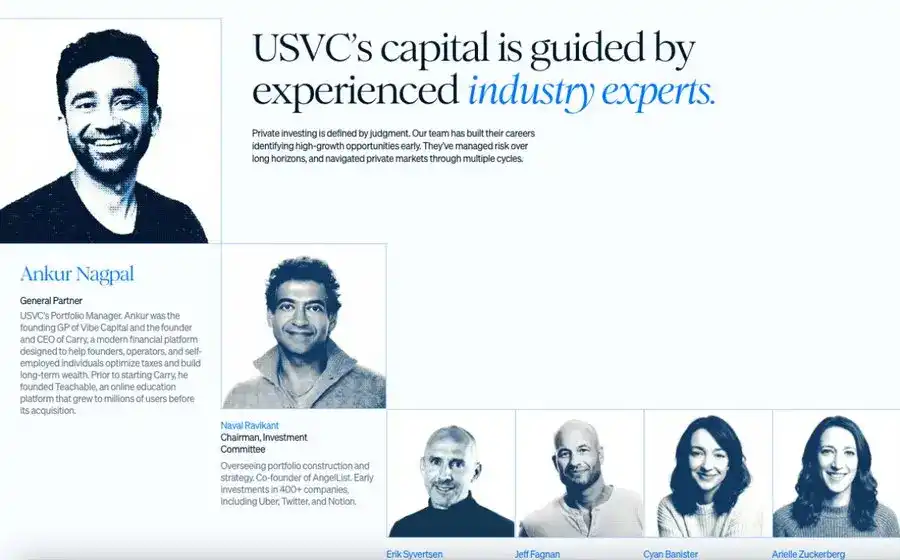
This time, he's not just discussing wealth, freedom, and leverage on a podcast, nor is he commenting on startup trends as a Silicon Valley thinker and angel investor. Instead, he is directly taking on the role of Chairman of the Investment Committee at USVC.
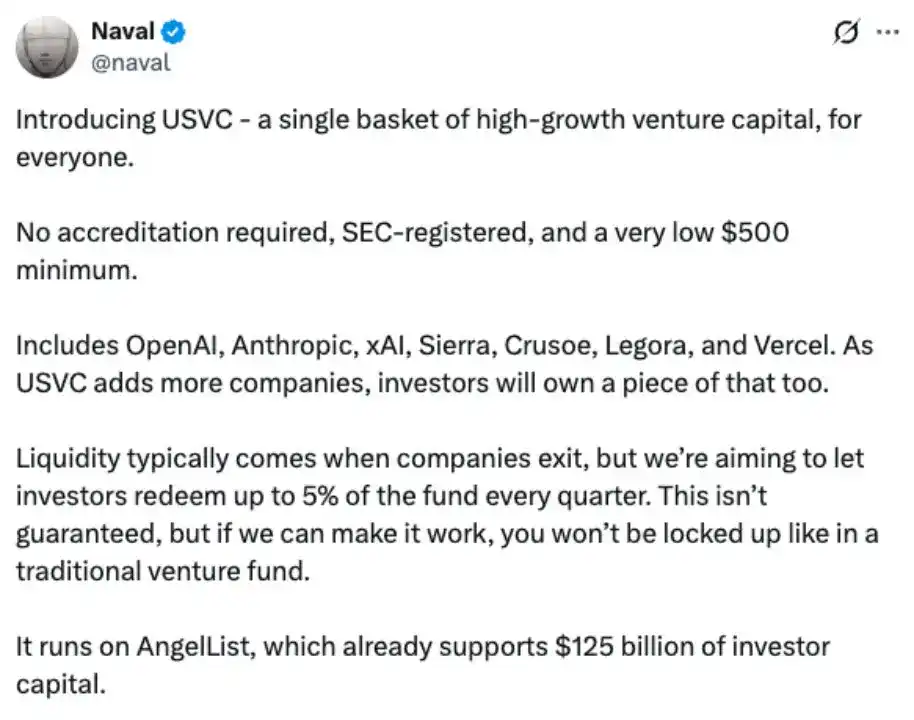
This signal itself is very telling. Naval is not someone who would easily endorse a financial product. His persona is complex: co-founder of @AngelList, a representative figure of early-stage investment culture, an evangelist for the Silicon Valley entrepreneurial spirit, and a long-standing intellectual symbol in the Web3 world.

So when Naval @naval chooses to step into the forefront for USVC, it's not just about the launch of a new fund. It seems more like a retail extension of AngelList's over-a-decade-long infrastructure for startup financing.

In the past, AngelList served entrepreneurs, angel investors, fund managers, and private capital networks. Now, it is attempting to break down a portion of the access to venture capital, once reserved for a select few, into a gateway that ordinary people can also participate in.

USVC is an SEC-registered fund with a minimum investment of $500, requiring no accredited investor status. Its early portfolio includes companies like OpenAI, Anthropic, xAI, Sierra, Crusoe, Legora, and Vercel.
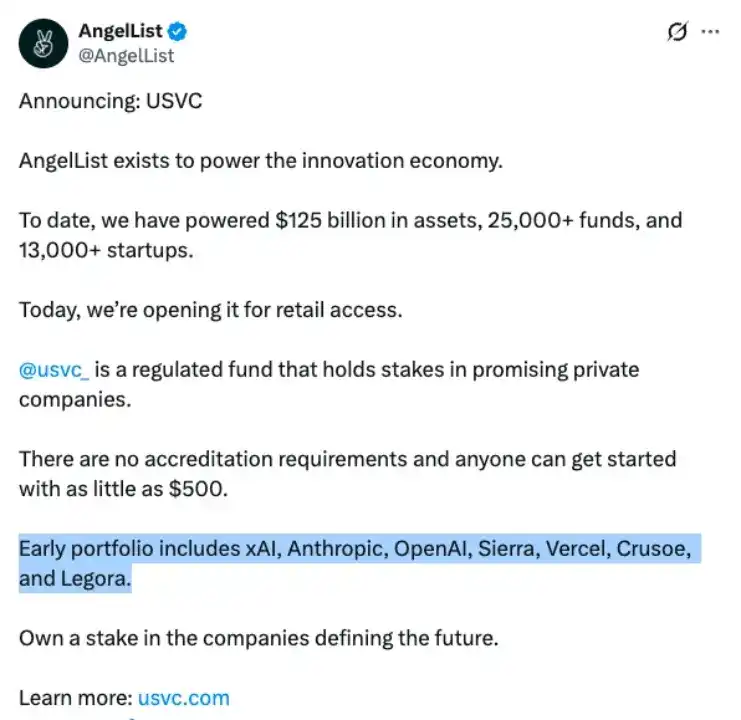
This is the real point of discussion that USVC provokes. It's not simply selling a basket of AI star companies; it's responding to an increasingly尖锐的时代问题: when the most explosive tech growth happens earlier and earlier in the private markets, can ordinary people still participate in the future sooner?

Over the past decade, the most brutal change in tech investing hasn't been the AI explosion, nor the revaluation of SaaS or chip stocks, but the overall forward shift of the wealth creation timeline.

Many of the most important companies complete multiple rounds of massive funding and value leaps long before entering the public markets. By the time ordinary investors can finally buy in through an IPO or the secondary market, the story has often been told many times over, valuations have been fully priced by earlier rounds of capital, and the truly asymmetric alpha has already been captured upfront by private capital.

For example, as we all know, Benchmark merely led a $75 million funding round in April 2025 for Manus, securing a position in this AI Agent newcomer's most critical growth window.

At that time, Manus @ManusAI was valued at around $500 million, and just months later, Meta acquired it for over $2 billion, delivering early capital an approximate 4x paper return in a very short time.

This is the most alluring aspect of venture capital. The real alpha often occurs when ordinary people don't yet have the qualifications to enter.

Names like OpenAI, Anthropic, xAI, and Vercel are exciting not just because they represent AI, large models, developer tools, and next-generation software infrastructure, but because they symbolize a fact: the future is being bought earlier and earlier.

Ordinary people use these products daily, contributing data, attention, subscription revenue, and ecosystem growth, but at the capital level, they often can only stand outside the glass window, watching institutions, funds, and high-net-worth investors participate in the value revaluation.

It is precisely this glass pane that USVC is attempting to shatter.

The entry point it offers is very direct: ordinary people can participate with a minimum of $500 in a venture capital basket composed of high-growth private tech companies. This threshold, placed alongside the names of these assets, creates a stark contrast.
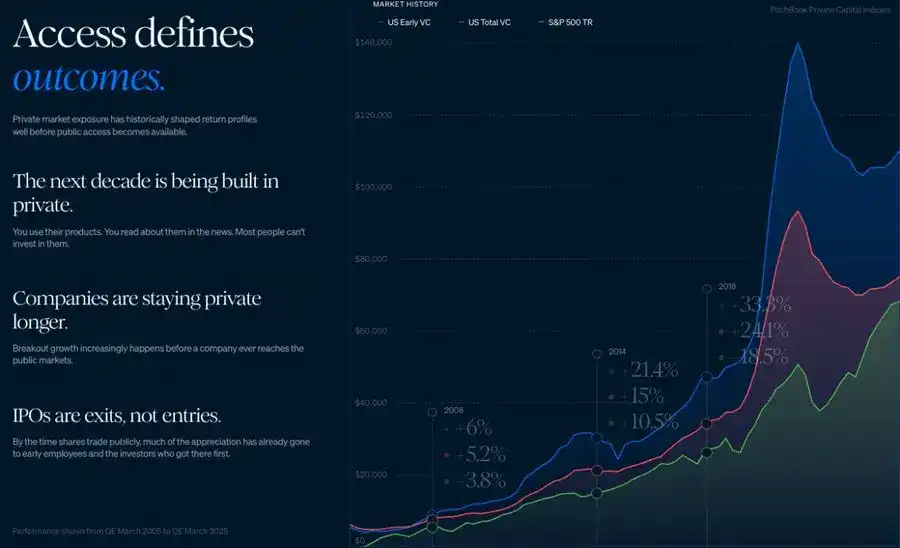
* US Early VC vs. S&P 500 returns, from USVC website https://usvc.com/

In the past, those who could access such assets were typically top VCs, family offices, sovereign wealth funds, university endowments, or accredited high-net-worth investors. Now, USVC is attempting to productize,合规化, and retail this asset exposure, placing it before ordinary investors.

But precisely because of this, USVC cannot be understood merely as an emotional product of "$500 to buy OpenAI." The真正复杂的地方在于, venture capital is never just about buying the name of a good company, but about the price, stage, structure, fees, and liquidity terms at which one buys.

OpenAI, Anthropic, and xAI are certainly the most watched tech companies of this era, but a great company does not automatically equate to a great investment. Especially after they have undergone multiple rounds of high-valuation funding, what investors真正需要判断 is not whether these companies are strong enough, but whether the future returns through USVC still possess sufficient吸引力.

This is also why Naval's involvement is crucial. Naval's symbolic significance is not just his influence, but that he represents a long-term understanding of entrepreneurship, capital, networks, and leverage.
One of the most important things AngelList did back in the day was to partially loosen startup financing from extremely closed circles, allowing more angel investors, entrepreneurs, and new fund managers to connect through the platform.

What USVC is doing today is, in a sense, a continuation of the same logic: if AngelList once reduced the organizational cost of the startup financing network, then USVC is now attempting to lower the barrier to entry for ordinary people to access venture capital assets.

However, the expansion of access does not mean the disappearance of risk.

USVC is not an ETF. It cannot be traded intraday like a Nasdaq ETF, nor can it be bought and sold at any time like public stocks. Its underlying assets are private companies and private fund shares, inherently characterized by low liquidity, opaque valuation, and long exit cycles.

The team mentions hoping to achieve up to 5% fund redemptions quarterly in the future, but this does not mean investors can exit at any time. More accurately, this is a designed partial liquidity, not the天然具备的高流动性 of the underlying assets.

The fee issue同样不能回避. USVC's current all-in fee for the first year is 2.5%. At first glance, this number is certainly high compared to S&P 500 ETFs, Nasdaq ETFs, or other low-cost index products.

But if compared within the traditional venture capital system, the situation becomes much more complex. The common fee structure for traditional VCs is 2/20, meaning a 2% annual management fee plus a 20% performance fee (carried interest).

If investing indirectly through a fund of funds, an additional layer of fees might be stacked on top of the underlying VC fees. USVC's proposition is that the current 2.5% includes fees related to the underlying funds, with AngelList absorbing costs exceeding that比例 in the first year, and USVC charging no additional fees for direct investments.

If it were merely repackaging already very expensive late-stage star assets for retail investors, then 2.5% would be hard to call cheap. But if it can consistently secure truly scarce, completely inaccessible-to-ordinary-people, and still attractively valued优质私募资产 through the AngelList and Naval network, then this fee更像是一种进入风险资本网络的通行成本.

In other words, the greatest value of USVC lies not in being cheap, but in whether it can持续提供真实的、稀缺的、值得付费的风投权限.

This is also where USVC subtly intersects with the Web3 narrative.

Over the past few years, Web3 has been talking about financial inclusion. DeFi allows ordinary people to lend, trade, market-make, and participate in yield strategies on-chain; RWA attempts to bring real-world assets on-chain; stablecoins have made dollar payments globalized, low-friction, and real-time.

But USVC is taking a different path. It hasn't used tokens to achieve asset openness, nor has it used on-chain mechanisms to provide liquidity. Instead, through an SEC-registered fund, NAV, an investment committee, the AngelList network, and compliant distribution channels, it is bringing exposure to previously closed private tech assets before ordinary investors.

The paths are different, but the underlying question is similar: Who is qualified to own the future? USVC might not be a ticket to guaranteed returns, but rather a ticket to get closer to the future, sooner. DYOR.


Perguntas relacionadas

QWhat is the significance of Naval Ravikant's role as the Investment Committee Chair at USVC?

ANaval Ravikant's involvement is significant because he is a respected Silicon Valley thinker, co-founder of AngelList, and a symbol of early investment culture. His endorsement signals that USVC is not just another financial product but a serious attempt to democratize access to high-growth private tech investments, extending AngelList's mission of making venture capital more accessible.

QHow does USVC aim to change普通人's access to venture capital investments?

AUSVC aims to democratize access by offering an SEC-registered fund with a minimum investment of $500, open to non-accredited investors. It provides exposure to a basket of high-growth private tech companies like OpenAI, Anthropic, and xAI, which were previously only available to institutional investors, VCs, or high-net-worth individuals.

QWhat are some key risks associated with investing in USVC?

AKey risks include low liquidity (as the fund holds private company shares and私募基金份额, with limited quarterly redemptions), valuation opacity, long investment horizons, and fees (an all-in fee of 2.5% annually). Unlike public ETFs, it lacks daily tradability and transparency in pricing.

QHow does USVC's fee structure compare to traditional venture capital funds?

AUSVC charges an all-in fee of 2.5% annually, which includes underlying fund fees. This is lower than the traditional VC '2 and 20' model (2% management fee plus 20% performance fee). However, it is higher than low-cost public market ETFs, and its value depends on USVC's ability to source稀缺, high-quality private assets at attractive valuations.

QWhat is the broader implication of USVC in the context of financial democratization and Web3 narratives?

AUSVC represents an alternative path to financial democratization, contrasting with Web3's use of tokens and DeFi for open access. It uses SEC-regulated funds and traditional structures to provide retail investors with exposure to private tech assets. This addresses the core issue of who gets to participate in early-stage wealth creation from high-growth companies before they go public.

Leituras Relacionadas

Vitalik: Building Index-Tracking Assets Based on Options Rather Than Debt

Vitalik Buterin proposes constructing index-tracking assets using synthetic options rather than debt-based mechanisms. The core problem is enabling exposure to a price index (T, e.g., USD/ETH) in a trust-minimized environment where only ETH is a trustless asset, relying solely on a decentralized oracle. Traditional approaches, like algorithmic stablecoins, use debt positions and require real-time, binding oracles for liquidations, which are difficult to secure. This article suggests a paradigm shift: eliminating liquidation and using options as the fundamental building block, requiring only a "slow" oracle. The design defines two synthetic assets, P and N, with parameters for the index T, a strike price S, and an expiry M. At any time, 1 ETH can be split to create a (P, N) pair or merged back. At expiry M, the oracle determines T's value x. P receives min(1, S/x) ETH, and N receives max(0, 1 - S/x) ETH. This structure inherently avoids insolvency risk (P+N=1) and can share an oracle with prediction markets. To gain stable exposure to T (e.g., USD), a user would hold deeply "in-the-money" P options (with S significantly below the current price) and periodically "roll" them to lower strikes as the price approaches the current strike, rebalancing their portfolio. This transfers the decision of *when* to act from a protocol-enforced liquidation (requiring a real-time oracle) to the user or an automated wrapper. Users can manage MEV risk and oracle dependency by choosing their rebalancing timing and data sources. A key trade-off is accepting some quadratic drift (deviation from perfect peg), estimated at 1-4% annualized volatility. Buterin argues this cost is reasonable compared to fiat currency volatility or equilibrium shifts in other stablecoins. The success of this model depends heavily on designing low-slippage market mechanisms for the rebalancing process, leveraging users' low time preference to execute trades patiently.

marsbitHá 44m

Vitalik: Building Index-Tracking Assets Based on Options Rather Than Debt

marsbitHá 44m

"Water Scarcity": The Hidden Fatal Flaw of AI Infrastructure

“Water Scarcity: The Hidden Vulnerability of AI Infrastructure” In June 2026, SpaceX revised its IPO prospectus to highlight a core resource constraint alongside power and processors: water. This move signals a pivotal shift where water scarcity has transformed from an operational cost to a major, uncontrollable investment risk, directly threatening AI data center expansion. The scale of the problem is immense. U.S. data centers consumed an estimated 17 billion gallons of water for direct cooling in 2023, with indirect water use for power generation exceeding 211 billion gallons. Giants like Google alone use billions of gallons annually, with single sites consuming volumes equivalent to a medium-sized city. This water is largely “consumptive,” evaporated into the atmosphere and lost. This massive demand is colliding with scarcity. Tech companies are building “water tigers” in arid regions, sparking community protests in places like Mexico and Arizona, where data centers can legally use millions of gallons daily—enough for tens of thousands of residents. These conflicts are not about illegality, but about a mismatch between historic water allocation frameworks and new, colossal demand. The consequences are real. Community opposition, largely centered on water, has reportedly stalled or canceled $64 billion in U.S. data center projects over two years. Simultaneously, investors are pressuring companies for greater water footprint transparency, viewing it as a financial risk, not just an ESG metric. Technological solutions like air or liquid cooling involve trade-offs between water and electricity use, with final choices dictated by local constraints. The irony is stark: while industry leaders envision AI as a utility “like water,” its physical infrastructure is straining real-world water supplies. The race for AI supremacy may ultimately be governed not by the fastest chip, but by the slowest water meter.

marsbitHá 1h

"Water Scarcity": The Hidden Fatal Flaw of AI Infrastructure

marsbitHá 1h

Global Card Issuance Enters a Compliance-Driven Era: WasabiCard is Building the Next-Generation Payment Infrastructure

Global card issuance is entering a compliance-driven era, with WasabiCard building next-generation payment infrastructure. The platform asserts that as stablecoins increasingly enter cross-border payments, corporate settlements, and global commerce, the industry is shifting focus from "availability" and "growth-driven" models to long-term, compliant operation under global frameworks. Competition will center on sustainable compliance and global infrastructure capabilities. Stablecoins are evolving from on-chain assets into key payment tools in global business, with card issuance acting as critical infrastructure connecting digital assets to traditional payment networks like Visa and Mastercard. This expansion has revealed structural issues, including cross-regional issuance, BIN resource management, and insufficient AML and risk controls. In response, the industry is moving away from reliance on "grey efficiency" towards prioritizing compliance, risk management, and long-term operational stability. WasabiCard outlines its strategy: collaborating with licensed principals and local partners for localized operations, building robust KYC/AML systems, strictly separating commercial and consumer BIN usage, and enhancing global issuance, payment, and cross-border fund flow infrastructure. The goal is to build stable, scalable payment infrastructure amid evolving global regulations, shifting industry competition from scale to infrastructure capability. As stablecoins integrate further with global commerce, payment infrastructure will become a fundamental, embedded component of internet business. WasabiCard will continue to develop capabilities in global card issuance, stablecoin payments, cross-border fund flows, and API-driven financial workflows.

marsbitHá 1h

Global Card Issuance Enters a Compliance-Driven Era: WasabiCard is Building the Next-Generation Payment Infrastructure

marsbitHá 1h

Trading

Spot
Futuros

Artigos em Destaque

Como comprar PEOPLE

Bem-vindo à HTX.com!Tornámos a compra de ConstitutionDAO (PEOPLE) simples e conveniente.Segue o nosso guia passo a passo para iniciar a tua jornada no mundo das criptos.Passo 1: cria a tua conta HTXUtiliza o teu e-mail ou número de telefone para te inscreveres numa conta gratuita na HTX.Desfruta de um processo de inscrição sem complicações e desbloqueia todas as funcionalidades.Obter a minha contaPasso 2: vai para Comprar Cripto e escolhe o teu método de pagamentoCartão de crédito/débito: usa o teu visa ou mastercard para comprar ConstitutionDAO (PEOPLE) instantaneamente.Saldo: usa os fundos da tua conta HTX para transacionar sem problemas.Terceiros: adicionamos métodos de pagamento populares, como Google Pay e Apple Pay, para aumentar a conveniência.P2P: transaciona diretamente com outros utilizadores na HTX.Mercado de balcão (OTC): oferecemos serviços personalizados e taxas de câmbio competitivas para os traders.Passo 3: armazena teu ConstitutionDAO (PEOPLE)Depois de comprar o teu ConstitutionDAO (PEOPLE), armazena-o na tua conta HTX.Alternativamente, podes enviá-lo para outro lugar através de transferência blockchain ou usá-lo para transacionar outras criptomoedas.Passo 4: transaciona ConstitutionDAO (PEOPLE)Transaciona facilmente ConstitutionDAO (PEOPLE) no mercado à vista da HTX.Acede simplesmente à tua conta, seleciona o teu par de trading, executa as tuas transações e monitoriza em tempo real.Oferecemos uma experiência de fácil utilização tanto para principiantes como para traders experientes.

487 Visualizações TotaisPublicado em {updateTime}Atualizado em 2026.06.02

Como comprar PEOPLE

Discussões

Bem-vindo à Comunidade HTX. Aqui, pode manter-se informado sobre os mais recentes desenvolvimentos da plataforma e obter acesso a análises profissionais de mercado. As opiniões dos utilizadores sobre o preço de PEOPLE (PEOPLE) são apresentadas abaixo.

活动图片












