National-Level Players Enter the Game: Deciphering the Escalation and Transformation of Crypto Crime in 2025

marsbitPublicado em 2026-01-12Última atualização em 2026-01-12

Resumo

In 2025, state-level involvement in cryptocurrency-related activities has significantly increased, marking a new phase in the maturation of illicit on-chain ecosystems. Illicit addresses received at least $154 billion, a 162% year-over-year surge, largely driven by a 694% increase in transactions involving sanctioned entities. Even excluding these, 2025 was a record year for crypto crime, with growth across most illegal categories. Stablecoins now dominate illicit transactions, accounting for 84% of the total. Nation-state threats were particularly prominent: North Korean hackers stole $2 billion, including a historic $1.5 billion attack on Bybit. Russia launched the ruble-backed A7A5 token, which saw $93.3 billion in transactions within a year, facilitating large-scale sanctions evasion. Iranian proxy networks and China-based money laundering networks also expanded their operations, offering specialized services like fraud, terror financing, and sanctions avoidance. The rise of full-stack illicit infrastructure providers has enabled both criminals and state actors to conduct malicious activities more effectively. Moreover, the connection between crypto crime and real-world violence is growing, with increased use in human trafficking and violent coercion attacks. Despite these challenges, illicit activity still represents less than 1% of all traceable cryptocurrency transaction volume. Collaboration among law enforcement, regulators, and crypto businesses remains crucial t...

Authored by: Chainalysis

Compiled by: Chopper, Foresight News

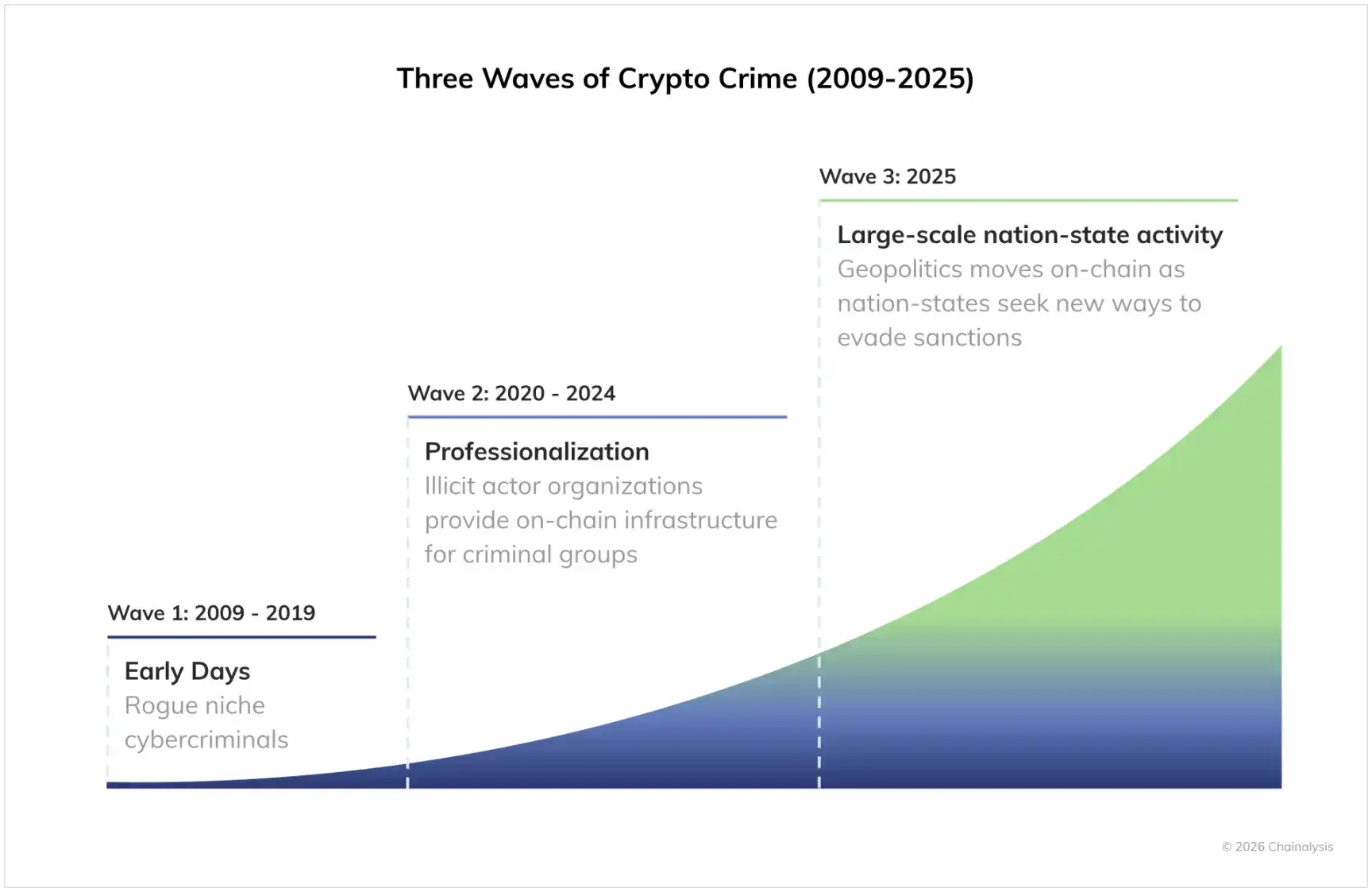
In 2025, we observed a significant increase in state-level cryptocurrency-related activities, marking a new mature phase in the development of the illegal on-chain ecosystem. Over the past few years, the professionalization within the crypto crime sphere has deepened; illicit organizations have established large-scale on-chain infrastructure to support transnational criminal networks in procuring goods and services and laundering crypto crime proceeds. Against this backdrop, national governments have also begun to engage in this domain, leveraging these mature professional service providers on one hand, and building their own customized infrastructure on the other, to evade sanctions on a large scale. As governments tap into this illicit cryptocurrency supply chain originally built for cybercriminals and organized crime groups, government agencies, compliance, and security teams now face severe challenges in terms of consumer protection and national security.
What are the specific on-chain manifestations of these developments and other industry changes? Next, we will analyze them by combining data and macro trends.
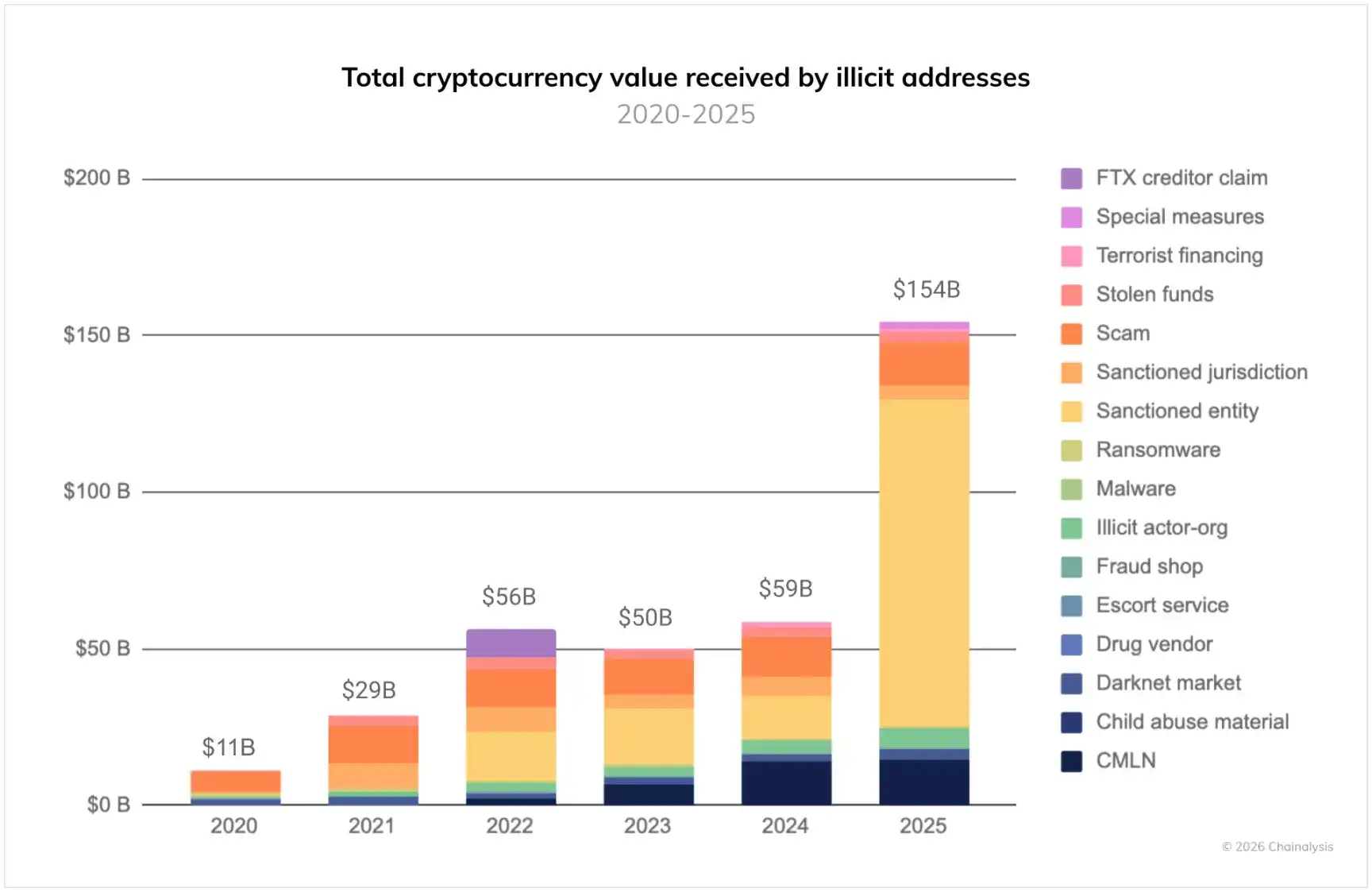
According to our monitoring data, the scale of funds flowing into illicit cryptocurrency addresses in 2025 reached at least $154 billion, a sharp increase of 162% year-on-year. This growth was primarily driven by a surge in fund inflows to sanctioned entities, which soared by 694% year-on-year. However, even excluding the growth from sanctioned entities, 2025 still stands as a record year for crypto crime, as the vast majority of illicit activity categories saw growth.

Nevertheless, the scale of these illicit transactions still pales in comparison to the overall cryptocurrency economy, where legitimate transactions remain the mainstay. We estimate that although the proportion of illicit transactions in the total traceable cryptocurrency transaction volume in 2025 increased slightly compared to 2024, it remained below 1%.

As shown in the figure below, we also observed a continuing shift in the types of assets involved in crypto crime.
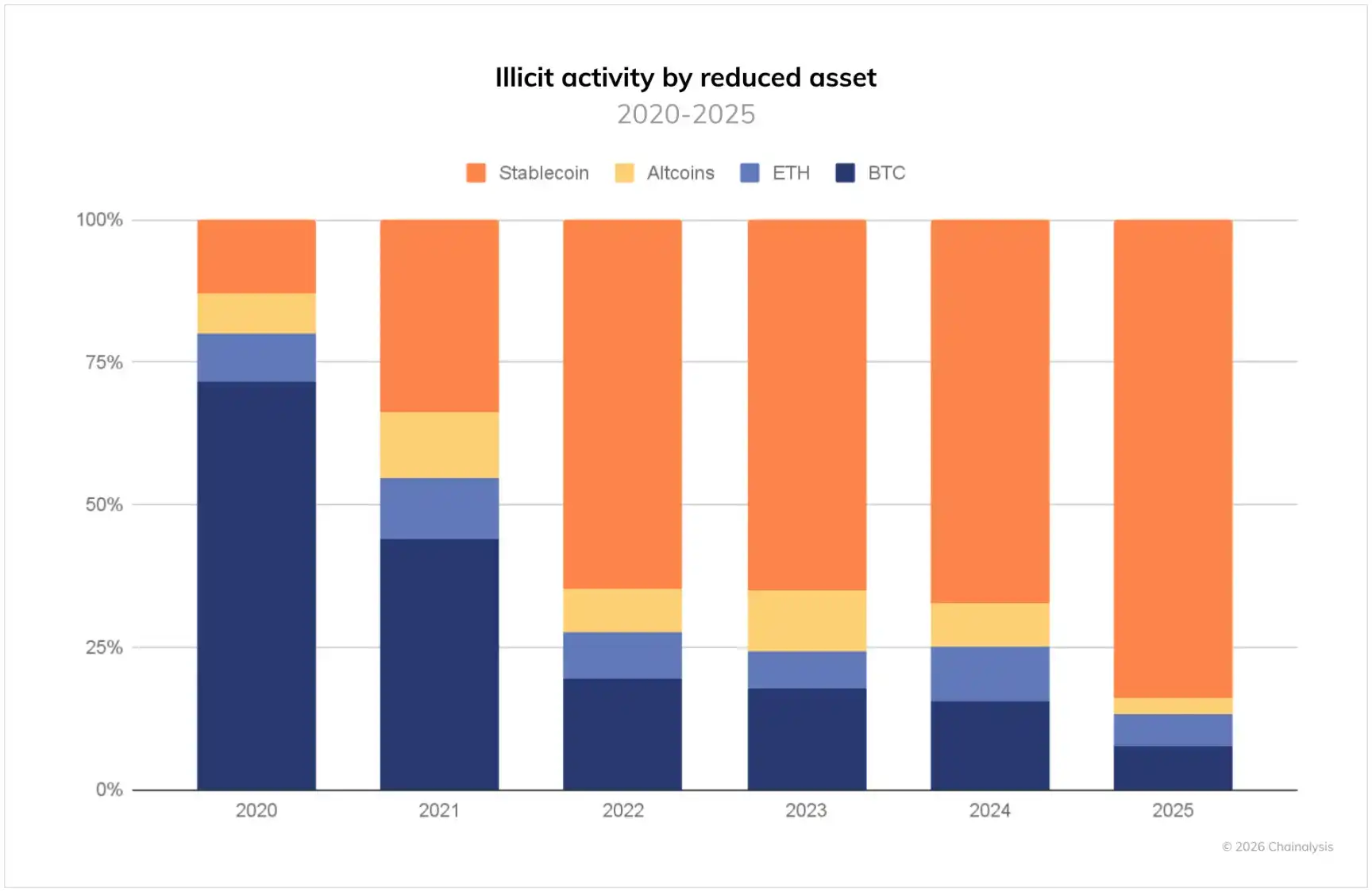
Over the past few years, stablecoins have gradually become the dominant asset for illicit transactions, currently accounting for 84% of the total illicit transaction volume. This trend aligns with the overall development characteristics of the cryptocurrency ecosystem: with advantages such as convenience for cross-border transfers, low volatility, and wide application scenarios, the share of stablecoins in the entire cryptocurrency transaction volume continues to expand.

The following sections will delve into the core trends that defined the crypto crime landscape in 2025, trends that will remain important to watch in the future.

National-Level Threats Drive Transaction Volume: North Korean Thefts Hit Record High, Russian A7A5 Token Facilitates Large-Scale Sanction Evasion

In 2025, stolen funds remained a major threat to the cryptocurrency ecosystem, with North Korean-linked hacker groups alone stealing $2 billion. This figure was primarily driven by several highly destructive large-scale hacking incidents, the most notable being the attack on the Bybit exchange in February. The incident involved nearly $1.5 billion, making it the largest digital asset theft in the history of cryptocurrency. Although North Korean hackers have long been a major force threatening the cryptocurrency ecosystem, the past year saw record highs both in the amount stolen and in the sophistication of their intrusion and money laundering methods.

Particularly noteworthy is that the scale of on-chain activities by national governments reached unprecedented levels in 2025. Russia introduced relevant legislation in 2024 to promote the use of cryptocurrency to evade sanctions, and this measure was formally implemented in February 2025. The country launched the ruble-backed token A7A5, which saw its transaction volume exceed $93.3 billion in less than a year since its launch.

Meanwhile, over the past few years, Iran's proxy networks have conducted money laundering, illegal oil trading, and procurement of weapons and bulk commodities on-chain through identifiable wallet addresses already on sanctions lists, with a cumulative transaction volume exceeding $2 billion. Despite multiple military strikes, Iran-backed terrorist groups such as Hezbollah, Hamas, and the Houthis continue to use cryptocurrency on an unprecedented scale.

In 2025, Chinese money laundering networks emerged as a dominant force in the illicit on-chain ecosystem. These organizations operate with sophisticated models, significantly driving the diversification and professionalization of crypto crime, offering specialized criminal services including "money laundering services." Building on early illegal operation models like "Huiyin Guarantee," these networks have established full-service criminal enterprises, covering areas such as fraud, scams, laundering proceeds from North Korean hacker thefts, sanction evasion, and terrorism financing.

Full-Stack Illicit Infrastructure Providers Fuel Malicious Cyber Activities

While national governments are increasing their use of cryptocurrency, traditional cybercrime remains rampant: ransomware operators, child sexual abuse and cybercrime platforms, malware distributors, scammers, and illicit marketplaces still rely on vast support networks to maintain operations. Illicit actors and national governments are increasingly dependent on full-stack on-chain infrastructure providers, including domain registrars, secure and reliable hosting services, and other technical infrastructure that can be used for malicious cyber activities.

These infrastructure providers have evolved into comprehensive infrastructure platforms capable of resisting platform takedowns, abuse complaints, and sanction enforcement. As the scale of these services continues to expand, they are likely to become a key force driving economic crime and state-backed entities to broaden the scope of their malicious cyber activities.

Growing Correlation Between Cryptocurrency and Violent Crime

In the perception of many, crypto crime is still confined to the virtual world. The masterminds are merely anonymous figures hiding behind keyboards, not translating into real-world threats. But in reality, the link between on-chain activities and violent crime is deepening. Human trafficking rings are increasingly using cryptocurrency for transactions; at the same time, disturbingly, there has been a significant rise in cases of violent coercion attacks, where criminals use violence to force victims to transfer crypto assets, and such assaults often occur during peak cryptocurrency price periods.

Looking ahead, collaboration between law enforcement agencies, regulatory bodies, and cryptocurrency companies will be key to addressing these complex, evolving, and interconnected threats. Although the proportion of illicit transactions within legitimate cryptocurrency trading volume remains limited, maintaining the integrity and security of the cryptocurrency ecosystem has never been more important.

Perguntas relacionadas

QWhat was the total value of illicit cryptocurrency transactions in 2025, and what was the primary driver of this growth?

AThe total value of illicit cryptocurrency transactions in 2025 reached at least $154 billion, a 162% year-over-year increase. This growth was primarily driven by a massive 694% surge in transaction volume from sanctioned entities.

QWhich asset type has become the dominant medium for illicit transactions and what percentage of the total illicit volume does it represent?

AStablecoins have become the dominant asset for illicit transactions, representing 84% of the total illicit transaction volume.

QWhat significant role did nation-states play in the 2025 crypto crime landscape, according to the article?

ANation-states played a significant role, with activities reaching unprecedented levels. This included North Korean hackers stealing a record $2 billion, Russia launching the A7A5 token to facilitate large-scale sanctions evasion (with nearly $93.3 billion in volume), and Iran's proxy networks laundering over $2 billion for activities like illegal oil trading and weapons procurement.

QWhat new concerning trend is emerging regarding the connection between cryptocurrency and real-world violence?

AA concerning trend is the increasing connection between on-chain activity and violent crime. This includes human trafficking syndicates using crypto for transactions and a significant rise in violent coercion attacks, where victims are physically forced to transfer crypto assets, often during periods of peak cryptocurrency prices.

QWhat is the role of 'full-stack illicit infrastructure providers' in the current crypto crime ecosystem?

AFull-stack illicit infrastructure providers offer comprehensive services to both criminals and nation-states. They have evolved into resilient platforms that can withstand takedowns, abuse complaints, and sanctions enforcement. Their services include domain registration, secure hosting, and other technical infrastructure for malicious cyber activity, making them a critical force in enabling economic crime and state-sponsored operations.

Leituras Relacionadas

Bank of Japan Signals Interest Rate Hike Despite Keeping Them at 1%

The Bank of Japan (BOJ) kept its benchmark interest rate at 1% on July 31, as widely expected, following a June hike to a 31-year high. The decision passed with an 8-1 vote, with board member Hajime Takata again dissenting in favor of a hike to 1.25%. Despite holding rates steady, the BOJ signaled a hawkish tilt, warning that underlying inflation is likely to accelerate and exceed 2% from the latter half of the fiscal year. While it slightly lowered its core inflation forecast for FY2026, officials expressed stronger confidence that an overshoot will occur later, driven by yen weakness, corporate pricing behavior, and lingering energy shock effects. Markets were focused on the BOJ's forward guidance. Analysts noted the central bank appeared to balance short-term caution with a long-term warning of tighter policy. Governor Kazuo Ueda faces the challenge of reconciling a government reluctant to tighten further with bond markets already pricing in additional hikes, with the timing of the next move debated. Adding complexity, the BOJ reportedly intervened in currency markets hours before the rate decision, buying yen to support the currency which had fallen to 40-year lows against the dollar. Yen weakness stems from the wide U.S.-Japan interest rate gap, high fuel prices, and market skepticism about the pace of BOJ policy normalization. The yield on Japan's 10-year government bonds fell to 2.8%, indicating investor expectations for future monetary tightening.

cryptonews.ruHá 4m

Bank of Japan Signals Interest Rate Hike Despite Keeping Them at 1%

cryptonews.ruHá 4m

Why Are Leveraged ETFs like 7709 Inherently Negative EV Products?

This article argues that the SK H力士 2x Leveraged ETF (7709) is fundamentally a negative expected value (EV) product, rather than simply a "double SK H力士" investment. Its core issue stems from its daily rebalancing mechanism to maintain a 2x leverage target. After a price move, the fund must buy more after a rise or sell after a fall to readjust its leverage, creating a systematic pattern of buying high and selling low. This introduces a "delay loss": it always reacts to past price changes, missing potential gains from adjusting earlier during an uptrend and suffering greater losses from adjusting later during a downtrend. While more frequent intraday rebalancing would improve returns in strong, smooth trending markets by reinvesting profits or cutting losses sooner, it also dramatically increases volatility drag (frictional losses) during choppy, oscillating markets due to more frequent high-buy/low-sell trades. The author draws a parallel to an option seller who delta hedges (short gamma), which involves similar "buy high, sell low" dynamic hedging. However, unlike an option seller who receives upfront premium (IV and theta) as compensation for this risk, the leveraged ETF investor receives no such compensation. Instead, they bear all the path-dependent volatility decay, plus additional costs like swap/derivatives financing, management fees, and trading slippage. Thus, the product's return profile can be framed as: 2x directional return minus realized variance drag minus financing costs minus derivatives costs minus management fees minus transaction costs. For the investor to profit, SK H力士's price must not only rise significantly but do so in a strong, sustained, and smooth trend to overcome these inherent structural costs. High volatility and frequent price reversals are particularly damaging. The article also notes that while the ETF has no explicit liquidation line like perpetual futures, avoiding a sudden "blow-up," its net asset value can still decay towards zero over time through this combination of volatility drag and fees. For experienced traders, directly managing leverage via perpetual contracts may offer more control and potentially lower costs than this packaged, mechanistic product.

marsbitHá 11m

Why Are Leveraged ETFs like 7709 Inherently Negative EV Products?

marsbitHá 11m

'Backstabbing' or 'Win-Win'? How Likely Is TradeXYZ to Break Away from Hyperliquid and Go Solo?

The article discusses the growing debate over whether TradeXYZ, which dominates Hyperliquid's HIP-3 market with over 90% of its volume, might break away to build its own independent trading platform. This possibility is fueled by TradeXYZ's immense market influence and the common industry trend of successful projects seeking more control and profit capture. Key arguments for a potential split include TradeXYZ's overwhelming contribution to Hyperliquid's metrics and the financial incentive to retain all transaction fees, as it currently splits them 50/50 with Hyperliquid. The piece draws parallels to other cases, like Anthropic's "Claude Code" competing with its former partner Cursor, suggesting "betrayal" can occur when business leverage shifts. However, strong counterarguments suggest a split is unlikely or would be detrimental. TradeXYZ relies on Hyperliquid's high-performance infrastructure and its platform as a primary user acquisition channel. Building a comparable system would be challenging. Furthermore, the founders of both projects share a history of trust and mutual admiration. The analysis concludes that a separation would likely be a lose-lose scenario: Hyperliquid would lose a major growth narrative and trading volume, while TradeXYZ would face technical hurdles, user migration issues, and reputational damage, potentially allowing competitors to seize market share. The most rational path is seen as continued collaboration, with TradeXYZ potentially negotiating better terms while leveraging Hyperliquid's established strengths.

marsbitHá 20m

'Backstabbing' or 'Win-Win'? How Likely Is TradeXYZ to Break Away from Hyperliquid and Go Solo?

marsbitHá 20m

Trading

Spot
活动图片