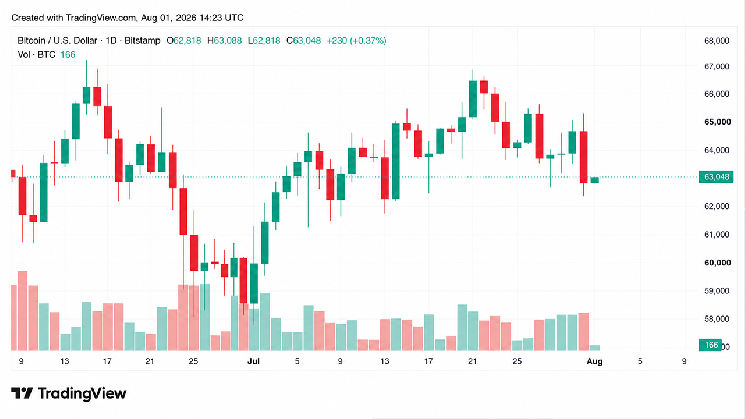
Mysticism Takes Over Crypto: When Candlestick Charts Give Way to Bazi and Feng Shui

比推Publicado em 2025-12-25Última atualização em 2025-12-25

Resumo

In the crypto world, traditional technical analysis is increasingly being overshadowed by metaphysical practices like astrology and feng shui. The author describes encountering well-known crypto figures—KOLs, traders, and VCs—praying at temples for wealth, highlighting a cultural shift where beliefs in destiny and supernatural forces are becoming mainstream. Some investors and funds now prioritize checking founders' facial fortunes or project name compatibility over conventional due diligence. Anecdotes include a listed company CEO who reportedly earned hundreds of millions by following feng shui advice, while others suffered losses after ignoring such guidance. The trend is framed not as mere superstition but as a psychological response to extreme market volatility and uncertainty. In an environment where tweets from influencers or politicians can trigger 50% price swings, metaphysical practices serve as emotional anchors—much like ocean-faring cultures relying on divine protection during unpredictable voyages. Ultimately, when rationality reaches its limits, belief fills the void.

Author: Xiaobing, Deep Tide TechFlow

Original Title: Satoshi Nakamoto Would Have to Kowtow to the God of Wealth


Every year on the fifth day of the Lunar New Year, Xiaobing wakes up early to go to the Number One Temple of Wealth at Beigao Peak in Hangzhou.

I thought I would be jostling with aunties and uncles, but when I arrived, the scene was filled with familiar faces amidst the swirling incense smoke.

On the left was a well-known爆料KOL, on the right was someone involved in community schemes, and a few tech elites who usually preach "decentralization" were devoutly kowtowing with loud thuds. In that moment, algorithmic consensus and Federal Reserve movements were no match for the three sticks of incense in their hands.

Over the past two years, mysticism has become the "prominent study" in the crypto world. If you're still looking at candlestick charts, you're a classical rookie. The real veterans are now reading Bazi (Eight Characters).

A crypto trader familiar with various macroeconomic indicators eventually turned to mysticism, recently calculating BTC's Bazi—and the outlook is grim: fire clashes with the wealth repository, making 2026 (Bing Wu Year) Bitcoin's darkest hour. I quickly checked my wallet; luckily, it was already empty.
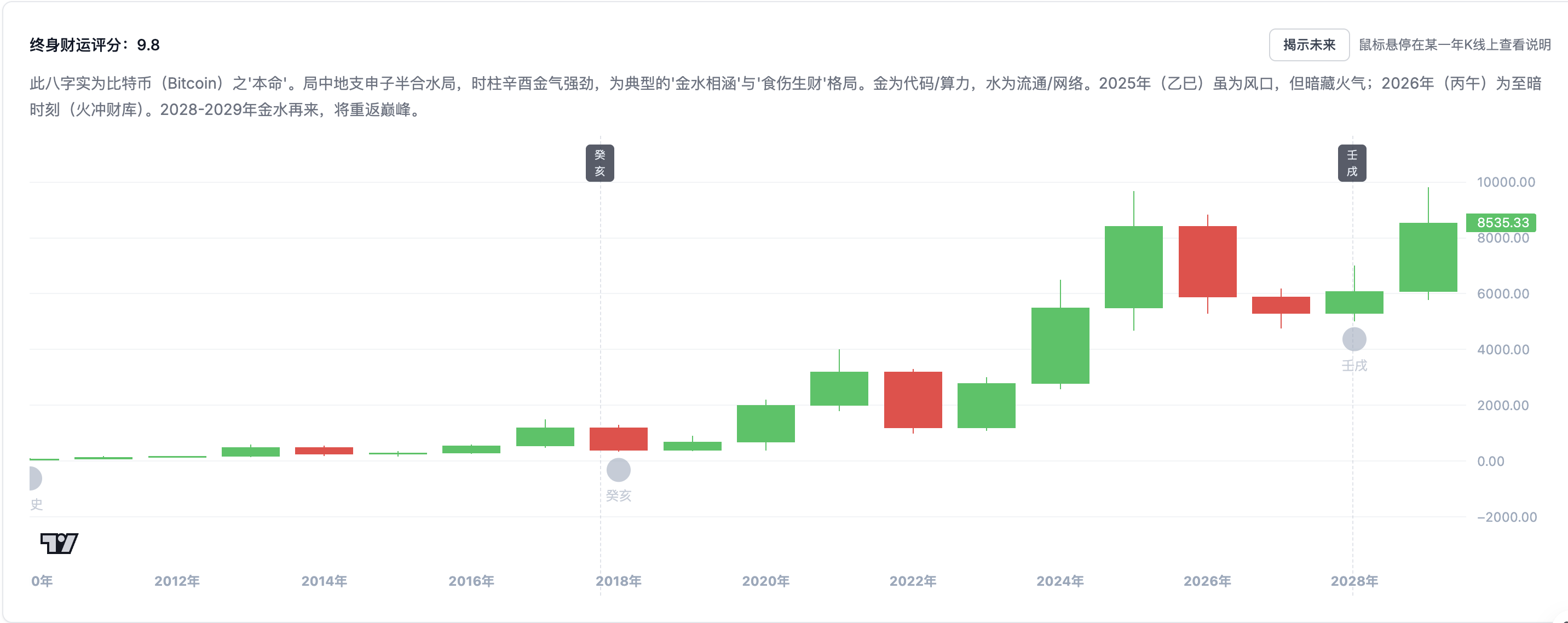
Remember, Alen, a partner at crypto VC y2z Ventures, once stated bluntly that one of their fund's core competencies was "reading faces." In the past, due diligence (DD) involved code audits and business models. Now, it's different: first, check if the founder has a "wealth-losing face," then see if the project's name clashes with Feng Shui.

During a recent trip to Shenzhen, I noticed that traders and KOLs' standard setup isn't data terminals; they all have a "Feng Shui consultant" behind them.

Don't laugh—this approach really works in crypto. Xiaobing knows a boss of a Hong Kong-listed company who is a devout believer in Feng Shui, donating real money to temples—possibly more than the company's R&D budget.

And the result? Feng Shui brought help from noble patrons. Starting in 2023, he bought Bitcoin, earning hundreds of millions of dollars by hoarding it. Later, he caught the wave of the DAT (Crypto Treasury Reserve) narrative, and the company's stock price doubled... Although everyone knows this is "survivorship bias," you can't argue with the fact that he really made a fortune.

There are counterexamples too. A爆料KOL with a frog avatar also had a Feng Shui consultant who advised him not to make moves recently. He couldn't resist and played with contracts, resulting in a neat and tidy liquidation.

About this phenomenon, it's not entirely superstition.

Our traditional land-based civilization emphasizes farming—"sow one grain in spring, reap ten thousand in autumn"—focusing on certainty. But what does maritime civilization face? Storms and unknown waters.

Why do people in the southeastern coastal areas worship Mazu? Not because of ignorance, but because on the vast ocean, besides experience and technology, you need something else.

The crypto world is essentially a modern version of the "Age of Exploration." It faces bottomless seas and sudden storms. This is human nature: the greater the randomness and volatility, the more we seek supernatural spiritual anchors.

When candlestick charts fail, and a single tweet from Musk, Trump, or CZ can sway the market, Feng Shui becomes the last psychological defense. This isn't ignorance; it's an instinctive stress response to massive wealth fluctuations.

After all, when your assets can swing 50% in a day, you need to believe in something to sleep at night. As for whether the God of Wealth understands blockchain, does it really matter?


Twitter:https://twitter.com/BitpushNewsCN

Bitpush TG Discussion Group:https://t.me/BitPushCommunity

Bitpush TG Subscription: https://t.me/bitpush

Original Link:https://www.bitpush.news/articles/7598323

Perguntas relacionadas

QWhat is the main theme of the article '玄学接管币圈:当K线图让位于八字与风水'?

AThe article discusses how metaphysical practices like astrology, fortune-telling, and feng shui are becoming increasingly influential in the cryptocurrency circle, replacing traditional methods like analyzing K-line charts for investment guidance.

QAccording to the article, what did the crypto VC y2z Ventures partner claim as one of their core competencies?

AAlen, a partner at y2z Ventures, stated that one of their fund's core competencies is 'reading facial features' (面相) to evaluate founders and projects, rather than relying solely on technical or business due diligence.

QWhy does the article compare the cryptocurrency market to the 'Age of Exploration'?

AThe article compares the crypto market to the Age of Exploration because both involve navigating high uncertainty and volatility, similar to sailors facing unpredictable storms at sea, leading people to seek supernatural or spiritual anchors for psychological comfort.

QWhat example does the article provide to show the effectiveness of feng shui in crypto investments?

AThe article cites a Hong Kong-listed company老板 who heavily donated to temples and followed feng shui practices, which allegedly helped him earn hundreds of millions by buying Bitcoin in 2023 and benefiting from market trends, though it acknowledges this could be survivorship bias.

QHow does the article explain the shift from traditional analysis to玄学in crypto trading?

AThe article attributes the shift to the extreme randomness and influence of factors like tweets from figures such as Elon Musk or Donald Trump, which make traditional charts unreliable, leading traders to adopt玄学as a psychological defense mechanism against high volatility.

Leituras Relacionadas

Raising Interest Rates Is Not a Tech Killer, EPS Is: A Strategy for Discarding the Weak and Retaining the Strong After the AI Theme's Sharp Decline

**Summary: Rising Interest Rates Are Not the Killer of Tech; EPS Is: The "Keep the Strong, Ditch the Weak" Strategy After the AI Theme Plunge** The author argues that the sharp sell-off in tech and AI-related stocks, triggered by a strong US jobs report that heightened Fed rate hike fears, represents a "pullback to pick up passengers" rather than a "car crash." The true end of a tech bull market is not determined by an extra 25 basis point hike, but by industry overcapacity and the disproval of earnings per share (EPS) expectations. Historical analysis shows that during past rate hike cycles, the Nasdaq-100 often outperformed, provided EPS growth remained strong. The current phase is seen as a shift from a "broad narrative-driven rally" to a "focused verification stage" for AI. The investment strategy should be to "keep the strong, ditch the weak." * **Retain exposure** to high-conviction AI infrastructure leaders with clear order visibility, stable margins, strong cash flow, and upward EPS revisions (e.g., AI servers, advanced packaging, optical modules, key cloud suppliers). * **Reduce exposure** to high-beta, narrative-driven stocks with unclear profit paths (e.g., some quantum computing, space, or speculative chip stocks), especially on rebounds. Valuation concerns should focus on whether earnings can catch up to high multiples, not on high P/E alone. Crowded positioning signals a concentration into quality assets, not necessarily a market top. The upcoming Q2 earnings season will be a key validation point. The core principle is to hold stocks with proven EPS, while using macro events (CPI data, central bank meetings) to manage timing and risk.

marsbitHá 34m

Raising Interest Rates Is Not a Tech Killer, EPS Is: A Strategy for Discarding the Weak and Retaining the Strong After the AI Theme's Sharp Decline

marsbitHá 34m

The Largest IPO in History Ignites Heated Debate: Is SpaceX Worth $1.77 Trillion?

SpaceX's potential IPO is priced at $135 per share, aiming to raise $75 billion and valuing the company at approximately $1.77 trillion, which would make it the largest IPO in history. This valuation has sparked intense debate among investors. Bullish analysts, including major underwriters Goldman Sachs and Morgan Stanley, argue the valuation is justified by SpaceX's long-term potential. They see it not just as a rocket company but as a future leader in space infrastructure, with key growth drivers being Starlink satellite internet, low-cost rocket launches, and future AI-related ventures. They project revenues reaching hundreds of billions to trillions of dollars by 2030-2040. ARK Invest's model suggests a 2030 enterprise value could reach $2.5 trillion. Bearish analysts from independent research firms like Morningstar, PitchBook, and New Constructs contend the IPO price is excessively high, already pricing in unrealistic future growth. Using DCF and sum-of-the-parts models, they estimate fair value between $780 billion and $1.7 trillion, significantly below the IPO target. They highlight risks such as the speculative nature of AI projections, over-dependence on Elon Musk, high growth expectations, and corporate governance concerns. Trefis set a target price of just $79 per share. While both sides acknowledge SpaceX's unique position in commercial space, the core disagreement centers on whether the $135 share price offers a reasonable margin of safety or is overly optimistic. Despite the valuation controversy, reported strong demand for the IPO indicates significant market interest.

marsbitHá 2h

The Largest IPO in History Ignites Heated Debate: Is SpaceX Worth $1.77 Trillion?

marsbitHá 2h

After the Passage of the GENIUS Act and the CLARITY Act, What Is the Correct Architecture for On-Chain Yield?

The article discusses the evolution of on-chain credit, distinguishing three markets: overcollateralized crypto lending, unsecured lending (largely unsuccessful), and asset-backed credit (ABC). ABC, backed by identifiable real-world collateral with legal recourse, is identified as the fastest-growing category and the only one credibly addressing adverse selection—the core problem in credit where the riskiest borrowers self-select. Current growth in on-chain Real World Assets (RWAs), particularly tokenized private credit funds (e.g., Maple Finance, Centrifuge), is substantial but often merely "wraps" existing fund structures, inheriting their risks rather than solving adverse selection at the protocol level. The regulatory landscape is a key driver, with the US GENIUS Act (prohibiting stablecoin issuers from paying yield) and the proposed CLARITY Act (closing loopholes on indirect yield) set to redefine permissible yield-bearing products. This makes vaults (like ERC-4626) the critical architecture—they become the primary compliant vehicle for delivering yield, functioning as issuance, disclosure, distribution, and recovery mechanisms. The author's thesis is that the correct post-GENIUS/CLARITY architecture involves building ABC solutions where credit assessment, structure, and recovery are encoded directly into the smart contract vault layer, moving beyond mere tokenized fund wrappers to solve adverse selection fundamentally and ensure regulatory compliance.

Foresight NewsHá 3h

After the Passage of the GENIUS Act and the CLARITY Act, What Is the Correct Architecture for On-Chain Yield?

Foresight NewsHá 3h

Trading

Spot
Futuros
活动图片