Written by: Niusike, Deep Tide TechFlow
Some dreams never die; they just wait for the right moment.
Original Title: What Musk Bought Was Not Twitter, But a 25-Year Unresolved Grudge
The Premature Birth of 1999
In March 1999, in Palo Alto, 27-year-old Elon Musk made a decision that seemed almost absurd at the time.
He invested all the $22 million he earned from selling Zip2 into a website called X.com.
At that time, Silicon Valley was still dominated by Yahoo and AOL, and the internet was synonymous with portal websites. Proposing the concept of an "online bank" at this point was like selling rockets in the era of horse-drawn carriages. But Musk envisioned X.com not just as an online bank; he wanted to create an online financial operating system: a single platform for all financial services, including transfers, investments, loans, insurance, and even daily expenses.
Silicon Valley at the time thought this young man from South Africa was crazy.
It was the era of dial-up internet, where opening a webpage sometimes took half a minute amid the screeching sound of modems. Asking users to transfer money on a 28.8K snail-paced network? It sounded like a joke.
His ambition was immense, but reality hit back harder.
A year later, X.com merged with Peter Thiel's Confinity (the predecessor of PayPal). What should have been a "genius alliance" turned into a Silicon Valley version of "Game of Thrones." Thiel and his Stanford elite crowd couldn't stand Musk's chaotic radicalism, viewing this engineer-turned-CEO as a dangerous madman.
In September 2000, the collapse came. Musk flew to Australia for his honeymoon. Just as his flight landed in Sydney, before he could even leave the airport, the board called: You're out.
Peter Thiel took over everything. A few months later, the X.com sign that Musk loved was taken down, and the company was renamed PayPal.
The foundation of the "financial empire" that Musk had spent a year building was bulldozed by a group of investment bankers in Brioni custom suits, leaving only the simplest function: payment.
In 2002, eBay acquired PayPal, and Musk received $180 million. Financially, he won, but at that moment, he was like a child whose favorite toy had been taken away. A fishbone was deeply lodged in his heart.
For the next twenty years, he built the best electric cars, sent rockets into space, and vowed to die on Mars. But whenever someone mentioned PayPal, he couldn't hide his disappointment.
X.com remained his inner demon.
Bringing the "Sink" to Wall Street
On October 27, 2022, Musk walked into Twitter headquarters carrying a sink.
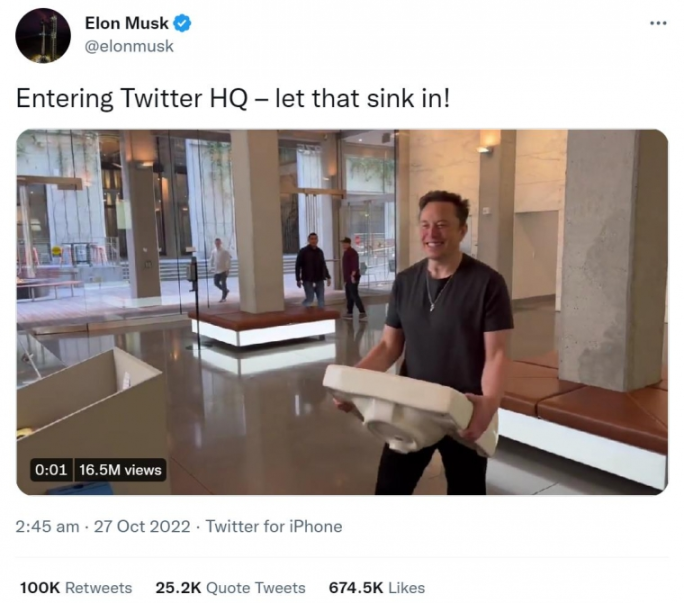
This detail was later widely reported by the media, but the real signal was the phrase in his tweet: "Let that sink in."
A pun. Let the sink in, and let it all sink in.
The outside world thought he bought Twitter for free speech or to defend Trump. They were wrong. Musk wanted revenge, revenge for the betrayal 25 years ago.
The first step was renaming.
X. A single letter, carrying all his anger and ambition. Those who mocked X.com for being too ahead of its time would now witness its resurrection on this platform.
But Musk was smart. He knew he couldn't go all out at once; turning Twitter directly into a bank would scare users away. So he chose a gradual transformation.
In early 2023, X was still primarily a lightweight social platform with a 140-character limit. Musk first adjusted the content strategy, encouraging more original content and real-time discussions. Then came paid subscriptions, getting users accustomed to spending money on the platform.
By mid-year, the long-tweet feature was launched. Users could post longer, more in-depth content, and the platform began shifting from a short-message square to an information hub.
Next came a significant enhancement of video features. Musk wanted X to become a one-stop platform for information consumption, eliminating the need for users to jump to YouTube or other video sites.
By the end of 2023, the creator revenue-sharing plan was officially introduced. The platform began to develop an economic ecosystem, allowing users to earn income through content creation. This was a crucial step; Musk was cultivating users' transaction habits.
Then came the big moves in 2024.
Financial license applications, payment system construction... Musk no longer hid his intentions; he wanted to turn X into a financial platform.
In January 2026, X product lead Nikita Bier stated that the platform was developing Smart Cashtags, allowing users to precisely point to specific assets or smart contracts when posting ticker symbols.
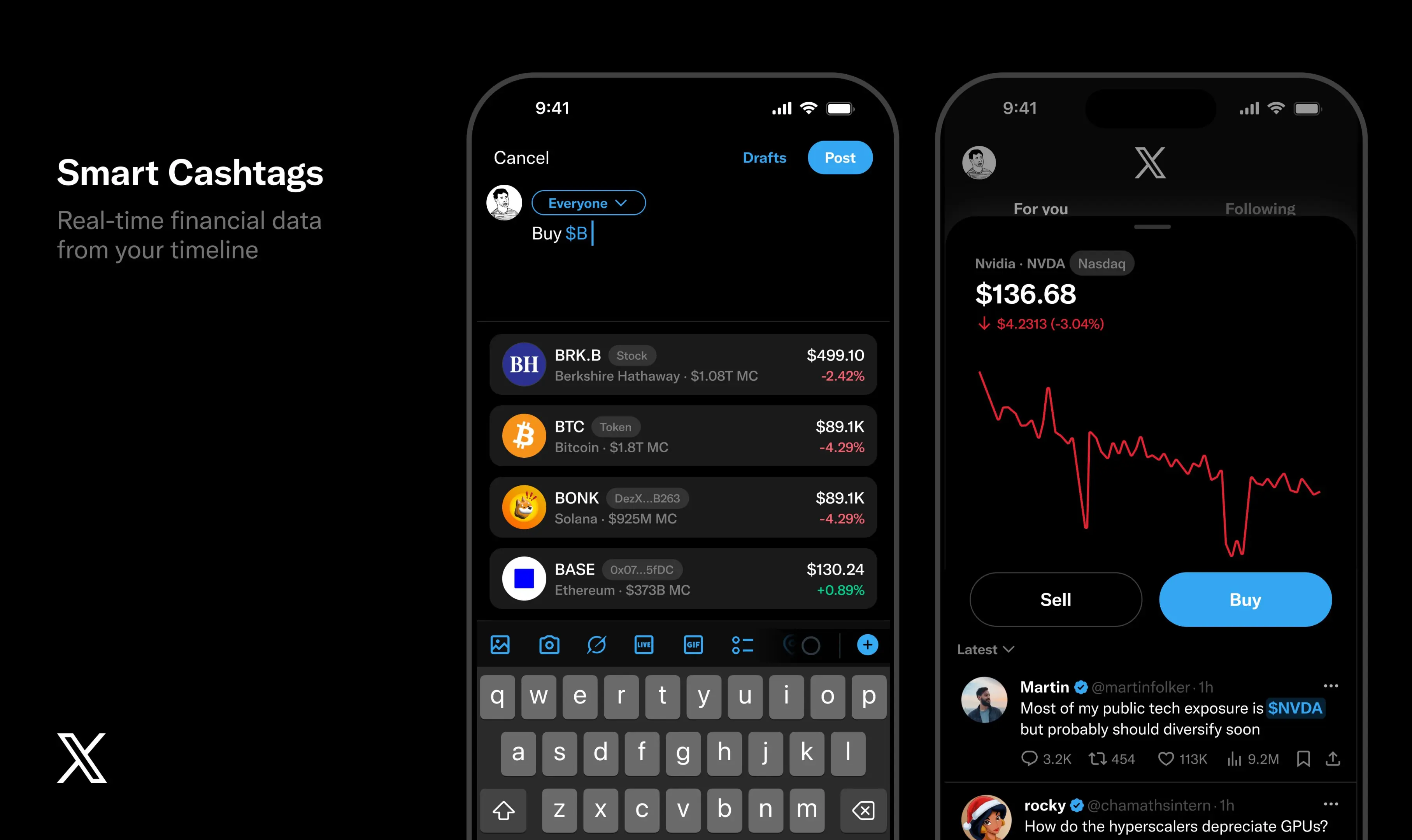
Users could embed tags like $TSLA in tweets to display stock prices in real-time. It seemed like just an information display feature, but it was actually the final piece of the financialization puzzle.
Imagine: You see a tweet about NVIDIA's new chip, and the stock price immediately jumps 5%. You then click the $NVDA tag to buy shares directly.
Social, information, and trading—all integrated. This was the vision Musk had for X.com back in 1999.
From a town square to an information hub, and then to a trading floor. Musk spent two years gradually guiding users to accept X's transformation.
To alleviate user concerns, Musk made an unprecedented decision: open-sourcing all algorithms.
On January 10, 2026, Musk announced on X that the platform would officially open-source its latest content recommendation algorithm within a week, covering code for both organic and ad content, with updates every four weeks along with developer explanations.
The recommendation algorithms of Facebook, YouTube, and TikTok are black boxes; no one knows why they see certain content. When financial services are involved, this lack of transparency becomes a fatal flaw.
Musk broke the black box with open source. Users can inspect the code, developers can audit security, and regulators can supervise compliance.
All to pave the way for financialization.
Belated Validation
X.com of 1999 died because it was "ahead of its time." The internet was still in the dial-up era, with broadband penetration below 10%. Online payments required dozens of security verifications, and users were terrified of putting their money online.
More importantly, the regulatory environment was extremely strict. Banking regulators viewed online finance as a menace, and governments were feeling their way forward. Musk's radical strategy was too risky in that conservative era.
But history proved his judgment right.
It's just that the validation came too late, and from an unexpected place: China.
In 2011, WeChat launched. Initially just a messaging app, it quickly evolved into the super app Musk had envisioned. Chatting, payments, ride-hailing, food delivery,理财—it could do everything. Alipay also developed from a simple third-party payment tool into a comprehensive financial platform.
Musk watched, anxious and impatient.
In June 2022, at his first all-hands meeting with Twitter employees, he publicly stated: "In China, people basically live on WeChat because it's so useful and helpful for daily life. I think if we can achieve that, or even come close to that, on Twitter, it would be a huge success."
This sounded like praise for WeChat, but also regret for his own failure 25 years ago. The Chinese had achieved in a decade what he had wanted to do in 1999.
Now it was his turn.
Mobile payments had rewritten global consumer habits, cryptocurrencies had evolved from geek toys to pension fund investments, and blockchain technology had made decentralized finance a reality. Regulators were also embracing innovation.
The U.S. SEC approved Bitcoin ETF, the EU launched a digital euro plan, and the People's Bank of China was piloting the digital yuan.
Musk waited 25 years for this moment.
With this context, when you look at Smart Cashtags, you realize Musk's opponent was never Zuckerberg.
Meta controls social relationships, Google controls information indexing, and Apple controls hardware access. But so far, no tech giant truly controls the global "flow of funds."
This is X's endgame. Finance is the underlying protocol of the commercial world. Whoever controls the flow of funds holds the throat of the digital economy. This is more lethal than building a search engine or selling phones.
Musk is reshaping an ultra-fast chain from "information" to "decision" to "action." Imagine: Musk tweets about a new Tesla technology. Within seconds, hundreds of thousands of people click the $TSLA tag. The algorithm predicts trends based on sentiment analysis, automatically pushes trading suggestions, and users place orders with one click. Influence is transformed into trading volume instantly.
This is the financialization of social media. The traditional Wall Street model—analysts writing reports, brokers making calls—will seem clumsy and expensive in the face of algorithms.
Back to the initial question: Why did Musk acquire Twitter?
The answer was already public. On October 5, 2022, Musk tweeted that acquiring Twitter accelerated the creation of the super app "X."
It's just that now, everyone truly understands this statement.
Dreaming back to 1999, the ghost of X.com finally found its moment to resurrect. This time, no one can stop him. He is no longer the 27-year-old entrepreneur at others' mercy but the world's richest man with absolute authority.
Welcome to the X Universe
If we zoom out, beyond Wall Street's fluctuations and Silicon Valley's grudges, you'll discover an even more chilling pattern.
Musk's obsession with the letter "X" has long transcended commercial branding, becoming an almost pathological totem worship.
Look at what he's done over the past two decades: When he tried to send humans to Mars, he named the company SpaceX; when he wanted to build a flagship SUV defining Tesla's future, he insisted on calling it Model X despite resistance; when he left OpenAI to develop his own AI model, he named it xAI.
He even named his most beloved son X Æ A-12, and in daily life, he calls him "Little X."
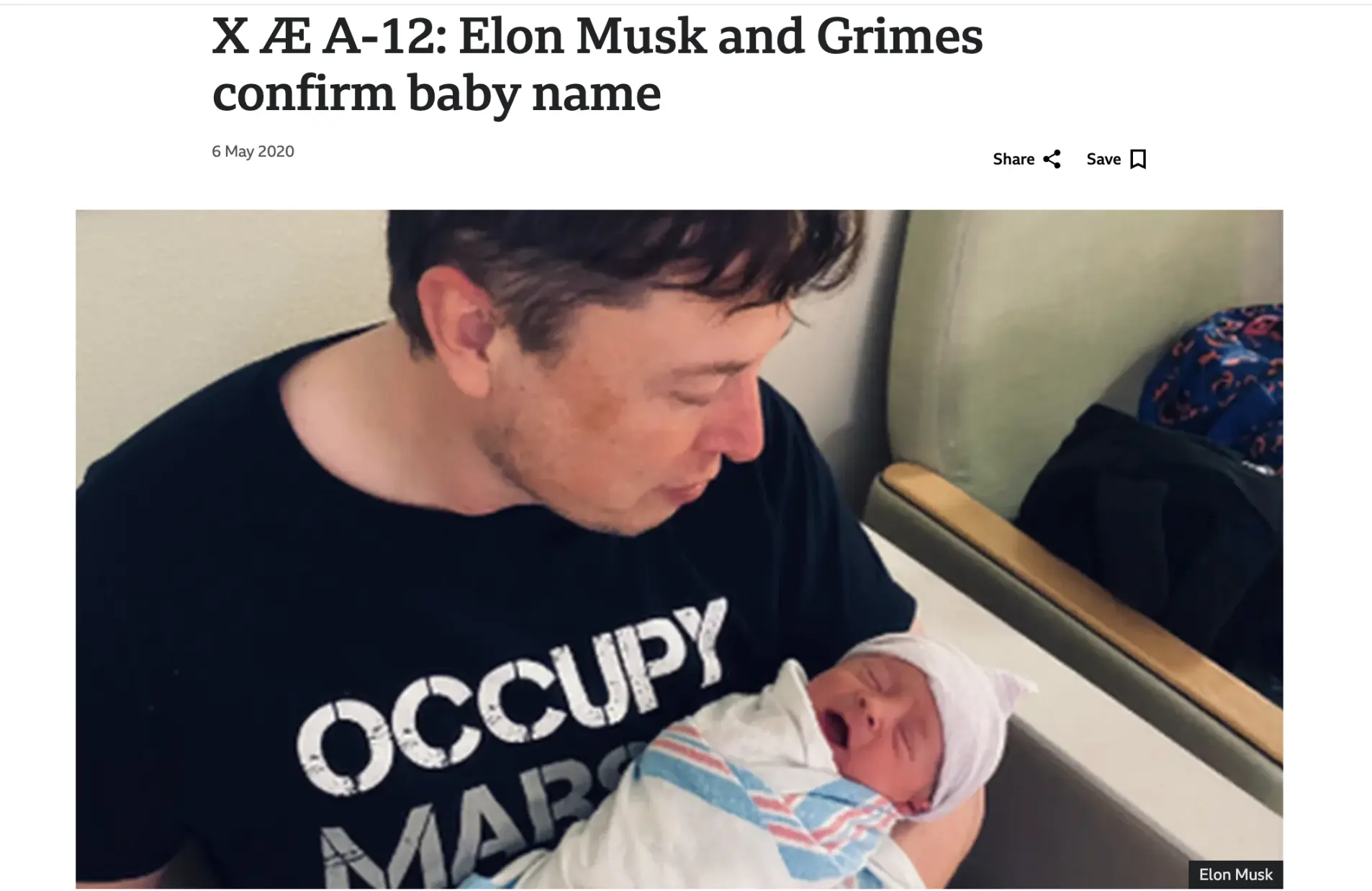
In mathematics, X represents the unknown, representing infinite possibilities. But in Musk's life script, X is the only constant.
25 years ago, that young man kicked out by the PayPal board lost his X. 25 years later, the billionaire with rockets, cars, AI, and the world's largest court of public opinion has finally picked up that piece of the puzzle.
Everything, everything, is to make X happen.
Welcome to Musk's X Universe.
Twitter:https://twitter.com/BitpushNewsCN
Bitpush TG Group:https://t.me/BitPushCommunity
Bitpush TG Subscription: https://t.me/bitpush