MoveBit Research Release | Belobog: A Move Fuzzing Framework for Real-World Attacks

marsbitPublicado em 2025-12-16Última atualização em 2025-12-16

Resumo

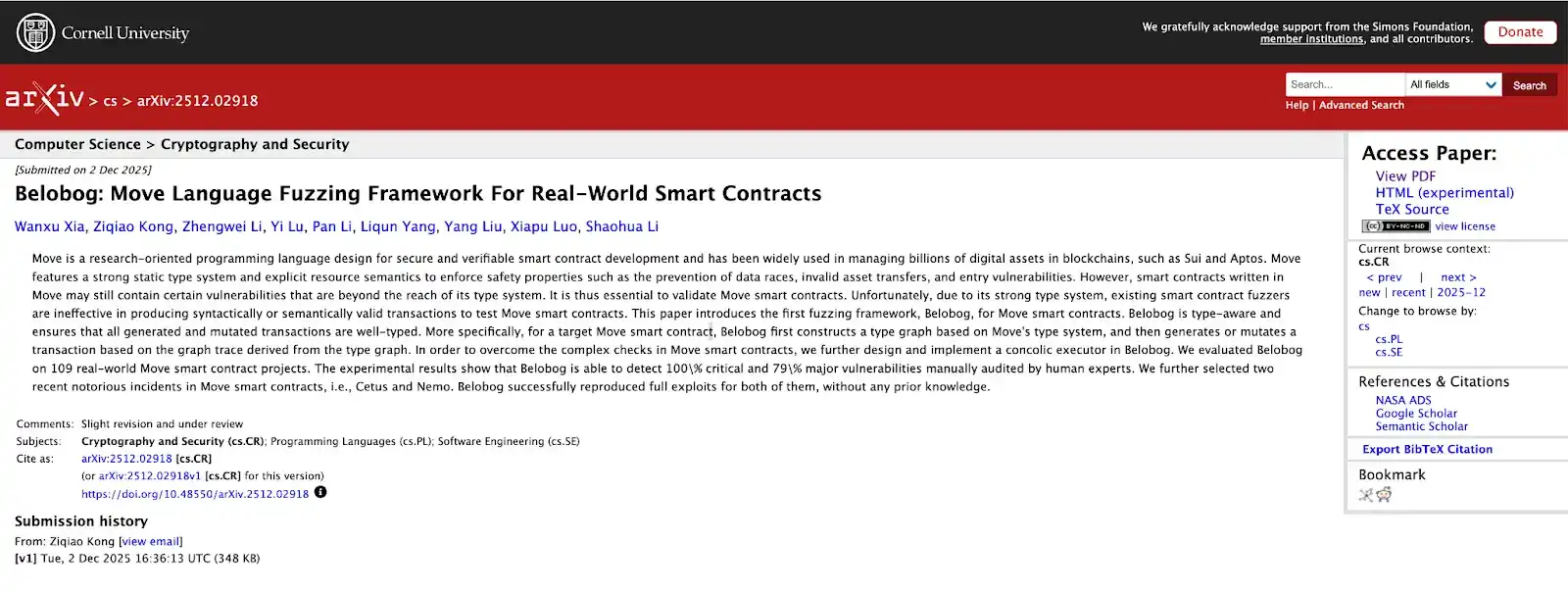
MoveBit introduces Belobog, a novel fuzzing framework designed specifically for Move smart contracts to address security challenges beyond syntax and type errors. Unlike traditional fuzzing methods that struggle with Move’s strong type system and resource semantics, Belobog leverages type-guided input generation and mutation. It constructs a type graph to produce semantically valid and executable transaction calls, significantly improving the efficiency and depth of state exploration. The framework integrates concolic execution (combining concrete and symbolic execution) to penetrate complex constraints and branch conditions, enabling deeper coverage of potential vulnerabilities. Evaluated on 109 real-world Move contracts, Belobog detected 100% of Critical and 79% of Major vulnerabilities confirmed by manual audits. It also demonstrated the ability to reproduce full exploit paths without prior knowledge of vulnerabilities. Designed to be developer-friendly, Belobog will be released as open-source to encourage community adoption and extension. The work is currently under peer review for PLDI’26. Preprint: https://arxiv.org/abs/2512.02918

Move, as a language that Web3 developers cannot afford to ignore, is particularly "hardcore" in its strong type system and resource semantics, especially regarding asset ownership, illegal transfers, and data races. Ecosystems like Sui and Aptos place increasingly important assets and core protocols on Move precisely because of its core language features, which enable the creation of more secure and lower-risk smart contracts.

However, the reality we've observed through long-term auditing and offensive/defensive practices is that a significant portion of thorny issues often do not occur in obvious places like "syntax errors" or "type mismatches," but rather at more complex, real-world levels—cross-module interactions, permission assumptions, state machine boundaries, and those call sequences that seem reasonable step-by-step but can be exploited when combined. Precisely because of this, even though the Move language has more robust security paradigms, there have still been significant attack incidents within its ecosystem. Clearly, security research for Move needs to go further.

We identified a core problem: the lack of an effective fuzzing tool for the Move language. Because Move has stronger constraints, traditional smart contract fuzzing faces a tricky pain point in the Move context: generating transaction sequences that are both "type-correct" and "semantically reachable" is very complex. If the input isn't precise enough, the call cannot be completed; if the call cannot be made, it fails to cover deep branches and reach critical states, making it easier to miss the paths that can truly trigger vulnerabilities.

Based on this long-standing pain point, we collaborated with a university research team to jointly complete and publish our research findings:

《Belobog: Move Language Fuzzing Framework For Real-World Smart Contracts》

arXiv:2512.02918 (Preprint)

Paper Link:https://arxiv.org/abs/2512.02918

This paper is currently published on arXiv as a preprint, its significance is to allow the community to see research progress faster and receive feedback. We are submitting this work to PLDI’26 and awaiting the peer review process. After the submission result is confirmed and peer review is completed, we will also share relevant updates promptly.
Making Fuzzing Truly "Run Into" Move: From Random Trial and Error to Type-Guided Exploration

Belobog's core idea is straightforward: since Move's type system is its fundamental constraint, fuzzing should use types as a guide, not an obstacle.

Traditional approaches often rely on random generation and mutation, but on Move, this quickly produces a large number of invalid samples: type mismatches, unreachable resources, parameters that cannot be correctly constructed, call chains with blocking points—what you end up with is not test coverage, but a pile of "failures at the starting line."

Belobog's method is more like giving the Fuzzer a "map." It starts from Move's type system, constructs a type graph based on type semantics for the target contract, and then uses this graph to generate or mutate transaction sequences. In other words, it doesn't blindly stitch calls together but constructs more reasonable, more executable, and更容易深入状态空间的调用组合 (easier to深入 state space call combinations) along type relationships.

For security research, the benefit this change brings is not a "fancier algorithm," but a very simple yet crucial gain:
Higher proportion of valid samples, higher exploration efficiency, and a better chance of reaching the deep paths where real vulnerabilities often appear.

Facing Complex Constraints: Belobog Introduces Concolic Execution to "Push Open the Door"

In real Move contracts, critical logic is often surrounded by layers of checks, assertions, and constraints. If you only rely on traditional mutation, you easily keep bumping at the door: the conditions are never met, the branches are never entered, the state is never reached.

To solve this problem, Belobog further designed and implemented concolic execution (a hybrid of concrete execution + symbolic reasoning). Simply put:

It maintains concrete execution that "can run," while on the other hand, it uses symbolic reasoning to more directionally approximate those branch conditions, thereby more effectively penetrating complex checks and advancing coverage depth.

This is particularly important for the Move ecosystem because the "sense of security" in Move contracts is often built on multiple layers of constraints, and the real problems often hide in the gaps after these constraints intersect. What Belobog wants to do is push testing near these gaps.

Aligning with the Real World: Not Just Running Demos, But Approaching Real Attack Paths

We don't want this kind of work to stop at "being able to run demos." Belobog's evaluation directly targets real projects and real vulnerability findings. According to the experimental results in the paper: Belobog was evaluated on 109 real-world Move smart contract projects. The experimental results show that Belobog was able to detect 100% of the Critical vulnerabilities and 79% of the Major vulnerabilities confirmed by manual security expert audits.

More notably: Without relying on prior vulnerability knowledge, Belobog was able to reproduce full exploits in real on-chain incidents. The value of this capability lies in the fact that it更接近我们在现实攻防里面对的情况 (closer to the situations we face in real-world offense/defense): attackers succeed not through "single-point function errors" but through complete paths and state evolution.

What This Work Aims to Express is Not Just "Making a Tool"

This paper is worth reading not only because it proposes a new framework, but because it represents a more pragmatic direction: abstracting frontline security experience into reusable methods and落地 (grounding) it with verifiable engineering implementations.

We believe the significance of Belobog lies not in being "yet another Fuzzer," but in making Fuzzing on Move closer to reality—able to run in, go deep, and align more closely with real attack paths. Belobog is not a closed tool designed for a few security experts, but a developer-friendly framework: it strives to lower the barrier to entry, allowing developers to continuously integrate security testing into their familiar development workflow, rather than making Fuzzing a one-time, after-the-fact task.

We will also release Belobog as open source, hoping it becomes infrastructure that the community can collectively use, extend, and evolve, rather than remaining an experimental project at the "tool level."

Paper (Preprint):https://arxiv.org/abs/2512.02918
(This work is also currently submitted to PLDI’26, awaiting peer review.)

About MoveBit

MoveBit (Mobi Security), a sub-brand under BitsLab, is a blockchain security company focused on the Move ecosystem, aiming to make the Move ecosystem the most secure Web3 ecosystem by pioneering the use of formal verification. MoveBit has successively cooperated with many well-known global projects and provided partners with comprehensive security audit services. The MoveBit team consists of security experts from academia and industry leaders with 10 years of security experience, having published security research results at top international security academic conferences such as NDSS and CCS. Moreover, they are early contributors to the Move ecosystem, working with Move developers to establish standards for secure Move applications.


Perguntas relacionadas

QWhat is the main challenge that traditional fuzzing tools face when applied to Move smart contracts?

ATraditional fuzzing tools struggle with generating transaction sequences that are both 'type-correct' and 'semantically reachable' in Move. Due to Move's strong type system and resource semantics, random generation and mutation produce a high volume of invalid samples, such as type mismatches, unreachable resources, and incorrectly constructed parameters. This results in many calls failing immediately, preventing deep branch coverage and making it difficult to reach critical states where real vulnerabilities often lie.

QHow does Belobog's approach differ from traditional fuzzing methods for smart contracts?

ABelobog uses Move's type system as a guide rather than an obstacle. It constructs a type graph based on the semantic relationships within the target contract and uses this graph to generate or mutate transaction sequences. This approach ensures that calls are constructed along type relationships, making them more reasonable, executable, and capable of penetrating deeper into the state space, unlike traditional methods that rely on blind, random splicing of calls.

QWhat technique does Belobog employ to handle complex constraints and branch conditions in Move contracts?

ABelobog employs concolic execution (a hybrid of concrete execution and symbolic reasoning). It maintains concrete execution to keep the program running' while using symbolic derivation to directionally approach branch conditions. This allows it to more effectively penetrate complex checks, such as assertions and constraints, and advance coverage depth, which is crucial for uncovering vulnerabilities hidden behind layered security checks in Move contracts.

QWhat were the key results of Belobog's evaluation on real-world Move smart contracts?

AIn an evaluation on 109 real-world Move smart contract projects, Belobog was able to detect 100% of the Critical vulnerabilities and 79% of the Major vulnerabilities that were confirmed by manual security audits. Notably, without relying on prior vulnerability knowledge, Belobog could also replicate full attack exploits (full exploits) from real on-chain incidents, demonstrating its ability to uncover complex attack paths that involve state evolution and multiple steps.

QHow does the Belobog team plan to release the framework, and what is its intended impact on the community?

AThe Belobog team plans to release the framework as open source. The goal is to make it a developer-friendly infrastructure that the community can collectively use, extend, and evolve, rather than keeping it as an experimental tool. By lowering the barrier to entry, it aims to integrate security testing seamlessly into developers' familiar workflows, promoting continuous security assessment rather than one-off, post-development audits.

Leituras Relacionadas

Stuck Polymarket: The Real Test After Riding the Traffic Boom Has Arrived

Polymarket, a leading prediction market platform, is facing significant technical challenges as its growth outpaces its current infrastructure on Polygon. Users are experiencing laggy transactions, unresponsive orders, and delayed confirmations, severely impacting the trading experience. In response, DeFi Engineering VP Josh Stevens outlined a comprehensive engineering overhaul. The plan includes reducing on-chain data delays, fixing order cancellation issues, rebuilding the central limit order book (CLOB), improving website performance, and developing a unified SDK and API. A major revelation was the ongoing "chain migration," indicating a potential move away from Polygon. The core issue is that Polymarket has evolved from a simple prediction market into a high-frequency trading platform, making Polygon's limitations—such as block space, gas fees, and block time—a ceiling for further growth. The migration is not just a simple chain switch but a fundamental rebuild of its trading system to support more complex products like perpetual contracts (Perps). This announcement has sparked competition among chains like Solana, Sui, and Algorand, all vying to host Polymarket. For Polygon, losing this key application, which contributes significantly to its gas fee revenue, would be a major setback. The real test for Polymarket is no longer attracting users but proving it can provide a stable, reliable trading environment that retains them.

Odaily星球日报Há 55m

Stuck Polymarket: The Real Test After Riding the Traffic Boom Has Arrived

Odaily星球日报Há 55m

Lowering Expectations for BTC's Next Bull Market

The author, Alex Xu, explains his decision to significantly reduce his Bitcoin holdings (from full to ~30% of his portfolio) during the current bull cycle, citing a lowered long-term outlook for BTC's price appreciation in the next cycle. He outlines six key reasons for this reduced expectation: 1. **Diminished Growth Drivers:** The narrative of exponential user adoption has largely played out with institutional ETF adoption. The next major growth phase—adoption by sovereign national reserves or central banks—seems unlikely in the near future. 2. **Personal Opportunity Cost:** More attractive investment opportunities have emerged in other assets, such as undervalued companies. 3. **Industry-Wide Contraction:** The broader crypto industry is struggling, with most Web3 business models (SocialFi, GameFi, DePIN) failing. This overall萧条 (depression) reduces the fundamental demand and consensus for Bitcoin. 4. **Strain on Major Buyer:** MicroStrategy, a major corporate buyer of BTC, faces rising financing expenses for its debt, which could slow its purchasing rate and create significant marginal pressure on the market. 5. **Increased Competition from Gold:** The emergence of "tokenized gold" has closed the functional gap (portability, divisibility) between physical gold and Bitcoin, offering a strong competitor in the non-sovereign store-of-value space. 6. **Security Budget Concerns:** The block reward halving continues to exacerbate the long-standing issue of funding Bitcoin's network security, with new fee source explorations like Ordinals and L2s largely failing. The author's decision to hold a significant (though reduced) position reflects a cautious, not bearish, outlook. He remains open to increasing his exposure if the fundamental reasons for his skepticism change or if new positive catalysts emerge.

marsbitHá 1h

Lowering Expectations for BTC's Next Bull Market

marsbitHá 1h

Can Iran 'Control' the Strait of Hormuz?

Iran has announced a comprehensive plan to assert control over the strategic Strait of Hormuz, a critical global oil shipping chokepoint. The proposed measures include requiring all vessels to obtain Iranian permission for passage, imposing fees for security, environmental protection, and navigation management—preferably paid in Iranian rials—and absolutely banning Israeli ships. Vessels from countries deemed hostile by Iran’s top security bodies may also be barred. Analysts suggest Iran’s motives are multifaceted: increasing pressure on the U.S. and Israel by leveraging control over oil transit to influence global prices and inflation; creating a new revenue stream, potentially exceeding $7.7 billion annually, to counter Western sanctions and support postwar reconstruction; and using transit permissions as bargaining chips in future negotiations, notably with the U.S. However, the plan faces significant practical and diplomatic challenges. Enforcing comprehensive interception and fee collection in the busy waterway, patrolled by international military forces, would be difficult. The U.S. has already countering with a blockade of Iranian ports and threats to intercept any ship paying fees, potentially strangling Iran’s oil exports and fee revenue. Broad international opposition, led by European and Gulf states, and legal controversies further complicate implementation. The proposal may ultimately serve more as a negotiating tactic than a feasible policy, with its execution remaining highly uncertain.

marsbitHá 2h

Can Iran 'Control' the Strait of Hormuz?

marsbitHá 2h

Trading

Spot
Futuros

Artigos em Destaque

O que é WL

I. Introdução ao ProjetoWorldLand é uma L2 ou side chain do Ethereum, concebida como uma solução de baixo para cima para melhorar o ecossistema Ethereum.II. Informação sobre o Token1) Informação BásicaNome do token: WL (WorldLand)III. Links RelacionadosWebsite:https://worldland.foundation/Exploradores:https://bscscan.com/address/0x8aaB31fbc69C92fa53f600910Cf0f215531F8239Redes Sociais:https://x.com/WorldLand_space Nota: A introdução ao projeto provém dos materiais publicados ou fornecidos pela equipa oficial do projeto, que é apenas para referência e não constitui aconselhamento de investimento. A HTX não se responsabiliza por quaisquer perdas diretas ou indiretas resultantes.

214 Visualizações TotaisPublicado em {updateTime}Atualizado em 2026.03.28

O que é WL

Como comprar WL

Bem-vindo à HTX.com!Tornámos a compra de WorldLand (WL) simples e conveniente.Segue o nosso guia passo a passo para iniciar a tua jornada no mundo das criptos.Passo 1: cria a tua conta HTXUtiliza o teu e-mail ou número de telefone para te inscreveres numa conta gratuita na HTX.Desfruta de um processo de inscrição sem complicações e desbloqueia todas as funcionalidades.Obter a minha contaPasso 2: vai para Comprar Cripto e escolhe o teu método de pagamentoCartão de crédito/débito: usa o teu visa ou mastercard para comprar WorldLand (WL) instantaneamente.Saldo: usa os fundos da tua conta HTX para transacionar sem problemas.Terceiros: adicionamos métodos de pagamento populares, como Google Pay e Apple Pay, para aumentar a conveniência.P2P: transaciona diretamente com outros utilizadores na HTX.Mercado de balcão (OTC): oferecemos serviços personalizados e taxas de câmbio competitivas para os traders.Passo 3: armazena teu WorldLand (WL)Depois de comprar o teu WorldLand (WL), armazena-o na tua conta HTX.Alternativamente, podes enviá-lo para outro lugar através de transferência blockchain ou usá-lo para transacionar outras criptomoedas.Passo 4: transaciona WorldLand (WL)Transaciona facilmente WorldLand (WL) no mercado à vista da HTX.Acede simplesmente à tua conta, seleciona o teu par de trading, executa as tuas transações e monitoriza em tempo real.Oferecemos uma experiência de fácil utilização tanto para principiantes como para traders experientes.

240 Visualizações TotaisPublicado em {updateTime}Atualizado em 2026.03.28

Como comprar WL

Como comprar BASED

Bem-vindo à HTX.com!Tornámos a compra de Based (BASED) simples e conveniente.Segue o nosso guia passo a passo para iniciar a tua jornada no mundo das criptos.Passo 1: cria a tua conta HTXUtiliza o teu e-mail ou número de telefone para te inscreveres numa conta gratuita na HTX.Desfruta de um processo de inscrição sem complicações e desbloqueia todas as funcionalidades.Obter a minha contaPasso 2: vai para Comprar Cripto e escolhe o teu método de pagamentoCartão de crédito/débito: usa o teu visa ou mastercard para comprar Based (BASED) instantaneamente.Saldo: usa os fundos da tua conta HTX para transacionar sem problemas.Terceiros: adicionamos métodos de pagamento populares, como Google Pay e Apple Pay, para aumentar a conveniência.P2P: transaciona diretamente com outros utilizadores na HTX.Mercado de balcão (OTC): oferecemos serviços personalizados e taxas de câmbio competitivas para os traders.Passo 3: armazena teu Based (BASED)Depois de comprar o teu Based (BASED), armazena-o na tua conta HTX.Alternativamente, podes enviá-lo para outro lugar através de transferência blockchain ou usá-lo para transacionar outras criptomoedas.Passo 4: transaciona Based (BASED)Transaciona facilmente Based (BASED) no mercado à vista da HTX.Acede simplesmente à tua conta, seleciona o teu par de trading, executa as tuas transações e monitoriza em tempo real.Oferecemos uma experiência de fácil utilização tanto para principiantes como para traders experientes.

221 Visualizações TotaisPublicado em {updateTime}Atualizado em 2026.03.30

Como comprar BASED

Discussões

Bem-vindo à Comunidade HTX. Aqui, pode manter-se informado sobre os mais recentes desenvolvimentos da plataforma e obter acesso a análises profissionais de mercado. As opiniões dos utilizadores sobre o preço de A (A) são apresentadas abaixo.

活动图片