Moscow Exchange Announces Timeline for Launch of Perpetual Crypto Futures

cryptonews.ruPublicado em 2026-08-17Última atualização em 2026-08-17

Resumo

The Moscow Exchange (MOEX) has announced plans to expand its range of cryptocurrency derivatives, aiming to launch perpetual futures. According to Patrikeeva, the exchange intends to increase the number of available crypto assets to ten and gradually expand the set of perpetual futures beyond just Bitcoin and Ethereum. Perpetual futures are one-day contracts with no fixed expiration date, automatically rolling over to provide traders with flexibility. Cryptocurrency-linked instruments first appeared on MOEX in summer 2025, where professional investors can currently trade quarterly and monthly futures on five cryptocurrencies: Bitcoin, Ethereum, Solana, Ripple, and Tron. While MOEX has not announced a timeline for spot crypto trading, market sources indicate the exchange is preparing to launch its own digital settlement depository, separate from the national one. This move comes as MOEX operates under U.S. blocking sanctions, which complicate access to international settlement infrastructure but do not directly prohibit crypto operations. Recently, the Bank of Russia approved Bitcoin, Ethereum, and Tether's USDT for trading by non-professional investors.

According to Patrikeeva, the exchange intends to increase the range of such cryptocurrency instruments: in the future, it aims to expand the number of available coins to ten and gradually expand the set of perpetual futures for the most popular assets beyond Ethereum and Bitcoin.

Perpetual futures are one-day contracts with no fixed expiration date (the termination of the futures contract between the seller and the buyer and the fulfillment of the contract obligation). The contracts are automatically rolled over to the next trading day, providing market participants with flexibility in managing their positions.

Instruments pegged to the value of digital assets appeared on the Moscow Exchange in the summer of 2025. As of today, professional investors can trade quarterly and monthly futures on five cryptocurrencies — Bitcoin, Ethereum, Solana, Ripple, and Tron.

The Moscow Exchange has not yet announced when it plans to start trading the actual cryptocurrencies. However, market sources claim that the platform is preparing to launch its own digital settlement depository, which will exist separately from the nationwide National Settlement Depository. The Moscow Exchange is under US blocking sanctions. These restrictions do not directly prohibit transactions with cryptocurrencies, but they significantly limit access to international settlement infrastructure.

Recently, the Bank of Russia included Bitcoin, Ethereum, and the US company Tether's USDT stablecoin in the list of crypto assets approved for trading by non-professional investors.

end-content
Perguntas relacionadas

QAccording to the article, what are perpetual futures, and how do they function?

APerpetual futures are one-day contracts without a fixed expiration date. They automatically roll over to the next trading day, providing market participants with flexibility in managing their positions.

QWhat type of futures contracts are already available to professional investors on the Moscow Exchange, and for which cryptocurrencies?

AProfessional investors can currently trade quarterly and monthly futures on five cryptocurrencies: Bitcoin, Ethereum, Solana, Ripple, and Tron.

QWhat does the Moscow Exchange plan regarding the expansion of its cryptocurrency product offerings?

AThe Moscow Exchange intends to increase its range of crypto instruments, aiming to make up to ten coins available and gradually expand the set of perpetual futures for popular assets beyond Ethereum and Bitcoin.

QWhat is the reported step the Moscow Exchange is preparing for to potentially facilitate direct cryptocurrency trading?

ASources report that the exchange is preparing to launch its own digital settlement depository, which will exist separately from the all-Russian National Settlement Depository.

QWhich cryptocurrencies did the Bank of Russia recently include in the list of assets approved for trading by non-professional investors?

AThe Bank of Russia recently added Bitcoin, Ethereum, and the stablecoin Tether USDT to the list of cryptocurrency assets approved for trading by non-professional investors.

Leituras Relacionadas

Glassnode: Consumer Confidence Falls as AI-Related Stocks Rise, Bitcoin Lags Behind

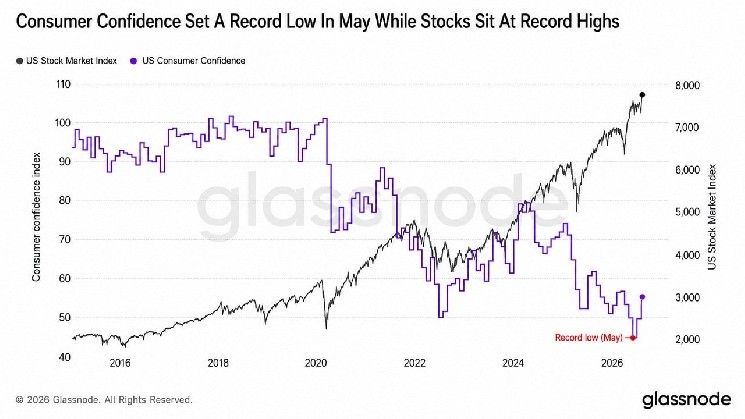
According to Glassnode, consumer confidence remains at one of its lowest levels in a decade, despite two consecutive months of improvement. This has not stopped households from moving money out of cash, as they expect further cost-of-living increases and a broader economic slowdown. The key question is where this capital is flowing. US stocks hit a new all-time high in early August, primarily driven by trading in AI-related stocks rather than a broad market rally. Bitcoin, historically seen as a hedge against declining trust in traditional finance, has not participated in this movement. Spot Bitcoin ETFs saw outflows of $389.7 million in one week, coinciding with rising equity markets—a divergence that aligns with Glassnode's data on capital flows. Bitcoin is currently trading at roughly half its October 2025 peak, stuck in a narrow range. Meanwhile, AI-related trading continues to attract fresh capital from retail traders, hedge funds, and even crypto-native institutional investors, who are redirecting funds into AI stocks and tokens. The macroeconomic backdrop has not been hostile to Bitcoin, with core inflation at a moderate 2.5% in July. However, Bitcoin's muted response to favorable inflation data is seen as a concerning signal, given its supposed role as a hedge against currency debasement. Spot Bitcoin exchange trading volume has fallen to its lowest since 2019, and recent ETF inflows are only a "fraction of any prior accumulation wave," suggesting institutional buying may have paused. This trend extends beyond trading: some Bitcoin miners are repurposing their power contracts and data center capacity for AI workloads. This appears to be a structural shift that could pressure Bitcoin's status as the default destination for capital leaving cash. The fundamental arguments for Bitcoin as a hedge against inflation or scarcity are not invalidated, but their expected impact has not materialized within the timeline anticipated by crypto optimists this summer.

cryptonews.ruHá 3m

Glassnode: Consumer Confidence Falls as AI-Related Stocks Rise, Bitcoin Lags Behind

cryptonews.ruHá 3m

The Optimal 'AI Bubble Trade': Simultaneously Going Long on 'Arrogance' and 'Bias'

The optimal investment strategy in the current AI bubble environment is a dual "leg" approach: going long on both "hubris" (AI tech leaders) and "humiliation" (neglected, underperforming cyclical assets). This aims to capture gains from both sides during the final surge of a nominal GDP-driven bubble, according to a Bank of America report by strategist Michael Hartnett. The bank's Bull & Bear Indicator remains in extreme bullish territory, signaling "sell", yet history shows such signals have limited immediate impact. Current fund flows show structural shifts: gold saw its largest weekly inflow since January, commodities are up 58.9% YTD, while tech stocks experienced their largest weekly outflow in seven weeks. The core thesis is that the final stage of a bubble benefits both the leading theme ("hubris" - AI) and oversold sectors ("humiliation" - like consumer stocks), similar to patterns seen in the 1999 tech bubble and 2007-2008 credit crisis. The report advises shorting "AI bonds," anticipating pressure from massive capital expenditures. Key risks include high concentration, surging bond yields, and cautious voter sentiment. The US debt burden is highlighted, with servicing costs reaching $1.4 trillion. The 10-year Treasury yield breaching 5% is seen as a red line for policymakers. For the "avoid the dollar" theme, BofA recommends gold and Hong Kong property stocks, the latter seen as deeply undervalued. The November US midterm elections, particularly the Texas governor race concerning AI data center expansion, are flagged as a critical political variable that could determine the AI bull market's trajectory. Private client data shows record-high equity allocations (66.4%) and record-low cash levels (9.4%), indicating bullish positioning. The report concludes that while overbought conditions can pause the bull market, ending it requires a combination of excessive positioning, overly optimistic earnings, and policy tightening—a scenario not yet in place.

marsbitHá 44m

The Optimal 'AI Bubble Trade': Simultaneously Going Long on 'Arrogance' and 'Bias'

marsbitHá 44m

Trading

Spot
活动图片