Morgan Stanley Drops Bitcoin ETF Bombshell, Who’s Really Behind The Buying?

bitcoinistPublicado em 2026-03-21Última atualização em 2026-03-21

Resumo

Morgan Stanley's head of digital assets, Amy Oldenburg, states that Bitcoin ETF adoption is still in its early stages, with 80% of current demand on their platform coming from self-directed investors. The bank, which now allows all wealth clients to invest in Bitcoin ETFs, is preparing to launch its own BTC, ETH, and SOL ETFs. Despite being a late entrant, its massive distribution network positions it for significant demand. On-chain data reveals Jane Street, Susquehanna, and Citadel as top institutional holders of Bitcoin ETFs, with BlackRock ranking 15th. Bitcoin's price is currently around $70,600.

Morgan Stanley’s head of digital assets strategy, Amy Oldenburg, has said that Bitcoin ETF adoption is still in its early stages. This comes as the Wall Street giant also looks to offer a BTC ETF, two years after the first funds launched.

Morgan Stanley Exec Says Bitcoin ETF Adoption Still In Early Stages

Speaking at the DC Blockchain Summit, the Morgan Stanley executive noted that most of the demand for the Bitcoin ETFs comes from self-directed investors, with many advisor-managed accounts yet to allocate to crypto. In line with this, Oldenburg declared that institutional crypto adoption is still ‘very early.’

She also revealed that 80% of the demand for ETFs on their platform comes from the self-directed business. Morgan Stanley currently allows all its wealth clients to invest in Bitcoin ETFs after removing restrictions last year. The bank has also notably recommended allocating up to 4% to crypto.

Oldenburg’s comments that Bitcoin ETF adoption is still early explain why Morgan Stanley is still looking to launch a BTC ETF, two years after the first funds launched. The bank has notably filed for BTC, ETH, and SOL ETFs and is also set to roll out crypto trading for its retail clients this year.

The Bitcoin ETFs have seen massive demand since their launch in 2024 and currently boast total net assets of $90.83 billion, according to SoSoValue data. This represents just over 6% of Bitcoin’s market cap. BlackRock’s BTC ETF is currently the largest with net assets of $55.19 billion.

Morgan Stanley is also expected to see demand for its BTC ETF despite the late launch, especially given the bank’s large distribution channel. Bloomberg analyst Eric Balchunas commended Morgan Stanley’s move as smart. He noted that they have, like, $8 trillion in advisory assets and have already authorized their advisors to allocate to these funds, so it could well be an allocation to their branded funds.

Top Institutional BTC ETF Holders

On-chain analyst Root recently highlighted the top 25 largest institutional Bitcoin ETF holders based on their Q4 filings, with Wall Street trading firm Jane Street ranking first, with total holdings worth around $5 billion. Susquehanna, Citadel Advisors, Millennium Management, and Goldman Sachs complete the top 5.
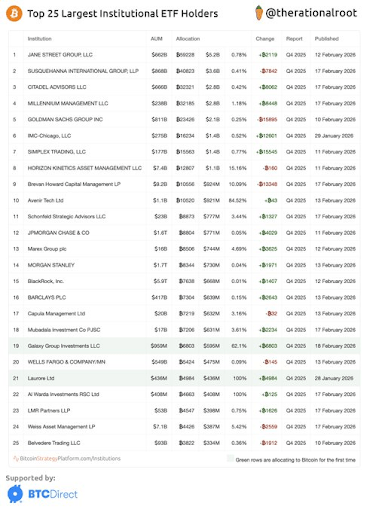
Source: Chart from Root on X

BlackRock, the world’s largest asset manager, currently ranks 15th among the top institutional Bitcoin ETF holders. The firm’s BTC holdings are currently worth around $670 million. A positive is that these institutions continue to increase their allocations. Root revealed that 17 of the top 25 institutional holders increased their BTC position in the fourth quarter of last year.

Related Reading: Analyst Says Bitcoin Price Is Showing Dangerous Weakness, Here’s Why

At the time of writing, the Bitcoin price is trading at around $70,600, down in the last 24 hours, according to data from CoinMarketCap.

BTC trading at $70,850 on the 1D chart | Source: BTCUSDT on Tradingview.com

Perguntas relacionadas

QAccording to Morgan Stanley's head of digital assets, what stage is Bitcoin ETF adoption currently in?

AAccording to Amy Oldenburg, Morgan Stanley's head of digital assets strategy, Bitcoin ETF adoption is still in its early stages.

QWhat percentage of the demand for Bitcoin ETFs on Morgan Stanley's platform comes from self-directed investors?

A80% of the demand for Bitcoin ETFs on Morgan Stanley's platform comes from self-directed investors.

QWhich Wall Street trading firm is the largest institutional holder of Bitcoin ETFs, according to Q4 filings?

AAccording to on-chain analyst Root, the Wall Street trading firm Jane Street is the largest institutional Bitcoin ETF holder, with total holdings worth around $5 billion.

QWhat is the total net asset value of all Bitcoin ETFs as mentioned in the article?

AThe total net assets of all Bitcoin ETFs is $90.83 billion, according to SoSoValue data.

QBesides a Bitcoin ETF, what other crypto ETFs has Morgan Stanley filed for?

AMorgan Stanley has filed for BTC, ETH, and SOL ETFs.

Leituras Relacionadas

Can Generative Models Finally Be Trained End-to-End? The Core Is a For Loop

This article introduces a novel training paradigm for generative models called Explorative Modeling (XM), which enables true end-to-end training. Traditionally, powerful generative models like autoregressive and diffusion models are not trained end-to-end. They are trained to predict a single small step but require iterative multi-step sampling for inference. This "exposure bias" leads to error accumulation and limits performance. The core challenge XM addresses is "mode blurring." In generative tasks, a single input (e.g., "generate a dog") corresponds to many valid outputs (multiple modes). Standard training objectives like reconstruction loss force the model to average these modes, producing unrealistic, blurry outputs. To avoid this, existing models break generation into many small, almost deterministic steps, sacrificing end-to-end training. XM tackles this by restructuring the training loop itself. Its key insight is to amplify "generative expressivity." For each training input, instead of generating one sample, the model generates K candidate outputs. Only the candidate closest to the real data is used for computing the loss and updating the model via backpropagation. This simple "best-of-K" mechanism is implemented as a short for-loop. By exploring multiple possibilities, the model learns to distribute its guesses across different modes rather than collapsing to their uninformative average. The paper demonstrates that "exploration" acts as a new, powerful scaling axis. Gains from XM increase with model size, data scale, and compute. Experiments show improvements in FID scores for image generation and significant efficiency gains, sometimes outperforming larger models without exploration. When pushed to the limit, XM enables fully single-step, end-to-end generative models. In robotics tasks, an "Explorative Policy" matched the performance of a 100-step Diffusion Policy with a single forward pass, drastically improving inference speed. While the best-of-K concept is not entirely new, the authors' contribution lies in formally understanding it as a direct method to boost generative expressivity without fragmenting the generation process. This work suggests that as models scale, enhancing exploration during training may become crucial for overcoming fundamental performance bottlenecks.

marsbitHá 47m

Can Generative Models Finally Be Trained End-to-End? The Core Is a For Loop

marsbitHá 47m

Annual Salary of Millions Competing for Electricians, Meta Rushes to Open Its Own Technical School

The AI boom is facing an unexpected bottleneck: a severe shortage of skilled construction workers and electricians. As tech giants like Meta, OpenAI, and Alphabet race to build massive data centers—such as OpenAI's $16 billion "Stargate" project—they are hitting a critical labor wall. The U.S. needs an estimated 130,000 more electricians, 240,000 construction workers, and 150,000 supervisors by 2030 for AI infrastructure alone, but tens of thousands of electrician jobs go unfilled each year. While AI companies offer high premiums, with electricians earning up to $280,000 annually, worker scarcity still causes massive losses—delays on a single project can cost $14.2 million per month. The complexity of building AI data centers, which require immense power (equivalent to powering hundreds of thousands of homes), sophisticated electrical systems, and advanced liquid cooling solutions, demands highly skilled technicians who are in short supply. To combat this, companies are investing heavily in training. Meta has committed $115 million to a free training school offering tuition, housing, and stipends, targeting 5,000 new workers. OpenAI is partnering with unions to secure skilled labor. These efforts are paying off, with a significant rise in Gen Z interest in trade schools over college. However, the power demands are staggering. AI data centers are driving a rapid surge in electricity consumption, projected to account for up to 12% of U.S. power use by 2028 and raising costs for consumers. Furthermore, the construction boom is project-based, leading to a potential future glut of trained workers once building peaks, which could depress wages industry-wide. The race for AI supremacy now depends as much on skilled hands as on advanced chips.

marsbitHá 2h

Annual Salary of Millions Competing for Electricians, Meta Rushes to Open Its Own Technical School

marsbitHá 2h

Trading

Spot
活动图片