Morgan Stanley Bitcoin ETF to Launch Tomorrow, Recommends Clients Allocate Up to 4% to Crypto Assets

marsbitPublicado em 2026-04-08Última atualização em 2026-04-08

Resumo

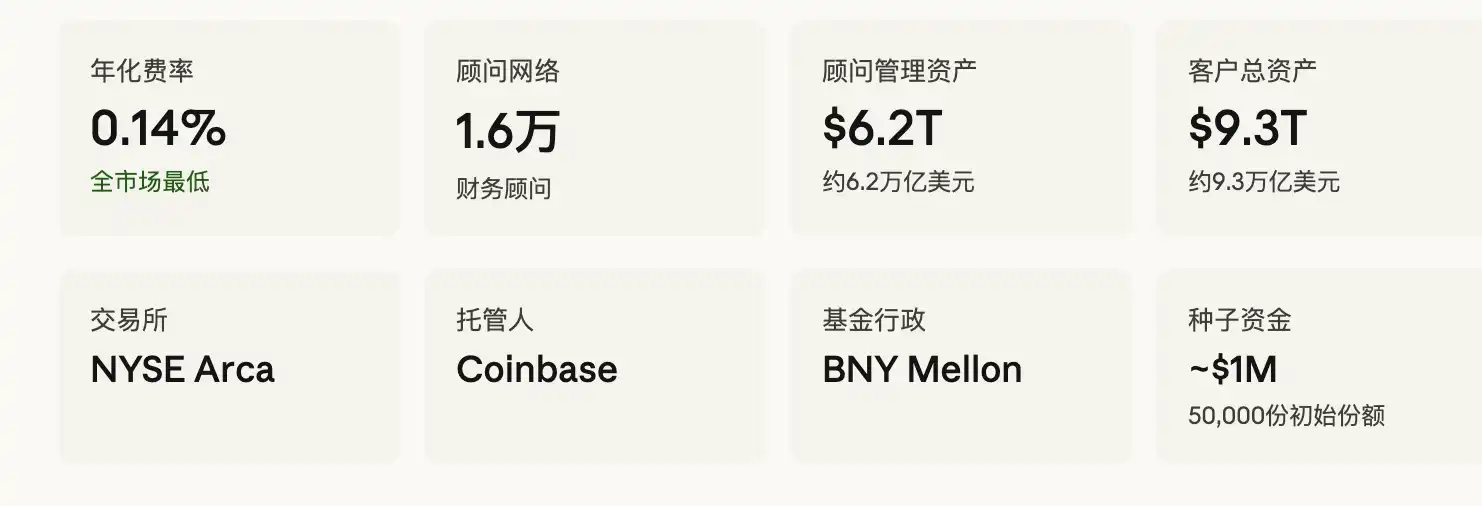
Morgan Stanley is set to launch its own spot Bitcoin ETF (ticker: MSBT) on NYSE Arca on April 8, making it the first major U.S. bank to directly issue such a product. With an annual management fee of 0.14%, it becomes the lowest-cost Bitcoin ETF on the market. The fund will hold Bitcoin directly and track the CoinDesk Bitcoin price index. The bank’s vast network of approximately 16,000 financial advisors, who manage around $6.2 trillion in client assets, can begin recommending the ETF immediately upon launch. Morgan Stanley’s Global Investment Committee has already advised clients to allocate up to 4% of their portfolios to crypto assets. Analysts suggest this distribution capability could unlock substantial institutional and advisory-driven capital into Bitcoin. Beyond Bitcoin, Morgan Stanley is building a broader crypto infrastructure, having also filed for Solana and staked Ethereum ETFs, applied for a national trust bank charter, and plans to offer direct crypto trading via E*Trade in 2026. The move is seen as a significant step in the institutional adoption of Bitcoin and a shift in traditional finance’s approach to cryptocurrency.

Author: Curry, Deep Tide TechFlow

Deep Tide Guide: The SEC has approved the registration statement for the Morgan Stanley Bitcoin Trust (ticker: MSBT), which will begin trading on NYSE Arca on April 8th, with an annual management fee of 0.14%, the lowest in the market.

Morgan Stanley thus becomes the first major U.S. bank to directly issue a Bitcoin spot ETF. Its approximately 16,000 financial advisors, managing $6.2 trillion in client assets, will be able to recommend the product to clients starting on the first day of trading.

The countdown to Morgan Stanley's Bitcoin spot ETF has officially begun.

According to a CoinDesk report on April 8th, the U.S. Securities and Exchange Commission (SEC) has declared the registration statement for the Morgan Stanley Bitcoin Trust (MSBT) effective. The bank submitted its final prospectus on the same day. Bloomberg ETF analyst Eric Balchunas confirmed on platform X that MSBT will begin trading on NYSE Arca on April 8th (Wednesday).

This comes just three months after Morgan Stanley initially filed the S-1 registration document in January of this year. The speed from application to listing far exceeded market expectations.
Lowest Fee in the Market, First Major Bank to Self-Issue

MSBT's annual management fee is set at 0.14%, which is 1 basis point lower than Grayscale's Bitcoin Mini Trust (0.15%) and 11 basis points lower than BlackRock's IBIT (0.25%), making it the product with the lowest fee among all U.S. Bitcoin spot ETFs.

Fee comparison of major competitors: Grayscale Bitcoin Mini Trust 0.15%, Bitwise BITB 0.20%, ARK/21Shares ARKB 0.21%, BlackRock IBIT and Fidelity FBTC both 0.25%, Grayscale's flagship product GBTC 1.5%.
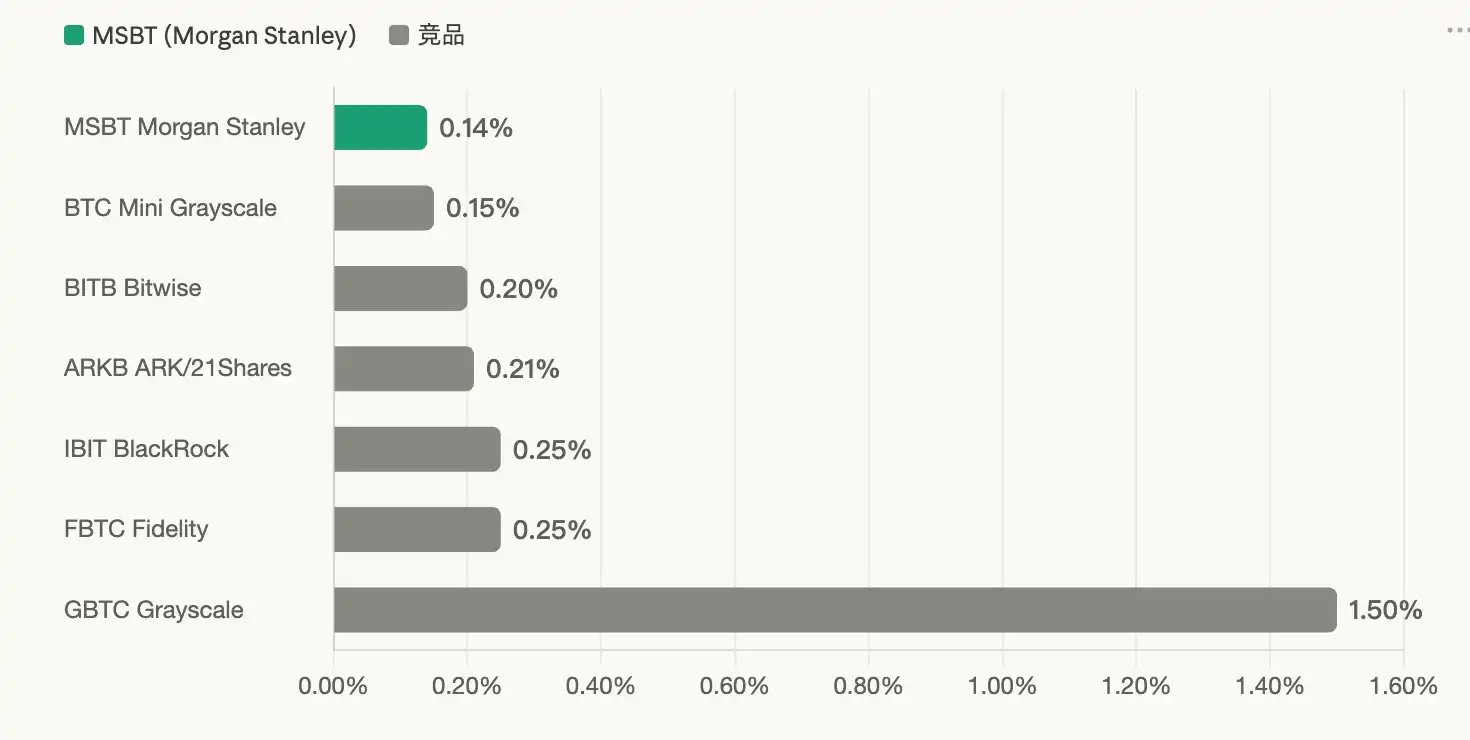
The fee is one of the few core differentiating factors in the Bitcoin spot ETF market. All products directly hold Bitcoin and track the spot price, with highly homogeneous investment strategies. Cost differences become significant in large allocations and long-term holdings. For a $100,000 investment, MSBT saves approximately $110 in management fees compared to IBIT annually.

Historical data has proven the driving force of fees on fund flows: Grayscale's flagship product GBTC charges 1.5% and has seen its assets under management (AUM) shrink from about $29 billion to less than half since its conversion to an ETF in January 2024.

Regarding the MSBT product structure, the fund directly holds Bitcoin, tracking the CoinDesk Bitcoin Benchmark 4:00 PM New York Settlement Price, without using leverage, derivatives, or active trading strategies. Coinbase serves as the custodian and prime broker, BNY Mellon is responsible for cash custody and fund administration, and the initial seed capital is approximately $1 million, corresponding to 50,000 creation baskets.

More importantly, MSBT is the 12th product of its kind since the first batch of Bitcoin spot ETFs were listed in January 2024, and the first Bitcoin spot ETF directly issued and listed by a major U.S. bank. Previously, the issuers of listed products were all asset management companies or crypto-native institutions. Morgan Stanley's entry means that Wall Street banks are moving from "distributing others' products" to "making their own products."

The Distribution Network is the Real Weapon

The fee is just one card on Morgan Stanley's table; the real differentiator is the distribution network.

Morgan Stanley's approximately 16,000 financial advisors manage about $6.2 trillion in client assets (total client assets for the entire bank are about $9.3 trillion). MSBT will receive distribution support from this network starting on its first trading day. Bloomberg ETF analyst Balchunas referred to Morgan Stanley as a "captive audience" for the Bitcoin ETF market and pointed out that while Fidelity also has a partial advisor network, "Morgan Stanley is a whole other level."

Amy Oldenburg, the bank's Head of Digital Asset Strategy, previously revealed that currently about 80% of crypto ETF trading activity comes from self-directed investors, not advisor-managed accounts.

A self-owned product with the lowest fee in the market is expected to eliminate cost concerns advisors might have when recommending Bitcoin allocations, thereby unlocking the incremental space of the advisor channel, which has not yet been fully activated.

Morgan Stanley's Global Investment Committee had already recommended that clients allocate 0-4% of their investment portfolio to crypto assets. Phong Le, CEO of Strategy (formerly MicroStrategy), provided a more aggressive calculation on platform X: based on $6.2 trillion in client assets and a 2% allocation ratio, the potential capital scale is approximately $160 billion, nearly three times the current AUM of BlackRock's IBIT. He called MSBT the "Monster Bitcoin".

However, the actual allocation pace still holds uncertainty. Multiple steps are typically required between product availability and large-scale recommendation through the advisor channel, including compliance approval, investment policy adjustments, and client education.

More Than One ETF: Morgan Stanley's Full-Scale Crypto Layout

MSBT is not an isolated product. Morgan Stanley is systematically building crypto asset infrastructure.

The bank submitted applications for both Bitcoin and Solana spot ETFs in January of this year, followed by an application for a staking Ethereum ETF. In February, Morgan Stanley applied for a National Trust Bank charter (Morgan Stanley Digital Trust) to directly provide clients with digital asset custody, trading, and staking services.

On the retail side, the bank plans to open spot trading for Bitcoin, Ethereum, and Solana to retail investors through the E*Trade platform in the first half of 2026, partnering with Zero Hash. Jed Finn, Head of the Wealth Management Division, called direct crypto trading the "tip of the iceberg," hinting that more services such as custody, wallets, and tokenized assets will follow.

The logic of this multi-channel strategy is clear: institutional clients get MSBT allocations through advisors, self-directed investors trade cryptocurrencies directly through E*Trade, all completed within Morgan Stanley's ecosystem. CEO Ted Pick has already communicated with the U.S. Treasury regarding product development.

Reddit Community: 'Traditional Finance Has Surrendered'

The news sparked heated discussion in the Reddit crypto community. Several users interpreted Morgan Stanley's self-issuance of a Bitcoin ETF as a "surrender signal" from traditional finance towards Bitcoin, believing that the shift from resistance and观望 (wait-and-see) to active embrace by major Wall Street banks marks an irreversible institutionalization process for Bitcoin as an asset class.

Other users offered pragmatic views: the trading volume on the first day and the net inflows in the first month will be key indicators to test whether the distribution network can truly translate into actual allocations.


Perguntas relacionadas

QWhat is the ticker symbol and management fee for Morgan Stanley's Bitcoin ETF?

AThe ticker symbol is MSBT, and it has an annual management fee of 0.14%, which is the lowest in the market.

QHow much client assets do Morgan Stanley's financial advisors manage, and what is the potential impact on the Bitcoin ETF market?

AMorgan Stanley's approximately 16,000 financial advisors manage about $6.2 trillion in client assets. The bank's global investment committee has recommended clients allocate 0-4% of their portfolio to crypto assets, potentially unlocking significant new capital into the Bitcoin ETF market.

QWhat makes Morgan Stanley's Bitcoin ETF (MSBT) unique compared to other existing Bitcoin ETFs?

AMSBT is the first Bitcoin spot ETF to be directly issued and listed by a major U.S. bank. Its key differentiators are its lowest-in-market fee (0.14%) and its immediate access to the bank's massive network of financial advisors and their clients.

QBesides the Bitcoin ETF, what other crypto-related products and services is Morgan Stanley developing?

AMorgan Stanley is building a full crypto infrastructure. This includes applications for a Solana spot ETF, a staking Ethereum ETF, a national trust bank charter (Morgan Stanley Digital Trust) for custody services, and plans to offer direct spot trading of Bitcoin, Ethereum, and Solana on its E*Trade platform for retail investors in 2026.

QWho are the key service providers (custodian, administrator) for the Morgan Stanley Bitcoin Trust (MSBT)?

ACoinbase serves as the custodian and prime broker for the MSBT, while BNY Mellon is responsible for cash custody and fund administration.

Leituras Relacionadas

Why Do You Always Lose Money on Polymarket? Because You're Betting on News, While the Pros Read the Rules

Why do you always lose money on Polymarket? Because you bet on news, while the pros study the rules. This article explains how top traders ("che tou") profit by meticulously analyzing market rules, not just predicting events. Polymarket, a prediction market platform, often sees disputes over event outcomes due to ambiguous rule wording. For instance, a market asking "Who will be the leader of Venezuela by the end of 2026?" was misinterpreted by many who bet on Delcy Rodríguez, assuming she held power. However, the rules specified "officially holds" as the formally appointed, sworn-in individual. Since Nicolás Maduro was still recognized as president officially, he won the market—even being in prison. To resolve such disputes, Polymarket uses a decentralized arbitration system via UMA protocol. The process involves: 1. Proposal: Anyone can propose a market outcome by staking 750 USDC, earning 5 USDC if unchallenged. 2. Dispute: A 2-hour window allows challenges with a 750 USDC stake; successful challengers earn 250 USDC. 3. Discussion: A 48-hour period on UMA Discord for evidence and debate. 4. Voting: UMA token holders vote in two 24-hour phases (blind then public). Outcomes require >65% consensus and 5M tokens voted; otherwise, four re-votes occur before Polymarket intervention. 5. Settlement: Results are final and automatic. Unlike traditional courts, Polymarket’s system lacks separation between arbitrators and stakeholders—voters often hold market positions, creating conflicts of interest. This leads to herd mentality in discussions and non-transparent outcomes without explanatory rulings, preventing precedent formation. Thus, success on Polymarket hinges on deep rule interpretation, not just event prediction, exploiting gaps between reality and contractual wording.

marsbitHá 1h

Why Do You Always Lose Money on Polymarket? Because You're Betting on News, While the Pros Read the Rules

marsbitHá 1h

DeepSeek Funding: Liang Wenfeng's 'Realist' Pivot

DeepSeek, a leading Chinese AI company, has initiated its first external funding round, aiming to raise at least $300 million at a valuation of no less than $10 billion. This move marks a significant shift from its founder Liang Wenfeng’s previous idealistic stance of rejecting external capital to maintain independence. Despite strong financial backing from its parent company, quantitative trading firm幻方量化 (Huanfang Quant), which provided an estimated $700 million in revenue in 2025 alone, DeepSeek faces mounting challenges. Key issues include a 15-month gap in major model updates, delays in its flagship V4 release, and the loss of several core researchers to competitors offering significantly higher compensation. The company is also undergoing a strategic pivot by migrating its infrastructure from NVIDIA’s CUDA to Huawei’s Ascend platform, a move aligned with China’s push for technological self-reliance amid U.S. export controls. However, DeepSeek lags behind rivals like智谱AI and MiniMax—both now publicly listed—in areas such as product ecosystem, multimodal capabilities, and commercialization. The funding round, though relatively small in scale, is seen as a way to establish a market-validated valuation anchor, making employee stock options more competitive and facilitating talent retention. It also signals DeepSeek’s transition from a pure research-oriented organization to a commercially-driven player in the global AI ecosystem.

marsbitHá 1h

DeepSeek Funding: Liang Wenfeng's 'Realist' Pivot

marsbitHá 1h

Trading

Spot
Futuros

Artigos em Destaque

Como comprar 4

Bem-vindo à HTX.com!Tornámos a compra de 4 (4) simples e conveniente.Segue o nosso guia passo a passo para iniciar a tua jornada no mundo das criptos.Passo 1: cria a tua conta HTXUtiliza o teu e-mail ou número de telefone para te inscreveres numa conta gratuita na HTX.Desfruta de um processo de inscrição sem complicações e desbloqueia todas as funcionalidades.Obter a minha contaPasso 2: vai para Comprar Cripto e escolhe o teu método de pagamentoCartão de crédito/débito: usa o teu visa ou mastercard para comprar 4 (4) instantaneamente.Saldo: usa os fundos da tua conta HTX para transacionar sem problemas.Terceiros: adicionamos métodos de pagamento populares, como Google Pay e Apple Pay, para aumentar a conveniência.P2P: transaciona diretamente com outros utilizadores na HTX.Mercado de balcão (OTC): oferecemos serviços personalizados e taxas de câmbio competitivas para os traders.Passo 3: armazena teu 4 (4)Depois de comprar o teu 4 (4), armazena-o na tua conta HTX.Alternativamente, podes enviá-lo para outro lugar através de transferência blockchain ou usá-lo para transacionar outras criptomoedas.Passo 4: transaciona 4 (4)Transaciona facilmente 4 (4) no mercado à vista da HTX.Acede simplesmente à tua conta, seleciona o teu par de trading, executa as tuas transações e monitoriza em tempo real.Oferecemos uma experiência de fácil utilização tanto para principiantes como para traders experientes.

574 Visualizações TotaisPublicado em {updateTime}Atualizado em 2025.10.20

Como comprar 4

Discussões

Bem-vindo à Comunidade HTX. Aqui, pode manter-se informado sobre os mais recentes desenvolvimentos da plataforma e obter acesso a análises profissionais de mercado. As opiniões dos utilizadores sobre o preço de 4 (4) são apresentadas abaixo.

活动图片