More Than One Person Has Wasted Three Years on Base

比推Publicado em 2026-01-14Última atualização em 2026-01-14

Resumo

A developer known as tuna, co-founder of Pandemic Labs, publicly criticized Base, the Ethereum L2 network backed by Coinbase, for failing to support builders despite initial promises. After nearly three years of developing 10 different products—including games, AI agents, and prediction markets—on Base, tuna received no meaningful support, even after creating the hit game *Infected*, which gained 50,000 users. In contrast, within 48 hours of launching a game on Solana, *Addicted*, it generated $4 million in revenue. Tuna expressed frustration that Base appears to prioritize certain projects like Farcaster and Zora while ignoring independent developers. Other builders, such as Shivam Tandon of zkCross Network and Jacek from the DEGEN project, shared similar experiences, citing ignored outreach and a lack of engagement from Base and its lead, Jesse. Despite bringing significant traffic and value, these teams felt overlooked, with DEGEN even choosing to expand to Solana, where they received immediate support and recognition. Critics argue that Base operates with a top-down, “narrative-driven” approach aligned with Coinbase’s interests, rather than fostering an open, community-oriented ecosystem like Solana. While Base’s 2026 roadmap focuses on asset tokenization and the Base App, many developers question whether it truly intends to serve the broader community or mainly functions as an extension of Coinbase.

Author: Eric, Foresight News

Original Title: More Than One Person Has Wasted Three Years on Base


At 1:13 AM Beijing time on January 13, the co-founder of game studio Pandemic Labs, a user with the X handle "tuna," published an article criticizing Base for its inaction.
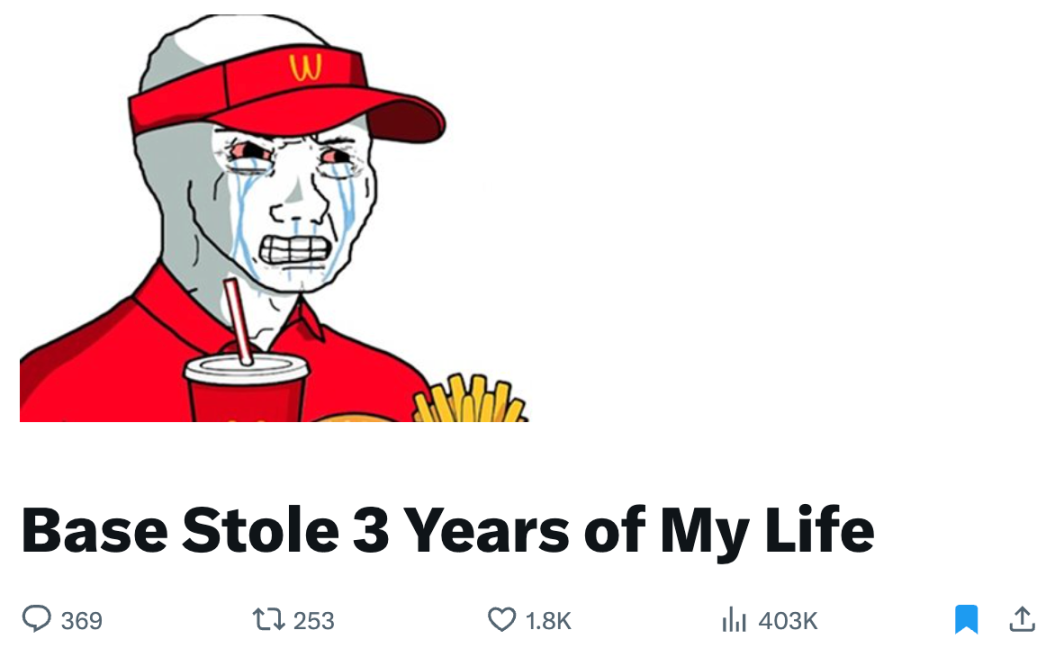
In the article, Tuna stated that Jesse's philosophy of Base being "application-first" rather than focusing on infrastructure attracted him to develop products on Base. However, after "three years" (Base's mainnet has only been live for about two and a half years) of developing 10 products including games, AI Agents, prediction markets, and zkTLS, the promised support from Base never materialized.

After launching the hit game Infected and gaining 50,000 followers in a month, Base proactively contacted tuna and promised support, but ultimately nothing came of it. Tuna mentioned that before Infected, they tried to reach Base officials through X, Discord, and Telegram but received no response.

Disheartened, tuna switched to Solana and developed the game Addicted, which generated $4 million in revenue within 48 hours of its launch on Solana. The stark contrast of earning $4 million in 2 days versus achieving nothing in nearly 3 years led tuna to lament that, compared to Base, which constantly promotes Farcaster and Zora, he had finally found an "organization" that treats developers like human beings.

Shivam Tandon, founder of zkCross Network, had a similar experience. He also initially believed in Jesse's story of prioritizing products and builders. However, after developing Surf on Base, their efforts to contact Base via email and private messages similarly went unanswered. Shivam Tandon stated that he doesn't mind if Base wants to support projects invested in by Coinbase, but he wishes they would be upfront about it and not waste developers' time.

Although some pragmatic users believe Base has its own preferences and that project failures shouldn't be blamed on this, most people expressed support for tuna.

Developer criticism of Base didn't start this year. In February 2025, a user with the X handle Lamboland felt that Base's approach seemed insufficiently "degen." Coinbase offered no support for a high-traffic project like Virtuals but listed the VVV token on its launch day. Lamboland mentioned that many projects were considering migrating to Solana, primarily because Base's marketing was out of touch, lacking "seasoned veterans" who understand CT culture to build a good community environment.

Similarly, just two weeks ago, Jacek, a member of DEGEN—which airdropped $50 million in tokens to Farcaster users and once had a market cap exceeding $1 billion—also posted a long thread expressing disappointment with Base.

Jacek stated that developers choose Base largely because of its connection to Coinbase, hoping to gain support or brand endorsement. However, as the previous two mentioned, Base devoted significant effort to projects like Zora, while even the official Base Twitter account didn't follow or retweet projects like DEGEN that brought massive traffic to Base. In Jacek's view, to Base, anything outside the mainstream narrative simply doesn't exist.

Furthermore, DEGEN's proposal for a $1 million airdrop on Base and the Base App was ignored. Jacek noted that when DEGEN announced plans to cross-chain to Solana, they immediately received attention and support from Solana. At offline events, Solana officials were eager to interact with ecosystem projects, even giving out Bonk keychains. It's these small, seemingly insignificant details that demonstrate official respect for developers and participants. In contrast, Jacek expressed that he doesn't mind Base promoting Zora, but the attitude of completely ignoring other projects is disappointing.

Interestingly, despite such severe public criticism, neither Base nor Jesse offered any explanation or proposed solutions in the replies to these tweets. On the 9th of this month, Jesse retweeted a post from Base product manager Nick, expressing Base's willingness to assist developers, but the comments were filled with skepticism, with the most common question being: How exactly do you plan to help?

Over the past year, Base has indeed been a gold rush destination, but it almost experienced "sudden death" after its flagship projects fizzled out. Unlike Solana, Base is part of the Coinbase ecosystem, an extension of the exchange, born with the attribute of serving stakeholders. Clearly, the unhealthy tendencies existing within the already large Coinbase have also affected Base's operations. Perhaps Base's sudden popularity was indeed supported by Coinbase's strong resources, but the core contributors to its brief success were still the talented developers in the community.

Coinbase's plans for Base in 2026 primarily revolve around on-chain assets and the Base App. Coinbase plans to gradually evolve into a comprehensive exchange in the future, with aspects like stock tokenization and commodity tokenization mainly being handled by Base. Additionally, the Base App is planned to be developed into a Web3 traffic入口 (entry point) integrating trading, social features, and a wallet. This indicates that Base will likely continue to adhere to its recognized "mainstream narrative," and its functional role in assisting Coinbase will remain stronger than being an open community itself.

Over the past year, Base wanted to use its influence to strongly promote projects like Farcaster and Zora, which have capital backing and "orthodox" narratives, but misjudged the "crazy" mainstream style of this market cycle. For Coinbase, it needs to clarify whether Base is merely a tool to serve the exchange and Coinbase Ventures, or a truly open network for the entire world. If it's the latter, it must adopt an operational philosophy like Solana's—"from the masses, to the masses."


Twitter:https://twitter.com/BitpushNewsCN

BitPush TG Discussion Group:https://t.me/BitPushCommunity

BitPush TG Subscription: https://t.me/bitpush

Original article link:https://www.bitpush.news/articles/7602760

Criptomoedas em alta

Perguntas relacionadas

QWhat was the main complaint of the game studio Pandemic Labs' co-founder (tuna) against Base?

ATuna complained that despite Base's initial promise of an 'application-first' approach and support for developers, after nearly three years of developing 10 different products (including games, AI Agent, prediction markets, zkTLS) on Base, the promised support never materialized. Even after creating a hit game 'Infected' that gained 50,000 followers, Base's offer of support ultimately came to nothing.

QWhat contrasting result did tuna experience after switching from Base to Solana?

AAfter switching to Solana and developing the game 'Addicted', tuna generated $4 million in revenue within just 48 hours of its launch. This starkly contrasted with nearly three years of achieving nothing on Base, leading him to feel that Solana was an organization that treated developers with respect.

QAccording to the article, what is a common criticism from developers like Shivam Tandon (zkCross Network) and Jacek (DEGEN) regarding Base's support?

ADevelopers like Shivam Tandon and Jacek criticized Base for ignoring their attempts to make contact via emails and private messages, and for showing preferential support to projects like Zora and those backed by Coinbase Ventures, while neglecting other developers who brought significant traffic and value to the ecosystem, such as DEGEN which airdropped $50 million to users.

QHow did the article characterize Base's relationship with Coinbase and its potential future focus?

AThe article characterized Base as an extension of the Coinbase exchange, born with the attribute of serving its stakeholders. Its future planning for 2026 is focused primarily on on-chain assets and the Base App, aiming to develop into a comprehensive exchange handling stock tokenization, commodity tokenization, and acting as a Web3 traffic entry point. Its functional role in assisting Coinbase is seen as stronger than being a truly open community.

QWhat key difference in community engagement did Jacek highlight between Solana and Base?

AJacek highlighted that when DEGEN announced plans to bridge to Solana, they immediately received attention and support from Solana. At offline events, Solana's official staff were eager to interact with ecosystem projects, even giving out small gifts like Bonk keychains. This demonstrated a respect for developers and participants that was lacking in Base's approach, which largely ignored projects outside its 'mainstream narrative'.

Leituras Relacionadas

The Verdict in Choi Tae-won's Divorce Case: Revealing the Inheritance Undercurrent Behind SK Hynix's Trillion-Won Empire

SK Group Chairman Chey Tae-won's high-profile divorce case, involving a record 1.38 trillion won settlement, has drawn attention to the succession plans for Korea's second-largest conglomerate, especially its crown jewel, SK hynix. Unlike traditional chaebol scripts centered on the eldest son, Chey's three children from his marriage to former President Roh Tae-woo's daughter, Roh Soh-yeong, are carving distinct, non-traditional paths. Eldest daughter Chey Yun-jung (b. 1989) is seen as the most evident successor. With a scientific and consulting background, she holds executive roles at SK bioscience and SK Inc.'s growth support department, focusing on future strategy and biopharma. Her marriage is to an AI infrastructure entrepreneur, not a traditional business alliance. Second daughter Chey Min-jung (b. 1991) took a unique route, voluntarily serving as a South Korean naval officer, including an anti-piracy deployment. She later worked on policy and strategy for SK hynix in Washington D.C. before co-founding an AI-driven healthcare startup. She married a former U.S. Marine Corps officer, connecting her to U.S. defense and policy circles—networks crucial for a global semiconductor giant. The only son, Chey In-geun (b. 1995), who studied physics like his father, worked briefly at SK E&S before joining McKinsey. Despite fitting the traditional "heir" profile as the eldest son, he remains silent and holds no public position or shares in SK, suggesting the old succession playbook is obsolete. As SK hynix's valuation soars, becoming a geopolitical asset in the AI era, the heirs' legitimacy is no longer automatic. They must prove themselves in fields like AI biotech, global policy, and strategic consulting. Their marriages also reflect new elite networks in tech and defense, not old political alliances. Their inheritance is the complex challenge of navigating a globalized, tech-driven world, not just a corporate throne.

marsbitHá 11h

The Verdict in Choi Tae-won's Divorce Case: Revealing the Inheritance Undercurrent Behind SK Hynix's Trillion-Won Empire

marsbitHá 11h

From OpenSea to OpenRouter: Is Alex Atallah Repeating His 'Exit at the Peak' Playbook?

From OpenSea to OpenRouter: Is Alex Atallah Repeating His "Exit at the Peak" Playbook? According to the Wall Street Journal, payments giant Stripe is in talks to acquire the AI model aggregation platform OpenRouter in a potential deal valuing the company near $100 billion. This would mark founder Alex Atallah's second creation of a company reaching a $100 billion valuation, following his co-founding of NFT marketplace OpenSea. OpenRouter, founded just over three years ago, has grown rapidly by acting as a unified gateway for developers to access over 400 AI models. It currently has about 10 million users and processes over 200 trillion tokens monthly. While the platform's annualized revenue is around $50 million, its valuation has skyrocketed from $1.3 billion in March 2026. The potential acquisition by Stripe, a company OpenRouter's founder once likened it to, represents a major expansion into AI infrastructure for the payments leader. This move echoes Atallah's previous timing with OpenSea, where he departed before the NFT market's significant downturn. For OpenRouter, selling now may be strategic. Despite its scale, its business model—charging a 5-5.5% fee on AI inference calls—faces pressure from competition, open-source models, and potential price wars among model providers, limiting its profitability narrative for an IPO. A key asset for potential acquirers like Stripe is OpenRouter's vast repository of real-world AI usage data, which offers unique insights into model performance and developer preferences that are difficult to replicate. Whether this potential deal signifies a new valuation benchmark for AI infrastructure or another market peak signal remains to be seen.

链捕手Há 11h

From OpenSea to OpenRouter: Is Alex Atallah Repeating His 'Exit at the Peak' Playbook?

链捕手Há 11h

Trading

Spot

Artigos em Destaque

Como comprar ONE

Bem-vindo à HTX.com!Tornámos a compra de Harmony (ONE) simples e conveniente.Segue o nosso guia passo a passo para iniciar a tua jornada no mundo das criptos.Passo 1: cria a tua conta HTXUtiliza o teu e-mail ou número de telefone para te inscreveres numa conta gratuita na HTX.Desfruta de um processo de inscrição sem complicações e desbloqueia todas as funcionalidades.Obter a minha contaPasso 2: vai para Comprar Cripto e escolhe o teu método de pagamentoCartão de crédito/débito: usa o teu visa ou mastercard para comprar Harmony (ONE) instantaneamente.Saldo: usa os fundos da tua conta HTX para transacionar sem problemas.Terceiros: adicionamos métodos de pagamento populares, como Google Pay e Apple Pay, para aumentar a conveniência.P2P: transaciona diretamente com outros utilizadores na HTX.Mercado de balcão (OTC): oferecemos serviços personalizados e taxas de câmbio competitivas para os traders.Passo 3: armazena teu Harmony (ONE)Depois de comprar o teu Harmony (ONE), armazena-o na tua conta HTX.Alternativamente, podes enviá-lo para outro lugar através de transferência blockchain ou usá-lo para transacionar outras criptomoedas.Passo 4: transaciona Harmony (ONE)Transaciona facilmente Harmony (ONE) no mercado à vista da HTX.Acede simplesmente à tua conta, seleciona o teu par de trading, executa as tuas transações e monitoriza em tempo real.Oferecemos uma experiência de fácil utilização tanto para principiantes como para traders experientes.

349 Visualizações TotaisPublicado em {updateTime}Atualizado em 2026.06.02

Como comprar ONE

Discussões

Bem-vindo à Comunidade HTX. Aqui, pode manter-se informado sobre os mais recentes desenvolvimentos da plataforma e obter acesso a análises profissionais de mercado. As opiniões dos utilizadores sobre o preço de ONE (ONE) são apresentadas abaixo.

活动图片