More Accurate Than Polls, More Dangerous Than Imagined: Prediction Markets in the Eyes of the Fed

比推Publicado em 2026-02-24Última atualização em 2026-02-24

Resumo

The Federal Reserve is exploring the use of prediction markets, particularly Kalshi, as a real-time tool for policy insights. A Fed-affiliated working paper found that Kalshi’s predictions for core CPI and unemployment are statistically comparable to—and sometimes more accurate than—Bloomberg consensus estimates. Prediction markets aggregate real-money, belief-backed trading, offering frequent updates and capturing nuanced shifts that traditional surveys miss. For instance, Kalshi priced inflation uncertainty in real time during a trade policy scare—a dynamic monthly surveys couldn’t reflect. While these markets provide valuable signals, they also carry risks. Prices reflect both expectations and risk preferences, and heavy reliance on sports betting for liquidity makes macroeconomic markets vulnerable to regulatory changes. If sports betting is restricted, liquidity could dry up, increasing manipulation risks. Moreover, if the Fed openly uses prediction markets, it could create a feedback loop where traders manipulate smaller markets like Kalshi to influence broader policy communication and traditional financial instruments. Despite these concerns, prediction markets offer a uniquely timely and distributed form of expectation aggregation—especially for events like FOMC meetings, where informed participants trade with real stakes. The Fed should require open data transparency to mitigate manipulation and carefully weigh the signal against the noise.

Source: The Token Dispatch

Author: Prathik Desai

Original Title: The Signal and the Noise


“Forecasts usually tell us more of the forecaster than of the future.”

— Warren Buffett

Money filters out empty talk. Supporters believe this is precisely why prediction markets are reliable. We saw people accurately predict the outcome of the 2024 U.S. presidential election on Polymarket and Kalshi. However, prediction markets themselves are not new, and their success in predicting political outcomes is not the first of its kind.

In October 1988, a group of economists at the University of Iowa supported their academic curiosity with a small, real-money prediction market. They launched a presidential election futures market where participants could buy contracts: if George H. W. Bush won, the contract paid $1; if Michael Dukakis won, it paid $0. On the eve of the election, Bush's contracts traded at 53 cents, while traditional polls suggested a close race. Ultimately, Bush won with 53.4% of the vote and a solid 8-point margin.

Since that academic experiment, these real-money futures markets have outperformed traditional polls in every election predicted more than 100 days in advance. In U.S. presidential elections since 1988, prediction markets have been closer to the final result than polls 74% of the time.

This success stems from a mechanism that forces people to express genuine beliefs backed by real money, something surveys can never achieve. Those who truly believed Bush would win bought and held contracts. For random participants, there is no incentive to spend $50 to support a claim they themselves do not believe. When this behavior aggregates thousands of traders, information converges into a price that reflects the true beliefs of a broad group, rather than a small, disproportionate sample.

That small academic experiment in Iowa, run on a shoestring budget, has now evolved into an institutionalized infrastructure.

Last week, a working paper authored by economists affiliated with the Federal Reserve noted that Kalshi, the largest regulated prediction market in the U.S., could serve as a valuable real-time benchmark for policymakers. The same week, New York Stock Exchange (NYSE) President Lynn Martin stated that Polymarket, the world's highest-volume prediction market, moved S&P index futures on election night by pricing Donald Trump's victory earlier than any news organization. Subsequently, Kalshi announced a partnership with a trading platform that handles $2.6 trillion in daily institutional volume.

In today's in-depth analysis, I will explore whether prediction markets can serve as reliable barometers for policymaking and what risks they bring.

Prediction Markets as Policymaking Tools

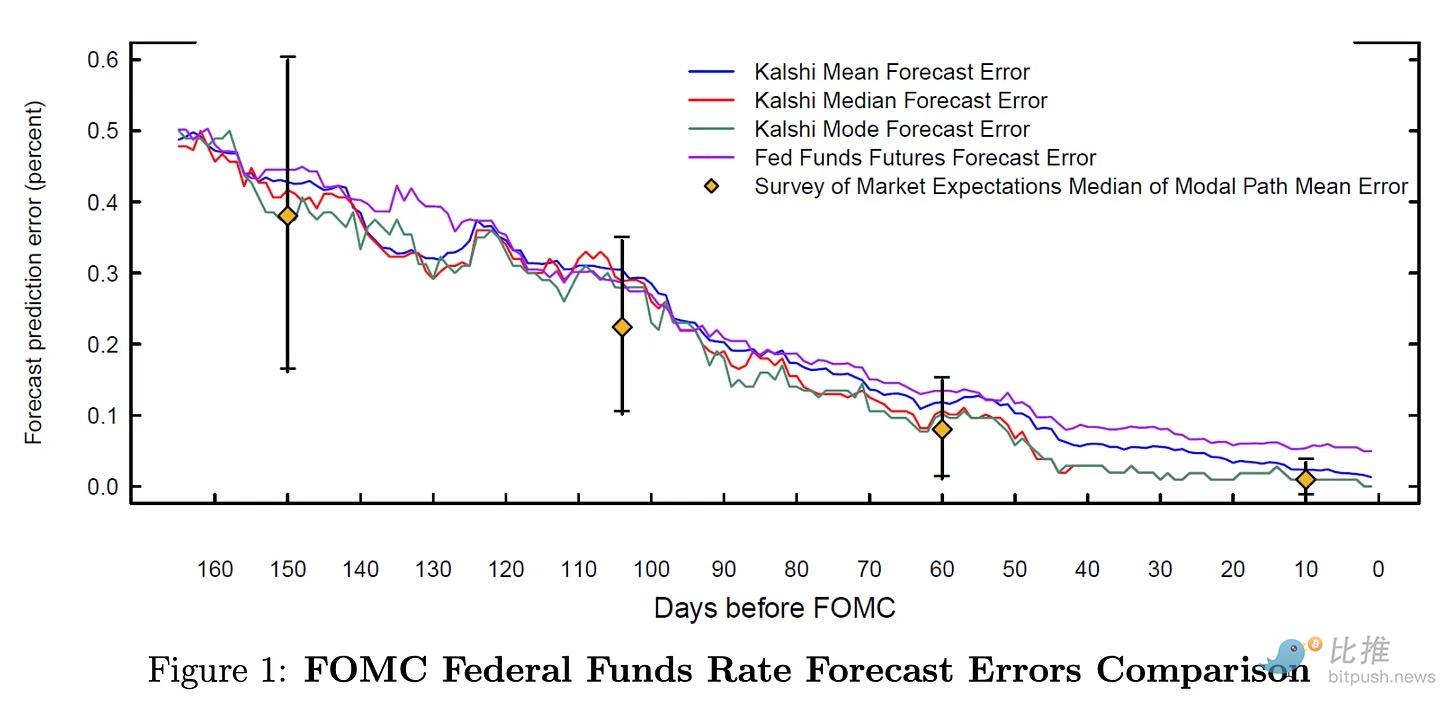
The paper found that Kalshi's predictions are statistically similar to Bloomberg's consensus expectations, with nearly identical prediction errors for core CPI and unemployment rates. In fact, the paper also found that Kalshi's predictions for core CPI were significantly better than Bloomberg's estimates.
@FederalReserve

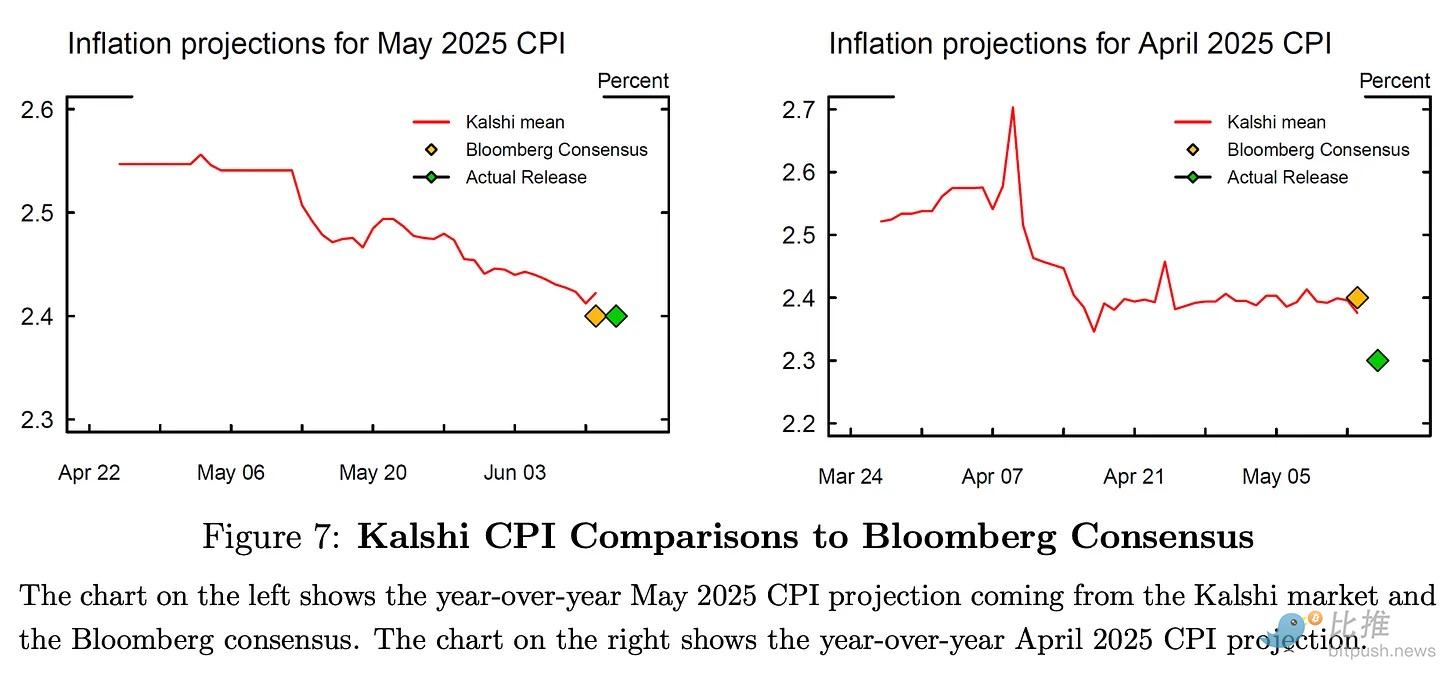
Despite similar statistical performance, Kalshi's uniqueness lies in its ability to provide more frequent, real-time probability curve updates for macroeconomic indicators such as GDP growth, core CPI, and unemployment rates. For estimates like inflation, the Bloomberg consensus is only available in the months leading up to the data release. This makes traditional estimates less frequent, with longer gaps that fail to reflect real-time expectation updates.

Kalshi not only provides predictions of outcomes but also real-time uncertainty ranges and tail risks. In early April 2025, uncertainty about trade policy temporarily raised inflation expectations. Although this uncertainty did not materialize, Kalshi priced this dynamic in real time. Monthly Bloomberg estimates could never capture this nuance.
@FederalReserve

Today, when Federal Reserve governors speak at Federal Open Market Committee (FOMC) meetings, Kalshi's market odds move in real time. They price every word from the governors, providing policymakers with a perspective on how traders interpret the expected information.

For example, when Christopher J. Waller made dovish remarks ahead of the July 2025 FOMC meeting, the probability of no rate cut fell to 75%. After the stronger-than-expected June jobs report, this probability quickly rebounded to over 90%. The entire expectation of traders, backed by real money, is presented to policymakers in a way no other tool can currently achieve.

Who Trades on These Markets?

Before deciding how much to trust prediction markets, it is important to examine who is trading and what the volume represents.

Between September 2024 and January 2026, volume on Polymarket for FOMC meetings grew 11-fold, from $59 million to $660 million. In total, Polymarket's FOMC markets processed $2.6 billion, surpassing the combined total of the platform's culture, economy, geopolitics, and science categories.

So, who is trading such large amounts on FOMC meetings? While it is difficult to pinpoint on anonymous prediction platforms like Polymarket, we can speculate: it is hard not to think of macro hedge fund analysts involved in drafting labor statistics reports, or money market fund managers who stand to gain if rates are not cut.

Why them? The Iowa market worked because the number of people who put their money where their mouth is, with reliable information, outweighed those who merely gambling without it. While acknowledging the risk of over-assumption, I believe that when real stakes and funds of this scale are involved, those with reliable information converge on the market, leading to more accurate price discovery.

What to Be Wary Of

All this does not mean prediction markets can be perfect measuring tools for policymakers.

Probabilities in prediction markets also reflect traders' risk preferences. They are not a raw reflection of outcome expectations. For example, when Kalshi prices the probability of unfavorable CPI data at 15% while traditional surveys price it at 10%, this gap can be explained by two factors:

  1. Prediction markets may be pricing real-time information missed by the Bloomberg consensus.

  2. Traders may be paying a premium on prediction markets to hedge against unfavorable outcomes.

Policymakers must understand what this gap reflects before treating this information as a signal for policymaking.

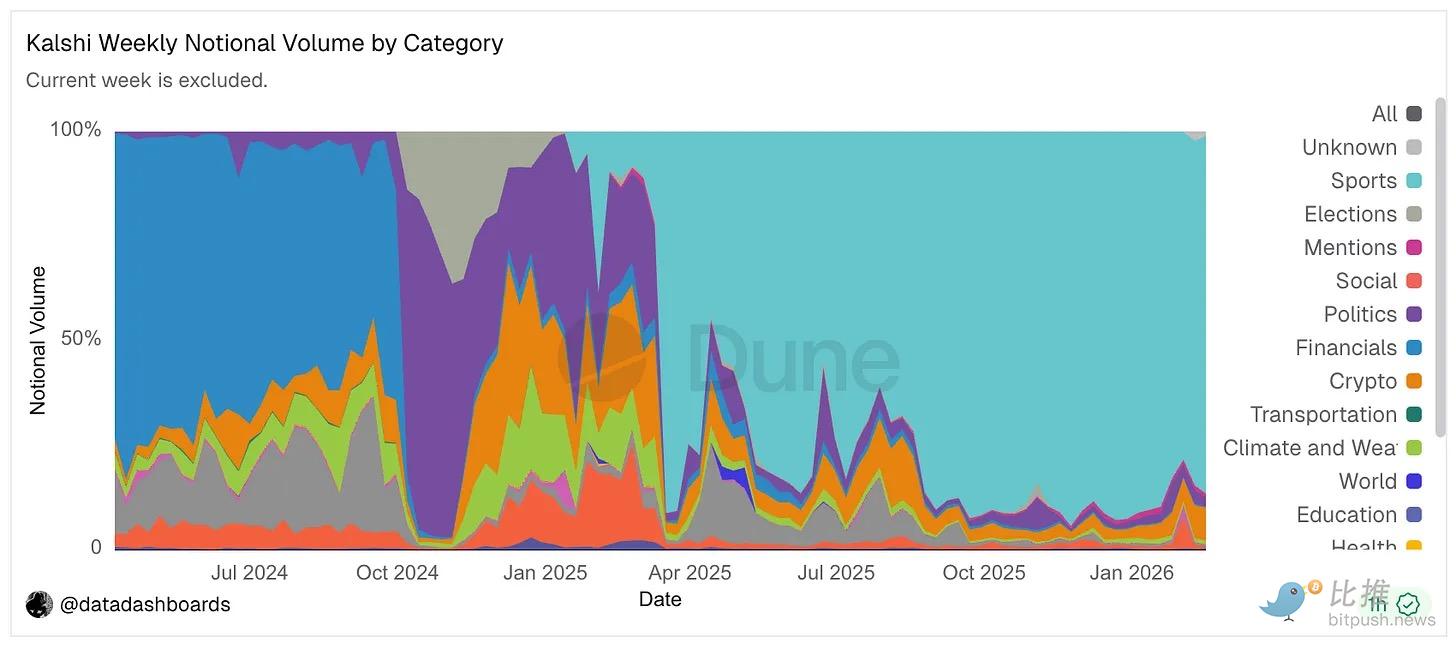
While Kalshi's macroeconomic signals to policymakers seem reliable, over 85% of its total nominal volume comes from the sports category.
@Dune

Currently, at least 20 federal lawsuits are challenging the regulatory arbitrage achieved through nationwide sports betting for prediction markets.

The reliability of Kalshi's FOMC markets is partly due to sports betting providing the platform with foundational liquidity through active traders, narrow bid-ask spreads, and market-making infrastructure, which sustains all Kalshi markets. Although macro markets operate independently, they benefit from this foundation. If sports betting disappears under regulatory pressure, the platform will lose the liquidity engine that keeps spreads tight and prices continuous. Thinner macro markets become easier to move with less capital, making them more susceptible to manipulation.

The Fed's paper recommends using Kalshi as a monitoring tool, not a decision-making input. But making this intention public is itself problematic.

The authors suggest greater use of Kalshi to interpret incoming data and check real-time interpretations of Fed communications. However, because the intention to reference prediction markets is public, it could create a feedback loop.

For example, a policymaker at the Fed might see Kalshi pricing a 15% probability of a rate cut, lower than the expectation they wish to convey through their actions. In response, they might soften their rhetoric in the next speech, which could then cause fluctuations in global traditional interest rate markets. The problem here is that while Kalshi's FOMC market size is $660 million, the federal funds futures market is worth hundreds of billions of dollars. The former requires relatively small positions to change the odds. A well-funded participant, aware that moving Kalshi could influence subsequent Fed remarks (if not decisions), could use relatively small positions to move a much larger market. Policymakers' communications could become targets for manipulation.

This scenario highlights the difference between the 1988 Iowa futures market and the 2026 prediction markets. The Iowa economists back then simply wanted to determine if a market with real stakes could produce better predictions than surveys. At that time, policymaking was not under such close scrutiny to deter manipulators.

Back then, prices reflected true beliefs because those prices did not influence the world. They merely allowed those with insights to monetize them. Once the Fed publicly announces (if it does so) its intention to use prediction markets as a policy input, this attribute disappears. It also introduces a "performative" element to trading.

However, incorporating prediction market odds into the policy toolbox is not a misstep. Financial commitment still filters out empty talk. Informed participants continue to dominate price discovery. The result is a signal unmatched by surveys in terms of speed and distribution richness. For FOMC markets, this is more pronounced than any other application: there are participants on both sides with genuine hedging capabilities, and the market, by pricing real-time events frequently, better reflects real-time expectations.

Policymakers should mandate open-source data transparency as a prerequisite for formal adoption. If the data is not auditable, manipulation may go undetected. They should understand that both signal and noise come from the same place. People with real money and real beliefs can tell you what they think in real time.

For those powerful enough to game the system, this window of opportunity did not exist when the Iowa economists were conducting their academic experiment decades ago. Today, this window is wider than ever.


Twitter:https://twitter.com/BitpushNewsCN

Bitpush TG Discussion Group:https://t.me/BitPushCommunity

Bitpush TG Subscription: https://t.me/bitpush

Original link:https://www.bitpush.news/articles/7614191

Perguntas relacionadas

QAccording to the Federal Reserve working paper, how does the predictive accuracy of Kalshi compare to Bloomberg's consensus forecasts for core CPI and unemployment?

AThe paper found that Kalshi's predictions were statistically similar to Bloomberg's consensus expectations, with nearly identical prediction errors for core CPI and unemployment. In fact, Kalshi's forecasts for core CPI were significantly better than Bloomberg's estimates.

QWhat key advantage does the article highlight for Kalshi over traditional survey-based forecasts like Bloomberg's?

AKalshi provides more frequent, real-time updates to its probability curves for macroeconomic indicators, offering real-time uncertainty ranges and tail risk assessments that traditional surveys, which are only available months before data releases, cannot capture.

QWhat is the primary risk identified if the Federal Reserve were to publicly state its intention to use prediction markets like Kalshi as a policy input?

AIt could create a feedback loop and make policy communication a target for manipulation. A well-funded participant could use a relatively small position to move the odds on Kalshi, potentially influencing subsequent Fed communication and causing volatility in the much larger traditional interest rate markets.

QWhat does the article identify as the main reason for the historical success of prediction markets over traditional polls in forecasting election outcomes?

AThe mechanism forces people to express true beliefs backed by real money, which a survey questionnaire can never do. This aggregates information from a large crowd into a price that reflects genuine collective belief rather than a small, disproportionate sample.

QWhat major category currently provides the vast majority of the nominal trading volume on the Kalshi platform, and why is this a potential concern?

ASports betting accounts for over 85% of Kalshi's total nominal volume. This is a concern because the liquidity from sports trading supports the platform's infrastructure. If sports betting faces regulatory pressure and declines, the macro markets could lose liquidity, becoming thinner and more susceptible to manipulation.

Leituras Relacionadas

Gate Research Institute: The 'Wall Street-ization' Wave of Crypto Financial Products – Competition or Integration?

The article titled "Gate Research Institute: Are Crypto Financial Products Sparking a 'Wall Street' Wave—Competition or Convergence?" explores the evolving relationship between the crypto ecosystem and traditional finance (TradFi). The piece begins by reflecting on Bitcoin's original 2009 vision of decentralization, disintermediation, and moving away from banks. It then contrasts this with the 2024 landscape, where key crypto assets like Bitcoin are increasingly held through Wall Street products like ETFs issued by giants like BlackRock. The article questions whether this signifies that TradFi is systematically taking over the rights to issue, price, custody, and distribute crypto financial assets. The core argument is that this is not a zero-sum takeover but rather a bidirectional convergence where each side addresses the other's weaknesses. Crypto offers 24/7 global markets, programmable settlement, and open access but lacks compliant channels, institutional-grade custody, deep fiat liquidity, and mainstream distribution. TradFi possesses these but is constrained by legacy systems, limited operating hours, and slow settlement. Two primary convergence paths are highlighted: * **Path A (CEX to TradFi):** Exemplified by Gate, which has progressed from offering tokenized stocks and CFDs to providing direct, real stock trading (US, Hong Kong, South Korea) within its platform, using USDT. * **Path B (TradFi to Crypto):** Exemplified by Robinhood, which has integrated crypto trading, acquired exchanges like Bitstamp, and is moving traditional assets like stocks onto the blockchain via tokenization and its own Layer 2. Both paths are ultimately competing to become the next-generation, unified financial account—a "super account" where users can seamlessly trade cryptocurrencies, stocks, ETFs, RWA (Real World Assets), and tokenized treasury products in one interface. The growth of RWA and tokenized treasuries (e.g., BlackRock's BUIDL) is presented as the asset-layer fusion, providing stable, yield-bearing assets on-chain and acting as a bridge between the two worlds. In conclusion, the "Wall Street-ization" of crypto is framed as a mutual transformation. Decentralized ideals persist in the protocol layer, while at the application layer, a more efficient, global, and accessible unified capital market is emerging from this convergence. The future competition lies not between crypto exchanges and stockbrokers, but between platforms vying to offer the most comprehensive asset coverage, liquidity, and user experience within a single account.

marsbitHá 2m

Gate Research Institute: The 'Wall Street-ization' Wave of Crypto Financial Products – Competition or Integration?

marsbitHá 2m

Claude's Major New Feature: Screen Recording + Voice, Distilling Your Skills into AI Tasks in One Click

Claude has introduced a major new feature called "Record a Skill," available for Pro, Max, and Team users. This function, found in the Claude desktop app's CoWork menu, allows users to create reusable AI skills simply by recording their screen and providing voice narration while performing a task. Claude then automatically analyzes the recording and generates a functional Skill. A hands-on test confirmed the feature works seamlessly. Users start recording via the Skills manager, perform their workflow while verbally explaining the steps and logic, and avoid including sensitive information. After recording, Claude processes the content and creates the Skill, which can be saved and later invoked with a slash command (/). This eliminates the need for manual adjustments or writing complex instruction files. The innovation goes beyond mere efficiency. Previously, creating a Skill required writing a detailed SKILL.md file in Markdown—a significant barrier for non-technical users. "Record a Skill" bypasses this by directly capturing both actions and the implicit reasoning shared in the narration. This lowers the barrier to knowledge transfer and automation, addressing a core challenge in corporate knowledge management: the difficulty of getting experts to write and maintain documentation. However, the feature also highlights a shift in the nature of work. A case study from March 2026 showed a freelancer whose five-year client relationship was effectively replaced by a hand-coded Claude Skill automating their content workflow. With the even lower barrier of screen recording, the ability to distill personal expertise into automatable skills accelerates this trend. The "moat" for work is moving from simply knowing how to do a task to mastering tasks that are difficult or impossible to automate.

marsbitHá 6m

Claude's Major New Feature: Screen Recording + Voice, Distilling Your Skills into AI Tasks in One Click

marsbitHá 6m

Feeding AI "Noise" Can Also Boost Scores, This Work Enables Positive Transfer with Noise

Feeding "Noise" to AI Can Improve Performance: A Method Enables Positive Transfer from Noise This work, Semi-Supervised Noise Adaptation (SSNA), introduces a Noise Adaptation Framework (NAF) that challenges traditional transfer learning. Instead of requiring a labeled source domain of real data (e.g., images, text), NAF uses randomly generated Gaussian noise as the source. For a target task with C classes, it constructs C noise clusters by sampling from Gaussian distributions. Although this synthetic noise contains no semantic meaning, NAF trains it to form a discriminative class structure in a shared representation space—clustering same-class noise and separating different classes. The key is aligning this learned structure from the noise domain to the real, sparsely labeled target domain. A small number of target labels are still essential to establish the correspondence between noise clusters and actual classes. The training objective combines: 1) supervised loss on the few labeled target samples, 2) classification loss for the noise to build its structure, and 3) a distribution alignment loss (using Negative Domain Similarity) to minimize the gap between the noise and target domains in the shared space. Experiments show significant gains in few-label settings. With just 4 labels per class, NAF with a ResNet-18 backbone improves accuracy over a standard supervised baseline (ERM) by +12.35% on CIFAR-10, +7.61% on CIFAR-100, +4.38% on DTD-47, and +2.74% on Caltech-101. It also benefits fine-grained datasets and scales to ImageNet-1K (with 100 labels/class) and text classification (AG News). NAF can be integrated into existing semi-supervised methods like FixMatch for further gains. Ablation studies confirm the transferred benefit comes from the discriminative structure of the noise, not randomness itself. Collapsing all noise into a single point causes negative transfer, while increasing separation between noise cluster centers improves performance. The amount of noise per class is less critical once a basic structure forms. In conclusion, this work demonstrates that for positive transfer, the semantic content of source data may not be necessary. What can be effectively transferred is the *organizational structure* of categories within a representation space. This offers a promising alternative for scenarios where real source data is unavailable due to privacy, copyright, or procurement constraints.

marsbitHá 8m

Feeding AI "Noise" Can Also Boost Scores, This Work Enables Positive Transfer with Noise

marsbitHá 8m

Trading

Spot
活动图片