Mining of the cryptocurrency Zcash ($ZEC) is rapidly gaining momentum against the backdrop of the asset's sharp price increase. According to an estimate by Zachary Pandl, Head of Research at Grayscale, Zcash miner rewards are roughly double those of Bitcoin miners per mining device and approximately four times higher per megawatt-hour. This incentivizes an increase in the network's computational power and, in turn, strengthens its security.
Zcash Ramps Up Mining Activity
Zcash is a cryptocurrency built on principles similar to Bitcoin but with additional privacy features. Both networks use the Proof-of-Work (PoW) algorithm, where miners perform computations to receive rewards and confirm new blocks.
According to Grayscale:
- Bitcoin's total daily miner reward is about $35 million, while Zcash's is about $2 million;
- however, the reward per mining device for Zcash is approximately twice as high;
- in terms of megawatt-hour, Zcash mining profitability is about four times that of Bitcoin;
- overall Zcash mining activity has increased more than 2.5 times since the beginning of the year.
"Due to the strong price dynamics of the token, mining Zcash has become highly profitable, which, in turn, stimulates an increase in mining activity and enhances network security," noted Pandl.
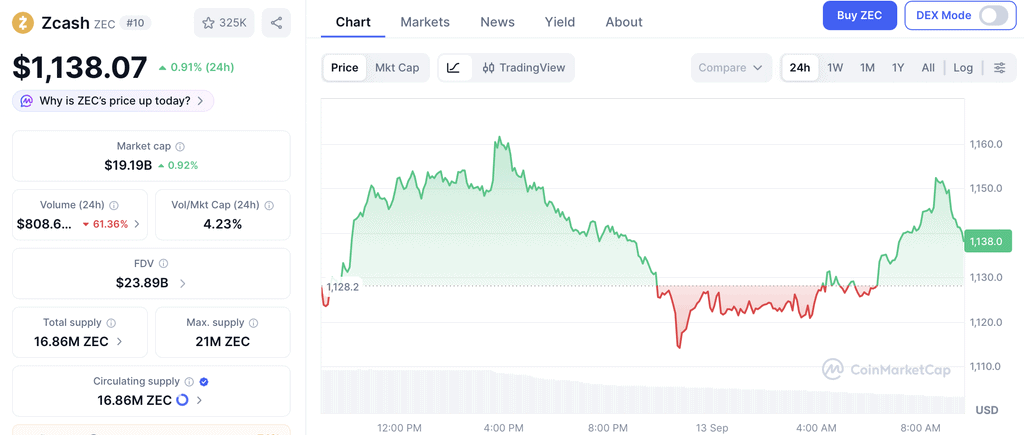
The increase in profitability is primarily linked to the price dynamics of $ZEC. In September, the coin's price exceeded $1,000, and its market capitalization surpassed $17 billion, allowing Zcash to enter the top 10 cryptocurrencies by this metric. At the time of writing, the asset is trading around $1,138, closing the top 10 list with a market capitalization of over $19 billion, according to CoinMarketCap.
Market attention towards Zcash intensified further following the launch of the first spot ETF based on $ZEC. On August 25, 2026, trading began on NYSE Arca for shares of The Zcash ETF (ZCSH) from Grayscale Investments.
Another significant milestone for the network was the July Ironwood upgrade. The hardfork was intended to completely eliminate a vulnerability in the Orchard pool by creating a new shielded pool for transferring funds, as well as to provide users with confirmation that the vulnerability had not been exploited.
end-content