Mining Firms Flock to AI, but Wall Street Cools Valuation Enthusiasm. The Earnings Season Reveals Who's 'Swimming Naked'?

marsbitPublicado em 2026-08-07Última atualização em 2026-08-07

Resumo

Bitcoin mining companies are increasingly pivoting to AI and HPC (high-performance computing) infrastructure, but Wall Street is growing skeptical, demanding proof of a viable business model over mere announcements. An analysis shows that while early AI-related announcements triggered significant stock price movements (average absolute change of 24.1%), recent similar news has had a much smaller market impact (average ~10.2%), despite the underlying business value of AI/HPC hosting contracts improving. A review of Q2 2024 earnings from five major mining firms reveals a mixed picture: * **Marathon Digital (MARA):** Reported declining revenue ($175M, down 27%) and a large net loss ($610M+). Its AI/HPC transformation remains in the building phase, contributing negligible revenue so far. * **Core Scientific:** Successfully shifted its business model, with AI/HPC hosting now dominating revenue (83% of total $164.2M). However, this came with high capital expenditure and negative shareholder equity. * **TeraWulf:** Showed early results from its pivot, with HPC leasing generating 71% of its total revenue ($44.77M). It secured major long-term contracts but also reported a significant net loss. * **Hut 8:** Achieved substantial revenue growth ($74.9M, up 81.4%) driven by computing operations and completed commercialization of its first major AI data center campus. It remains unprofitable on a net income basis. * **CleanSpark:** Revenue still relies entirely on Bitcoin mining...

Author: Nancy, PANews

The story of Bitcoin mining companies pivoting to AI is no longer novel, and has even gradually become an industry standard. However, as more mining firms rush into this track, Wall Street is beginning to lower the valuation premium for this AI pivot narrative.

Blocksbridge Consulting recently pointed out in an analysis that as more mining companies ramp up their AI/HPC infrastructure, the market's reaction to the related transformation stories is noticeably cooling off. Even large-scale AI hosting contracts are finding it increasingly difficult to replicate the market stimulus seen in the early days. Data shows that early AI business announcements often triggered significant stock price volatility, with the average absolute price movement for related companies reaching 24.1% after announcements; however, the average absolute price movement following recent similar transaction announcements has dropped to about 10.2%.
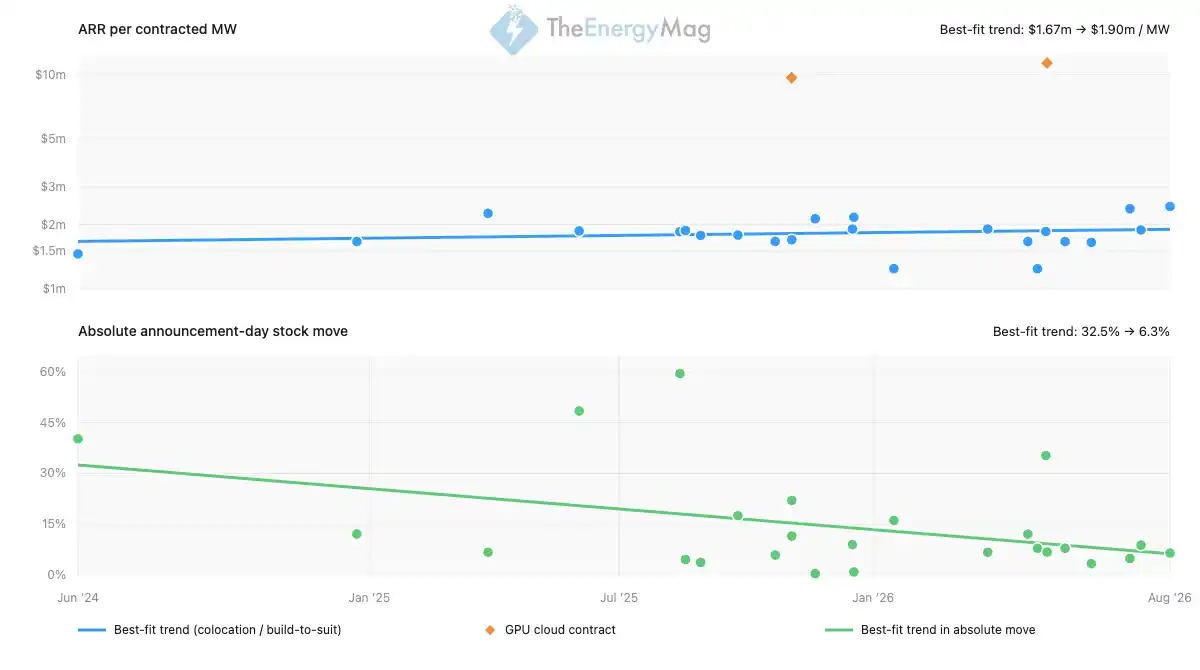
Meanwhile, the commercial value of AI/HPC hosting businesses themselves continues to rise. Data shows the annualized revenue level for related leases has increased from about $1.67 million per megawatt in the early stages to approximately $1.9 million.

This change means the market is no longer buying into the mere slogan of an AI pivot; instead, it's starting to focus on tenant quality, project delivery capabilities, capital expenditure, and the realization of future cash flows. For Bitcoin mining companies, the key to AI transformation has shifted from "storytelling" to the stage of "proving the business model."

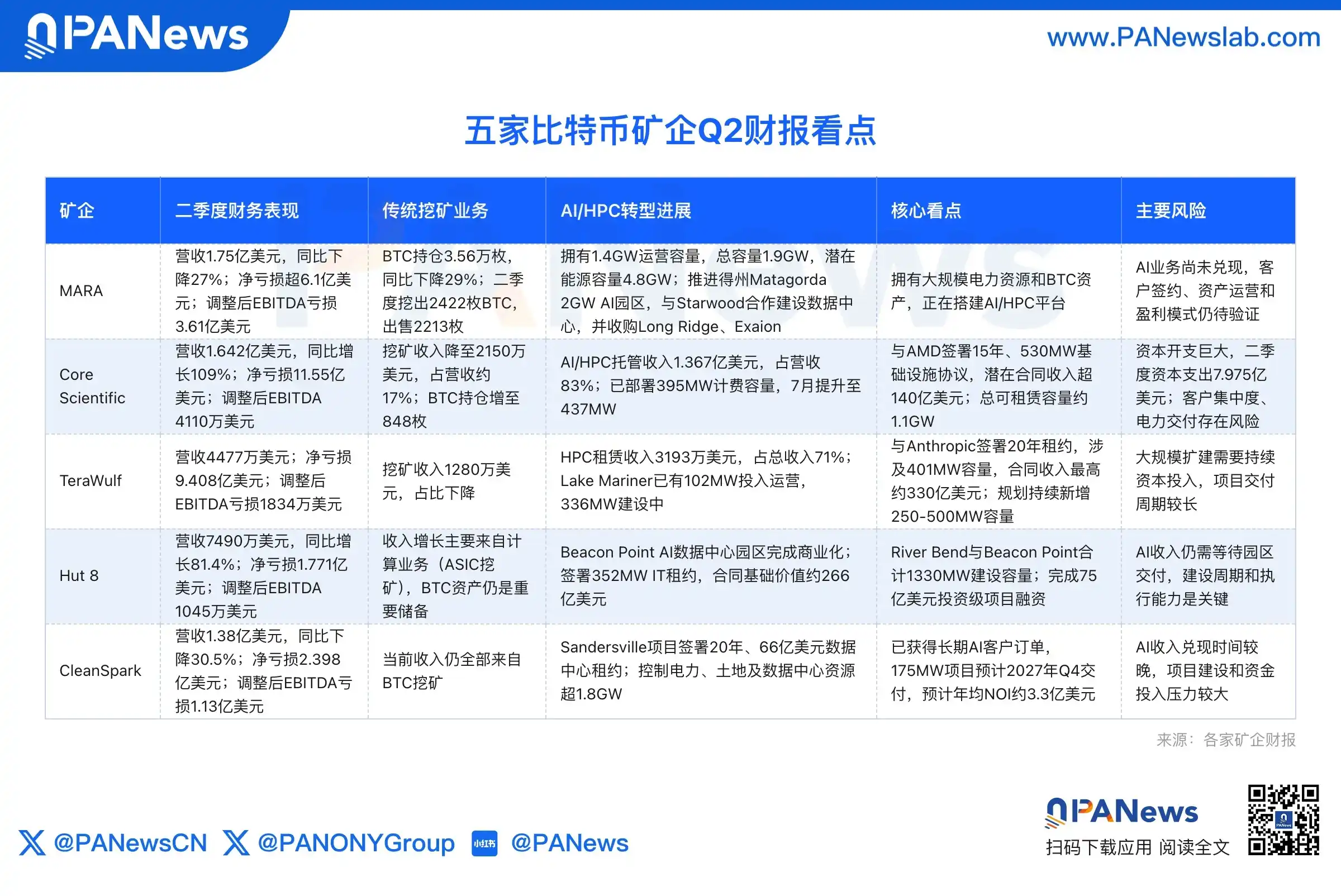
As Q2 earnings reports roll out, the AI pivot of Bitcoin miners is entering a new phase of examination. PANews reviewed the latest financial reports of five leading Bitcoin mining companies. In terms of transformation progress and results, some miners are still in the construction phase, with AI businesses yet to contribute revenue; some companies have already generated new revenue through AI/HPC hosting businesses, even starting to reshape their business structure. Overall, most mining companies still face declining revenue, widening losses, and high capital expenditure pressure. The transformation story still has a distance to go before cash flow realization.

Looking at secondary market performance, investor attitudes toward miners' AI pivots are also becoming more rational. Over the past month, most Bitcoin mining stocks have seen varying degrees of correction, which is also influenced by the overall pullback in the global AI sector. However, even when some miners announce large AI/HPC leases or make business progress, the market reaction remains relatively muted.
MARA: Losses Widen, AI Pivot Yet to Contribute Revenue

Data shows MARA's stock price fell about 11.6% over the past month, dropping about 5.25% on the day its Q2 earnings were released.

Looking at the latest quarterly report, MARA's traditional mining business remains pressured by the industry cycle, with profit margins continuing to shrink. Its bet on AI/HPC infrastructure remains largely in the setup phase, with the commercialization story yet to materialize.

In Q2 this year, MARA reported revenue of approximately $175 million, a 27% year-over-year decline, significantly down from $238.5 million in the same period last year. In terms of profit, MARA posted a net loss exceeding $610 million in Q2, compared to a profit of about $810 million a year ago. Adjusted EBITDA was a loss of $361 million, a sharp drop from the $1.245 billion profit in the same quarter last year, mainly impacted by approximately $343 million in digital asset impairment due to the decline in Bitcoin's price.

In this earnings report, MARA explicitly outlined its "Three Infrastructure Strategy," encompassing Bitcoin mining, energy resources, and AI computing infrastructure.

Regarding mining operations, as of the end of Q2, MARA held 35,577 BTC, down 29% from 49,951 BTC a year ago. The company mined 2,422 BTC during the quarter and sold 2,213 BTC, with an average selling price of about $73,000. Currently, its combined holdings of cash and BTC assets amount to approximately $2.5 billion.

In terms of the AI/HPC pivot, as of June 2026, MARA had 1.4 GW of operating capacity, with total capacity reaching 1.9 GW and potential energy capacity of about 4.8 GW. The project in Matagorda County, Texas, is a key future transformation node. This project plans to reach up to 2 GW of power capacity and be developed into an AI/HPC computing campus, with construction expected to commence in 2027. Concurrently, MARA partnered with Starwood to establish a data center and acquired the Long Ridge energy asset and French HPC operator Exaion (full-year estimated revenue under eight figures, i.e., millions to around ten million dollars).

Notably, to support energy infrastructure expansion, MARA established a new $100 million credit facility, with 18,750 BTC serving as initial collateral. This indicates the company is enhancing the liquidity and capital efficiency of its Bitcoin assets to provide funding support for subsequent infrastructure investments.

However, AI/HPC currently contributes virtually nothing to MARA's revenue. During the earnings call, MARA management acknowledged this reality, stating that the company's core task in the first half of this year was scaling up and driving the platform transformation. The second half will enter the execution phase, including securing customer agreements, bringing new assets online, and validating the platform's profit potential.

Core Scientific: AI Revenue Exceeds 80%, Starts Accumulating BTC

Data shows Core Scientific's stock price fell about 3.04% over the past month, rising about 0.05% on the day its Q2 earnings were released.

Based on the latest quarterly report, Core Scientific's traditional mining business share has significantly contracted. Its bet on AI/HPC infrastructure has become revenue-dominant, and the commercialization story is largely realized.

In Q2 this year, Core Scientific reported revenue of approximately $164.2 million, a massive year-over-year increase of about 109%. In terms of profitability, the company still recorded a net loss of about $1.155 billion, but adjusted EBITDA reached about $41.1 million, gross profit was about $70 million, with a gross margin of about 43%.

From a business structure perspective, Core Scientific is rapidly reducing its reliance on mining revenue. Q2 mining revenue fell to about $21.5 million, accounting for roughly 17% of total revenue. Meanwhile, Core Scientific's Bitcoin holdings increased from 547 BTC at the end of Q1 to 848 BTC, adding 301 BTC in the quarter. Previously, it sold BTC extensively to support its AI and high-performance computing business transition but began accumulating again in Q2.

The real driver of revenue growth is the AI/HPC infrastructure business. Q2 hosting revenue reached about $136.7 million, far surpassing $10.6 million in the same period last year, accounting for about 83% of total revenue. Currently, the company has deployed approximately 395 MW of billable capacity, further increasing to 437 MW as of mid-July, corresponding to annualized hosting revenue of about $635 million. Concurrently, Core Scientific announced signing a 15-year infrastructure agreement with AMD, covering 530 MW of capacity across five data center campuses, with potential base contract revenue exceeding $14 billion. Currently, Core's total leasable customer power capacity reaches about 1.1 gigawatts, with potential contract revenue over $24 billion.

Of course, this transformation also comes with high capital expenditure. The miner's Q2 capital expenditure was $797.5 million for data center construction and land acquisition, with net cash used in investing activities exceeding $1.18 billion in the first half. It also supplemented funds through issuances like $3.3 billion in senior secured notes, but interest burdens subsequently increased, and balance sheet leverage rose noticeably. Shareholders' equity remains negative, and the volatility of warrant liabilities persists. Additionally, hosting revenue is highly concentrated among a few clients. Construction progress, power availability, and supply chain stability will directly affect delivery timelines and revenue realization capabilities.

Core Scientific management noted in the Q2 earnings call that the transformation inflection point has passed. The company now possesses the capability to continuously create value for customers and shareholders. The subsequent focus is on efficiently delivering computing capacity, strictly controlling project timelines, and allocating capital responsibly.

TeraWulf: Transformation Expectations Shift to Earnings Realization, HPC Business Becomes Revenue Driver

Data shows TeraWulf's stock price fell about 12.97% over the past month, dropping about 4.29% on the day its Q2 earnings were released.

In the same quarter, TeraWulf's traditional mining business was also affected by the industry cycle, contributing less, but its AI/HPC pivot is beginning to show results, starting to generate significant revenue.

Q2 earnings show TeraWulf's total quarterly revenue was approximately $44.77 million. Bitcoin mining revenue was only about $12.8 million, while HPC leasing revenue reached about $31.93 million, accounting for about 71% of total revenue. The net loss widened to approximately $940.8 million, mainly impacted by changes in the fair value of warrants (a loss of $755.7 million). Adjusted EBITDA was a loss of $18.34 million. As of June 30, combined cash and restricted cash totaled about $3 billion, indicating relatively ample liquidity.

On the operational front, progress at the Lake Mariner data center campus is smooth. As of early July, 102 MW of critical IT capacity was operational, with another 336 MW under construction. The cost per MW of critical IT construction remains within the guidance range of $8 million to $10 million. Following the CB-3 delivery, the $600 million credit support from Google for the Fluidstack lease obligation has officially taken effect. Simultaneously, TeraWulf is advancing applications for an additional 250 MW of power capacity. The Lake Hawkeye campus spans about 183 acres with a potential capacity of approximately 320 MW critical IT load and is not expected to be operational before 2029.

Post-quarter, TeraWulf signed a 20-year data center lease with Anthropic, involving about 401 MW of critical IT capacity at the Justified campus in Kentucky. The contract value over its term is about $19 billion, potentially reaching up to approximately $33 billion if Anthropic exercises two five-year renewal options. Initial deliveries are expected to begin in the second half of 2027.

Additionally, TeraWulf sold its 50.1% stake in the Abernathy joint venture for approximately $530 million and acquired the Muskie Data Campus in Kentucky, securing a power services agreement for up to 1 GW. FERC approved the acquisition of the Morgantown power plant in Maryland, clearing a major regulatory hurdle for its subsidiary Chesapeake Data Campus. This campus can scale up to 1 GW, with data center operations expected to commence around 2030. TeraWulf reiterated its target of signing 250 to 500 MW of new critical IT capacity annually, emphasizing the prioritization of opportunities with stable power, clear customer demand, and scalable infrastructure.

TeraWulf CEO Paul Prager stated that the company is shifting from platform building to scaled execution. The model is replicable, with the core lying in controlling power-advantaged infrastructure, securing long-term creditworthy customers, and delivering capacity in phases.

Hut 8: Revenue Surges but Losses Persist, Completes First AI Campus Commercialization

Data shows Hut 8's stock price fell about 6.3% over the past month, dropping about 9.74% on the day its Q2 earnings were released.

In Q2, Hut 8 reported revenue of approximately $74.9 million, an 81.4% year-over-year increase. The main driver of revenue growth was the computing business (primarily ASIC mining), reaching about $72.5 million. Digital infrastructure revenue was $1.3 million, and power revenue was $1.2 million. Despite strong revenue performance, the company posted a net loss of about $177.1 million for the quarter, primarily dragged down by $138.6 million in unrealized losses on digital assets. Adjusted EBITDA was $10.45 million, a 149% year-over-year increase.

In terms of commercialization, Hut 8 completed the commercialization of its first gigawatt-scale AI data center campus, Beacon Point, signing a second 352 MW IT lease after the quarter ended. The base contract period is valued at approximately $26.6 billion, with expected annual Net Operating Income (NOI) exceeding $1.75 billion. This lease covers 949 MW of contracted IT capacity, with tenants primarily being investment-grade counterparties. Meanwhile, the combined under-construction power capacity at the River Bend and Beacon Point campuses is 1,330 MW, targeting first data hall deliveries in Q2 and Q3 2027, respectively. As of the end of Q2, Hut 8's total development pipeline is about 8,660 MW, primarily impacted by $138.6 million in unrealized losses on digital assets.

Regarding financing, Hut 8 secured $7.5 billion in investment-grade project financing within the quarter: $3.3 billion for the River Bend campus and $4.25 billion for Beacon Point Phase 1. These are non-recourse, non-dilutive arrangements, setting a precedent for investment-grade construction financing for single-sponsor data center projects, providing solid funding support for large-scale construction.

Hut 8 CEO Asher Genoot emphasized that the company's core task has shifted from securing orders to project delivery. The focus is on quickly converting contracted capacity into actual operations and stable cash flow, further solidifying the foundation for the transition from mining to AI infrastructure.

CleanSpark: Mining Revenue Drops, $6.6 Billion Lease Becomes Key Highlight

Data shows CleanSpark's stock price rose about 2.16% over the past month, falling about 5.56% on the day its Q2 earnings were released.

For fiscal Q3 2026, CleanSpark's revenue was $138 million, a 30.5% year-over-year decline. The net loss reached $239.8 million, compared to a net profit of $257.4 million in the same period last year. Adjusted EBITDA also dropped sharply from $377.7 million in the prior year to a loss of $113 million.

As of June 30, CleanSpark held $202.6 million in cash, Bitcoin assets valued at approximately $814.9 million, net long-term debt of $1.78 billion, and working capital of $761 million. Overall, CleanSpark maintains strong asset reserves and financing capabilities, but continued expansion of data centers and computing infrastructure also requires significant capital investment.

Notably, this quarter's revenue for CleanSpark still came entirely from Bitcoin mining, with AI/HPC-related businesses yet to contribute actual revenue.

However, the biggest highlight this quarter was CleanSpark's Sandersville project signing a 20-year, $6.6 billion data center lease agreement with an undisclosed global technology company. According to CleanSpark's disclosure, the project adopts a high-specification data center construction plan, with a per-MW construction cost of approximately $10 million to $12 million. The 175 MW capacity corresponds to a total investment of about $1.75 billion to $2.1 billion, with the project expected to generate average annual Net Operating Income (NOI) of about $330 million. However, this revenue still awaits project completion, with deliveries expected to start as early as Q4 2027. CleanSpark also stated that the required equity funding for the project is already secured, and critical long-lead-time equipment procurement and prepayments have been arranged, ensuring subsequent planned operation.

Compared to some miners still touting AI stories, CleanSpark's advantage lies in having accumulated scaled energy resources, land reserves, and data center operational experience. Currently, its controlled power, land, and data center resources in the U.S. exceed 1.8 GW.

Looking at the report cards from various mining companies, this AI transformation is entering a watershed stage. For investors, the focus is no longer on who has the biggest AI story, but on more specific operational metrics. For Bitcoin miners, possessing power, land, and computing resources is just the entry ticket. Ultimately, what determines valuation reassessment is project delivery capability, client quality, and future cash flow realization ability.

Criptomoedas em alta

Perguntas relacionadas

QAccording to the article, why is Wall Street reducing the valuation premium for bitcoin mining companies' AI transformation stories?

AWall Street is reducing the valuation premium because the market's reaction to AI transformation announcements is cooling down. Early AI business announcements used to cause significant stock price volatility, but recent similar deals have a much smaller average impact. The market is no longer paying for the story alone but is instead focusing on tenant quality, project delivery capabilities, capital investment, and the ability to generate future cash flow.

QBased on the Q2 2026 earnings reports reviewed, which company had the largest proportion of its revenue come from AI/HPC hosting?

ACore Scientific had the largest proportion of its revenue come from AI/HPC hosting. In Q2 2026, its hosting revenue reached approximately $136.7 million, accounting for about 83% of its total revenue.

QWhat was the main reason for MARA's significant net loss in Q2 2026, as mentioned in the article?

AThe main reason for MARA's significant net loss in Q2 2026 was a digital asset impairment of approximately $343 million, driven by the decrease in Bitcoin's price. This contributed to a net loss of over $610 million for the quarter.

QWhich company signed a major 20-year, $66 billion data center lease agreement during the quarter, and what is a key feature of this deal?

ACleanSpark signed a major 20-year, $66 billion data center lease agreement with an undisclosed global tech company for its Sandersville project. A key feature is that the required equity funding for the project has already been secured.

QWhat common challenge do most of the profiled bitcoin mining companies face in their AI transformation, despite some generating revenue from it?

AA common challenge is the high capital investment pressure required for building data center and computing infrastructure. Most companies still face declining revenues, widening losses, and the pressure of significant capital expenditures. The transformation story is still some distance from being fully realized in terms of consistent cash flow generation.

Leituras Relacionadas

The person closest to the Federal Reserve commented on US non-farm payroll data!

The U.S. non-farm sector lost 23,000 jobs in July, indicating the labor market has not yet stabilized following four months of positive growth, although the unemployment rate edged down to 4.1%. Following the weak jobs data, Wall Street Journal reporter Nick Timiraos, known for his close ties to Federal Reserve policy, stated that interpreting the July employment report will be a complex task for the Fed. According to Timiraos, the new data showing the labor market is no longer improving could reduce the need for the Fed to raise interest rates next month. However, the most critical factor determining the direction of the interest rate decision will be inflation data. He noted that market focus will remain on inflation, especially as unemployment continues to fall, with rising or falling price pressures likely to shape the Fed's approach to interest rate policy. Therefore, moderate inflation data could strengthen the argument for the Fed to leave rates unchanged. Specifically, two consecutive months of moderate inflation could be interpreted as a sign that slowing price pressures are becoming a more pronounced trend, not a temporary fluctuation. Conversely, positive inflation data could force the Fed to reconsider its current inflation forecasts and increase the likelihood of a rate hike. Timiraos added that if inflation proves to be high, forecasts of reaching inflation targets without changing interest rates could be questioned by more Fed officials. In such a scenario, support for a rate hike among policymakers could increase.

cryptonews.ruHá 1h

The person closest to the Federal Reserve commented on US non-farm payroll data!

cryptonews.ruHá 1h

Trading

Spot

Artigos em Destaque

O que é BITCOIN

Compreender o HarryPotterObamaSonic10Inu (ERC-20) e a Sua Posição no Espaço Cripto Nos últimos anos, o mercado de criptomoedas assistiu a um aumento na popularidade das moedas meme, cativando não apenas os traders, mas também aqueles que procuram envolvimento comunitário e valor de entretenimento. Entre estes tokens únicos está o HarryPotterObamaSonic10Inu (ERC-20), um projeto intrigante que mistura referências culturais no tecido das criptomoedas. Este artigo explora os principais aspetos do HarryPotterObamaSonic10Inu, examinando os seus mecanismos, a sua ética orientada pela comunidade e o seu envolvimento com o vasto panorama cripto. O que é o HarryPotterObamaSonic10Inu (ERC-20)? Como o nome sugere, o HarryPotterObamaSonic10Inu é uma moeda meme construída na blockchain Ethereum, classificada sob o padrão ERC-20. Ao contrário das criptomoedas tradicionais, que podem enfatizar a utilidade prática ou o potencial de investimento, este token prospera no valor de entretenimento e na força da sua comunidade. O projeto visa promover um ambiente onde utilizadores envolvidos possam reunir-se, partilhar ideias e participar em atividades inspiradas por diversos fenómenos culturais. Uma característica notável do HarryPotterObamaSonic10Inu é a zero taxa sobre transações. Este elemento atraente visa encorajar a negociação e o envolvimento da comunidade, isento de encargos adicionais que podem desencorajar os traders de pequena escala. A oferta total da moeda está fixada em mil milhões de tokens, uma cifra que marca a sua intenção de manter uma circulação substancial dentro da comunidade. Criador do HarryPotterObamaSonic10Inu (ERC-20) As origens do HarryPotterObamaSonic10Inu estão um pouco envoltas em mistério; os detalhes sobre o criador permanecem desconhecidos. O desenvolvimento deste token carece de uma equipa identificável ou de um plano explícito, o que não é raro no setor das moedas meme. Em vez disso, o projeto surgiu de forma orgânica, com o seu progresso a depender fortemente do entusiasmo e da participação da sua comunidade. Investidores do HarryPotterObamaSonic10Inu (ERC-20) No que diz respeito a investimentos externos e apoios, o HarryPotterObamaSonic10Inu também permanece ambíguo. O token não lista quaisquer fundações de investimento conhecidas ou apoio organizacional significativo. Em vez disso, o “sangue vital” do projeto é a sua comunidade de base, que informa o seu crescimento e sustentabilidade através da ação coletiva e do envolvimento no espaço cripto. Como Funciona o HarryPotterObamaSonic10Inu (ERC-20)? Como uma moeda meme, o HarryPotterObamaSonic10Inu opera principalmente fora dos quadros tradicionais que muitas vezes governam o valor dos ativos. Existem vários aspetos distintivos que definem como o projeto funciona: Transações Sem Taxas: Sem taxas sobre transações, os utilizadores podem comprar e vender o token livremente, sem a preocupação de custos ocultos. Envolvimento da Comunidade: O projeto prospera na interação da comunidade, aproveitando plataformas de redes sociais para criar entusiasmo e facilitar a participação. Discussões, partilha de conteúdo e envolvimento são elementos cruciais que ajudam a expandir o seu alcance e a fomentar a lealdade entre os apoiantes. Sem Utilidade Prática: Deve ser notado que o HarryPotterObamaSonic10Inu não oferece utilidade concreta dentro do ecossistema financeiro. Em vez disso, é classificado como um token principalmente para entretenimento e atividades comunitárias. Referência Cultural: O token incorpora de forma inteligente elementos da cultura popular para atrair interesse, conectando-se tanto com entusiastas de memes como com seguidores de criptomoedas. HarryPotterObamaSonic10Inu exemplifica como as moedas meme operam de forma diferente de projetos de criptomoedas mais tradicionais, entrando no mercado como construções sociais inovadoras em vez de ativos utilitários. Linha do Tempo do HarryPotterObamaSonic10Inu (ERC-20) A história do HarryPotterObamaSonic10Inu é marcada por vários marcos notáveis: Criação: O token surgiu de um meme viral, capturando a imaginação de muitos entusiastas de criptomoedas. Datas específicas de criação não estão disponíveis, sublinhando a sua ascensão orgânica. Listagem em Exchanges: O HarryPotterObamaSonic10Inu conseguiu entrar em várias exchanges, permitindo um acesso e negociação mais fáceis pela comunidade. Iniciativas de Envolvimento da Comunidade: Atividades contínuas direcionadas a melhorar a interação comunitária, incluindo concursos, campanhas em redes sociais e geração de conteúdo por fãs e defensores. Planos de Expansão Futura: O roteiro do projeto inclui o lançamento de uma coleção de NFTs, mercadorias e um site de eCommerce relacionado aos seus temas culturais, envolvendo ainda mais a comunidade e tentando adicionar mais dimensões ao seu ecossistema. Pontos-Chave sobre o HarryPotterObamaSonic10Inu (ERC-20) Natureza Orientada pela Comunidade: O projeto prioriza a contribuição coletiva e a criatividade, assegurando que o envolvimento dos utilizadores está na vanguarda do seu desenvolvimento. Classificação como Moeda Meme: Representa o epítome da criptomoeda baseada em entretenimento, destacando-se dos veículos de investimento tradicionais. Sem Afiliação Direta com o Bitcoin: Apesar da semelhança no nome do ticker, o HarryPotterObamaSonic10Inu é distinto e não tem qualquer relação com o Bitcoin ou outras criptomoedas estabelecidas. Foco na Colaboração: O HarryPotterObamaSonic10Inu é projetado para criar um espaço de colaboração e partilha de histórias entre os seus detentores, proporcionando uma via para a criatividade e o fortalecimento da comunidade. Perspectivas Futuras: A ambição de expandir além da sua premissa inicial para NFTs e mercadorias delineia um caminho para o projeto potencialmente entrar em avenidas mais mainstream dentro da cultura digital. À medida que as moedas meme continuam a capturar a imaginação da comunidade cripto, HarryPotterObamaSonic10Inu (ERC-20) destaca-se devido aos seus laços culturais e abordagem centrada na comunidade. Embora possa não se encaixar no molde típico de um token orientado para utilidade, a sua essência reside na alegria e camaradagem fomentadas entre os seus apoiantes, destacando a natureza em evolução das criptomoedas em uma era cada vez mais digital. À medida que o projeto continua a desenvolver-se, será importante observar como as dinâmicas comunitárias influenciam a sua trajetória no panorama em constante mudança da tecnologia blockchain.

2.2k Visualizações TotaisPublicado em {updateTime}Atualizado em 2024.12.03

O que é BITCOIN

Como comprar BTC

Bem-vindo à HTX.com!Tornámos a compra de Bitcoin (BTC) simples e conveniente.Segue o nosso guia passo a passo para iniciar a tua jornada no mundo das criptos.Passo 1: cria a tua conta HTXUtiliza o teu e-mail ou número de telefone para te inscreveres numa conta gratuita na HTX.Desfruta de um processo de inscrição sem complicações e desbloqueia todas as funcionalidades.Obter a minha contaPasso 2: vai para Comprar Cripto e escolhe o teu método de pagamentoCartão de crédito/débito: usa o teu visa ou mastercard para comprar Bitcoin (BTC) instantaneamente.Saldo: usa os fundos da tua conta HTX para transacionar sem problemas.Terceiros: adicionamos métodos de pagamento populares, como Google Pay e Apple Pay, para aumentar a conveniência.P2P: transaciona diretamente com outros utilizadores na HTX.Mercado de balcão (OTC): oferecemos serviços personalizados e taxas de câmbio competitivas para os traders.Passo 3: armazena teu Bitcoin (BTC)Depois de comprar o teu Bitcoin (BTC), armazena-o na tua conta HTX.Alternativamente, podes enviá-lo para outro lugar através de transferência blockchain ou usá-lo para transacionar outras criptomoedas.Passo 4: transaciona Bitcoin (BTC)Transaciona facilmente Bitcoin (BTC) no mercado à vista da HTX.Acede simplesmente à tua conta, seleciona o teu par de trading, executa as tuas transações e monitoriza em tempo real.Oferecemos uma experiência de fácil utilização tanto para principiantes como para traders experientes.

4.7k Visualizações TotaisPublicado em {updateTime}Atualizado em 2026.06.02

Como comprar BTC

O que é $BITCOIN

OURO DIGITAL ($BITCOIN): Uma Análise Abrangente Introdução ao OURO DIGITAL ($BITCOIN) OURO DIGITAL ($BITCOIN) é um projeto baseado em blockchain que opera na rede Solana, com o objetivo de combinar as características dos metais preciosos tradicionais com a inovação das tecnologias descentralizadas. Embora partilhe um nome com o Bitcoin, frequentemente referido como “ouro digital” devido à sua percepção como uma reserva de valor, o OURO DIGITAL é um token separado projetado para criar um ecossistema único dentro da paisagem Web3. O seu objetivo é posicionar-se como um ativo digital alternativo viável, embora os detalhes sobre as suas aplicações e funcionalidades ainda estejam em desenvolvimento. O que é o OURO DIGITAL ($BITCOIN)? OURO DIGITAL ($BITCOIN) é um token de criptomoeda explicitamente projetado para uso na blockchain Solana. Em contraste com o Bitcoin, que fornece um papel amplamente reconhecido como armazenamento de valor, este token parece focar em aplicações e características mais amplas. Aspectos notáveis incluem: Infraestrutura Blockchain: O token é construído na blockchain Solana, conhecida pela sua capacidade de lidar com transações de alta velocidade e baixo custo. Dinâmicas de Oferta: O OURO DIGITAL tem um fornecimento máximo limitado a 100 quatrilhões de tokens (100P $BITCOIN), embora os detalhes sobre o seu fornecimento circulante ainda não tenham sido divulgados. Utilidade: Embora as funcionalidades precisas não estejam explicitamente delineadas, existem indicações de que o token poderia ser utilizado para várias aplicações, potencialmente envolvendo aplicações descentralizadas (dApps) ou estratégias de tokenização de ativos. Quem é o Criador do OURO DIGITAL ($BITCOIN)? Neste momento, a identidade dos criadores e da equipa de desenvolvimento por trás do OURO DIGITAL ($BITCOIN) permanece desconhecida. Esta situação é típica entre muitos projetos inovadores no espaço da blockchain, particularmente aqueles alinhados com finanças descentralizadas e fenómenos de moedas meme. Embora tal anonimato possa fomentar uma cultura orientada pela comunidade, intensifica as preocupações sobre governança e responsabilidade. Quem são os Investidores do OURO DIGITAL ($BITCOIN)? As informações disponíveis indicam que o OURO DIGITAL ($BITCOIN) não tem apoiantes institucionais conhecidos ou investimentos proeminentes de capital de risco. O projeto parece operar num modelo peer-to-peer focado no apoio e adoção da comunidade, em vez de rotas de financiamento tradicionais. A sua atividade e liquidez estão principalmente situadas em exchanges descentralizadas (DEXs), como a PumpSwap, em vez de plataformas de negociação centralizadas estabelecidas, destacando ainda mais a sua abordagem de base. Como Funciona o OURO DIGITAL ($BITCOIN) A mecânica operacional do OURO DIGITAL ($BITCOIN) pode ser elaborada com base no seu design de blockchain e nas características da rede: Mecanismo de Consenso: Ao aproveitar o exclusivo proof-of-history (PoH) da Solana combinado com um modelo de proof-of-stake (PoS), o projeto assegura uma validação eficiente das transações, contribuindo para o alto desempenho da rede. Tokenomics: Embora mecanismos deflacionários específicos não tenham sido extensivamente detalhados, o vasto fornecimento máximo de tokens implica que pode atender a microtransações ou casos de uso de nicho que ainda estão por definir. Interoperabilidade: Existe o potencial para integração com o ecossistema mais amplo da Solana, incluindo várias plataformas de finanças descentralizadas (DeFi). No entanto, os detalhes sobre integrações específicas permanecem não especificados. Cronologia de Eventos Chave Aqui está uma cronologia que destaca marcos significativos relacionados ao OURO DIGITAL ($BITCOIN): 2023: O lançamento inicial do token ocorre na blockchain Solana, marcado pelo seu endereço de contrato. 2024: O OURO DIGITAL ganha visibilidade ao tornar-se disponível para negociação em exchanges descentralizadas como a PumpSwap, permitindo que os utilizadores o negociem contra SOL. 2025: O projeto testemunha atividade de negociação esporádica e potencial interesse em envolvimentos liderados pela comunidade, embora não tenham sido documentadas parcerias ou avanços técnicos notáveis até ao momento. Análise Crítica Forças Escalabilidade: A infraestrutura subjacente da Solana suporta altos volumes de transações, o que pode aumentar a utilidade do $BITCOIN em vários cenários de transação. Acessibilidade: O potencial preço de negociação baixo por token pode atrair investidores de retalho, facilitando uma participação mais ampla devido a oportunidades de propriedade fracionada. Riscos Falta de Transparência: A ausência de apoiantes, desenvolvedores ou um processo de auditoria publicamente conhecidos pode gerar ceticismo em relação à sustentabilidade e confiabilidade do projeto. Volatilidade do Mercado: A atividade de negociação depende fortemente do comportamento especulativo, o que pode resultar em volatilidade significativa dos preços e incerteza para os investidores. Conclusão O OURO DIGITAL ($BITCOIN) surge como um projeto intrigante, mas ambíguo, dentro do ecossistema em rápida evolução da Solana. Embora tente aproveitar a narrativa do “ouro digital”, a sua divergência do papel estabelecido do Bitcoin como reserva de valor sublinha a necessidade de uma diferenciação mais clara da sua utilidade pretendida e estrutura de governança. A aceitação e adoção futuras dependerão provavelmente da abordagem da atual opacidade e da definição mais explícita das suas estratégias operacionais e económicas. Nota: Este relatório abrange informações sintetizadas disponíveis até outubro de 2023, e desenvolvimentos podem ter ocorrido além do período de pesquisa.

408 Visualizações TotaisPublicado em {updateTime}Atualizado em 2025.05.13

O que é $BITCOIN

Discussões

Bem-vindo à Comunidade HTX. Aqui, pode manter-se informado sobre os mais recentes desenvolvimentos da plataforma e obter acesso a análises profissionais de mercado. As opiniões dos utilizadores sobre o preço de BTC (BTC) são apresentadas abaixo.

活动图片