Mining Artificial Intelligence: Why Bitcoin Miners Are Changing Their Business Model

cryptonews.ruPublicado em 2026-08-15Última atualização em 2026-08-15

Resumo

"Bitcoin miners pivot to AI: Economic pressures and new opportunities drive business model shift." Major publicly-traded US bitcoin mining companies are shifting their business model away from solely cryptocurrency mining. They are repurposing their infrastructure for artificial intelligence (AI) and high-performance computing (HPC). This move is driven by rising mining costs and declining profitability following the 2024 halving and a 2025 BTC price drop. According to a CoinShares report, the average cost to mine one BTC exceeded its market price in late 2025, making operations unprofitable for many. Companies like IREN, HUT 8, and TerraWulf are now leveraging their existing data centers, power access, and cooling systems to provide infrastructure for AI firms. This transition is facilitated by multi-billion dollar contracts with tech giants; for example, HUT 8 secured a $7 billion deal, and IREN partnered with Microsoft for $9.7 billion. While this pivot requires replacing specialized ASIC mining hardware with GPUs suitable for AI computations, it offers a more stable and potentially lucrative revenue stream. The shift has temporarily reduced Bitcoin's hash rate, but a recovery is expected. Most mining companies' stock prices have risen significantly since the announcement of their AI ventures. Analysts predict that AI-related income could soon constitute the majority of these firms' revenue, fundamentally changing their core business from cryptocurrency mining to AI inf...

Many large public American (and not only) mining companies are moving away from the model involving almost exclusively cryptocurrency mining. They have repurposed their activities towards developing infrastructure for artificial intelligence-based developments and high-performance computing (HPC). The largest players are IREN (formerly Iris Energy), HUT 8, TerraWulf, Riot Platforms, Bitdeer, and Cipher Digital.

The Rising Cost of Mining

Any business, including mining, must first and foremost be profitable. Certain difficulties with profitability have emerged in the Bitcoin mining market following the 2024 halving and the decline in the value of $BTC in late 2025.

According to a report from investment company CoinShares, mining the largest cryptocurrency by market capitalization was unprofitable for public American companies in the last quarter of last year. The average cost to mine 1 $BTC was $79,995, while the market price was around $70,000. For TerraWulf, mining one coin at a certain point even cost $385,000. In other words, revenue did not cover expenses at all.

No less telling data is shown by the Bitcoin Hash Price Index, which indicates the expected daily revenue for a miner from one petahash per second of computing power. As of August this year, the indicator is near its historically low values around $32. This is almost half of what it was a year earlier, more than ten times lower than the peak in 2021, and more than a hundred times lower than the 2017 peak. In short, the same amount of power brings less revenue to miners each year.
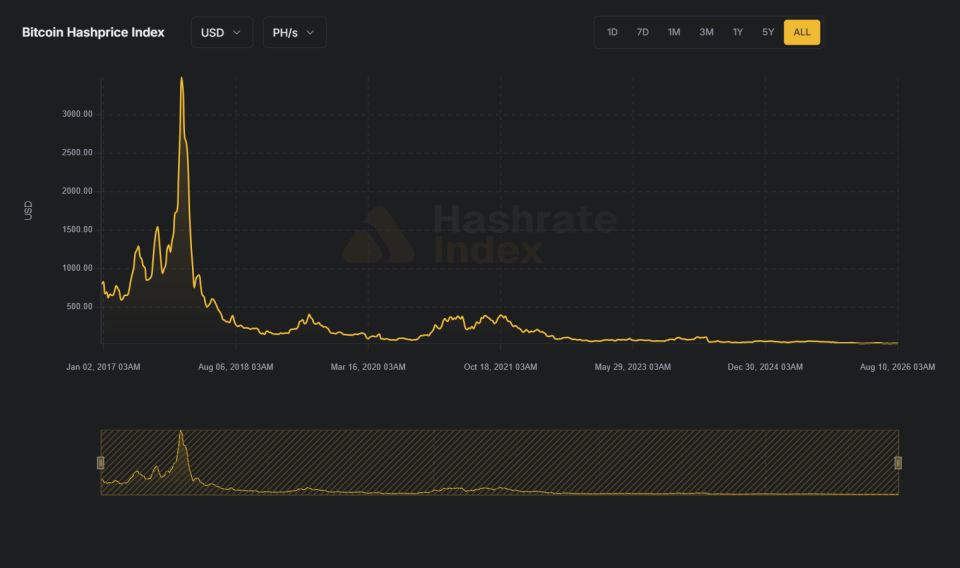
Source: hashrateindex.com

It turns out that large mining companies have faced realities where the economic feasibility of cryptocurrency mining has been called into question. Of course, the metrics above do not allow us to claim that Bitcoin mining suddenly became completely unprofitable everywhere. It's worth considering that miners in different countries and regions incur different costs: electricity and ASIC device prices vary, as do associated expenses like taxes, rent, and salaries for maintenance personnel. Equipment does not stand still and evolves, requiring timely replacement. Mining $BTC becomes less profitable for players unable to efficiently cover such costs.

However, there are other reasons for the shift to artificial intelligence.

Capital Availability

Let's clarify immediately: miners who previously mined Bitcoin do not themselves become AI operators. They merely provide their infrastructure to meet the needs of companies directly involved in artificial intelligence.

For providing their data centers, miners will receive very good money, which they did not have access to before. For example, HUT 8 signed a $7 billion deal to lease out its capacity, including the River Bend farm in Louisiana. The technical partners in the deal are the firm Anthropic, creator of the Claude neural network, and the cloud platform Fluidstack, with funding provided by tech giant Google and banks J.P. Morgan and Goldman Sachs.

IREN struck a deal with the world's largest software developer, Microsoft, for $9.7 billion. Microsoft thereby gains access to AI systems based on Nvidia GB-300 chips in Texas. And IREN will additionally purchase graphics processing units (GPUs) worth $5.8 billion from Dell Technologies, which is expected to bring in another $1.9 billion in annual revenue.

Economic Feasibility

Companies that have been exclusively mining cryptocurrency for years already have a certain infrastructure: specialized buildings, access to electricity, cooling systems. It's easier to repurpose a hypothetical data center from mining needs to AI needs than to build everything from scratch for the same Microsoft or Google. It's quite possible that fintech companies will someday switch to their own infrastructure, but that's not happening yet.

Speaking about converting mining farms for AI needs, it's necessary to understand that this doesn't happen in 100% of cases. New specialized data campuses will appear somewhere. Nevertheless, even here miners have it easier, as they know the specifics of data centers and have experience in organizational, operational-financial, and management issues. In other words, it is sometimes more profitable for large capital to delegate such matters to specialized companies.

Among the examples of infrastructure repurposing is the Bitdeer campus in the Norwegian municipality of Tydal.

ASIC Nuances

Modern large-scale cryptocurrency mining occurs primarily using highly specialized ASICs—equipment designed specifically for mining. Generally, an ASIC (Application Specific Integrated Circuit) is a special-purpose integrated circuit designed to solve one specific task. Such microchips can be implemented not only in mining but also in other fields where there is a need to minimize the cost of producing such equipment for specific needs.

ASIC miners themselves are different, which is related to the hashing algorithms used by specific coins. For example, Bitcoin uses the SHA-256 hashing algorithm, while Litecoin uses Scrypt. Manufacturers of such devices offer different and most often non-interchangeable units.

For instance, the manufacturer Bitmain releases the Antminer S21 model for the SHA-256 algorithm, the Antminer L9 for the Scrypt algorithm, and the Antminer D9—already for the X11 hashing algorithm. To explain in the simplest terms, an ASIC miner is a computing device from which everything unnecessary has been removed, increasing efficiency in mining cryptocurrencies and thereby reducing production costs.

On the other hand, advanced AI computations also require their own special technical capabilities. Moreover, even the efficiency of individual computations using graphics processing units (GPUs) varies depending on the manufacturer and specific model because their architectures differ fundamentally.

In other words, it's not enough to simply take down the "Mining" sign and hang up a new one—"Artificial Intelligence"—from a facility where coin mining previously took place and the corresponding ASICs stood. The equipment used will have to be replaced.

But did the reorientation of major American miners deal a decisive blow to Bitcoin?

What Happened to the Hashrate

The $BTC hashrate has definitely been influenced by miners moving into AI. From October 2025 to January 2026, the seven-day moving average of the hashrate fell by 28%, dropping from 1.15 EH/s to 0.83 EH/s. However, such dynamics shouldn't be too surprising, considering that American mining companies account for up to 40% of Bitcoin's total hashrate.
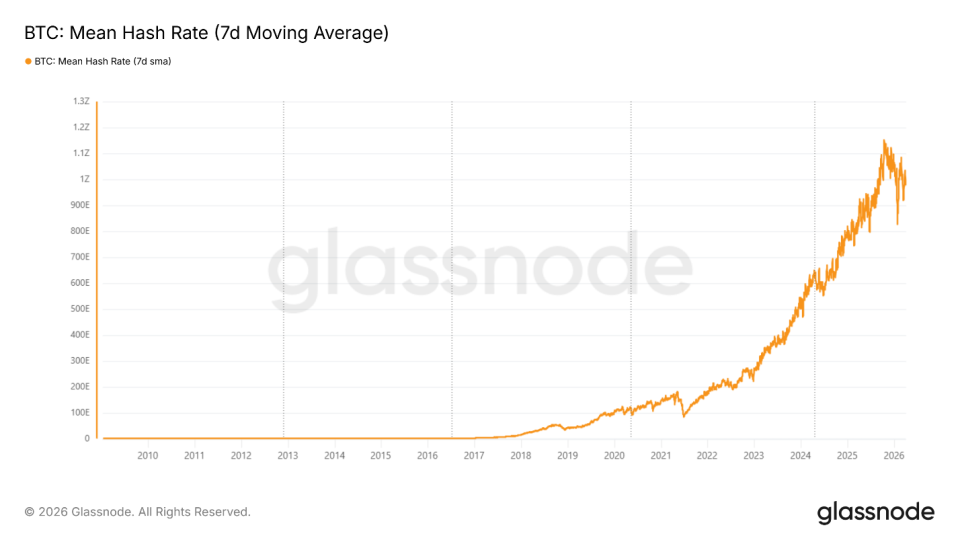
Source: studio.glassnode.com

By August 2026, some recovery in hashrate is already being observed. Its value fluctuates around 0.9 EH/s. Furthermore, according to CoinShares forecasts, the 1.8 EH/s mark should be broken by the end of the year, and by the end of 2027—2 EH/s.

It's worth remembering that reorienting towards AI does not mean miners are completely abandoning mining. In most cases, they are merely scaling back financial investments in this direction against the backdrop of expectations of greater profits from AI.

And how many bitcoins could miners potentially have mined if they hadn't reoriented to AI?

The Number of Missed Bitcoins

Actually, it's hardly possible to answer this question.

  • First, how to calculate it all? If miners had not started working on AI infrastructure, they would not have secured large contracts. Accordingly, this money cannot be factored into the potential expansion of the monetary base for mining. Similarly, the credit funds actively attracted by mining companies. From this angle—it seems the companies themselves may have earned even more than they could have without AI computing.

  • Second, the question: who missed out and how much? If we refer, for example, to Riot Platforms' report for the first quarter (data for the second quarter is not yet available), this company mined 1,473 $BTC. This is only 57 coins less than during the same period in 2025 (a 3.7% decrease). The change is more in the nature of a statistical error than a structural shift. Additionally, miners, without ceasing mining, are able to abandon further expansion in the field of mining and develop the AI direction as a short-term, highly profitable venture.

It is also worth considering here: if hypothetical IREN, TerraWulf, or HUT 8 did not mine $BTC, it means that only their balance sheets were not replenished. Bitcoin is still being mined as before, it's just that new coins went not to these companies' wallets but to other miners. The block reward remains fixed with predictable reduction during halvings and only the amount of network transaction fees changes. Moreover, if some major players suddenly switch off their power, it will become slightly easier for other participants to mine the cryptocurrency during the next network difficulty recalculation. In other words, these "bitcoins not mined by others" will still be mined somewhere in the world.

Miner Revenue

Amidst current economic/geopolitical instability, unfortunately, it's not yet possible to talk about exact figures. There are only forecast values. CoinShares believes that revenue from AI for mining companies will reach 70%, while at the beginning of the year it accounted for only 30%. In other words, the growth will be twofold. Essentially, if mining was the main activity for companies before, now it will become auxiliary. On the other hand, this doesn't mean mining will be abandoned for sure. Priorities will likely just be reassessed.

And how have such large-scale changes affected the stocks of cryptocurrency mining organizations?

Stocks and the Transition to AI

In most cases, the impact has been positive. Since the beginning of the year, the shares of five companies have shown price increases: IREN — 5.69%, Terra Wulf — 45.92%, MARA Holdings — 9.49%, Riot Platforms — 57.72%, Cipher Digital — 14.76%. The exception is Bitdeer, whose securities fell by 4.73%.

However, certain investor concerns regarding the transition to AI remain.

  • First, it's still unclear how successful this entire venture will be in the future. Will miners really be able to generate profits that cover all current and future costs?

  • Second, the transition from mining to developing infrastructure for artificial intelligence has forced a number of organizations to borrow huge sums. For TerraWulf — it's $5.7 billion, for IREN — $3.7 billion. Such a significant scale of debt load growth cannot but worry shareholders.

Conclusion

Large mining companies are transitioning from exclusively mining cryptocurrency to earning from AI due to economic feasibility and the availability of necessary infrastructure/management models. According to some forecasts, by the end of the year, the majority of their income will come from payments from AI operators, not from mining. The Bitcoin hashrate, after such companies reoriented their business, declined insignificantly and briefly but is already recovering. The stocks of most public miners are demonstrating price growth against the backdrop of business repurposing.

This material and the information in it are not individual or any other recommendation. The opinion of the editorial staff may not coincide with the opinions of analytical portals and experts.


end-content

Criptomoedas em alta

Perguntas relacionadas

QWhy are major Bitcoin mining companies shifting their business model away from pure cryptocurrency mining?

AThey are shifting due to the decreasing profitability of Bitcoin mining after events like the 2024 halving and the 2025 price drop, and the emergence of more lucrative opportunities in providing infrastructure for artificial intelligence (AI) and high-performance computing (HPC) for companies like Microsoft and Google.

QWhat are the key financial challenges that made Bitcoin mining less profitable for public US companies, according to the article?

AAccording to a CoinShares report, the average cost to mine one Bitcoin in the last quarter of the past year was $79,995, while the market price was around $70,000, making it unprofitable. Companies like TerraWulf even faced costs as high as $385,000 per coin at one point.

QHow do Bitcoin mining companies benefit from providing infrastructure for AI development?

AThey secure large, lucrative contracts by leasing their data centers and expertise. For example, HUT 8 secured a $7 billion deal, and IREN secured a $9.7 billion deal with Microsoft, providing them with revenue streams that were previously unavailable from mining alone.

QWhat was the impact on Bitcoin's hashrate when major miners began transitioning to AI, and what is the forecast?

ABitcoin's seven-day moving average hashrate dropped by 28%, from 1.15 EH/s to 0.83 EH/s between October 2025 and January 2026. However, it has since recovered to around 0.9 EH/s by August 2026. Forecasts predict it will reach 1.8 EH/s by the end of 2026 and 2 EH/s by the end of 2027.

QHow has the stock performance of major mining companies been affected by their pivot towards AI infrastructure?

AThe stock performance has been largely positive. Since the beginning of the year, shares of IREN, TerraWulf, MARA Holdings, Riot Platforms, and Cipher Digital have increased by 5.69%, 45.92%, 9.49%, 57.72%, and 14.76% respectively. Only Bitdeer's stock decreased by 4.73%.

Leituras Relacionadas

Robert Kiyosaki Shares His Mentor's Predictions About the Emergence of Bitcoin and AI

American entrepreneur and author of "Rich Dad Poor Dad," Robert Kiyosaki, discussed the influence of futurist R. Buckminster Fuller on his worldview, linking Fuller's past technological predictions to the emergence of Bitcoin and the development of artificial intelligence. In an X post, Kiyosaki also reflected on personal purpose, sharing his journey from the music business—where he worked with bands like The Police and Iron Maiden—to creating the "Cashflow" board game and writing his famous book. He described feeling an inner emptiness despite his success, a turning point that came after meeting Fuller, whom he studied with for three summers. Kiyosaki described Fuller as a "friendly genius" who foresaw world-changing developments like Bitcoin and AI. However, the core of his post focused on Fuller's philosophical impact, particularly a quote about belonging to the universe and finding purpose by dedicating one's life to the maximum benefit of others. The entrepreneur remains a vocal advocate for cryptocurrencies. He regularly advises buying Bitcoin during market panics, viewing it and assets like Ethereum, gold, and silver as hedges against traditional financial system failures. Kiyosaki has predicted a major market crash by 2026, seeing it as an opportunity for prepared investors, with long-term price targets including $750,000 for Bitcoin and $95,000 for Ethereum.

cryptonews.ruHá 43m

Robert Kiyosaki Shares His Mentor's Predictions About the Emergence of Bitcoin and AI

cryptonews.ruHá 43m

Etherealize CEO Calls Wall Street's Private Blockchains a 'Race to the Bottom'

Etherealize co-founder and CEO Vivek Raman criticized Wall Street's growing interest in private, permissioned blockchains, calling them a "race to the bottom." In an interview with CoinDesk, Raman argued that consortium networks fragment liquidity and return the industry to the siloed systems that blockchain technology was meant to overcome. He stated that closed networks do not interoperate, undermining two key advantages of the technology: system compatibility and liquidity concentration. Etherealize promotes Ethereum as an open, foundational layer for institutional players. Raman insists that privacy and access restrictions should be built on top of public infrastructure—at the application or L2 level—rather than creating separate, closed networks. He compared Ethereum to HTTP as a base layer, with additional permissioned and private layers akin to HTTPS. Examples of this new wave of "closed" solutions mentioned include Canton Network from Digital Asset, Circle's Arc project, and Stripe's Tempo. Raman termed this trend "consortium chains 2.0," recalling earlier initiatives like the R3 interbank consortium and the Hyperledger corporate ecosystem from 2016 that failed to gain significant traction. He reiterated his firm belief that a global, open, permissionless infrastructure is necessary as a foundational base layer. Raman previously noted in June that traditional financial institutions had begun implementing Ethereum-based solutions into real business processes.

cryptonews.ruHá 45m

Etherealize CEO Calls Wall Street's Private Blockchains a 'Race to the Bottom'

cryptonews.ruHá 45m

Trading

Spot

Artigos em Destaque

O que é BITCOIN

Compreender o HarryPotterObamaSonic10Inu (ERC-20) e a Sua Posição no Espaço Cripto Nos últimos anos, o mercado de criptomoedas assistiu a um aumento na popularidade das moedas meme, cativando não apenas os traders, mas também aqueles que procuram envolvimento comunitário e valor de entretenimento. Entre estes tokens únicos está o HarryPotterObamaSonic10Inu (ERC-20), um projeto intrigante que mistura referências culturais no tecido das criptomoedas. Este artigo explora os principais aspetos do HarryPotterObamaSonic10Inu, examinando os seus mecanismos, a sua ética orientada pela comunidade e o seu envolvimento com o vasto panorama cripto. O que é o HarryPotterObamaSonic10Inu (ERC-20)? Como o nome sugere, o HarryPotterObamaSonic10Inu é uma moeda meme construída na blockchain Ethereum, classificada sob o padrão ERC-20. Ao contrário das criptomoedas tradicionais, que podem enfatizar a utilidade prática ou o potencial de investimento, este token prospera no valor de entretenimento e na força da sua comunidade. O projeto visa promover um ambiente onde utilizadores envolvidos possam reunir-se, partilhar ideias e participar em atividades inspiradas por diversos fenómenos culturais. Uma característica notável do HarryPotterObamaSonic10Inu é a zero taxa sobre transações. Este elemento atraente visa encorajar a negociação e o envolvimento da comunidade, isento de encargos adicionais que podem desencorajar os traders de pequena escala. A oferta total da moeda está fixada em mil milhões de tokens, uma cifra que marca a sua intenção de manter uma circulação substancial dentro da comunidade. Criador do HarryPotterObamaSonic10Inu (ERC-20) As origens do HarryPotterObamaSonic10Inu estão um pouco envoltas em mistério; os detalhes sobre o criador permanecem desconhecidos. O desenvolvimento deste token carece de uma equipa identificável ou de um plano explícito, o que não é raro no setor das moedas meme. Em vez disso, o projeto surgiu de forma orgânica, com o seu progresso a depender fortemente do entusiasmo e da participação da sua comunidade. Investidores do HarryPotterObamaSonic10Inu (ERC-20) No que diz respeito a investimentos externos e apoios, o HarryPotterObamaSonic10Inu também permanece ambíguo. O token não lista quaisquer fundações de investimento conhecidas ou apoio organizacional significativo. Em vez disso, o “sangue vital” do projeto é a sua comunidade de base, que informa o seu crescimento e sustentabilidade através da ação coletiva e do envolvimento no espaço cripto. Como Funciona o HarryPotterObamaSonic10Inu (ERC-20)? Como uma moeda meme, o HarryPotterObamaSonic10Inu opera principalmente fora dos quadros tradicionais que muitas vezes governam o valor dos ativos. Existem vários aspetos distintivos que definem como o projeto funciona: Transações Sem Taxas: Sem taxas sobre transações, os utilizadores podem comprar e vender o token livremente, sem a preocupação de custos ocultos. Envolvimento da Comunidade: O projeto prospera na interação da comunidade, aproveitando plataformas de redes sociais para criar entusiasmo e facilitar a participação. Discussões, partilha de conteúdo e envolvimento são elementos cruciais que ajudam a expandir o seu alcance e a fomentar a lealdade entre os apoiantes. Sem Utilidade Prática: Deve ser notado que o HarryPotterObamaSonic10Inu não oferece utilidade concreta dentro do ecossistema financeiro. Em vez disso, é classificado como um token principalmente para entretenimento e atividades comunitárias. Referência Cultural: O token incorpora de forma inteligente elementos da cultura popular para atrair interesse, conectando-se tanto com entusiastas de memes como com seguidores de criptomoedas. HarryPotterObamaSonic10Inu exemplifica como as moedas meme operam de forma diferente de projetos de criptomoedas mais tradicionais, entrando no mercado como construções sociais inovadoras em vez de ativos utilitários. Linha do Tempo do HarryPotterObamaSonic10Inu (ERC-20) A história do HarryPotterObamaSonic10Inu é marcada por vários marcos notáveis: Criação: O token surgiu de um meme viral, capturando a imaginação de muitos entusiastas de criptomoedas. Datas específicas de criação não estão disponíveis, sublinhando a sua ascensão orgânica. Listagem em Exchanges: O HarryPotterObamaSonic10Inu conseguiu entrar em várias exchanges, permitindo um acesso e negociação mais fáceis pela comunidade. Iniciativas de Envolvimento da Comunidade: Atividades contínuas direcionadas a melhorar a interação comunitária, incluindo concursos, campanhas em redes sociais e geração de conteúdo por fãs e defensores. Planos de Expansão Futura: O roteiro do projeto inclui o lançamento de uma coleção de NFTs, mercadorias e um site de eCommerce relacionado aos seus temas culturais, envolvendo ainda mais a comunidade e tentando adicionar mais dimensões ao seu ecossistema. Pontos-Chave sobre o HarryPotterObamaSonic10Inu (ERC-20) Natureza Orientada pela Comunidade: O projeto prioriza a contribuição coletiva e a criatividade, assegurando que o envolvimento dos utilizadores está na vanguarda do seu desenvolvimento. Classificação como Moeda Meme: Representa o epítome da criptomoeda baseada em entretenimento, destacando-se dos veículos de investimento tradicionais. Sem Afiliação Direta com o Bitcoin: Apesar da semelhança no nome do ticker, o HarryPotterObamaSonic10Inu é distinto e não tem qualquer relação com o Bitcoin ou outras criptomoedas estabelecidas. Foco na Colaboração: O HarryPotterObamaSonic10Inu é projetado para criar um espaço de colaboração e partilha de histórias entre os seus detentores, proporcionando uma via para a criatividade e o fortalecimento da comunidade. Perspectivas Futuras: A ambição de expandir além da sua premissa inicial para NFTs e mercadorias delineia um caminho para o projeto potencialmente entrar em avenidas mais mainstream dentro da cultura digital. À medida que as moedas meme continuam a capturar a imaginação da comunidade cripto, HarryPotterObamaSonic10Inu (ERC-20) destaca-se devido aos seus laços culturais e abordagem centrada na comunidade. Embora possa não se encaixar no molde típico de um token orientado para utilidade, a sua essência reside na alegria e camaradagem fomentadas entre os seus apoiantes, destacando a natureza em evolução das criptomoedas em uma era cada vez mais digital. À medida que o projeto continua a desenvolver-se, será importante observar como as dinâmicas comunitárias influenciam a sua trajetória no panorama em constante mudança da tecnologia blockchain.

2.4k Visualizações TotaisPublicado em {updateTime}Atualizado em 2024.12.03

O que é BITCOIN

Como comprar BTC

Bem-vindo à HTX.com!Tornámos a compra de Bitcoin (BTC) simples e conveniente.Segue o nosso guia passo a passo para iniciar a tua jornada no mundo das criptos.Passo 1: cria a tua conta HTXUtiliza o teu e-mail ou número de telefone para te inscreveres numa conta gratuita na HTX.Desfruta de um processo de inscrição sem complicações e desbloqueia todas as funcionalidades.Obter a minha contaPasso 2: vai para Comprar Cripto e escolhe o teu método de pagamentoCartão de crédito/débito: usa o teu visa ou mastercard para comprar Bitcoin (BTC) instantaneamente.Saldo: usa os fundos da tua conta HTX para transacionar sem problemas.Terceiros: adicionamos métodos de pagamento populares, como Google Pay e Apple Pay, para aumentar a conveniência.P2P: transaciona diretamente com outros utilizadores na HTX.Mercado de balcão (OTC): oferecemos serviços personalizados e taxas de câmbio competitivas para os traders.Passo 3: armazena teu Bitcoin (BTC)Depois de comprar o teu Bitcoin (BTC), armazena-o na tua conta HTX.Alternativamente, podes enviá-lo para outro lugar através de transferência blockchain ou usá-lo para transacionar outras criptomoedas.Passo 4: transaciona Bitcoin (BTC)Transaciona facilmente Bitcoin (BTC) no mercado à vista da HTX.Acede simplesmente à tua conta, seleciona o teu par de trading, executa as tuas transações e monitoriza em tempo real.Oferecemos uma experiência de fácil utilização tanto para principiantes como para traders experientes.

4.9k Visualizações TotaisPublicado em {updateTime}Atualizado em 2026.06.02

Como comprar BTC

O que é $BITCOIN

OURO DIGITAL ($BITCOIN): Uma Análise Abrangente Introdução ao OURO DIGITAL ($BITCOIN) OURO DIGITAL ($BITCOIN) é um projeto baseado em blockchain que opera na rede Solana, com o objetivo de combinar as características dos metais preciosos tradicionais com a inovação das tecnologias descentralizadas. Embora partilhe um nome com o Bitcoin, frequentemente referido como “ouro digital” devido à sua percepção como uma reserva de valor, o OURO DIGITAL é um token separado projetado para criar um ecossistema único dentro da paisagem Web3. O seu objetivo é posicionar-se como um ativo digital alternativo viável, embora os detalhes sobre as suas aplicações e funcionalidades ainda estejam em desenvolvimento. O que é o OURO DIGITAL ($BITCOIN)? OURO DIGITAL ($BITCOIN) é um token de criptomoeda explicitamente projetado para uso na blockchain Solana. Em contraste com o Bitcoin, que fornece um papel amplamente reconhecido como armazenamento de valor, este token parece focar em aplicações e características mais amplas. Aspectos notáveis incluem: Infraestrutura Blockchain: O token é construído na blockchain Solana, conhecida pela sua capacidade de lidar com transações de alta velocidade e baixo custo. Dinâmicas de Oferta: O OURO DIGITAL tem um fornecimento máximo limitado a 100 quatrilhões de tokens (100P $BITCOIN), embora os detalhes sobre o seu fornecimento circulante ainda não tenham sido divulgados. Utilidade: Embora as funcionalidades precisas não estejam explicitamente delineadas, existem indicações de que o token poderia ser utilizado para várias aplicações, potencialmente envolvendo aplicações descentralizadas (dApps) ou estratégias de tokenização de ativos. Quem é o Criador do OURO DIGITAL ($BITCOIN)? Neste momento, a identidade dos criadores e da equipa de desenvolvimento por trás do OURO DIGITAL ($BITCOIN) permanece desconhecida. Esta situação é típica entre muitos projetos inovadores no espaço da blockchain, particularmente aqueles alinhados com finanças descentralizadas e fenómenos de moedas meme. Embora tal anonimato possa fomentar uma cultura orientada pela comunidade, intensifica as preocupações sobre governança e responsabilidade. Quem são os Investidores do OURO DIGITAL ($BITCOIN)? As informações disponíveis indicam que o OURO DIGITAL ($BITCOIN) não tem apoiantes institucionais conhecidos ou investimentos proeminentes de capital de risco. O projeto parece operar num modelo peer-to-peer focado no apoio e adoção da comunidade, em vez de rotas de financiamento tradicionais. A sua atividade e liquidez estão principalmente situadas em exchanges descentralizadas (DEXs), como a PumpSwap, em vez de plataformas de negociação centralizadas estabelecidas, destacando ainda mais a sua abordagem de base. Como Funciona o OURO DIGITAL ($BITCOIN) A mecânica operacional do OURO DIGITAL ($BITCOIN) pode ser elaborada com base no seu design de blockchain e nas características da rede: Mecanismo de Consenso: Ao aproveitar o exclusivo proof-of-history (PoH) da Solana combinado com um modelo de proof-of-stake (PoS), o projeto assegura uma validação eficiente das transações, contribuindo para o alto desempenho da rede. Tokenomics: Embora mecanismos deflacionários específicos não tenham sido extensivamente detalhados, o vasto fornecimento máximo de tokens implica que pode atender a microtransações ou casos de uso de nicho que ainda estão por definir. Interoperabilidade: Existe o potencial para integração com o ecossistema mais amplo da Solana, incluindo várias plataformas de finanças descentralizadas (DeFi). No entanto, os detalhes sobre integrações específicas permanecem não especificados. Cronologia de Eventos Chave Aqui está uma cronologia que destaca marcos significativos relacionados ao OURO DIGITAL ($BITCOIN): 2023: O lançamento inicial do token ocorre na blockchain Solana, marcado pelo seu endereço de contrato. 2024: O OURO DIGITAL ganha visibilidade ao tornar-se disponível para negociação em exchanges descentralizadas como a PumpSwap, permitindo que os utilizadores o negociem contra SOL. 2025: O projeto testemunha atividade de negociação esporádica e potencial interesse em envolvimentos liderados pela comunidade, embora não tenham sido documentadas parcerias ou avanços técnicos notáveis até ao momento. Análise Crítica Forças Escalabilidade: A infraestrutura subjacente da Solana suporta altos volumes de transações, o que pode aumentar a utilidade do $BITCOIN em vários cenários de transação. Acessibilidade: O potencial preço de negociação baixo por token pode atrair investidores de retalho, facilitando uma participação mais ampla devido a oportunidades de propriedade fracionada. Riscos Falta de Transparência: A ausência de apoiantes, desenvolvedores ou um processo de auditoria publicamente conhecidos pode gerar ceticismo em relação à sustentabilidade e confiabilidade do projeto. Volatilidade do Mercado: A atividade de negociação depende fortemente do comportamento especulativo, o que pode resultar em volatilidade significativa dos preços e incerteza para os investidores. Conclusão O OURO DIGITAL ($BITCOIN) surge como um projeto intrigante, mas ambíguo, dentro do ecossistema em rápida evolução da Solana. Embora tente aproveitar a narrativa do “ouro digital”, a sua divergência do papel estabelecido do Bitcoin como reserva de valor sublinha a necessidade de uma diferenciação mais clara da sua utilidade pretendida e estrutura de governança. A aceitação e adoção futuras dependerão provavelmente da abordagem da atual opacidade e da definição mais explícita das suas estratégias operacionais e económicas. Nota: Este relatório abrange informações sintetizadas disponíveis até outubro de 2023, e desenvolvimentos podem ter ocorrido além do período de pesquisa.

484 Visualizações TotaisPublicado em {updateTime}Atualizado em 2025.05.13

O que é $BITCOIN

Discussões

Bem-vindo à Comunidade HTX. Aqui, pode manter-se informado sobre os mais recentes desenvolvimentos da plataforma e obter acesso a análises profissionais de mercado. As opiniões dos utilizadores sobre o preço de BTC (BTC) são apresentadas abaixo.

活动图片