Micron Invests $24 Billion in Singapore Factory, But Your RAM Sticks Are Not in the Plan

marsbitPublicado em 2026-01-27Última atualização em 2026-01-27

Resumo

Micron announces a $24 billion investment to build an advanced NAND wafer fabrication plant in Singapore, with production starting in late 2028. This follows a previous $7 billion investment in a high-bandwidth memory (HBM) advanced packaging facility at the same site, bringing total new investments in Singapore to over $30 billion. The move comes as Micron shifts its focus toward AI-driven demand and away from consumer products, having recently discontinued its Crucial consumer brand, which sold retail memory modules and SSDs. The strategic pivot is driven by surging demand from AI and data centers. Micron’s HBM revenue reached $1.98 billion in Q3 FY2025, with full-year 2026 HBM supply already sold out. The company predicts the HBM market will grow to around $100 billion by 2028, surpassing the entire DRAM market of 2024. In contrast, consumer memory market is lower-margin and highly competitive. This supply shift has contributed to significant price increases in consumer memory products, with DDR4 and DDR5 spot prices rising over 150% and 300% respectively in 2025. Although Samsung and SK Hynix have extended DDR4 production in response to soaring prices, overall supply remains tight. As AI continues to drive memory demand, consumer memory costs are expected to stay elevated.

Author: David, Shenchao TechFlow

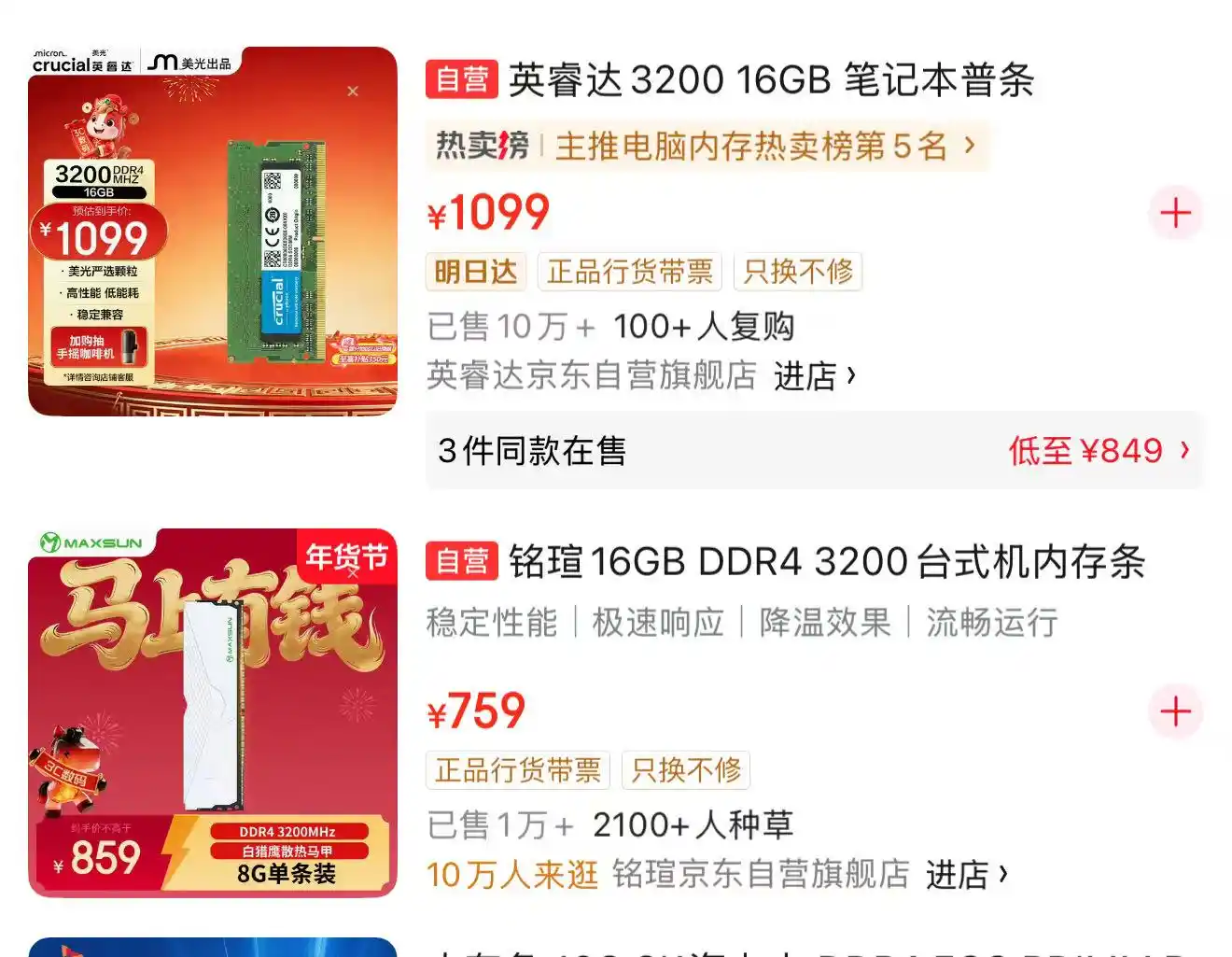
At this time last year, a 16GB DDR4 RAM stick cost just over 200 RMB. Now, the same model is priced at 600 RMB, with some models even approaching 700 RMB.

The direct reason for the price increase is a tightening of supply. The three major memory giants have collectively shifted their production capacity towards the AI market. And Micron is the latest to lay its cards on the table.

On January 27, Micron Technology announced a $24 billion (approximately S$31 billion) investment to build an advanced NAND (flash memory) wafer fabrication plant in Singapore. The investment will be phased over 10 years, with shipments starting in the second half of 2028. Singapore's Deputy Prime Minister Gan Kim Yong attended the groundbreaking ceremony.

This is Micron's second major investment in Singapore.

In January 2025, Micron had already begun construction on a $7 billion HBM (High Bandwidth Memory) advanced packaging facility within the same campus, scheduled for production in 2027. Combined, these two projects represent over $30 billion in new investments by Micron in Singapore.
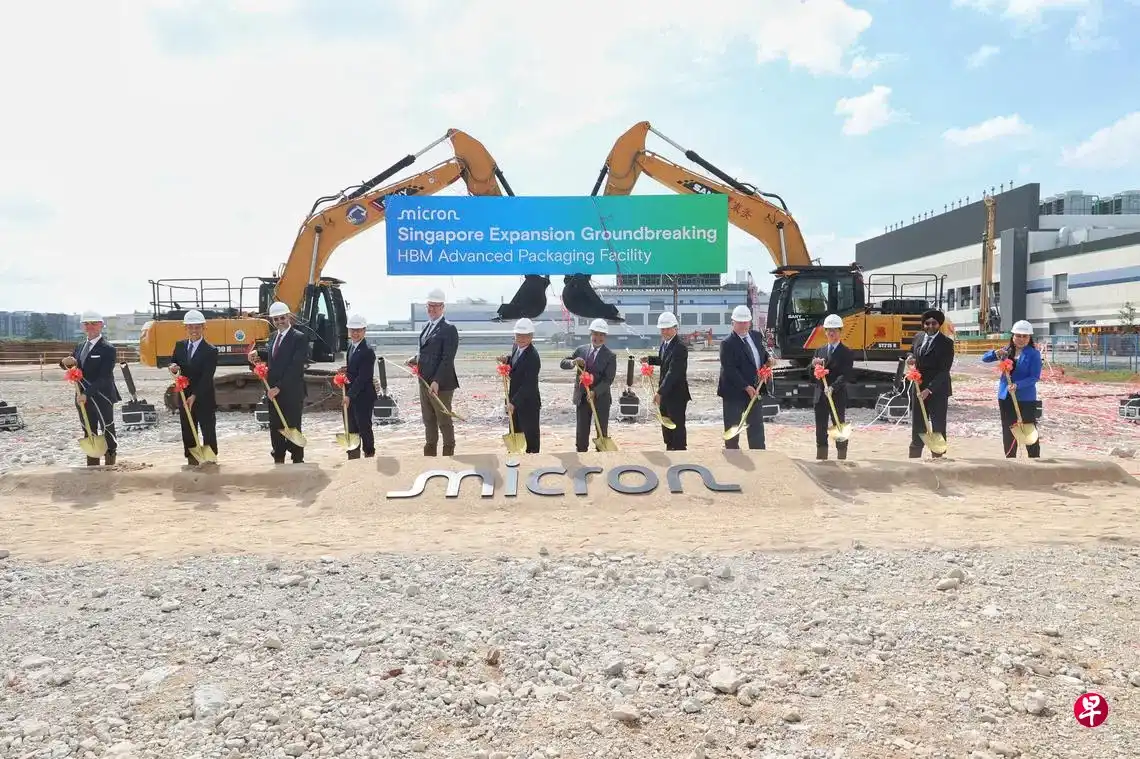
Image source: Lianhe Zaobao, photo by Tang Jiahong

Yet, this is the same company that just two months ago announced the shutdown of its 29-year-old Crucial consumer brand—the memory sticks and solid-state drives you can buy on JD.com and Taobao.

On one hand, spending billions to build factories; on the other, cutting the consumer business. Both point to the same clue: the demand for memory from AI remains high.

Capacity Reallocation After China Market Contraction

Micron's increased investment in Singapore has a clear geopolitical background.

In May 2023, China's Cyberspace Administration announced that Micron's products had not passed the cybersecurity review and required domestic critical information infrastructure operators to stop procurement. In 2018, the Chinese mainland market contributed 58% of Micron's revenue (approximately $17.36 billion); by fiscal year 2022, this had fallen to 10.8% (approximately $3.31 billion).

Production capacity needs a new outlet.

Currently, Micron already has three 3D NAND fabrication plants and several packaging and testing facilities in Singapore, employing about 9,000 people and producing 98% of Micron's flash memory chips.

Micron stated in its latest announcement that the HBM factory is expected to make a significant contribution to supply by 2027 and mentioned that as HBM becomes part of the Singapore manufacturing operations, "synergistic effects" in both NAND and DRAM (Dynamic Random-Access Memory, the common memory chips) production are anticipated.

But the priority of this "synergy" is clear: HBM capacity for 2026 is completely sold out, data center customer demand cannot be fully met, and the consumer brand is being shut down simultaneously.

Within the same campus, consumer-grade production lines are making way for AI production lines.

The Business Logic of Exiting the Consumer Market

On December 3, 2025, Micron announced via its official website a complete exit from the Crucial consumer business, including the sales of RAM sticks and SSD (Solid State Drive) products through global retailers, e-commerce platforms, and distributors.

Shipments will continue until the end of February 2026, at which point this brand, founded in 1996, will bid farewell to the retail market.

In the statement, Micron's Executive Vice President, Sadana, stated that the surge in memory and storage demand driven by AI in data centers prompted Micron to make the "difficult decision" to exit the Crucial consumer business in order to more effectively supply and support large strategic customers in high-growth areas.

Data supports this judgment.

Micron's fiscal year 2025 third-quarter HBM product income reached $1.98 billion, with an annualized revenue close to $8 billion. According to TrendForce data, the unit price of HBM memory required for AI servers is about 8 times that of ordinary servers.

Micron predicts the HBM market size will grow from approximately $35 billion in 2025 to about $100 billion in 2028, by which time it will exceed the size of the entire DRAM market in 2024.

In contrast, consumer-grade storage is a business with thin profits and fierce competition.

Micron's exit means the world's major consumer DRAM manufacturers are reduced from three—Samsung, SK Hynix, Micron—to two.

The AI Rally of Memory Stocks

The capital market has already priced in this shift.

According to statistics from *National Business Daily*, memory stocks occupied the top four spots on the U.S. stock gainers list for the full year 2025:

SanDisk rose 577%, becoming the S&P 500's top performer for the year; Western Digital rose 281%; Micron rose 236%; Seagate rose 216%.
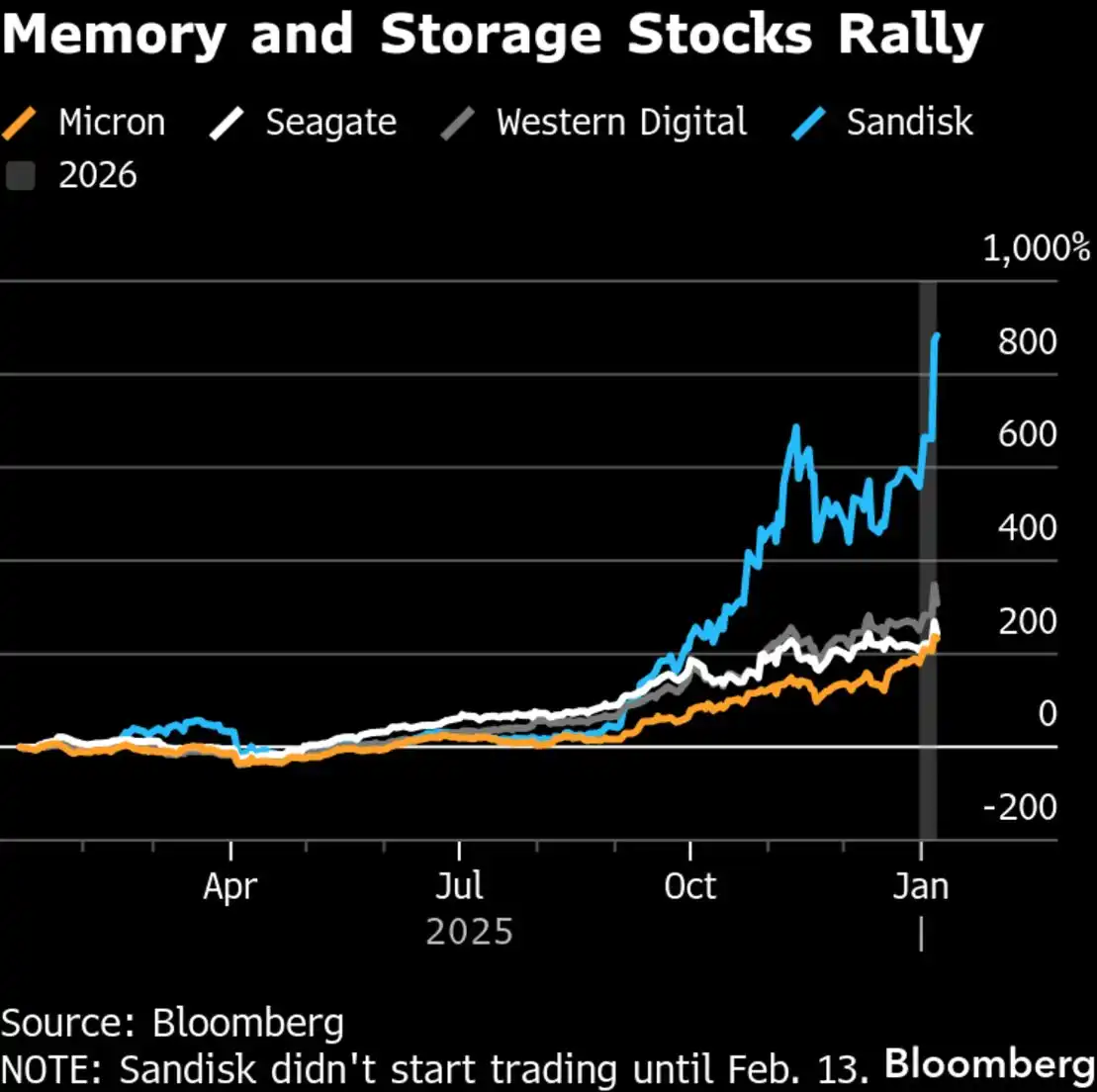
For comparison, Nvidia rose 39% in the same period, ranking 71st.

It was reported that tech giants like Google and Amazon presented Micron with "unlimited purchase demands" in October 2025. Micron CEO Mehrotra revealed on an earnings call that the company's entire HBM supply for 2026 is already sold out, and currently, it can only meet half to two-thirds of the demand from key customers.

Micron's latest financial report shows revenue of $13.6 billion for September-November 2025, a year-on-year increase of 57%, with DRAM revenue of $10.8 billion, up 69% year-on-year.

Consumer Side: Price Hikes May Continue

Samsung, SK Hynix, and Micron had all previously announced plans to gradually phase out DDR4 production from late 2025 to early 2026. Micron issued an end-of-life notice for DDR4/LPDDR4 in June.

Although Samsung and SK Hynix later extended their DDR4 production plans to the end of 2026 due to soaring DDR4 prices, the overall trend of tightening supply remains unchanged.

The price reaction has been intense. According to TrendForce data, since 2025, the spot price of DDR5 memory chips has risen over 300%, while DDR4 has risen over 150%. DDR4 has even seen a "price inversion," with the price of some specifications exceeding that of DDR5.
ADATA Chairman Chen Libai also publicly stated that the comprehensive shortage and price increase across the four major storage categories—DRAM, NAND, SSD, HDD—is a situation he is witnessing for the first time in over thirty years in the industry.

If you want to add memory to your old computer or build a new desktop, the cost remains high. Because AI needs computing power, and computing power needs memory. Your old computer is probably still behind AI demand in the queue.

Memory stocks have risen, and memory stick prices have risen too.

One is an investment opportunity; the other is paying the bill for that opportunity.

Perguntas relacionadas

QWhy did Micron announce the closure of its Crucial consumer brand?

AMicron closed its Crucial consumer brand to reallocate resources and supply to meet the surging demand for memory and storage from data centers and large strategic customers driven by AI, as the consumer market is less profitable and highly competitive.

QWhat is the total investment Micron is making in Singapore for new manufacturing facilities?

AMicron is investing a total of over $30 billion in Singapore, including $24 billion for a new NAND wafer fab and over $7 billion for an HBM advanced packaging plant.

QHow has the price of consumer memory modules changed recently according to the article?

AThe price of a 16GB DDR4 memory module has increased from over 200 yuan to about 600 yuan, with some models nearing 700 yuan, due to tightened supply and shifted production focus to AI.

QWhat percentage of Micron's revenue came from the Chinese market in 2022 compared to 2018?

AIn 2018, the Chinese market contributed 58% of Micron's revenue, but by the 2022 fiscal year, it had decreased to 10.8%.

QWhich storage-related stocks were the top performers in the U.S. stock market in 2025 according to the article?

AIn 2025, the top-performing U.S. storage stocks were SanDisk (up 577%), Western Digital (up 281%), Micron (up 236%), and Seagate (up 216%).

Leituras Relacionadas

Within Strategy's Framework, STRC's Dividend Yield Remains at 12% as Share Price Stays Below Par Value

Michael Saylor, Executive Chairman of Strategy (MSTR), confirmed that the dividend rate for its STRC perpetual preferred shares will remain at 12.00% through August 2026. The rate has increased from 9% at its July 2025 launch to the current high via a "ratchet" mechanism, which permanently raises the rate by 0.5% whenever the share price falls below $95. This mechanism is intended to push the price back toward its $100 par value and support Strategy's "at-the-market" (ATM) program for issuing new shares to fund Bitcoin purchases. However, the mechanism has not worked as intended. STRC shares closed at $89.46 on July 31, remaining about 10-11% below par value despite the record-high dividend. Competition from rival Strive's higher-yielding SATA securities has pressured demand. The persistent discount has forced Strategy to suspend new STRC issuances via its ATM program, limiting this funding channel for Bitcoin acquisitions. STRC's struggles reflect Bitcoin's own volatility, as the preferred shares historically move in tandem. Analysts have warned the ratchet structure carries long-term, one-way risk. A law firm is investigating Strategy's ability to maintain dividend payments if Bitcoin's price stays low. Retail investors own roughly 83% of outstanding STRC shares, a group seen as prone to panic selling during downturns. In response, Strategy has established financial reserves, including a liquidity cushion covering about 26 months of dividend/interest obligations, and a $2 billion share buyback program alongside a Bitcoin monetization framework, though the company emphasized it is not obligated to sell any Bitcoin.

cryptonews.ruHá 2m

Within Strategy's Framework, STRC's Dividend Yield Remains at 12% as Share Price Stays Below Par Value

cryptonews.ruHá 2m

Analyst: Bitcoin's Price Will Drop to $60k in August, Then Rebound to $70k

Financial analyst Andrey Poroshin has provided a new forecast for Bitcoin's price dynamics in August. Poroshin, an analyst at the Bitbanker exchange, expects the cryptocurrency market to experience a downturn this month, with prices retesting the $60,000 level due to a lack of supportive macroeconomic catalysts. He noted that the recent US Federal Reserve decision to hold interest rates did not significantly impact the market, while inflation remains above the 2% target. Poroshin stated that Bitcoin is ending July under pressure from moderate volatility and a lack of new macroeconomic stimuli, leading to continued market caution. According to his base scenario, Bitcoin will drop to a range of $60,000 to $62,000 before recovering to $70,000. He pointed out that even $70,000 remains below the cost of mining in the US, which has prompted some miners to shift towards AI data center operations. Poroshin cited the winding down of BitMEX's operations as a potential catalyst for a price rebound, suggesting the exit of weaker players often coincides with market reversals and reduced short-term selling pressure. He believes Bitcoin is currently less susceptible to geopolitical shocks, such as the Iran-US conflict, and does not expect significant market changes in August related to the pending CLARITY Act. Looking ahead, Poroshin forecasts that September will bring more active price fluctuations driven by potential Fed rate decisions and possible discussions or approval of the CLARITY Act.

cryptonews.ruHá 2m

Analyst: Bitcoin's Price Will Drop to $60k in August, Then Rebound to $70k

cryptonews.ruHá 2m

In Jinjiang, Fujian, a Storage Super Unicorn Lies Quiet

In Fujian's Jinjiang, a city known for sportswear, lies a quiet semiconductor giant: Fujian Jinhua Integrated Circuit Co. (JHICC). Once a promising domestic DRAM manufacturer alongside Yangtze Memory and ChangXin Memory Technologies (CXMT), its journey was derailed in 2018 when the U.S. placed it on an Entity List and filed criminal charges for alleged trade secret theft. This halted production for years. A turning point came in February 2024 when a U.S. federal court found JHICC not guilty. However, it had lost crucial time. While CXMT soared to become a top-valued A-share company in 2024, JHICC, with an estimated valuation of 80 billion RMB, was just restarting. Its current output is primarily customized DDR4 chips, not the advanced DDR5/HBM demanded for AI, but it still benefits from the broader memory chip upcycle. JHICC's story is tied to Chen Zhengkun, a veteran engineer who left Micron to lead the venture. Founded in 2016 with state-backed funding, JHICC partnered with Taiwan's UMC to develop DRAM technology. Rapid progress was cut short by the U.S. actions, which Micron initiated, partly due to its heavy reliance on the Chinese market. Post-sanctions, Chen's team worked to rebuild the production line with reduced reliance on U.S. technology. According to its records, JHICC achieved small-scale production and revenue growth under immense pressure. It now focuses on the stable "niche" DRAM market (e.g., TVs, routers) with a monthly capacity of ~40,000 wafers, aiming for 60,000 by 2026. It holds over 1,000 patents but remains on the Entity List. For Jinjiang, investing in JHICC was a bold industrial leap. The local government provided unwavering financial and logistical support during the crisis, helping the company survive. JHICC has become the anchor for a growing local semiconductor cluster. Though its scale lags behind domestic peers, JHICC's persistence symbolizes a hard-won foothold in a global market long dominated by Samsung, SK Hynix, and Micron. Having missed one boom, it seeks a place in the new AI-driven memory supercycle.

marsbitHá 2h

In Jinjiang, Fujian, a Storage Super Unicorn Lies Quiet

marsbitHá 2h

Trading

Spot
活动图片





