Michael Saylor hints at next Bitcoin buy as BTC falls below $88K

cointelegraphPublicado em 2025-12-15Última atualização em 2025-12-15

Resumo

Bitcoin (BTC) fell below $88,000, hitting a two-week low of $87,600 on Sunday, though it slightly recovered to over $89,000. MicroStrategy’s executive chairman Michael Saylor hinted at another Bitcoin purchase by posting “Back to More Orange Dots” on social media. The firm, which already holds 660,624 BTC worth about $58.5 billion, last bought 10,624 BTC on December 12. Some analysts attributed the selling pressure to expectations that the Bank of Japan may raise interest rates by 0.25%, potentially impacting risk assets like Bitcoin. However, others argued that such a move is already priced in, predicting that Bitcoin will likely remain range-bound between $80,000 and $100,000 until a new catalyst emerges.

Strategy chair Michael Saylor has hinted at his firm’s next Bitcoin buy as the markets tanked again late on Sunday, with some observers blaming the Bank of Japan for the selling pressure.

Bitcoin (BTC) fell to a two-week low of $87,600 on Coinbase in late trading on Sunday, according to TradingView. The quick Sunday wick down has become a common trait over the last few weeks.

It is the lowest price the asset has seen since Dec. 2, when it was recovering from a fall to $84,000. It had recovered back over $89,000 at the time of writing, however.

Saylor posts more “orange dots” indicating Bitcoin buy

Meanwhile, Michael Saylor hinted at another Bitcoin purchase, posting “Back to More Orange Dots” on X with the accompanying portfolio chart on Sunday.

Its last Bitcoin buy, and its largest since late July, was 10,624 BTC on Dec. 12, according to SaylorTracker.

The firm currently holds 660,624 BTC worth around $58.5 billion at current prices. Strategy’s average cost per coin is $74,696, so the company is still up on its investments, for now.
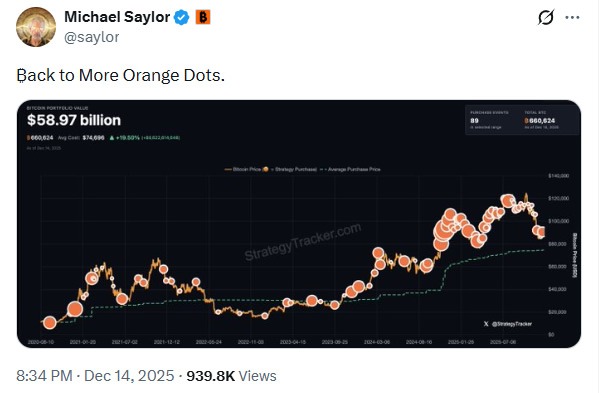
Is Strategy about to buy more BTC? Source: Michael Saylor

Analysts eye Bank of Japan as source of selling pressure

Some analysts speculate that the increased selling pressure is coming from an imminent interest rate decision by Japan’s central bank.

“People are seriously underestimating what Japan is about to do to Bitcoin,” said analyst “NoLimit” on Sunday. They pointed out that previous rate hikes in Japan were followed by significant Bitcoin crashes, as Japan is the largest holder of US debt.

Polymarket’s predictions platform has a 98% chance that the Bank of Japan will hike rates by 0.25% on Friday.

Related: Rising Japanese bond yields could shake global carry trade, crypto

Justin d’Anethan, head of research at the market advisory firm Arctic Digital, told Cointelegraph that while prices have recouped from the lows of November, the move down to $88,000 “feels like a defeat.”

“In Japan, rate expectations instilled fear of yet another carry trade unwind, which would weigh on risk assets and so push macro funds and day-traders to take some money off the table, expecting some further downside.”

Markets have priced it in already

Analyst “Sykodelic” said that Japan’s move was already known and already expected, therefore priced in. “Markets are forward-thinking, forward-moving. They move in anticipation of events, not when those events happen,” they said.

“We do expect prices to stay range-bound, though, very much in this $80K to $100K zone, as traders wait for a catalysis that may not come,” d’Anethan predicted.

Magazine: Big questions: Would Bitcoin survive a 10-year power outage?

Leituras Relacionadas

From 'Safe Harbor' to 'Compliant Innovation': An Analysis of the Impact of the SEC's Innovation Exemption Policy

From "Safe Harbor" to "Compliant Innovation": An Analysis of the SEC's Innovation Exemption Policy The U.S. SEC, under Chairman Paul Atkins, introduced the "Innovation Exemption" policy in July 2025, marking a historic shift from an "enforcement-as-regulation" approach to a proactive framework. This temporary exemption, set to take effect in January 2026, provides a 12–24 month grace period for crypto projects (exchanges, DeFi protocols, stablecoin issuers, DAOs) to operate with simplified disclosures instead of full SEC registration, reducing initial compliance burdens. The exemption is principle-based, requiring basic investor protections like periodic reporting, risk disclosures, investment limits, and adherence to technical standards such as ERC-3643 for identity verification. It operates alongside congressional efforts like the CLARITY Act (clarifying SEC/CFTC jurisdiction) and the enacted GENIUS Act (regulating stablecoins under banking rules). Reactions are polarized: startups and institutions welcome the lower entry costs and regulatory clarity, which attract capital and foster innovation. However, the DeFi community warns that mandatory KYC/AML and transfer restrictions risk "traditionalizing" decentralized protocols. Traditional financial institutions oppose it, fearing regulatory arbitrage. Globally, this flexible U.S. model contrasts with the EU’s pre-authorization MiCA regime, forcing companies into dual compliance strategies. The exemption positions the U.S. as a competitive "global crypto capital hub," but international coordination remains crucial for long-term stability. Ultimately, "compliant innovation" becomes the new core competency, requiring projects to balance agility with a clear path to verifiable decentralization.

marsbitHá 1h

From 'Safe Harbor' to 'Compliant Innovation': An Analysis of the Impact of the SEC's Innovation Exemption Policy

marsbitHá 1h

Trading

Spot
Futuros
活动图片