Meta Picks Solana And Polygon For Creator Stablecoin Payouts

bitcoinistPublicado em 2026-04-30Última atualização em 2026-04-30

Meta has begun rolling out USDC payouts for select creators in Colombia and the Philippines, marking the company’s most concrete return to crypto payments since the collapse of its Libra and Diem ambitions. The feature uses Solana and Polygon as supported blockchain rails, putting two major public networks inside a creator-payment flow run through Meta’s payout system.

According to Meta’s business help page, stablecoin payouts are currently available only to select creators in the two markets. Fortune reported that creators who choose the option are asked to add a third-party crypto wallet address to Facebook’s payout platform, with payments made in USDC over Solana or Polygon. Meta is not providing its own conversion service from USDC into local currency, meaning creators who want fiat will need to rely on external wallets, exchanges or payment services.

Meta Turns To Solana And Polygon

The rollout is narrow, but the signal is larger. Meta is not launching a new currency, not reviving Libra, and not trying to build a vertically controlled global money network. Instead, the company is testing stablecoin payouts through existing crypto infrastructure, using USDC and established chains to move money to creators in markets where cross-border payouts can be slow, expensive or operationally uneven.

A Meta spokesperson told Fortune that the company is “exploring how stablecoins could become part of our suite of options,” framing the move as an expansion of payment methods rather than a full crypto strategy. Stripe is also involved, with Fortune reporting that the payments company is working with Meta on the rollout and that Meta’s page references Stripe for crypto-specific tax reporting tied to the payouts.

For Solana, the integration gives the network another high-profile payments use case at a time when stablecoins have become a central battleground for blockchain adoption. The official Solana account called the news directly on X: “BREAKING: Meta adds support for USDC payments on Solana for creators in Colombia and the Philippines.”

That post was quickly amplified by ecosystem voices. Vibhu Norby, Chief Product Officer & Interim CMO at Solana Foundation, wrote: “All the money in the world will move on Solana. You’re just a bit earlier to it than everyone else.”

Mert Mumtaz, CEO of Helius, framed the Meta rollout as part of a broader stablecoin stack forming around Solana. “Meta just added stablecoin payments via solana! Altitude has just launched a full platform for stablecoins and banking on solana. Ramp also recently added solana support. And we have a privacy solution cooking. Quietly becoming the best place for payments & stables.”

Polygon’s inclusion is equally notable. Fortune cited Polygon Labs CEO Marc Boiron as saying that marketplace payouts are increasingly being built on blockchain infrastructure such as Polygon, while adding that Meta’s stablecoin payout program is expected to expand to more than 160 countries by year-end.

The contrast with Libra is sharp. Meta’s earlier stablecoin effort, later renamed Diem, was abandoned in 2022 after sustained regulatory resistance. This time, the company is not attempting to issue a Meta-controlled coin. It is using USDC, a widely circulated dollar-backed stablecoin, and routing payouts across existing public blockchain networks rather than trying to define the monetary layer itself.

At press time, SOL traded at $82.92.
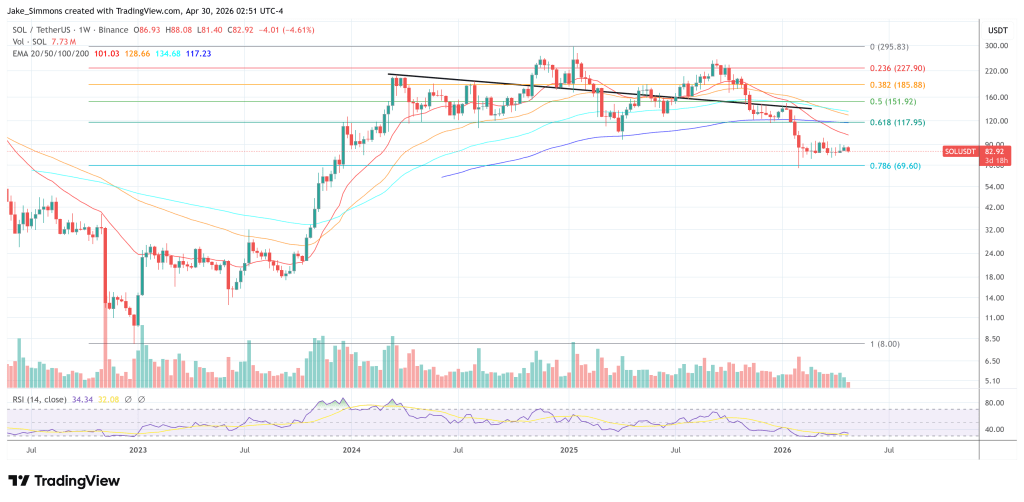
SOL must reclaim the 20-week EMA, 1-monthly chart | Source: SOLUSDT on TradingView.com

Leituras Relacionadas

Elon Musk Building Terafab: The Largest Chip Factory for AI, Robots, and Space Data Centers

Elon Musk's SpaceX and Tesla have launched the Terafab project to build a massive semiconductor facility in Grimes County, Texas. The plant, exceeding 9.3 million square meters, aims to integrate logic chip manufacturing, memory production, advanced packaging, and testing. The initial phase requires $16.8 billion in capital investment, with a long-term goal of producing over 1 terawatt of computing power annually. This capacity will support Tesla's Optimus robots and Cybercab autonomous vehicles, as well as SpaceX's orbital data centers. Texas Governor Greg Abbott confirmed the project's start in August 2026, highlighting 3,000 new jobs and a $30 million state grant. Elon Musk emphasized the strategic advantage of combining logic, memory, and packaging under one roof. Musk called the future complex the "largest and most valuable building on Earth," with an area roughly 50 times that of the Pentagon. Intel is the key technology partner, with plans to use its 14A process node for chip production. This partnership aims to diversify supply chains currently dominated by TSMC. The project aligns with the U.S. Pax Silica initiative to secure semiconductor supply chains. An AI analysis notes the project's scale and potential challenges, comparing it to delays seen in other U.S. megafab projects like Intel's Ohio facility. It questions whether Terafab can avoid similar pitfalls related to timelines, budgets, workforce, and supply chain stability. The facility's success could significantly shift the global semiconductor balance and strengthen the U.S. position in the tech race.

cryptonews.ruHá 2h

Elon Musk Building Terafab: The Largest Chip Factory for AI, Robots, and Space Data Centers

cryptonews.ruHá 2h

Elon Musk is Building Terafab: The Largest Chip Plant for AI, Robots, and Space Data Centers

Elon Musk's SpaceX and Tesla have launched the massive Terafab project to build a semiconductor plant in Grimes County, Texas. Spanning over 9.3 million square meters, the facility will integrate logic chip and memory production, advanced packaging, and testing. The initial phase requires $16.8 billion in capital investment, with a long-term goal of producing over 1 terawatt of computing power annually. This output is intended to supply Tesla's Optimus robots and Cybercab autonomous vehicles, as well as SpaceX's orbital data centers. Texas Governor Greg Abbott confirmed the project's start on August 6, 2026, highlighting the creation of 3,000 jobs and a $30 million grant from the Texas Enterprise Fund. Musk emphasized the strategic advantage of combining chip design, memory production, and packaging under one roof to accelerate hardware development. He stated the fully built complex would be "the largest and most valuable building on Earth," about 50 times larger than the Pentagon. An estimated 25% of production is earmarked for Tesla's robotics, with 75% for SpaceX's space-based AI systems. Earlier tax documents suggested a total project cost of up to $119 billion, but this has not been officially confirmed. Intel is the key technology partner, with plans to use its 14A process node for chip manufacturing. This partnership aims to diversify supply chains and reduce dependence on dominant foundries like TSMC. The initiative aligns with the broader U.S. Pax Silica program, which seeks to build secure international semiconductor supply chains with allied nations. An AI-driven analysis notes that megafab projects, such as Intel's delayed Ohio facility, often face schedule and budget overruns. While Terafab represents a significant step toward U.S. semiconductor self-sufficiency and could shift the global tech balance, its success will depend on factors like skilled labor availability, energy supply, and supply chain stability. The final outcome may not be clear until the late 2030s.

cryptonews.ruHá 3h

Elon Musk is Building Terafab: The Largest Chip Plant for AI, Robots, and Space Data Centers

cryptonews.ruHá 3h

Trading

Spot
活动图片