Author: Oluwapelumi Adejumo
Compiled by: Chopper, Foresight News
As the prices of tokens like PEPE and SHIB surge, the total market valuation of the Memecoin market has exceeded $50 billion, once again sparking discussions about speculative fervor.
After a year of continuous decline, a core metric measuring the share of Memecoins in the altcoin market, the "Memecoin Dominance Rate," has rebounded strongly from its historical low. The total market capitalization of Memecoins has returned to the $500 billion mark, with tokens like PEPE, BONK, and FLOKI recording double-digit gains at the beginning of the year.
This sharp rise has forced both institutional fund managers and retail traders to confront a key question: Is this merely a short-lived burst of post-holiday speculative sentiment, or an early signal of a comprehensive shift in market dynamics?
Data from market intelligence firm CryptoQuant highlights the intensity of this shift. After the "Memecoin Mania" peaked in November 2024, the sector's dominance rate in the altcoin market began a prolonged downward trend.
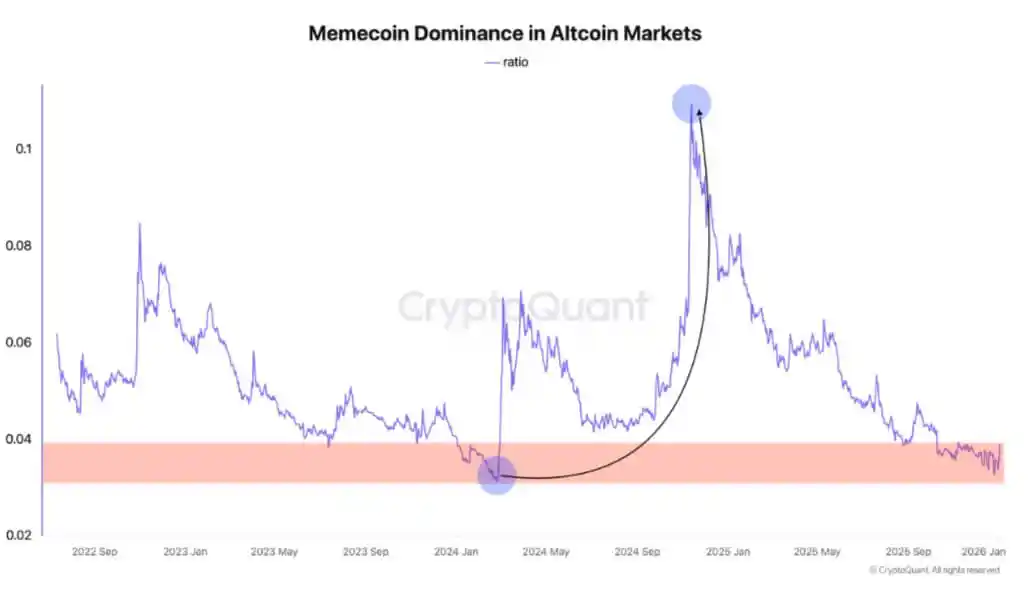
Memecoin Market Dominance Rate, Data Source: CryptoQuant
At its peak, Memecoins accounted for 11% of the total altcoin market capitalization, with a dominance rate of 0.11. By December 2025, this figure had plummeted to just 0.032, hitting a historical bottom.
However, analysts point out that the last time this indicator hit such a low level, it was followed by a massive influx of speculative liquidity, which ultimately drove the entire altcoin sector higher.
Now, speculative investors are viewing the current rebound from the bottom as a potential leading indicator.
If this trend continues, it would mean that market risk appetite is recovering at a faster-than-expected pace, potentially kicking off a new altcoin bull run and having a profound impact on blockchain activity and token listing standards throughout 2026.
Key Signals Amid the Noise
Data from analytics platform Santiment shows that in the first week of the new year, the overall market capitalization of Memecoins surged by over 20.8%, with the sector's total value exceeding $45.3 billion.
Cryptocurrency price-tracking website CoinGecko provides an even higher valuation, estimating that the "Memecoin economy," encompassing dog, frog-themed, and politically satirical coins, has reached approximately $51.6 billion.
Leading this rebound are the veteran coins that dominated previous bull markets. Over the past seven days, PEPE and the self-deprecatingly named USELESS coin both gained 54%; MOG rose 38%; and Solana-based BONK recorded a 34% increase. Even legacy assets like Dogecoin and Shiba Inu joined the rally, with a renewed trading frenzy on Sunday pushing Shiba Inu up 13% in a single day.
Santiment analysts attribute the timing of this rebound to a classic contrarian investment signal. The rally began shortly after Christmas, precisely when retail trader FUD (Fear, Uncertainty, Doubt) towards speculative assets peaked.
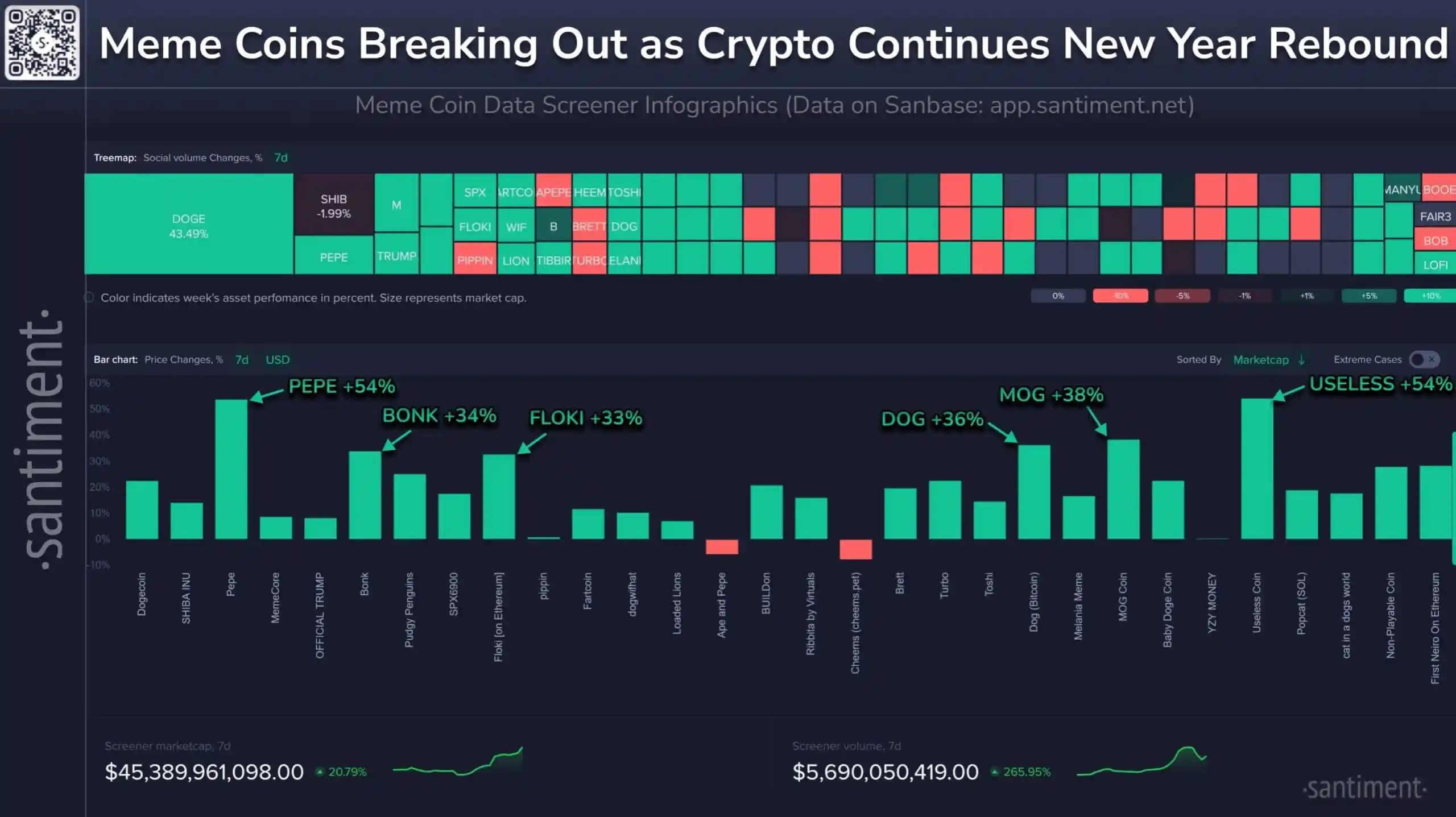
Memecoins Lead Cryptocurrency Market Rebound, Data Source: Santiment
When market sentiment hits rock bottom and ordinary traders turn bearish and exit, savvy capital chooses to enter against the trend, aggressively accumulating positions at low prices during periods of selling.
For fund managers who shifted their asset allocation to "quality coins" in 2025, the resurgence of the Memecoin sector presents a dilemma.
This rally tests the industry's willingness to re-embrace leveraged trading: ignoring this rebound could mean missing the first phase of a risk-on cycle; while chasing the rally would mean having to re-enter the most volatile asset class in the crypto market.
The ETF Boost
Unlike previous Memecoin bull runs, which were almost entirely driven by overseas exchanges and decentralized exchanges (DEXs), the 2026 rebound also carries a mark of compliance.
The approval and listing of several complex cryptocurrency ETFs in the U.S. have opened new channels for the speculative fervor to penetrate traditional brokerage accounts.
Bloomberg Intelligence ETF analyst Eric Balchunas pointed out that some of the best-performing fund products at the start of the year are leveraged Memecoin ETFs.
Among them, the 21Shares Double Long Dogecoin ETF (TXXD) performed particularly well, a phenomenon indicating that investment demand for Memecoins is no longer limited to crypto-native狂热 traders using on-chain wallets.
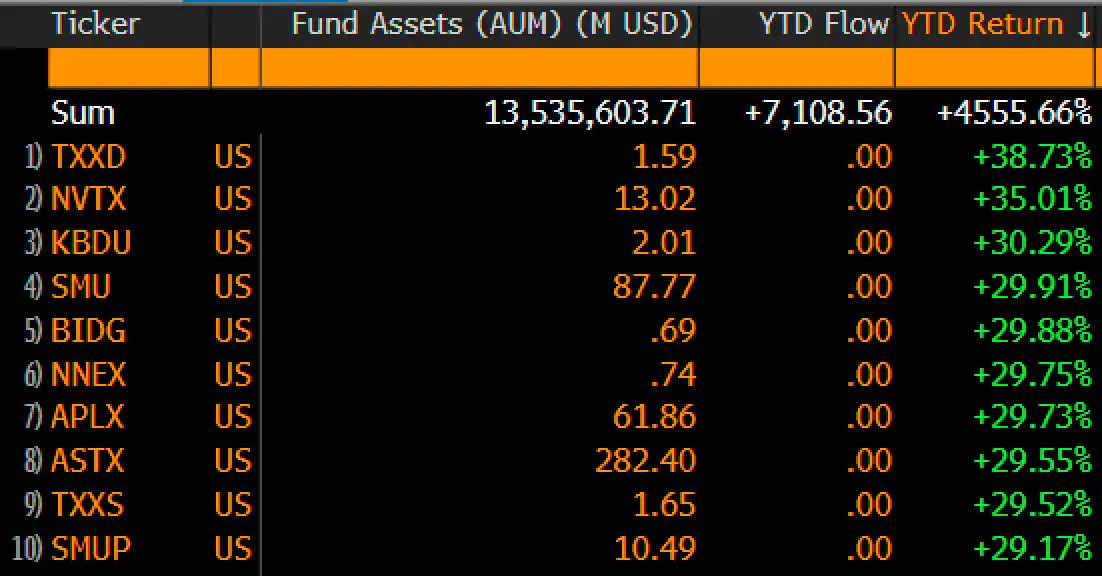
21Shares Dogecoin ETF Leads Market Gains, Data Source: Eric Balchunas
The institutionalization of the "Memecoin economy" has fundamentally changed its weight in influencing the entire crypto market. When billions of dollars flow into Memecoin-related assets, the ripple effects spread outward.
This impacts listing decisions on large centralized exchanges, which rely on trading fees from high-volume tokens to subsidize operations of other businesses; it also forces asset management firms to broaden their product lines.
Once this $50 billion asset class begins to dictate the rhythm of market cycles, the entire crypto industry's infrastructure will be forced to adapt to the liquidity demands of these assets once deemed "fleeting joke coins."
Meanwhile, the internal landscape of the Memecoin sector is also constantly diversifying. CoinGecko's data divides the $51.6 billion Memecoin market into multiple segments, revealing a complex hierarchical structure.
"Boy's Club" and "Frog-Themed" coins currently account for 10.9% and 10.7% of the Memecoin market share respectively, challenging the long-dominant "Dog-Themed" coins (approx. 6.1% market share).
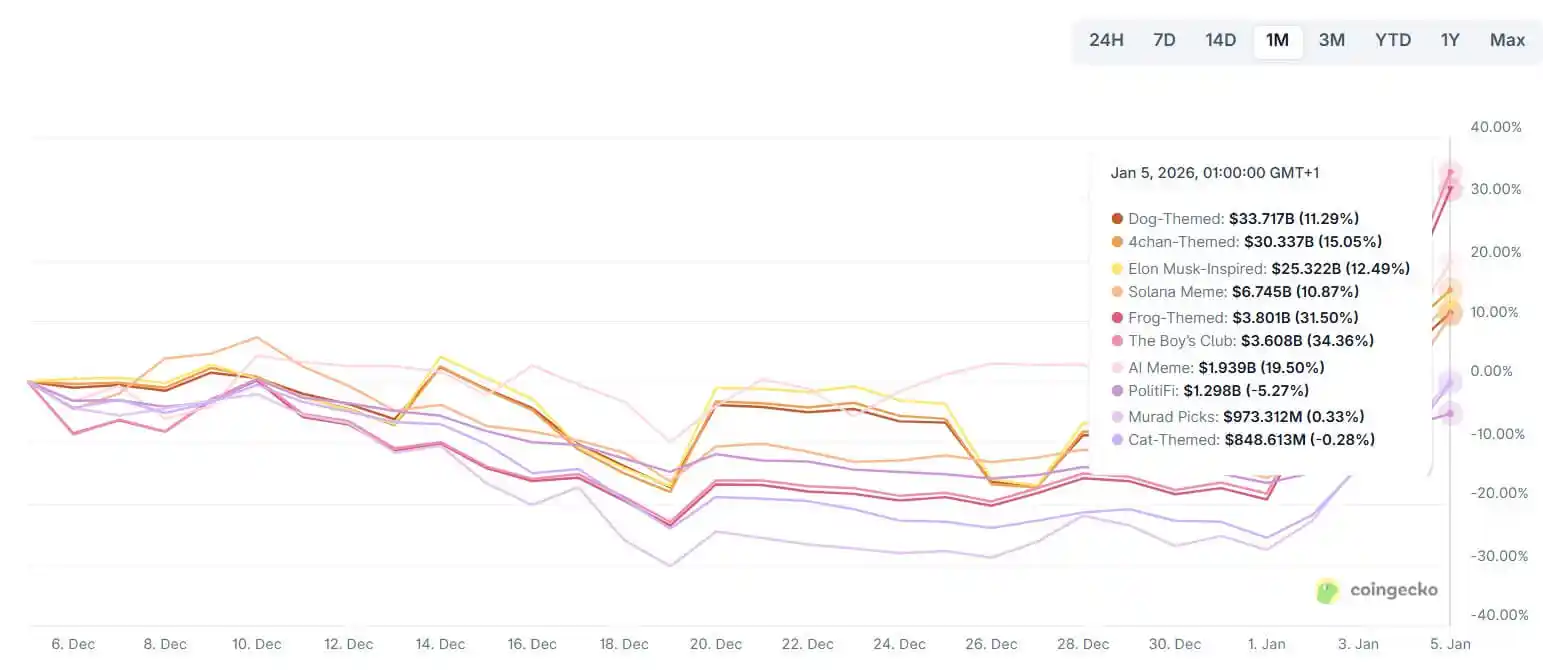
Memecoin Sub-Sector Market Share, Data Source: CoinGecko
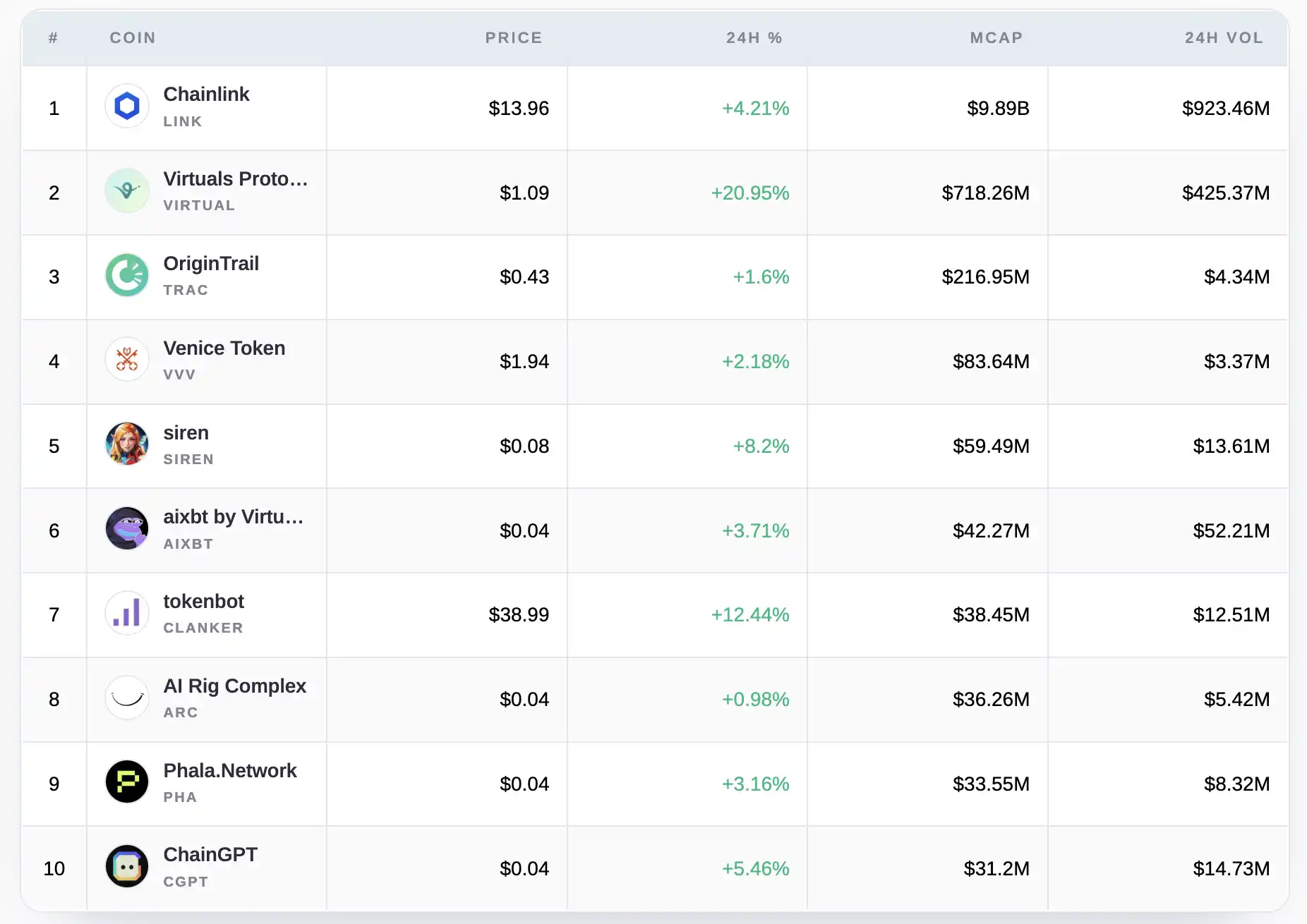
Emerging categories like "PolitiFi coins" and "AI Memecoins" have also captured market capitalizations in the billions of dollars, a trend indicating that the Memecoin sector is developing its own internal rotation patterns.
Public Chain Ecosystem Wars Reignite
The comeback of Memecoins also serves as a stress test and growth engine for the underlying blockchain networks, with the Solana blockchain and Coinbase's Layer-2 network Base particularly standing out.
Within the Solana ecosystem, activity on Memecoin Launchpads has climbed to a three-month high. Daily trading volume, the number of new tokens issued, and the "daily token graduation count"—referring to the number of tokens with enough traction to successfully migrate from initial launch platforms to decentralized exchanges—have all surged significantly.
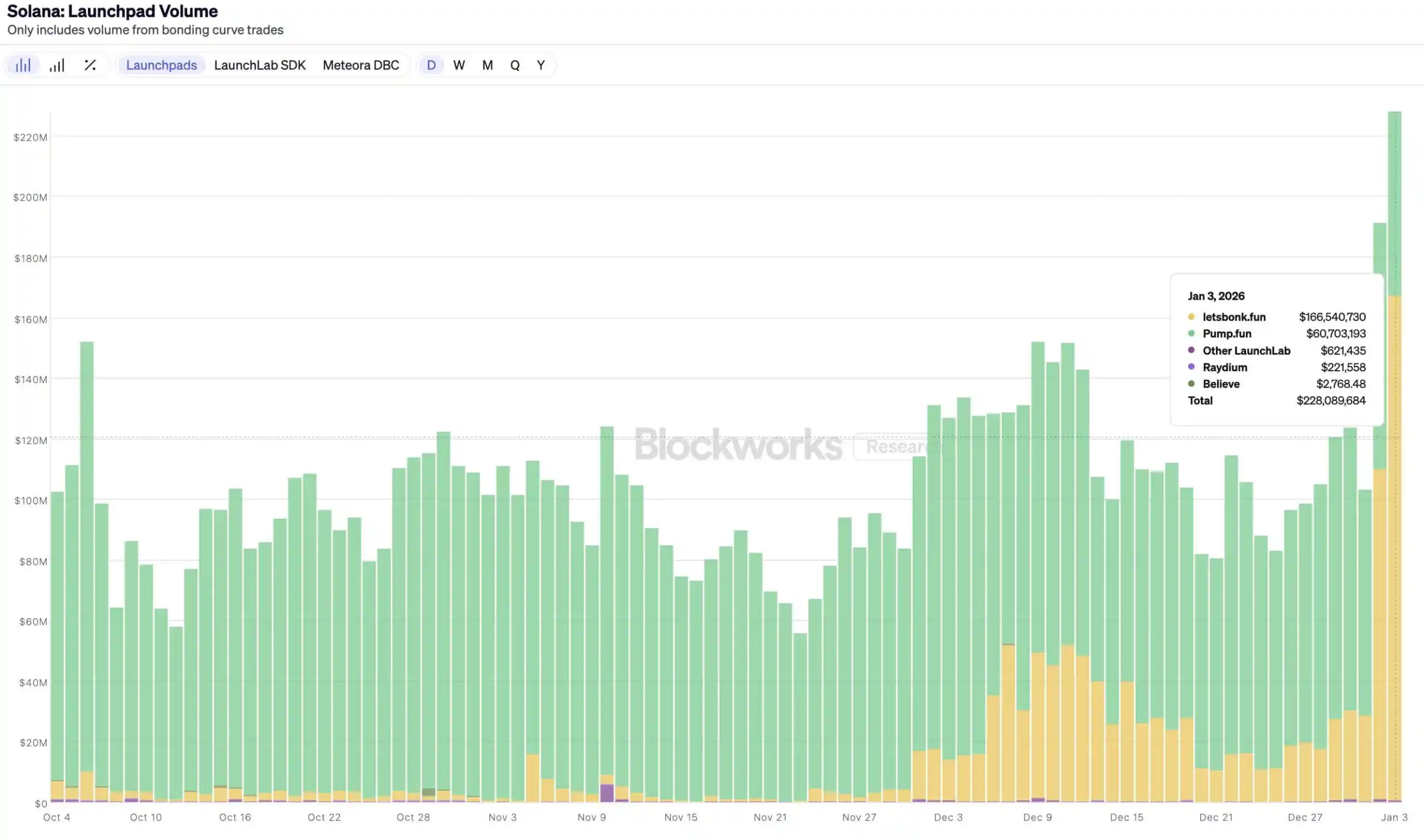
Solana Memecoin Launchpad Platform Trading Volume, Data Source: Blockworks Research
This resurgence of activity has reignited the topic of "fee wars"—the competition among different public chains vying to become the preferred venue for high-frequency speculative trading.
Last year, platforms like Pump.fun and LetsBonk contributed significant revenue to the Solana network; data from early 2026 shows this trend is accelerating once again.
This market dynamic has also sparked discussion among industry leaders, who believe the significance of the Memecoin phenomenon extends far beyond speculative gambling.
Base network's lead developer, Jesse Pollak, stated that such assets have practical functions within the crypto economy. He defined Memecoins as "collaborative anchors for communities," capable of bringing people together and providing a context for collective creative activity.
"We need more Memecoins because we need more creativity, community vitality, and collective action," Pollak stated, viewing Memecoins as a user acquisition mechanism that attracts users who may eventually transition to other on-chain applications.
For the blockchain networks themselves, the impact of this Memecoin frenzy is tangible: sustained rises increase demand for the native tokens of public chains, test network throughput, and attract more liquidity providers.
The Centralization Paradox
Although the narrative around Memecoins always revolves around "community autonomy" and "decentralized fun," existing data reveals a significant risk regarding the concentration of holdings.
On the surface, the current rally appears broad-based, but ownership of top tokens is highly concentrated.
Data from Santiment shows that for Shiba Inu, one of the leaders in the Memecoin space, 10 wallets control nearly 63% of the total supply. Among them, the largest single wallet holds approximately 41% of the supply, currently worth about $3.3 billion.
This highly concentrated ownership structure is not unique to Shiba Inu; coins in several popular sectors like "Solana Memecoins" and "Frog-Themed" coins exhibit similar distribution characteristics.
This poses a huge hidden danger for retail investors entering later: with liquidity concentrated in the hands of a few "whale" wallets, the market is always at risk of a sell-off.
CryptoQuant analysts warn that although the current market structure resembles signals seen before previous bull runs began, "it is still too early to conclude whether the trend can be sustained."
For speculative investors, this is a classic high-risk, high-reward moment. The rebound of the Memecoin dominance rate from historical lows suggests the market is awakening, but the highly concentrated ownership structure and the leverage-driven nature of the rally still leave the foundation of the entire sector precarious.