Meme Fading, Narrative Cooling: Falling Below $80, Has Solana's Cycle Dividend Ended?

marsbitPublicado em 2026-02-13Última atualização em 2026-02-13

Resumo

Solana (SOL) has experienced a significant downturn, with its token price dropping to a low of $67 in early February 2026, down over 71% from its October 2025 peak of $295. Currently trading around $80, SOL has been declining for five consecutive months. The NFT market on Solana, exemplified by Mad Lads, has also suffered, with floor prices collapsing from over $40,000 to around $1,760. The decline is largely attributed to the cooling of the Meme coin frenzy that previously drove Solana's growth. Platforms like Pump.fun saw weekly trading volumes plummet from over $3 billion to around $500 million. Meanwhile, competitors like BNB Chain gained traction with meme platforms such as Four.Meme, diverting attention and capital away from Solana. Broader narratives around high-throughput blockchains have also weakened. Ethereum's Fusaka and upcoming Glamsterdam upgrades have significantly improved its scalability and reduced fees, diminishing Solana's technical advantages. Additionally, Real-World Asset (RWA) tokenization, dominated by Ethereum with $149 billion in assets compared to Solana's $17 billion, has further marginalized Solana's ecosystem. Despite earlier support from corporate Digital Asset Treasuries (DATs) that purchased SOL, the ongoing bear market has overwhelmed this buy-side pressure. Companies like Forward Industries face massive unrealized losses on their SOL holdings. With declining user engagement beyond meme culture and intensified competition, Solana confron...

Author: Ma He, Foresight News

Even one of the most successful public chains, Solana, has encountered a winter moment.

On February 5th, during the market crash, Solana's token SOL once fell to $67, hitting a new low since December 2023. As of now, SOL is trading at $80, with a 24-hour decline of 3.57%. On a monthly chart, SOL has been declining for five consecutive months since its high in October 2025, with a maximum drop of over 71% during this period. The floor price of its most famous NFT, Mad Lads, once dropped to 22 SOL, approximately $1,760, while at its peak, this NFT was worth over $40,000.

Looking back during this bull market, SOL rose from a low of $8 to $295, performing quite impressively among public chains. Coupled with the explosion of the Meme sector, even U.S. President Donald Trump chose to launch his token first on the Solana network, creating countless wealth stories during this period.

However, as the market turns bearish, with token prices falling, TVL halved, on-chain transaction volume sharply decreasing, and the growth flywheel stalling, Solana also faces its own various problems.

Meme Craze Ends

This cycle, the Meme craze began on Solana. From late 2024 to early 2025, Solana sparked the "Meme Summer" with the Pump.fun platform, with the number of new tokens issued daily once exceeding ten thousand, and transaction volume peaking at over $6 billion. Meme coins like Dogwifhat and Bonk saw their market caps soar, pushing Solana's overall activity to its peak. This reached its zenith when Trump issued TRUMP, creating a historic high of $295. However, as various frauds emerged and the wealth effect diminished, starting from mid-2025, the Meme craze began to cool, with many projects having a graduation rate of less than 2%, and capital began to outflow.
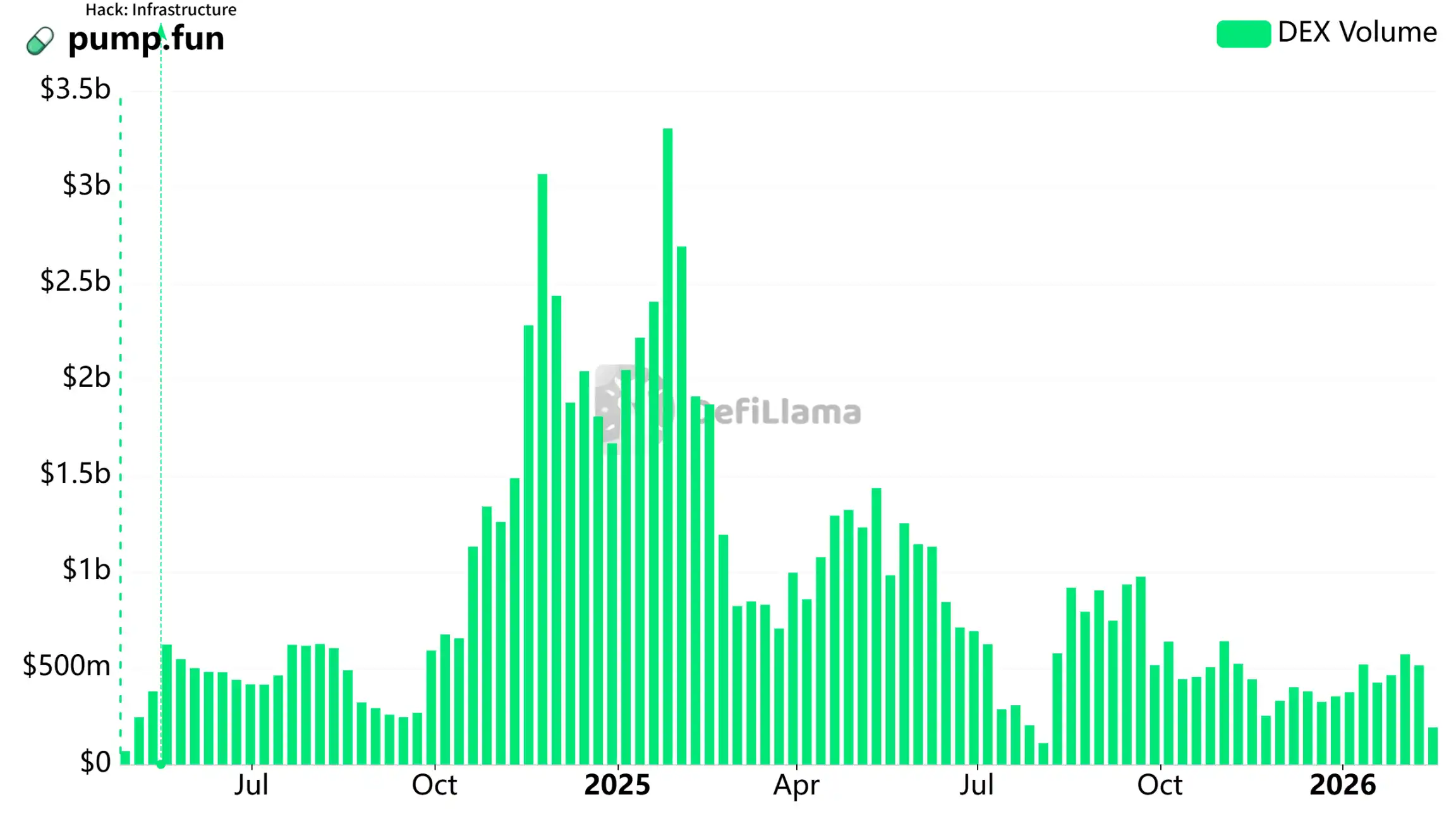
Defilama data shows that around the beginning of 2025, the trading volume of the Meme platform pump.fun reached a historical high. Weekly trading volume exceeded $3 billion twice, followed by a continuous decline. In early 2026, its trading volume hovered around $500 million, only one-sixth of its peak.

At the same time, some Meme traffic shifted to BNB Chain. BNB Chain rapidly rose through the Four.Meme platform. In the second half of 2025, Chinese-themed Memes like "Binance Life" and "I'm F*cking Coming" sparked FOMO sentiment. BNB Chain's Meme market cap grew from almost zero to hundreds of millions of dollars, with a 24-hour trading volume reaching $460 million. In comparison, although Solana's Meme market cap still amounts to billions of dollars, its growth has stagnated, with many projects falling over 95% from their peaks.

In October 2025, BNB Chain once replaced Solana on the trending Meme list, showing obvious capital rotation: when BNB Chain Memes surged, Solana's capital contracted; after BNB Chain receded, capital partially flowed back, but the momentum had weakened. Furthermore, under the influence of key figures like CZ/He Yi, BNB Chain saw short-term traction, while Solana's Pump.fun, despite its first-mover advantage, weakened due to narrative exhaustion and a lack of incremental funds.

The end of the Meme wave means that the demand for its public chain token has also decreased simultaneously.

Public Chain Narrative Cools

Additionally, the overall cooling of the public chain narrative has further weakened Solana's ecosystem expansion plans. Between 2025 and 2026, the crypto market retreated from early high leverage and excessive narrative expansion. Many weak narratives, such as celebrity tokens and the Meme craze, quickly faded, shifting focus to areas with more practicality and institutional support. Solana's narrative as a "high-speed public chain" once attracted developers, but as the market entered the "deep water of value," investors tended to prefer mainstream assets like Bitcoin and Ethereum for their "digital gold" or "settlement layer" positioning, leading to a continued overall bear market and intensified capital outflows from Solana.

This narrative fatigue reflects that public chain competition has shifted from pure TPS competition to ecosystem maturity and regulatory adaptability. Solana's previous TPS and ecosystem advantages have been diluted. Whether in terms of Memes or airdrop incentives, Solana's appeal to new users has weakened.

Meanwhile, the significant speed improvement of the Ethereum mainnet has also weakened Solana's core advantage. Through the Fusaka upgrade in 2025, Ethereum increased data blob capacity from 3 to 6-9 and introduced the PeerDAS mechanism, significantly reducing transaction fees and increasing throughput. Transaction volume and active addresses subsequently rebounded.
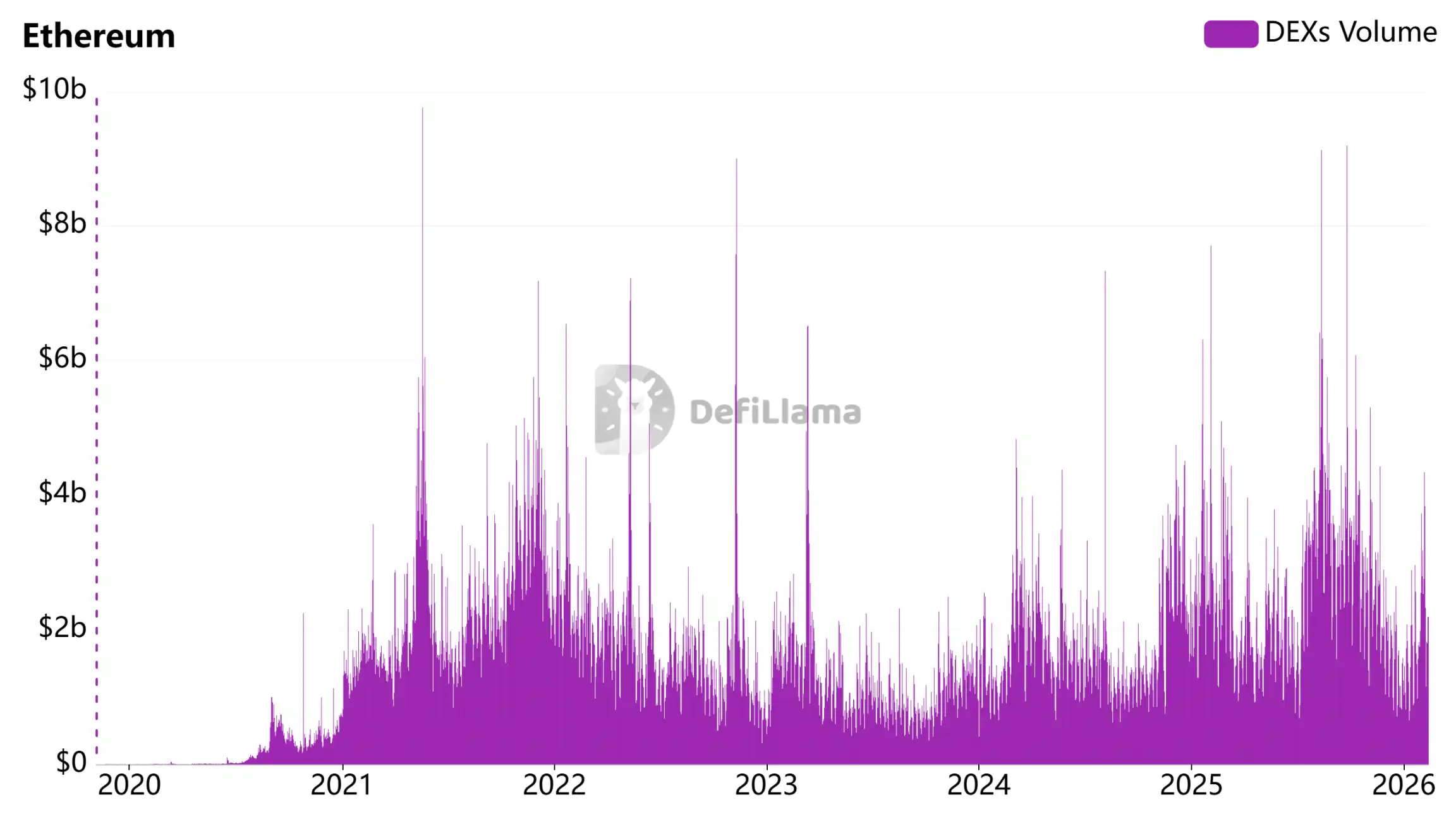
Data shows that DEX trading volume on Ethereum overall rose at the end of 2025. Entering 2026, the Glamsterdam upgrade will achieve near-perfect parallel processing, further accelerating block verification and reducing fees, bringing the mainnet closer to an "operating system" level. These improvements have brought Ethereum mainnet's TPS and cost close to Solana's levels, while retaining higher security and decentralization, reducing the necessity for users to switch to Solana.

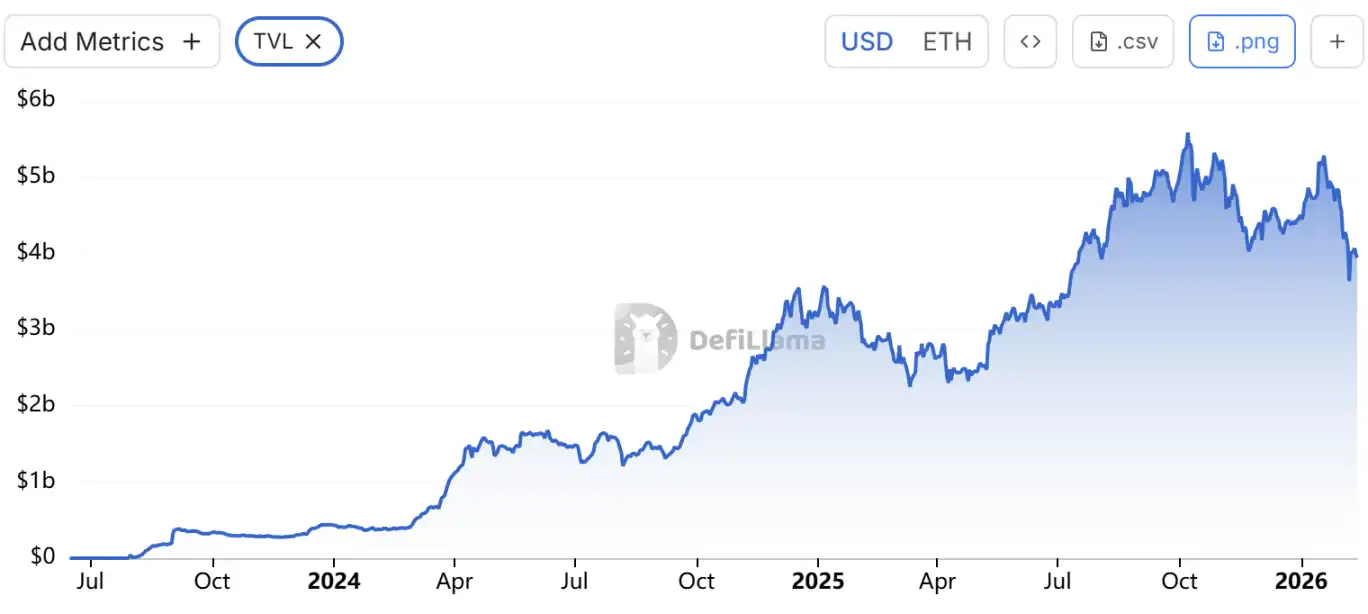
Another rising competitor, Base, is also growing rapidly, particularly attracting many users with AI tokens. According to DefiLlama data, its TVL is still maintained at a high level of $4 billion.
Under the tokenization热潮, RWA (Real World Assets) activities occur more on Ethereum, further marginalizing Solana's ecosystem. As of February 12, 2026, data from rwa.xyz shows that RWA assets on the Ethereum mainnet amount to $14.9 billion, while Solana has only $1.7 billion, still a significant gap. The tokenization trend of RWA emphasizes stability and compliance, and Ethereum's leading position makes it difficult for Solana to get a share.

Digital Asset Treasury Buyers Fail to Offset Overall Bearish Selling Pressure

From the perspective of Digital Asset Treasuries (DAT), in 2025, the DAT model was once popular. Many publicly traded companies like Forward Industries, Upexi, and Sharps Technology purchased large amounts of SOL as treasury assets through private financing or debt issuance.
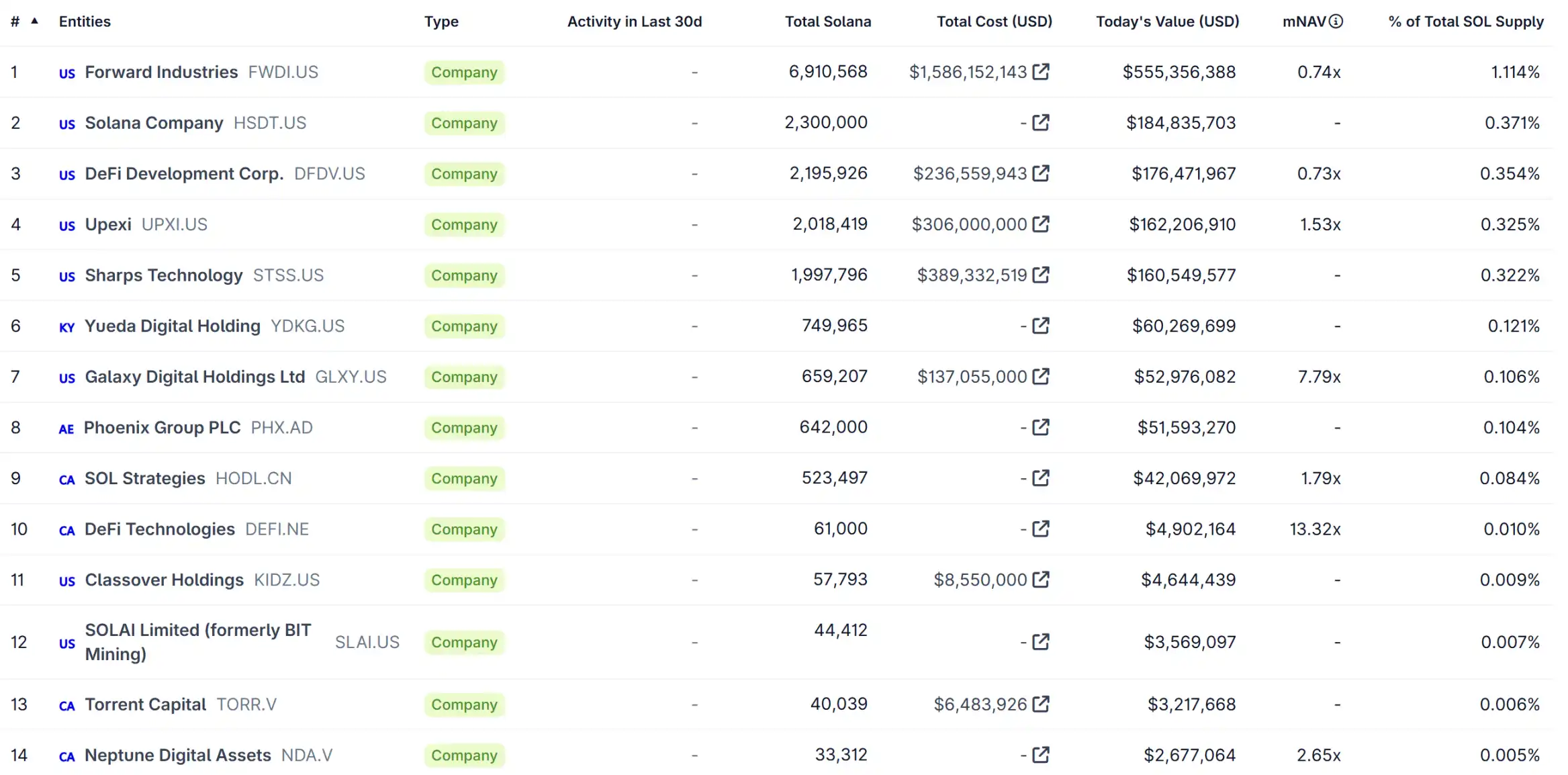
Entering 2026, as the price of SOL fell from its 2025 peak of around $200 to about $80, the market capitalization of these DAT companies shrank significantly. For example, Forward Industries spent $158 million to purchase SOL, now worth only $55.5 million, shaking the confidence of some investors.

Furthermore, the DAT purchasing热潮 has weakened, with fewer new companies joining. Although the early purchased locked SOL reduces circulating supply, it has failed to offset the overall bearish market pressure.

Bitcoin and Ethereum prices have also been severely hit in the bearish market of recent months. BTC fell from $126,000 to the current $67,000, and ETH dropped from $4,900 to the current $2,000.

In January 2026, Solana founder toly once asked on X in Chinese: What do you think is the biggest challenge for Solana now? The comments section received a variety of feedback and answers, including: no direct exchange, users have less perception of other product ecosystems besides Memes, etc.

Perhaps Solana will find its own solutions.

Perguntas relacionadas

QWhat was the peak price of SOL during the recent bull market and what is its current price as mentioned in the article?

AThe peak price of SOL during the recent bull market was $295. Its current price is $80.

QAccording to the article, what was a major driver of Solana's activity that has now cooled down?

AThe major driver of Solana's activity that has now cooled down was the Meme coin frenzy, which was popularized by platforms like Pump.fun.

QWhich competing blockchain saw a rise in Meme activity, partially at the expense of Solana, according to the article?

ABNB Chain saw a rise in Meme activity, partially at the expense of Solana, through its platform Four.Meme.

QHow has Ethereum's recent upgrade, as described in the article, impacted its competitive position against Solana?

AEthereum's Fusaka upgrade increased data blob capacity and introduced PeerDAS, significantly reducing transaction fees and increasing throughput. The upcoming Glamsterdam upgrade will further improve parallel processing, making its TPS and cost competitive with Solana while offering higher security and decentralization.

QWhat is the significant difference in RWA (Real World Asset) tokenization value between Ethereum and Solana mentioned in the article?

AAs of February 12, 2026, the value of RWA assets on Ethereum was $149 billion, compared to only $17 billion on Solana, indicating a substantial gap.

Leituras Relacionadas

Not Speculation but a Necessity: The 4 Unique Values of Prediction Markets

Polymarket's recent $4 billion funding round and soaring valuation of $15 billion highlight the explosive growth of prediction markets, with trading volume reaching $25.7 billion in March 2026—a 10.6% monthly increase. This analysis argues that prediction markets serve critical non-speculative functions, positioning them as essential tools rather than mere gambling platforms. Prediction markets offer four unique values: entertainment consumption, insurance-like protection, risk hedging, and truth discovery. Firstly, they stimulate economic activity by engaging users in event-based betting, similar to the broader sports industry. Secondly, they act as a form of decentralized insurance, allowing users to hedge against specific, well-defined risks (e.g., weather events) transparently and without traditional overhead costs. Thirdly, institutions and individuals use these markets to hedge against geopolitical and commodity price risks, as demonstrated during the U.S.-Iran conflict and the launch of 24/7 commodity markets on platforms like Kalshi. Finally, prediction markets counter media bias by aggregating crowd-sourced information, often achieving 30% higher accuracy than surveys due to users' vested interests. Experts like Bitwise’s Jeff Park and SIG’s Jeff Yass emphasize the markets' role in risk transfer and financial innovation. As these platforms evolve, they are poised to become trillion-dollar markets, offering more reliable, decentralized mechanisms for information pricing and risk management.

marsbitHá 16m

Not Speculation but a Necessity: The 4 Unique Values of Prediction Markets

marsbitHá 16m

Interview with Jeff Hoffman: How Web3 and AI Are Reshaping the Trillion-Dollar Social Travel Market

Interview with Jeff Hoffman: Web3 and AI Reshaping the Trillion-Dollar Social Travel Market Jeff Hoffman, co-founder of Priceline, discusses how Web3 and AI are transforming the social travel industry. He highlights that the current travel market is fragmented and inefficient, dominated by traditional online travel agencies (OTAs) that act as intermediaries with opaque models. Web3 introduces direct connections, transparency, and faster settlements, shifting value back to travelers. Key trends driving this change include demand for flexible rewards, digital payments, and trust in communities over ads. Hoffman joined Staynex not for its Web3 label, but because it addresses industry inefficiencies by integrating booking, payments, AI-driven itineraries, and rewards into a single ecosystem. This Web2.5 model combines Web2 scale with Web3 incentives. He emphasizes the team’s focus on execution over hype as a key reason for his involvement. Looking ahead, blockchain will enable transparent rewards and seamless cross-border payments, while AI provides personalization. Together, they will turn travel into a continuous relationship rather than a transaction. Hoffman predicts traditional OTAs will persist, but value will shift to platforms that own payment, loyalty, and community networks. Social travel represents a significant, underestimated opportunity in Web3.

marsbitHá 46m

Interview with Jeff Hoffman: How Web3 and AI Are Reshaping the Trillion-Dollar Social Travel Market

marsbitHá 46m

Trading

Spot
Futuros

Artigos em Destaque

O que é MEME 2.0

Memecoin 2.0: A Ascensão do $MEME 2.0 no Mundo das Criptomoedas Introdução No panorama em constante evolução das criptomoedas, um novo concorrente surgiu. Memecoin 2.0, simbolizado como $MEME 2.0, eleva o conceito de moedas meme a um novo nível emocionante. Como um subproduto do Memecoin original, este projeto capturou a atenção da comunidade crypto ao mudar o foco de incentivos financeiros típicos para uma experiência envolvente e divertida. Operando na blockchain Ethereum, Memecoin 2.0 redefine audaciosamente o envolvimento da comunidade na esfera crypto. O que é Memecoin 2.0, $MEME 2.0? No seu cerne, Memecoin 2.0 é um projeto de criptomoeda que prioriza o espírito comunitário e a diversão associada à cultura meme. Ao contrário das criptomoedas convencionais, que se concentram em casos de uso práticos e benefícios tangíveis, Memecoin 2.0 distingue-se ao abraçar o lado mais leve da moeda digital. O projeto existe sem promessas de utilidade, um roteiro estruturado ou retornos financeiros, focando em vez disso em fomentar uma comunidade vibrante centrada em memes e no prazer partilhado. Ao fazer isso, aproveita a crescente tendência da cultura meme no espaço online, tornando-se num jogador único no mundo dos ativos digitais. Criador do Memecoin 2.0, $MEME 2.0 Apesar de extensa pesquisa sobre as origens do Memecoin 2.0, a identidade explícita do seu criador continua desconhecida. Esta anonimidade não é incomum na comunidade crypto, onde muitos projetos são liderados por indivíduos ou grupos que preferem ficar nos bastidores. A falta de informações publicamente disponíveis sobre o criador pode ser vista como um movimento estratégico, colocando os holofotes no envolvimento da comunidade em vez de na notoriedade individual dentro do espaço. Investidores do Memecoin 2.0, $MEME 2.0 As informações sobre os investidores ou o financiamento do Memecoin 2.0 são escassas. Esta ausência de detalhes pode sugerir que o projeto é autofinanciado ou que o seu foco na comunidade, em vez de estruturas de investimento tradicionais, atraiu um tipo diferente de apoiador. Como o mundo das moedas memes geralmente envolve mais envolvimento de base do que investimento institucional, esta abordagem alinha-se ao ethos de projetos orientados pela comunidade. Como Funciona o Memecoin 2.0, $MEME 2.0? O Memecoin 2.0 opera inteiramente na blockchain Ethereum, aproveitando as suas robustas características de segurança e escalabilidade. Ao aproveitar os pontos fortes da Ethereum, o Memecoin 2.0 pode oferecer um ambiente seguro para interações dos utilizadores enquanto assegura que as transações são eficientes e custo-efetivas. Uma das características únicas do Memecoin 2.0 reside na sua estrutura orientada pela comunidade. O valor e a popularidade do token $MEME 2.0 derivam da participação ativa dos seus utilizadores, em vez de uma utilidade inerente. Este design reforça o foco do projeto no aspecto de entretenimento das criptomoedas, implicando que o riso e o envolvimento da comunidade são as verdadeiras moedas que impulsionam o seu sucesso. Além disso, o projeto insere-se no ecossistema mais amplo das moedas meme, onde o valor de cada moeda meme oscila com base na cultura, nas tendências e no envolvimento da comunidade, em vez de nos princípios económicos tradicionais. Linhas do Tempo do Memecoin 2.0, $MEME 2.0 Para melhor entender a evolução e os marcos do Memecoin 2.0, aqui está uma linha do tempo que destaca eventos significativos na sua história: 2024: O início do Memecoin 2.0 é reconhecido como um desdobramento do Memecoin original, estabelecendo-se dentro do contexto próspero das moedas meme enquanto opera na blockchain Ethereum. 13 de Julho de 2024: O Memecoin 2.0 posiciona-se oficialmente como uma moeda meme centrada na comunidade na rede Ethereum, enfatizando a sua abordagem centrada no entretenimento que convida os utilizadores a participar e envolver-se no seu crescimento. Pontos Chave Sobre o Memecoin 2.0, $MEME 2.0 Várias características críticas definem o Memecoin 2.0: Abordagem Centrada na Comunidade: A missão primária do Memecoin 2.0 é criar uma experiência comunitária divertida e envolvente, capitalizando o prazer coletivo derivado da cultura meme. Construído na Ethereum: Operar na blockchain Ethereum fornece ao projeto uma infraestrutura essencial que garante segurança e escalabilidade. Falta de Utilidade ou Roteiro: Numa notável divergência das criptomoedas tradicionais, o Memecoin 2.0 não promete quaisquer características utilitárias ou retornos financeiros, reafirmando o seu compromisso com o envolvimento da comunidade e a participação social. Foco na Cultura Meme: Ao abraçar os aspectos humorísticos e culturais do fenómeno meme, o Memecoin 2.0 fornece uma plataforma para que os utilizadores se envolvam com a crypto offline e online. Contexto Adicional: A Importância das Moedas Meme As moedas meme emergiram como uma classe distinta de criptomoeda, frequentemente impulsionadas pelo humor e por uma abordagem leve ao comércio. Estas moedas geralmente carecem de utilidade significativa ou roteiros de desenvolvimento, atraindo os utilizadores com a promessa de diversão, interação comunitária e relevância cultural. No panorama do ecossistema crypto mais amplo, as moedas meme revive a importância do envolvimento da comunidade, resistindo contra abordagens exclusivamente orientadas para o lucro. Projetos como o Memecoin 2.0 inauguram uma era em que o entretenimento pode harmonizar-se com aspirações financeiras, transformando a blockchain numa plataforma para criatividade e interação social. Conclusão O Memecoin 2.0, ou $MEME 2.0, representa uma nova onda de criptomoeda que prioriza o envolvimento da comunidade em detrimento de estruturas financeiras rígidas. Com um foco no humor e na interação social, capitaliza a fascinação em torno da cultura meme. Ao operar na blockchain Ethereum, o Memecoin 2.0 aproveita as capacidades da tecnologia, enquanto mantém um compromisso firme com o valor de entretenimento da moeda digital. À medida que o espaço em torno das criptomoedas continua a evoluir, o Memecoin 2.0 serve como um testemunho da ideia de que o futuro dos ativos digitais pode muito bem depender de experiências partilhadas, risadas e conexões comunitárias sólidas. No mundo imprevisível da crypto, talvez a alegria possa ser tão valiosa quanto o ganho financeiro tradicional.

32 Visualizações TotaisPublicado em {updateTime}Atualizado em 2024.12.03

O que é MEME 2.0

Como comprar MEME

Bem-vindo à HTX.com!Tornámos a compra de Memeland (MEME) simples e conveniente.Segue o nosso guia passo a passo para iniciar a tua jornada no mundo das criptos.Passo 1: cria a tua conta HTXUtiliza o teu e-mail ou número de telefone para te inscreveres numa conta gratuita na HTX.Desfruta de um processo de inscrição sem complicações e desbloqueia todas as funcionalidades.Obter a minha contaPasso 2: vai para Comprar Cripto e escolhe o teu método de pagamentoCartão de crédito/débito: usa o teu visa ou mastercard para comprar Memeland (MEME) instantaneamente.Saldo: usa os fundos da tua conta HTX para transacionar sem problemas.Terceiros: adicionamos métodos de pagamento populares, como Google Pay e Apple Pay, para aumentar a conveniência.P2P: transaciona diretamente com outros utilizadores na HTX.Mercado de balcão (OTC): oferecemos serviços personalizados e taxas de câmbio competitivas para os traders.Passo 3: armazena teu Memeland (MEME)Depois de comprar o teu Memeland (MEME), armazena-o na tua conta HTX.Alternativamente, podes enviá-lo para outro lugar através de transferência blockchain ou usá-lo para transacionar outras criptomoedas.Passo 4: transaciona Memeland (MEME)Transaciona facilmente Memeland (MEME) no mercado à vista da HTX.Acede simplesmente à tua conta, seleciona o teu par de trading, executa as tuas transações e monitoriza em tempo real.Oferecemos uma experiência de fácil utilização tanto para principiantes como para traders experientes.

214 Visualizações TotaisPublicado em {updateTime}Atualizado em 2025.03.21

Como comprar MEME

Discussões

Bem-vindo à Comunidade HTX. Aqui, pode manter-se informado sobre os mais recentes desenvolvimentos da plataforma e obter acesso a análises profissionais de mercado. As opiniões dos utilizadores sobre o preço de MEME (MEME) são apresentadas abaixo.

活动图片














