Meme Coin with $60 Million Market Cap Plunges 65% in One Minute, FOMO Faces Renewed Scrutiny

marsbitPublicado em 2026-08-05Última atualização em 2026-08-05

Resumo

A Solana-based meme token, $CATE, which had surged from a $20M+ to over $80M market cap in about a week, experienced a dramatic 65% crash within one minute. This flash crash has intensified scrutiny on the trading app 'fomo' and highlighted the speculative nature of the current meme coin market. The crash coincided with two events: the token's X account being suspended and the fomo app experiencing downtime, preventing users from trading. While the X suspension was straightforward, the fomo outage raised significant questions. $CATE's primary narrative driver was the open endorsement by Poorgoat, a top-ranked trader on fomo with over 200,000 followers, who had turned a ~$45,000 investment into over $2M at the peak. The token itself had no novel fundamentals, being a "cat sister" to Doge, a concept already existing on Ethereum without success. The crash, triggered by less than $1.5M in selling volume despite over 60,000 holder addresses, exposed a harsh reality: purely "organic" community-driven meme tokens (excluding past successes like $SPX) may now have a market cap ceiling around $17M, as exemplified by the long-term chart of $neet. This incident has fueled existing controversies surrounding fomo. Critics have grown skeptical of the app, alleging that rankings dominated by KOLs who receive lucrative token airdrops could be manipulated to create "pump-and-dump" schemes, luring in retail users before a rug pull. The timing of the crash during fomo's outage—preventing many...

$CATE, one of the most talked-about meme coins on Solana lately, skyrocketed from a market cap of just over $2,000 to over $80 million in a little over a week, only to crash 65% in one minute early yesterday morning:
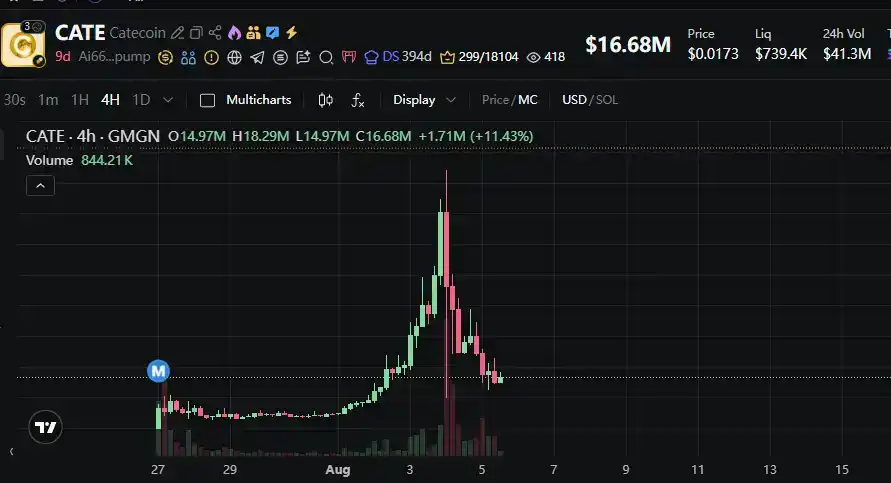
For seasoned on-chain veterans, such a price movement in a meme coin isn't surprising. However, witnessing it happen to a high-profile token like this is quite dramatic and serves as another stark reminder of some harsh realities in the current market.

Harsh Realities

Let's start by examining why this coin crashed. The community has identified several potential reasons:

- $CATE's X (Twitter) account was suddenly suspended.

- FOMO experienced downtime, preventing users from trading during the outage.

The account suspension is self-explanatory, but why would FOMO's downtime cause such a crash?

Because, much like $ANSEM rode on Ansem's clout and explicit support, $CATE's rise was largely fueled by the influence and open backing of "mini-Ansem" Poorgoat.

Poorgoat, a member of the FOMO Hall of Fame (recognized by FOMO for achieving significant profits on the platform) and currently topping FOMO's 7-day profit leaderboard while ranking 2nd on the 30-day board, entered $CATE at an average market cap of around $1.4 million, with a total investment of approximately $44,700. At the coin's peak, this single trade alone netted him over $2 million in profit.
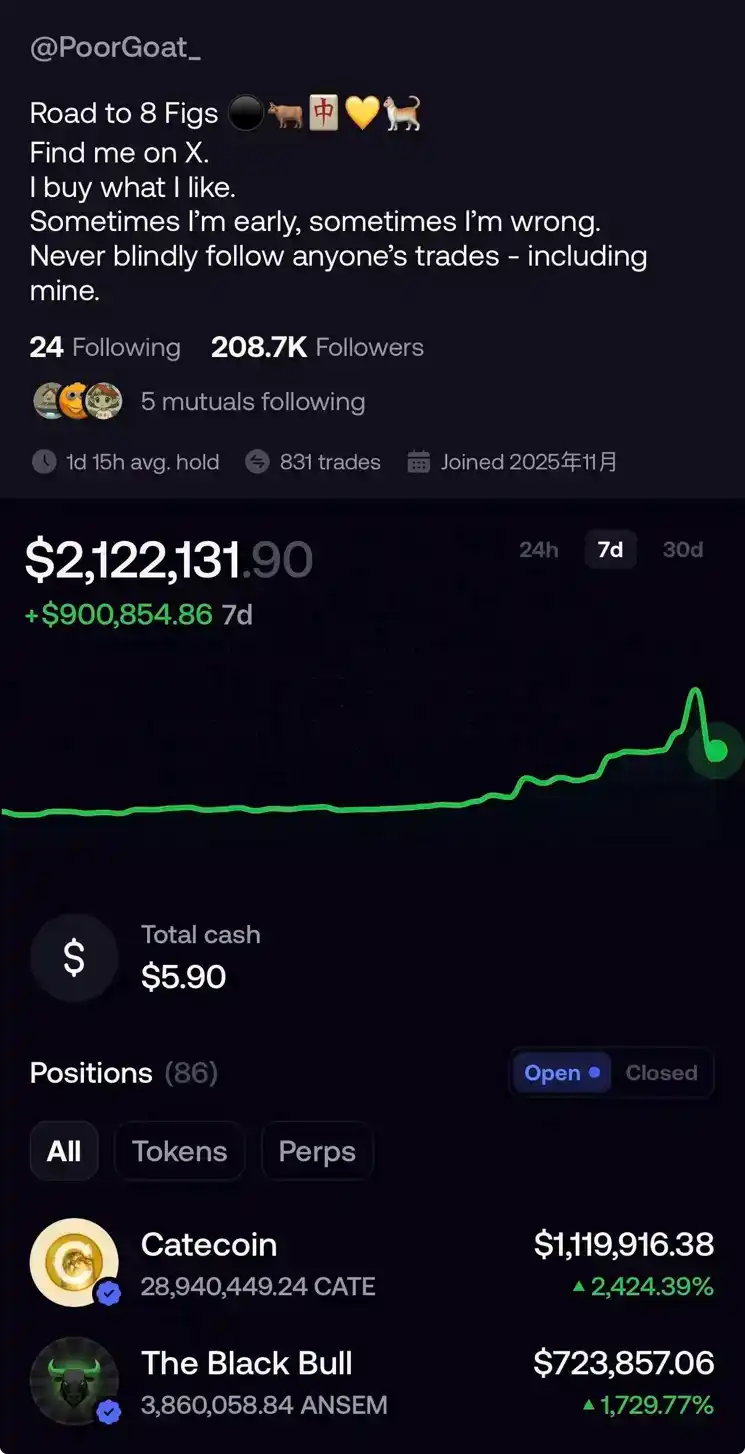
He gained fame by holding onto a $30,000 $ANSEM airdrop, which ballooned to nearly $1.75 million at its peak. Now, he has amassed over 208,000 followers on FOMO.

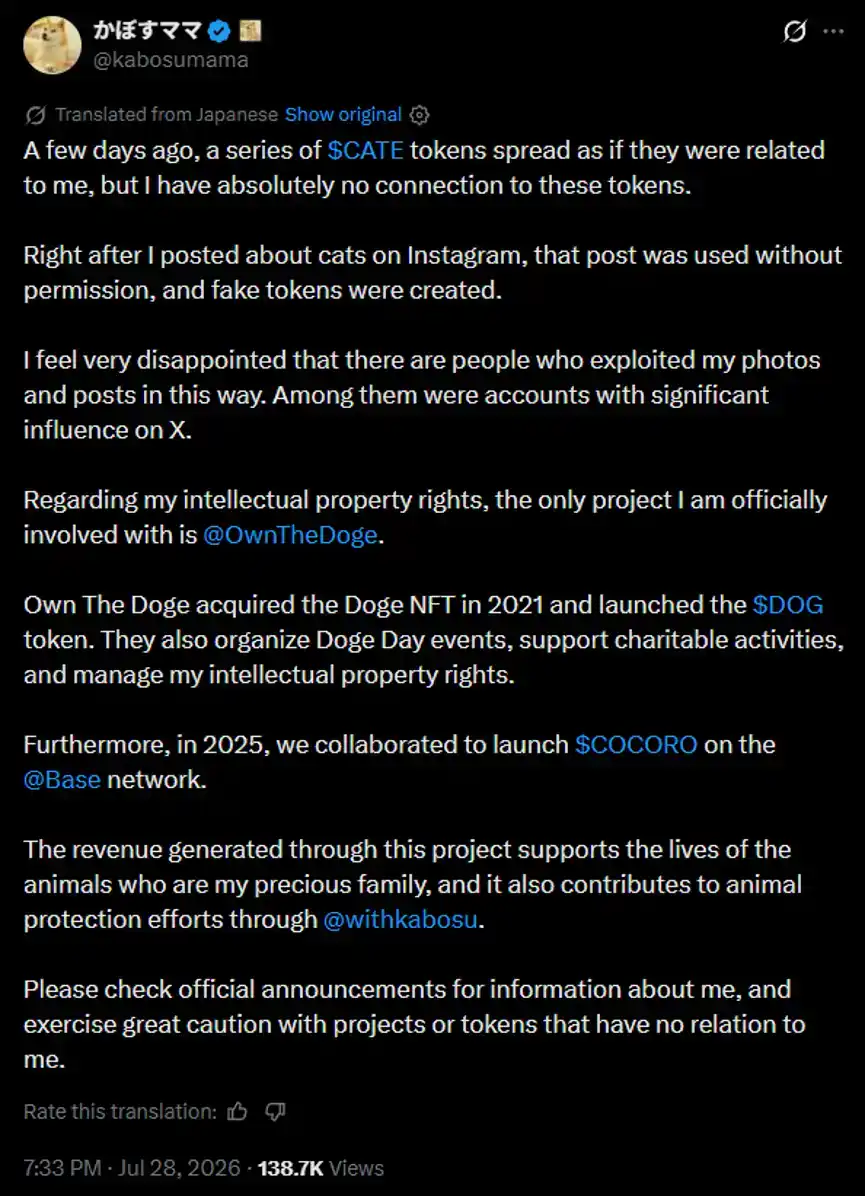
Given this context, it becomes clear why FOMO's downtime is seen as a major catalyst for the crash—fundamentally, the coin's narrative was nothing new, positioning itself as the "cat sister" to Doge. In fact, Doge's creator even publicly denied any association with the token:
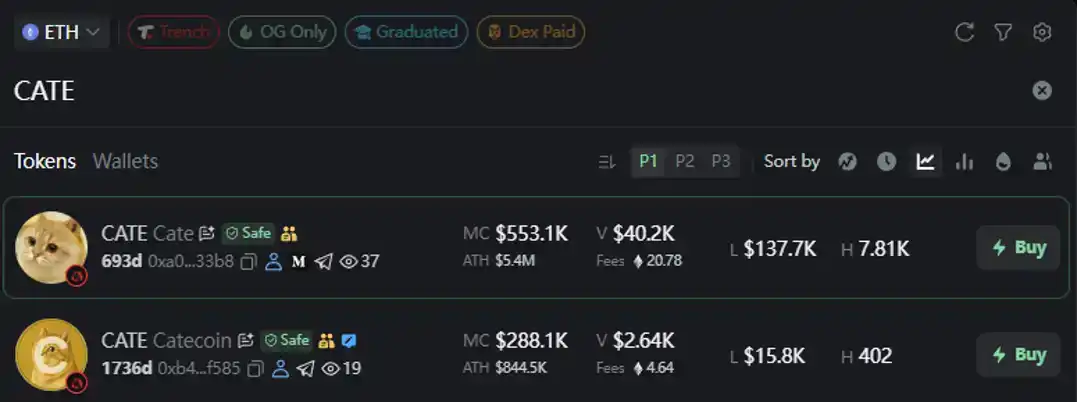
Moreover, a token with the same narrative has existed on the Ethereum mainnet for quite some time, showing no signs of revival:
Adding to the controversy surrounding this crash is the fact that Poorgoat, FOMO's current top influencer, effectively became the Chief Token Officer (CTO) for this coin, publishing a lengthy post on X arguing that the token's growth was "organic":
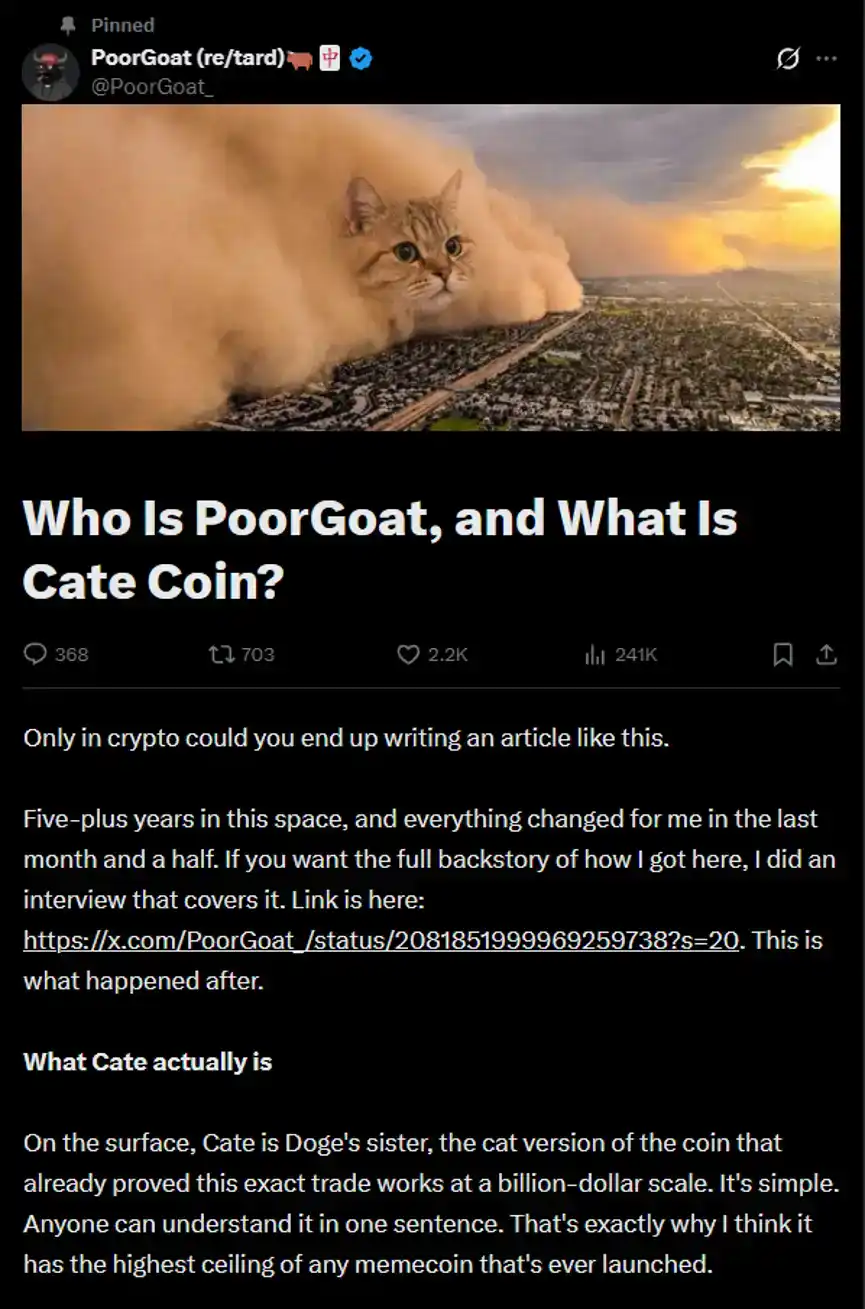
Yet, this supposedly "organic" coin, still boasting over 60,000 holder addresses, plunged more than 60% in one minute due to selling pressure of less than $1.5 million:

This brings us to the harsh reality we mentioned. In the current market, the ceiling for any token that follows the traditional "organic" community-building path (excluding past successes like $SPX, $MOG that left a strong impression) might be limited to around $17 million, similar to $neet's current market cap. We won't delve too deep into why $neet is considered organic; its price action over the past 460+ days speaks for itself:

Next, let's discuss why FOMO is facing such significant backlash this time.

Fame Brings Scrutiny

Earlier this year, when the 6000x-in-a-week "Nietzsche Penguin" $PENGUIN propelled trader logjam (now with ~138k followers on FOMO) to fame, the community largely admired and celebrated his success. At that time, logjam profited around $564,000 from $PENGUIN, and no one doubted his achievement; it was met with recognition and well-wishes.

However, controversies began to swirl around FOMO following the rise of $UNC, the pioneer of the "airdrop wealth creation" playbook later used by $ANSEM, where airdrops were distributed within a small circle to pump the price. Many recipients of these airdrops were active KOLs on FOMO. Their resulting profits, prominently displayed on FOMO's leaderboards (dominating weekly and monthly charts), essentially turned them into walking billboards for these airdropped tokens. Consequently, some users started suspecting that FOMO's data might be manipulated, suggesting collusion among KOLs to create "pump-and-dump" schemes aimed at attracting more users to the app, only to let the KOLs exit and leave others holding the bag.

Regardless of whether such insider dealings actually exist, the mere possibility fuels user resentment, a sentiment also vividly reflected in the BSC ecosystem. Moreover, the most fitting explanation found for $CATE's crash is "FOMO was down." It's not just that users felt a FOMO-related token being untradable was a major negative. The timing was simply too coincidental, leading many to believe it was a pretext to trap and liquidate users who primarily trade via FOMO.

Currently, $CATE still has over 60,000 holder addresses. FOMO's data shows over 38,400 of these holder addresses, meaning more than 60% of holders are from FOMO. If a significant portion of these addresses were mass-created by FOMO itself, it becomes hard to dismiss allegations of manipulation. If not, then the hardest hit are still the retail investors on FOMO.

Another highly contentious point is that trader MarcellxMarcell (with nearly 40k followers on FOMO) "exited at the top" when $CATE's market cap was around $45 million. Although it was still possible to trade on-chain by exporting the wallet address during FOMO's downtime, the community questions: if you publicly bought in around a $30 million market cap, showing considerable confidence, why would you consider FOMO's downtime such a massive negative catalyst?

Recently, FOMO's updated terms of service explicitly state they do not guarantee the security of user assets. However, the process of exporting an address from FOMO—requiring logging into the FOMO page to obtain the private key—has also raised security concerns. Critics question whether FOMO transmits the private key to the webpage with sufficient encryption.
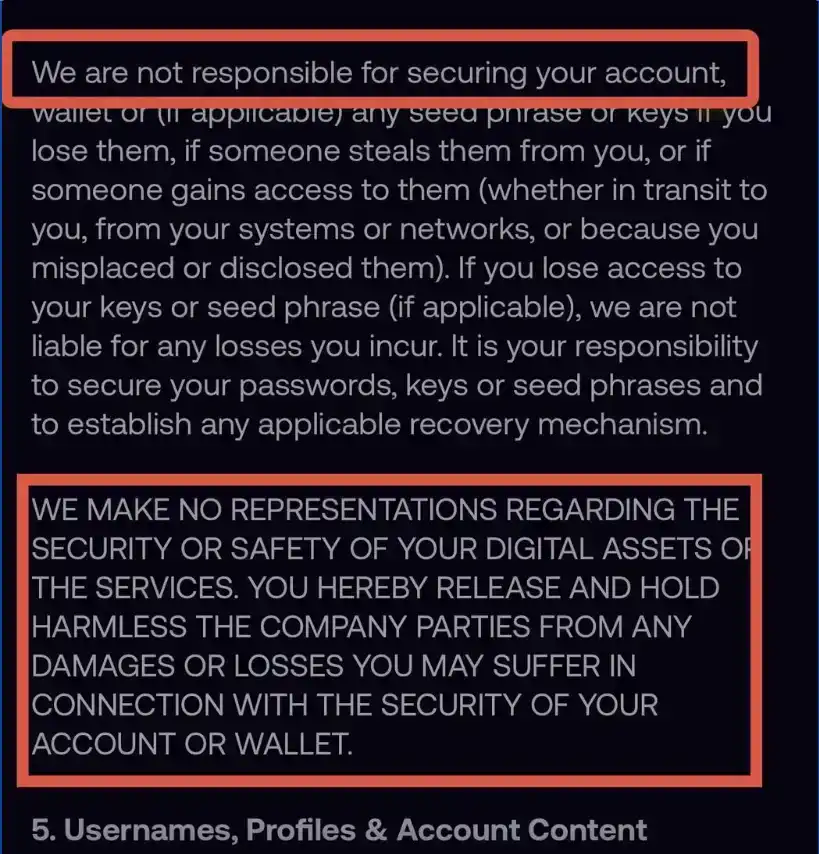
FOMO's official explanation points to overload due to a sudden surge in user volume, a reason many players find hard to accept. After all, the trading volume during that one-minute crash wasn't exceptionally high. "Come on, you raised $75 million in funding, and you get paralyzed by less than $5 million in volume over 5 minutes?"

Had users consistently used on-chain trading terminals like gmgn, they might have avoided this sudden, trapped liquidation.

Fame brings scrutiny, and the criticisms leveled at FOMO during its rapid growth are not entirely without merit.


Criptomoedas em alta

Perguntas relacionadas

QWhat is the primary reason suggested in the article for the flash crash of the $CATE meme coin?

AThe article suggests the primary reasons for the $CATE flash crash were the temporary suspension of its X account and, more critically, the fomo trading platform experiencing downtime, which prevented users from trading.

QWho is Poorgoat and what role did he play in the $CATE token?

APoorgoat is a prominent trader on the fomo platform, known as the 'little Ansem' and a member of its 'Hall of Fame.' He publicly supported and endorsed the $CATE token, acting as a key figure in its promotion and perceived legitimacy.

QAccording to the article, what is a major point of controversy surrounding the fomo platform after this incident?

AA major point of controversy is the suspicion that fomo's downtime during the crash was not coincidental. Some users believe it was a pretext to trap retail investors on the platform, allowing insiders or KOLs to sell their holdings, which fuels allegations of market manipulation.

QWhat does the article imply about the 'organic' growth narrative of certain meme coins in the current market?

AThe article implies that the current market severely limits the potential of meme coins claiming 'organic' community-driven growth. It suggests their market cap ceiling is relatively low, using $neet's ~$17 million cap as an example, compared to tokens heavily promoted by influencers on platforms like fomo.

QWhat alternative trading method does the article mention to avoid issues like those experienced with fomo's downtime?

AThe article mentions that using on-chain trading terminals like gmgn would allow users to avoid being trapped by platform-specific outages, as they enable direct blockchain transactions independent of any single app's functionality.

Leituras Relacionadas

On L1 Value Capture from Two Solana Proposals

The article, "Discussing L1 Value Capture Through Two Solana Proposals," by Max Resnick, explores how Layer 1 (L1) blockchain tokens derive their fundamental value, drawing parallels to traditional asset pricing theory. Resnick argues that L1 token value, like stock value, stems from claims on future income streams for holders, not merely from network activity or technological promise. This value is captured when fees are either burned (economically akin to a buyback) or distributed to stakers (akin to dividends). Inflationary staking rewards, by contrast, redistribute value among holders rather than creating it. The core challenge is the quality and defensibility of fee-based revenue. High-quality fees come from sustainable, recurring demand for the network's economic utility (e.g., long-term financial activity), not from transient speculation (e.g., meme coins, airdrops). The strength of a blockchain's network effects—liquidity, applications, users—can make its revenue more defensible and grant it greater pricing power than often assumed. The article proposes a foundational valuation framework for L1s, separating revenue (fees captured for token holders), costs, and total token supply. A key accounting principle is that inflationary rewards should not be counted as a cost unless the newly minted tokens are symmetrically counted as a value input; otherwise, it misrepresents profitability. Finally, Resnick discusses the economics of increasing protocol fees to boost revenue. Since revenue equals price times quantity, the net effect depends on demand elasticity. Research on Ethereum suggests transaction demand is somewhat elastic; a fee increase reduces volume. A uniform fee is a blunt instrument, as different transactions (e.g., small transfers vs. large settlements) have vastly different abilities to pay. The article suggests that transaction-value-based fees, potentially implemented via token programs, could be a more efficient way to capture value from high-willingness-to-pay activities. The discussion is framed around ongoing Solana proposals (SIMD-550, SIMD-553) but focuses on the universal principles of L1 value accrual.

marsbitHá 1h

On L1 Value Capture from Two Solana Proposals

marsbitHá 1h

Trading

Spot

Artigos em Destaque

O que é MEME 2.0

Memecoin 2.0: A Ascensão do $MEME 2.0 no Mundo das Criptomoedas Introdução No panorama em constante evolução das criptomoedas, um novo concorrente surgiu. Memecoin 2.0, simbolizado como $MEME 2.0, eleva o conceito de moedas meme a um novo nível emocionante. Como um subproduto do Memecoin original, este projeto capturou a atenção da comunidade crypto ao mudar o foco de incentivos financeiros típicos para uma experiência envolvente e divertida. Operando na blockchain Ethereum, Memecoin 2.0 redefine audaciosamente o envolvimento da comunidade na esfera crypto. O que é Memecoin 2.0, $MEME 2.0? No seu cerne, Memecoin 2.0 é um projeto de criptomoeda que prioriza o espírito comunitário e a diversão associada à cultura meme. Ao contrário das criptomoedas convencionais, que se concentram em casos de uso práticos e benefícios tangíveis, Memecoin 2.0 distingue-se ao abraçar o lado mais leve da moeda digital. O projeto existe sem promessas de utilidade, um roteiro estruturado ou retornos financeiros, focando em vez disso em fomentar uma comunidade vibrante centrada em memes e no prazer partilhado. Ao fazer isso, aproveita a crescente tendência da cultura meme no espaço online, tornando-se num jogador único no mundo dos ativos digitais. Criador do Memecoin 2.0, $MEME 2.0 Apesar de extensa pesquisa sobre as origens do Memecoin 2.0, a identidade explícita do seu criador continua desconhecida. Esta anonimidade não é incomum na comunidade crypto, onde muitos projetos são liderados por indivíduos ou grupos que preferem ficar nos bastidores. A falta de informações publicamente disponíveis sobre o criador pode ser vista como um movimento estratégico, colocando os holofotes no envolvimento da comunidade em vez de na notoriedade individual dentro do espaço. Investidores do Memecoin 2.0, $MEME 2.0 As informações sobre os investidores ou o financiamento do Memecoin 2.0 são escassas. Esta ausência de detalhes pode sugerir que o projeto é autofinanciado ou que o seu foco na comunidade, em vez de estruturas de investimento tradicionais, atraiu um tipo diferente de apoiador. Como o mundo das moedas memes geralmente envolve mais envolvimento de base do que investimento institucional, esta abordagem alinha-se ao ethos de projetos orientados pela comunidade. Como Funciona o Memecoin 2.0, $MEME 2.0? O Memecoin 2.0 opera inteiramente na blockchain Ethereum, aproveitando as suas robustas características de segurança e escalabilidade. Ao aproveitar os pontos fortes da Ethereum, o Memecoin 2.0 pode oferecer um ambiente seguro para interações dos utilizadores enquanto assegura que as transações são eficientes e custo-efetivas. Uma das características únicas do Memecoin 2.0 reside na sua estrutura orientada pela comunidade. O valor e a popularidade do token $MEME 2.0 derivam da participação ativa dos seus utilizadores, em vez de uma utilidade inerente. Este design reforça o foco do projeto no aspecto de entretenimento das criptomoedas, implicando que o riso e o envolvimento da comunidade são as verdadeiras moedas que impulsionam o seu sucesso. Além disso, o projeto insere-se no ecossistema mais amplo das moedas meme, onde o valor de cada moeda meme oscila com base na cultura, nas tendências e no envolvimento da comunidade, em vez de nos princípios económicos tradicionais. Linhas do Tempo do Memecoin 2.0, $MEME 2.0 Para melhor entender a evolução e os marcos do Memecoin 2.0, aqui está uma linha do tempo que destaca eventos significativos na sua história: 2024: O início do Memecoin 2.0 é reconhecido como um desdobramento do Memecoin original, estabelecendo-se dentro do contexto próspero das moedas meme enquanto opera na blockchain Ethereum. 13 de Julho de 2024: O Memecoin 2.0 posiciona-se oficialmente como uma moeda meme centrada na comunidade na rede Ethereum, enfatizando a sua abordagem centrada no entretenimento que convida os utilizadores a participar e envolver-se no seu crescimento. Pontos Chave Sobre o Memecoin 2.0, $MEME 2.0 Várias características críticas definem o Memecoin 2.0: Abordagem Centrada na Comunidade: A missão primária do Memecoin 2.0 é criar uma experiência comunitária divertida e envolvente, capitalizando o prazer coletivo derivado da cultura meme. Construído na Ethereum: Operar na blockchain Ethereum fornece ao projeto uma infraestrutura essencial que garante segurança e escalabilidade. Falta de Utilidade ou Roteiro: Numa notável divergência das criptomoedas tradicionais, o Memecoin 2.0 não promete quaisquer características utilitárias ou retornos financeiros, reafirmando o seu compromisso com o envolvimento da comunidade e a participação social. Foco na Cultura Meme: Ao abraçar os aspectos humorísticos e culturais do fenómeno meme, o Memecoin 2.0 fornece uma plataforma para que os utilizadores se envolvam com a crypto offline e online. Contexto Adicional: A Importância das Moedas Meme As moedas meme emergiram como uma classe distinta de criptomoeda, frequentemente impulsionadas pelo humor e por uma abordagem leve ao comércio. Estas moedas geralmente carecem de utilidade significativa ou roteiros de desenvolvimento, atraindo os utilizadores com a promessa de diversão, interação comunitária e relevância cultural. No panorama do ecossistema crypto mais amplo, as moedas meme revive a importância do envolvimento da comunidade, resistindo contra abordagens exclusivamente orientadas para o lucro. Projetos como o Memecoin 2.0 inauguram uma era em que o entretenimento pode harmonizar-se com aspirações financeiras, transformando a blockchain numa plataforma para criatividade e interação social. Conclusão O Memecoin 2.0, ou $MEME 2.0, representa uma nova onda de criptomoeda que prioriza o envolvimento da comunidade em detrimento de estruturas financeiras rígidas. Com um foco no humor e na interação social, capitaliza a fascinação em torno da cultura meme. Ao operar na blockchain Ethereum, o Memecoin 2.0 aproveita as capacidades da tecnologia, enquanto mantém um compromisso firme com o valor de entretenimento da moeda digital. À medida que o espaço em torno das criptomoedas continua a evoluir, o Memecoin 2.0 serve como um testemunho da ideia de que o futuro dos ativos digitais pode muito bem depender de experiências partilhadas, risadas e conexões comunitárias sólidas. No mundo imprevisível da crypto, talvez a alegria possa ser tão valiosa quanto o ganho financeiro tradicional.

126 Visualizações TotaisPublicado em {updateTime}Atualizado em 2024.12.03

O que é MEME 2.0

Como comprar MEME

Bem-vindo à HTX.com!Tornámos a compra de Memeland (MEME) simples e conveniente.Segue o nosso guia passo a passo para iniciar a tua jornada no mundo das criptos.Passo 1: cria a tua conta HTXUtiliza o teu e-mail ou número de telefone para te inscreveres numa conta gratuita na HTX.Desfruta de um processo de inscrição sem complicações e desbloqueia todas as funcionalidades.Obter a minha contaPasso 2: vai para Comprar Cripto e escolhe o teu método de pagamentoCartão de crédito/débito: usa o teu visa ou mastercard para comprar Memeland (MEME) instantaneamente.Saldo: usa os fundos da tua conta HTX para transacionar sem problemas.Terceiros: adicionamos métodos de pagamento populares, como Google Pay e Apple Pay, para aumentar a conveniência.P2P: transaciona diretamente com outros utilizadores na HTX.Mercado de balcão (OTC): oferecemos serviços personalizados e taxas de câmbio competitivas para os traders.Passo 3: armazena teu Memeland (MEME)Depois de comprar o teu Memeland (MEME), armazena-o na tua conta HTX.Alternativamente, podes enviá-lo para outro lugar através de transferência blockchain ou usá-lo para transacionar outras criptomoedas.Passo 4: transaciona Memeland (MEME)Transaciona facilmente Memeland (MEME) no mercado à vista da HTX.Acede simplesmente à tua conta, seleciona o teu par de trading, executa as tuas transações e monitoriza em tempo real.Oferecemos uma experiência de fácil utilização tanto para principiantes como para traders experientes.

351 Visualizações TotaisPublicado em {updateTime}Atualizado em 2026.06.02

Como comprar MEME

Discussões

Bem-vindo à Comunidade HTX. Aqui, pode manter-se informado sobre os mais recentes desenvolvimentos da plataforma e obter acesso a análises profissionais de mercado. As opiniões dos utilizadores sobre o preço de MEME (MEME) são apresentadas abaixo.

活动图片