Market Pullback Accelerates After Senate Postpones Long-Awaited Crypto Framework Bill

bitcoinistPublicado em 2025-12-17Última atualização em 2025-12-17

Resumo

The Senate Banking Committee's postponement of a key crypto market structure bill to early 2026 has triggered a sharp market pullback, erasing around $140 billion in market capitalization. Bitcoin fell below $86,000 and Ethereum dropped under $3,000 as regulatory uncertainty led to risk-off behavior. The delay, occurring at a fragile time, amplified downside moves due to elevated derivatives positioning and ETF outflows. Despite ongoing regulatory actions, the lack of comprehensive legislation continues to fuel volatility, leaving investors facing extended uncertainty until at least 2026.

The market entered a sharper pullback this week after the Senate confirmed that a long-anticipated crypto structure legislation will not advance before the end of the year.

Related Reading: Crypto Market Structure Bill Stalled: Senate Banking Committee Pushes Markup To Early 2026

What many investors had hoped would be a closing act for regulatory clarity in 2025 instead became another extension of uncertainty, triggering risk-off behavior across digital assets and related investment products. The delay arrived at a fragile moment for markets grappling with growing sensitivity to policy signals from Washington.

Bitcoin slid below the $86,000 level, while the broader digital asset market shed roughly $140 billion in capitalization within hours. The total market value has fallen to around $2.93 trillion, its lowest level in several weeks, as traders reassessed regulatory timelines that now extend into early 2026.
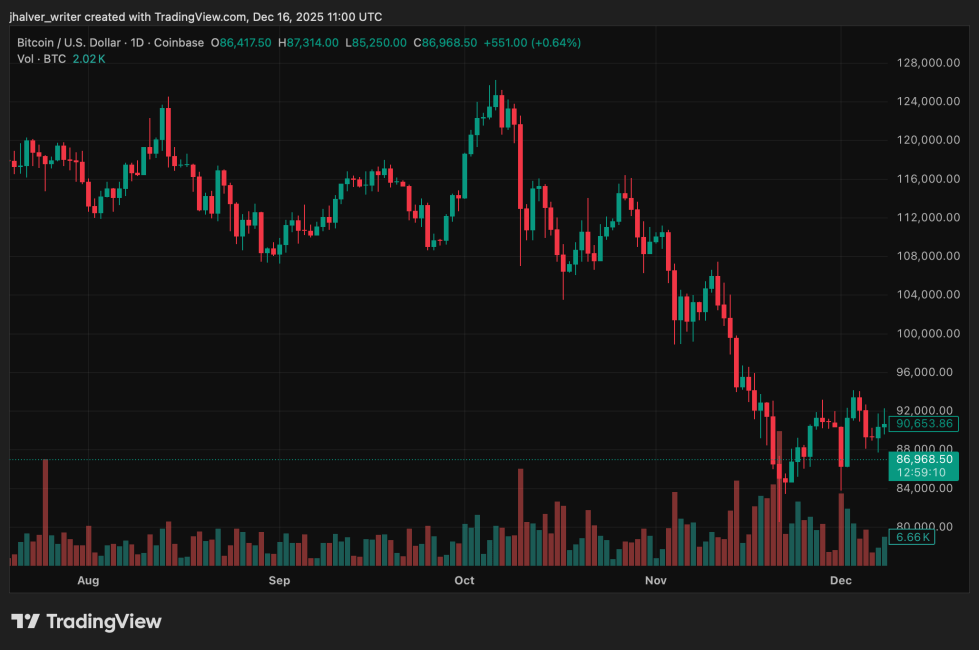
BTC's price trends to the downside on the daily chart. Source: BTCUSD on Tradingview

Senate Pushes Crypto Market Structure Talks Into 2026

The Senate Banking Committee confirmed it will not hold a markup hearing on the crypto market structure billbefore Congress adjourns for the holidays.

While committee leadership says bipartisan negotiations are progressing, lawmakers acknowledged that time has run out to move the bill forward in 2025. Chairman Tim Scott’s office reiterated that discussions with Democratic counterparts are ongoing, with a markup now expected in early 2026.

The proposed legislation is designed to clarify how digital assets are regulated in the U.S., including defining the respective roles of the Securities and Exchange Commission and the Commodity Futures Trading Commission.

Under current drafts, the CFTC would oversee spot crypto markets, while securities laws would be more clearly applied to token issuers and intermediaries. Parallel efforts in the Senate Agriculture Committee, which also oversees the CFTC, have yet to reach a markup stage, further slowing the process.

Market Reaction Highlights Fragile Sentiment

The legislative setback quickly translated into market pressure. Bitcoin fell from near $90,000 to the mid-$85,000 range, while Ethereum dropped below $3,000. Additionally, the average crypto RSI fell to around 32, indicating that the market is within oversold territory.

Analysts pointed to elevated derivatives positioning and heavy open interest around key price levels as factors amplifying downside moves. Exchange-traded products reflected the shift, with Bitcoin and Ethereum spot ETFs recording significant outflows as institutional investors reduced exposure.

Some market observers noted that unrealized losses have risen sharply, while funding conditions and leverage remain stretched, making prices more vulnerable to negative catalysts such as policy delays.

Regulatory Uncertainty Persists Despite Agency Actions

Despite the legislative pause, regulators have continued to act within existing frameworks. The SEC has issued staff guidance and hosted public discussions on how current securities laws apply to crypto activities, while the CFTC has taken steps to expand supervised spot market participation.

However, industry participants say these measures fall short of the comprehensive clarity the market structure bill is meant to deliver.

Related Reading: Terra Founder Do Kwon Could Face 30-Year Sentence In Potential South Korean Trial

The Senate’s decision reinforces a familiar pattern for crypto markets: policy delays translating into heightened volatility. With negotiations set to resume in early 2026, investors will be left to navigate another extended period where regulatory questions remain unresolved.

Cover image from ChatGPT, BTCUSD chart on Tradingview

Criptomoedas em alta

Leituras Relacionadas

Qualcomm: AI Hype Subsides, When Will Smartphones Emerge from the Gloom?

Qualcomm reported its Q3 FY2026 results (ending June 2026), with revenue of $9.95B, down 4% YoY but above expectations. Gross margin declined to 53.1%, pressured by rising costs across manufacturing and memory. Key business segments showed mixed performance: Handset revenue fell 19.6% YoY to $5.09B, dragged by an 11% decline in non-Apple Android shipments and weaker high-end mix. Conversely, Automotive revenue surged 61% to $1.59B, and IoT grew 9% to $1.83B. Core operating profit dropped 41% YoY due to margin compression and higher expenses. Management's Q4 FY2026 guidance projects revenue of $9.7B-$10.5B, in line with consensus, but Non-GAAP EPS guidance of $2.05-$2.25 fell short of expectations. Amidst persistent weakness in its core handset market, Qualcomm is pursuing growth in AI, focusing on Edge AI (smartphones, PCs, automotive) and Data Center AI. Its data center strategy includes four pillars: AI accelerators (e.g., AI200), commercial CPUs (Dragonfly C1000), custom silicon, and connectivity solutions. While these initiatives initially boosted its stock, concerns over AI capital expenditure sustainability have since erased those gains. The company targets $5B in data center revenue for FY2027 and $15B for FY2029. The report concludes that with the traditional handset business still under pressure, the data center opportunity is currently viewed as a longer-term option, and a more conservative valuation based on core operations may be warranted until AI contributions materialize.

marsbitHá 2m

Qualcomm: AI Hype Subsides, When Will Smartphones Emerge from the Gloom?

marsbitHá 2m

From TPU to Self-Evolving Agents: How Jeff Dean Predicts the Next Step in AI

At the 2026 YC Startup School, Jeff Dean outlined his vision for AI's next phase, shifting focus from simply scaling models to building intelligent, autonomous systems. He believes AI's progress is no longer just about creating smarter models, but about integrating them into systems capable of long-term, iterative work, automated experimentation, and continuous learning. This evolution moves the competition from "who has the bigger model" to "who can best organize intelligence." Dean suggests AI capabilities are now comparable to a junior engineer, enabling the automation of complex workflows. However, the true challenge and opportunity lie in managing these AI "workers" at scale. He emphasizes the importance of **context engineering**—structuring tools, memory, and feedback loops—over raw model power. For startups, this means building deep expertise in niche domains where general models currently fail (near 0-1% success rates), leveraging proprietary data, specialized tools, and domain-specific evaluators. A recurring theme is re-examining fundamental constraints. Dean's past work, like moving Google's search index to memory or creating the TPU, stemmed from questioning outdated assumptions about hardware and cost. He sees similar inflection points today, particularly in **specialized inference hardware** to drastically reduce latency and energy consumption for real-time Agent operation. Notably, he points out that in modern AI systems, the dominant cost is often not computation but **data movement**. Reliable, long-running Agents require robust system design, borrowing concepts from distributed computing like checkpointing, state management, and parallel exploration to handle failures and maintain progress over days or weeks. As AI automates execution, the scarcest human skills will shift to **defining clear specifications**, **judging what problems are worth solving** (taste), and designing effective feedback loops. Ultimately, Dean's framework prioritizes understanding the problem deeply, identifying the true bottlenecks, and systematically building closed-loop systems where AI can not only perform tasks but also improve AI itself.

marsbitHá 2m

From TPU to Self-Evolving Agents: How Jeff Dean Predicts the Next Step in AI

marsbitHá 2m

Trading

Spot

Artigos em Destaque

Como comprar O

Bem-vindo à HTX.com!Tornámos a compra de O1 exchange (O) simples e conveniente.Segue o nosso guia passo a passo para iniciar a tua jornada no mundo das criptos.Passo 1: cria a tua conta HTXUtiliza o teu e-mail ou número de telefone para te inscreveres numa conta gratuita na HTX.Desfruta de um processo de inscrição sem complicações e desbloqueia todas as funcionalidades.Obter a minha contaPasso 2: vai para Comprar Cripto e escolhe o teu método de pagamentoCartão de crédito/débito: usa o teu visa ou mastercard para comprar O1 exchange (O) instantaneamente.Saldo: usa os fundos da tua conta HTX para transacionar sem problemas.Terceiros: adicionamos métodos de pagamento populares, como Google Pay e Apple Pay, para aumentar a conveniência.P2P: transaciona diretamente com outros utilizadores na HTX.Mercado de balcão (OTC): oferecemos serviços personalizados e taxas de câmbio competitivas para os traders.Passo 3: armazena teu O1 exchange (O)Depois de comprar o teu O1 exchange (O), armazena-o na tua conta HTX.Alternativamente, podes enviá-lo para outro lugar através de transferência blockchain ou usá-lo para transacionar outras criptomoedas.Passo 4: transaciona O1 exchange (O)Transaciona facilmente O1 exchange (O) no mercado à vista da HTX.Acede simplesmente à tua conta, seleciona o teu par de trading, executa as tuas transações e monitoriza em tempo real.Oferecemos uma experiência de fácil utilização tanto para principiantes como para traders experientes.

464 Visualizações TotaisPublicado em {updateTime}Atualizado em 2026.06.29

Como comprar O

Como comprar PROS

Bem-vindo à HTX.com!Tornámos a compra de Pharos (PROS) simples e conveniente.Segue o nosso guia passo a passo para iniciar a tua jornada no mundo das criptos.Passo 1: cria a tua conta HTXUtiliza o teu e-mail ou número de telefone para te inscreveres numa conta gratuita na HTX.Desfruta de um processo de inscrição sem complicações e desbloqueia todas as funcionalidades.Obter a minha contaPasso 2: vai para Comprar Cripto e escolhe o teu método de pagamentoCartão de crédito/débito: usa o teu visa ou mastercard para comprar Pharos (PROS) instantaneamente.Saldo: usa os fundos da tua conta HTX para transacionar sem problemas.Terceiros: adicionamos métodos de pagamento populares, como Google Pay e Apple Pay, para aumentar a conveniência.P2P: transaciona diretamente com outros utilizadores na HTX.Mercado de balcão (OTC): oferecemos serviços personalizados e taxas de câmbio competitivas para os traders.Passo 3: armazena teu Pharos (PROS)Depois de comprar o teu Pharos (PROS), armazena-o na tua conta HTX.Alternativamente, podes enviá-lo para outro lugar através de transferência blockchain ou usá-lo para transacionar outras criptomoedas.Passo 4: transaciona Pharos (PROS)Transaciona facilmente Pharos (PROS) no mercado à vista da HTX.Acede simplesmente à tua conta, seleciona o teu par de trading, executa as tuas transações e monitoriza em tempo real.Oferecemos uma experiência de fácil utilização tanto para principiantes como para traders experientes.

490 Visualizações TotaisPublicado em {updateTime}Atualizado em 2026.06.29

Como comprar PROS

O que é VERONA

I. Introdução ao Projeto VERONA é uma blockchain construída para todos, em todo o lado, através da abstração da cadeia. Utilizando a sua camada de Abstração Generalizada, a VERONA distingue-se por integrar funcionalidades complexas de blockchain, como contas, assinaturas e interoperabilidade, diretamente ao nível do protocolo. Esta abordagem permite a interação com aplicações de blockchain sem a necessidade de compreender as tecnologias subjacentes.1) Informação Básica Nome: VERONA (VERONA)III. Links Relacionados Link do site oficial: https://xion.burnt.com/ Whitepaper: https://xion.burnt.com/whitepaper.pdf Exploradores: https://explorer.burnt.com/ Mídias Sociais: https://x.com/burnt_xion Nota: A introdução ao projeto provém dos materiais publicados ou fornecidos pela equipa oficial do projeto, que é apenas para referência e não constitui aconselhamento de investimento. A HTX não se responsabiliza por quaisquer perdas diretas ou indiretas resultantes.

1.2k Visualizações TotaisPublicado em {updateTime}Atualizado em 2026.06.22

O que é VERONA

Discussões

Bem-vindo à Comunidade HTX. Aqui, pode manter-se informado sobre os mais recentes desenvolvimentos da plataforma e obter acesso a análises profissionais de mercado. As opiniões dos utilizadores sobre o preço de A (A) são apresentadas abaixo.

活动图片














