Mark Cuban Cleared As Court Dismisses Voyager Digital Investor Lawsuit

bitcoinistPublicado em 2026-01-03Última atualização em 2026-01-03

Resumo

A US federal judge dismissed a class-action lawsuit against Mark Cuban and the Dallas Mavericks brought by former Voyager Digital customers. The court ruled it lacked personal jurisdiction in Florida, as the defendants were not conducting business in the state. The lawsuit stemmed from Voyager's 2021 bankruptcy, where customers lost funds and alleged misleading statements. Plaintiffs argued Cuban's promotion of Voyager, including a fan incentive offer, encouraged platform use. The dismissal was based solely on jurisdictional grounds and did not address the case's merits. Plaintiffs may refile in another court.

A US federal judge has tossed a class-action lawsuit brought by former Voyager Digital customers against billionaire Mark Cuban and the Dallas Mavericks, ruling the court did not have the power to hear the case.

The order, entered at the end of December, dismissed the suit in its entirety after finding the plaintiffs failed to show the defendants were subject to personal jurisdiction in Florida.

Mark Cuban Vs. Voyager: Judge Cites Lack Of Personal Jurisdiction

According to the court filing, Judge Roy K. Altman concluded that Mark Cuban and the Mavericks did not “carry on a business or business venture in Florida” in a way that would let the Miami-area court preside over the matter.

The decision follows extensive jurisdictional discovery and multiple amended complaints that, the judge said, still fell short of establishing the necessary legal ties to Florida. The defense team hailed the ruling as a complete win for their clients.
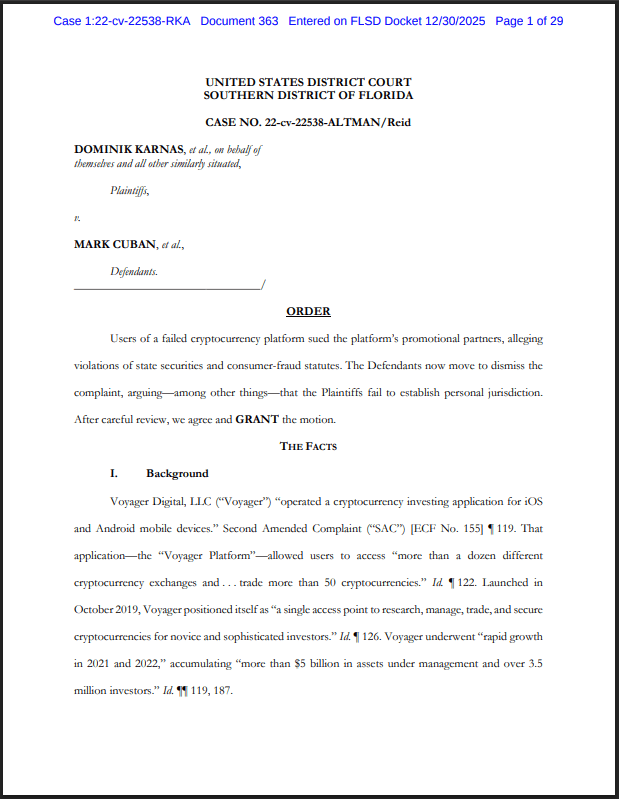
Source: Courtlistener

The suit traces back to 2022, when Voyager Digital filed for Chapter 11 protection after a sharp market downturn and loan defaults. Voyager’s bankruptcy and the fallout led to a wave of litigation by users who said they lost access to funds and were misled by the company’s statements. Reports have noted the firm had roughly $1.3 billion in customer crypto assets implicated during restructuring talks.

Image: www.mak.kg

Promotion And The $100 Fan Offer

Based on reports from earlier coverage, the dispute focused on a 2021 promotion in which Cuban and the Mavericks partnered with Voyager and offered fans incentives tied to deposits and trading.

Bitcoin is currently trading at $89,299. Chart: TradingView

Plaintiffs argued the partnership and public backing helped convince customers to use the platform. Other defendants in related Voyager litigation have settled; Cuban and the Mavericks maintained they would fight the claims.

Legal experts say the outcome highlights the limits of suing public figures in forums far from where those figures are based. Courts increasingly demand concrete evidence that a defendant targeted a state before allowing local lawsuits to proceed. This dismissal does not decide whether the promotional statements were true or false; it addresses only where the case could be heard.

Plaintiffs’ Options And Wider Litigation

Reports have not shown an immediate refiling in another court by the named plaintiffs. Because the judge dismissed the complaint for lack of jurisdiction, the plaintiffs were denied the chance to proceed in that Florida court but may pursue claims elsewhere if they choose.

Featured image from MediaNews Group via Getty Images, chart from TradingView

Perguntas relacionadas

QWhy was the class-action lawsuit against Mark Cuban and the Dallas Mavericks dismissed?

AThe lawsuit was dismissed because the US federal judge ruled that the court did not have personal jurisdiction over Mark Cuban and the Dallas Mavericks in Florida, as they did not 'carry on a business or business venture in Florida' in a way that would allow the Miami-area court to preside over the case.

QWhat was the central argument made by the plaintiffs in the lawsuit?

AThe plaintiffs argued that the partnership and public backing from Mark Cuban and the Dallas Mavericks helped convince customers to use the Voyager Digital platform, and they were misled by the company's statements, leading to financial losses.

QWhat event precipitated the wave of litigation against Voyager Digital and its partners?

AThe wave of litigation was triggered after Voyager Digital filed for Chapter 11 bankruptcy protection in 2022 following a sharp market downturn and loan defaults, which caused users to lose access to their funds.

QDoes the court's dismissal rule on the truthfulness of the promotional statements made by Mark Cuban and the Mavericks?

ANo, the dismissal does not decide whether the promotional statements were true or false; it addresses only the issue of jurisdiction and where the case could be heard.

QWhat are the legal options for the plaintiffs following this dismissal?

AThe plaintiffs were denied the chance to proceed in the Florida court but may choose to pursue their claims by refiling the lawsuit in another court that has proper jurisdiction over the defendants.

Leituras Relacionadas

Bitcoin Withdrawals Continue: 8 Years of Storage in a Coldcard Cold Wallet Ended in Zero

Coldcard Hardware Wallet Hacked: Losses Mount Due to Vulnerable Seed Generation A critical vulnerability in Coldcard hardware wallets has led to a continued wave of fund thefts. According to Galaxy Research, the total stolen has reached 1,367.05 BTC (approx. $88.6 million) from 4,585 addresses, a significant increase from the initial 594.5 BTC reported on July 30, 2026. Most of the stolen funds remain on the attackers' addresses. The issue is not with the current firmware, which Coinkite has updated, but with seed phrases generated on vulnerable devices between March 2021 and the release of fixed firmware versions. Due to a programmer error, devices switched from using a hardware random number generator to the software-based Yasmarang generator, which was initialized with publicly accessible data like the chip's serial number. This made the seed phrases predictable through offline brute-force attacks, meaning wallets remain at risk until funds are moved to a new wallet generated with the patched firmware. Affected devices include Mk2/Mk3 with firmware 4.0.1–4.1.9 (and up to 5.0.3), Mk4/Mk5 up to version 5.6.0, and Q models up to 1.5.0Q. The only exceptions are seeds created with a high-entropy method like at least 50 independent dice rolls or a strong unique BIP-39 passphrase. All other owners must generate a new seed on the fixed firmware and transfer their assets. A case highlighting the human impact involves a 39-year-old long-term investor who lost 2 BTC (approx. $130,000) in minutes. He had accumulated the Bitcoin over eight years through physical labor, viewing it as a financial lifeline and a retirement plan in a country suffering from hyperinflation. His story underscores that even conservative "buy and hold in cold storage" strategies can be compromised by such underlying technical flaws. From a technical perspective, this incident echoes historical failures where weak random number generators undermined cryptographic security, challenging the assumption that offline storage is automatically foolproof.

cryptonews.ruHá 3h

Bitcoin Withdrawals Continue: 8 Years of Storage in a Coldcard Cold Wallet Ended in Zero

cryptonews.ruHá 3h

Trading

Spot
活动图片





