March 27 Market Summary: Nasdaq Enters Correction, Lagarde Ignites Global Rate Hike Expectations, Trump Grants Another Lifeline with Post-Market Extension

marsbitPublicado em 2026-03-27Última atualização em 2026-03-27

Resumo

Market Summary March 27: Nasdaq Enters Correction, Lagarde Fuels Global Rate Hike Expectations, Trump Grants Extension Wall Street saw significant losses with the Dow falling 469 points (-1.01%), the S&P 500 dropping 1.74% (its worst day in two months), and the Nasdaq plunging 2.38%, officially entering correction territory—down over 10% from its October high. European Central Bank President Christine Lagarde warned markets were "too optimistic," citing inflation risks that could force renewed rate hikes. The OECD added pressure by raising its 2026 U.S. inflation forecast to 4.2%, far above the Fed’s own projection. Oil prices rebounded, with Brent crude surpassing $107/barrel and WTI near $93, as Iran’s foreign minister rejected direct negotiations with the U.S., dimming hopes for a near-term ceasefire. Gold fell 4%, on track for its worst monthly loss since 2008, pressured by rising yields, a strong dollar, and shifting rate expectations. Bitcoin dropped 3.4% to around $68,837, breaking below $70,000. After hours, Trump delayed the deadline for strikes on Iranian energy infrastructure to April 6, citing ongoing negotiations. Futures and crypto briefly rebounded on the news, but skepticism remains high as the market awaits Iran’s response. The extended deadline offers a reprieve but intensifies pressure for a resolution.

Author: Deep Tide TechFlow

US Stocks: Nasdaq Officially Enters Correction Territory, Wall Street's Worst Fear Materializes

Thursday saw the lingering warmth from Wall Street's two-day rally completely dissipate.

The Dow fell 469 points (-1.01%), the S&P 500 plunged 1.74%, marking its largest single-day drop in two months. The Nasdaq plummeted 2.38%, officially entering correction territory—down more than 10% from its historical peak in late October last year. To sum up the day: stocks, gold, and bonds were all sold off, with no asset providing effective safe-haven protection.

The first shot came from across the Atlantic. European Central Bank President Christine Lagarde, in a public speech, directly doused market optimism: she characterized the Iran conflict as a "real shock," stated that "markets may be too optimistic," warned that inflation might force Europe to reconsider rate hikes, and said economic damage could take years to repair. Lagarde's wording caused another pillar of the already fragile rate cut expectations to crumble.

Following closely was a heavy blow from the OECD. In its latest economic update, the Organisation for Economic Co-operation and Development sharply raised its US full-year inflation forecast for 2026 from 2.8% to 4.2%, far above the Fed's own prediction of 2.7% last week. What does this number mean? It means that under the sustained impact of this war, even "holding steady" has become a luxury for the Fed—the probability of rate hikes is being gradually priced in by the market.

On the diplomatic front, the Iranian Foreign Minister's statement shattered the remaining optimistic narrative for the week: Foreign Minister Hossein Amirabdollahian explicitly stated that exchanging messages through intermediaries "does not mean negotiating with the US," adding that Tehran is reviewing the US ceasefire proposal but refuses direct contact. Asia-Pacific markets reacted first: South Korea's KOSPI index plunged over 3%, Hong Kong's Hang Seng Index fell 1.9%, and the CSI 300 dropped over 1%.

At the individual stock level, the tech sector bore the brunt. Nvidia fell 3.7%, Alphabet dropped 3.5%, with almost all heavyweight members of the Nasdaq 100 closing lower. Nvidia has been under pressure for weeks from both geopolitical tensions and AI regulation, with no sign of relief in the downtrend.

In the Dow, only a few defensive and energy stocks like Salesforce (+1.65%) and Chevron (+1.44%) held onto gains, but the entire index still couldn't escape the drag, with only 9 of its 30 components closing higher.

A noteworthy detail: Trump stated during a cabinet meeting that the war's impact on oil prices and stocks was "not as big as I thought it would be," claiming that "everything will come down, even lower than before the war." The market's reaction to these comments was to continue falling.

Gold & Oil: Oil Stages a Comeback, Gold Heads for Worst Monthly Loss Since 1983

Oil: Back Above $100, Renewed Fears of Negotiation Breakdown

Brent crude returned above $107/barrel during the session, while WTI hovered near $93. Both benchmark prices rebounded significantly from Wednesday's lows, returning to the suffocatingly high range.

The driving force remains the familiar logic: the Iranian Foreign Minister's tough stance cast a shadow over the prospects for talks, and the market began repricing a "prolonged blockade." The transit situation in the Strait of Hormuz remains impaired—freight rates, insurance costs, and route feasibility are becoming the first hurdles for oil price discovery, no longer just the supply numbers.

Gold: A Brutal Month Under Triple Pressure

Gold futures fell 4% on Thursday, bringing the monthly decline for March to nearly 17%, on track for the worst monthly performance since October 2008.

This is a phenomenon that requires serious explanation. Why is gold falling instead of rising in the face of a real Middle East war? The answer points to three mutually reinforcing logic chains: first, rising US Treasury yields increase the opportunity cost of holding gold; second, the US dollar continues to strengthen under the "inflation → tightening expectations → strong dollar" transmission chain, and gold is priced in dollars; third, oil-driven inflation expectations反而 reinforce the judgment that "central banks will not cut rates, liquidity will not ease," stripping gold of its monetary easing narrative support.

Gold's failure to rise during war is one of the most counterintuitive, and most cautionary, market signals of this 2026 oil price shock.

Cryptocurrency: Bitcoin Falls Below $70,000

Bitcoin fell below $70,000 on Thursday, trading around $68,837, down approximately 3.4%. Ethereum fell in sync, approaching the key support zone between $2,000 and $2,100.

The timing of this drop below $70,000 is particularly sensitive—coming less than a week after Bernstein loudly proclaimed "the bottom is in." Bitcoin's decline from its October high of around $126,000 has now widened to about 45%, testing the market's confidence in a "bottom rebound" once again.

An interesting structural observation: looking at the shocks since the war began, Bitcoin's reaction amplitude to geopolitical negatives has been narrowing successively—the first strike on February 28 triggered a 9% drop, the Hormuz blockade caused a 4% drop, and subsequent escalations only induced fluctuations within 2%. This break below $70,000 was driven by macro factors (ECB hawkishness + OECD inflation forecast hike) rather than directly triggered by the war itself—in a way, it恰恰说明 Bitcoin's "crisis resilience" is building, but the杀伤力 of the interest rate narrative should not be underestimated.

A turning point emerged after hours: Trump posted on Truth Social, announcing an extension of the deadline for striking Iranian energy infrastructure from the original this Friday to April 6, stating that "negotiations are ongoing and progressing well." After the news, Dow futures immediately jumped about 205 points (+0.4%), while S&P 500 and Nasdaq 100 futures both rose about 0.4%. Bitcoin also rebounded slightly from its lows.

This is Trump's Nth "after-hours market rescue" in this war—the market is savvy enough to know this doesn't equal the end of the war, just buying more time.

Today's Summary: Under a Triple Sell-off, Lagarde and OECD Sound Global Inflation Alarm

March 26 (Thursday), external shocks combined with technical breakdowns, making it the toughest day for US stocks since the war began:

US Stocks: Dow -469 points (-1.01%), S&P 500 -1.74% (biggest single-day drop in two months), Nasdaq -2.38% officially enters correction. ECB President Lagarde warned markets were "too optimistic," OECD raised US inflation expectations to 4.2%, both acting as catalysts accelerating the decline.

Oil/Gold: Brent returned to $107/barrel, WTI around $93, oil staged a comeback; gold反而 fell 4%, with a cumulative monthly drop nearing 17%, its worst monthly performance since 2008—gold not acting as a safe haven in war is the most反常 signal in the current market.

Cryptocurrency: Bitcoin lost the $70,000 level, trading around $68,837 (-3.4%), Ethereum under pressure同步; after hours, Trump extended the strike deadline to April 6, futures rebounded slightly, Bitcoin followed higher from its lows.

The market now only cares about one question: Can Tehran provide an answer before April 6?

Trump has given Iran another window. But this time, market patience is much thinner than three weeks ago—every "extension" consumes market期待值 for a "real ceasefire." April 6 is a new hard deadline. If Iran still offers no substantive response by then, Trump will face the dilemma of "another extension leading to credibility collapse" or "actually acting leading to inflation失控."

The most expensive cost of this war might not be the oil price, but the market having completely lost trust in the "next turnaround."

Perguntas relacionadas

QWhat were the main factors that led to the significant drop in the Nasdaq on March 27?

AThe Nasdaq's decline was primarily due to hawkish comments from ECB President Christine Lagarde, who warned that inflation might force a reconsideration of interest rate hikes, and an OECD report that significantly raised the US inflation forecast for 2026 to 4.2%, far above the Fed's own prediction. These factors crushed market's easing expectations.

QWhy did the price of gold fall significantly during a period of geopolitical tension, which is unusual?

AGold fell due to three reinforcing factors: rising US Treasury yields increased the opportunity cost of holding gold; a strong dollar, driven by inflation and tightening expectations, made gold more expensive; and oil-driven inflation expectations reinforced the view that central banks would not ease monetary policy, removing a key support for gold prices.

QHow did Trump's announcement after the market close on March 27 affect financial markets?

ATrump announced an extension of the deadline to strike Iranian energy infrastructure from the original date to April 6, citing ongoing and progressing negotiations. This caused a rebound in market sentiment, with Dow futures jumping about 205 points, and S&P 500 and Nasdaq 100 futures rising about 0.4%. Bitcoin also saw a slight bounce from its lows.

QWhat was the significance of the OECD's updated inflation forecast for the US in 2026?

AThe OECD dramatically raised its US inflation forecast for 2026 from 2.8% to 4.2%, which is significantly higher than the Fed's own forecast of 2.7%. This implied that the ongoing war's shocks could make it impossible for the Fed to merely 'hold steady,' and the market began to price in a growing probability of future interest rate hikes.

QAccording to the article, what is the most counterintuitive and alarming market signal from the 2026 oil price shock?

AThe most counterintuitive and alarming market signal is that gold, a safe-haven asset, is not rising but instead falling sharply during a real war. Its monthly loss was nearly 17%, the worst since 2008, defying the typical expectation that it would act as a hedge during geopolitical crises.

Leituras Relacionadas

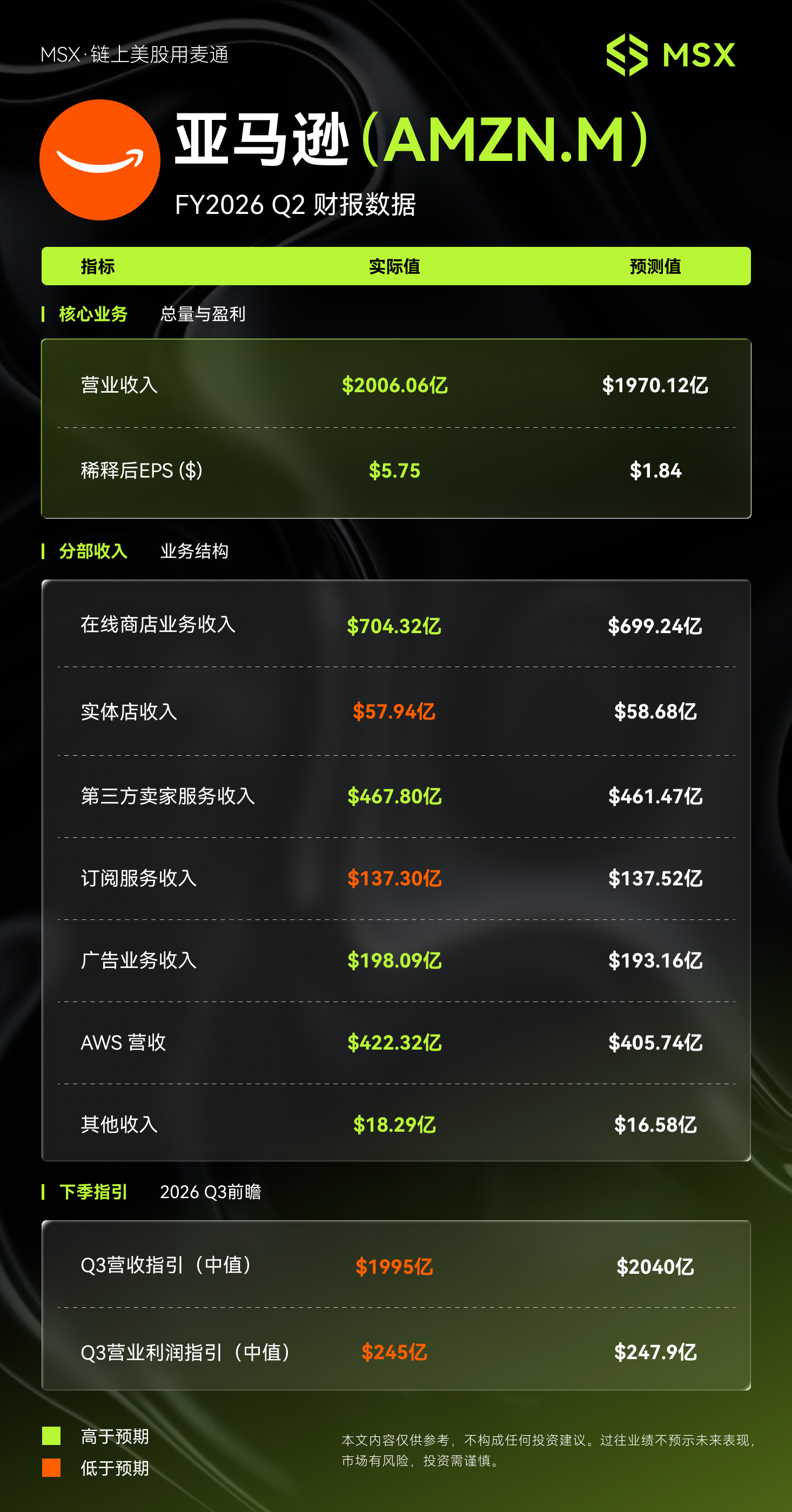
MSX US Stock Daily Insight: Amazon 2026 Q2 Earnings: AWS Records Fastest Growth in Five Years

**MSX Daily US Stock Observation: Amazon's Q2 2026 Earnings: AWS Achieves Fastest Growth in Five Years** Amazon's latest quarterly results exceeded expectations, driven by a strong performance from its cloud computing unit. The company reported revenue of $200.66 billion, surpassing estimates of approximately $197 billion. The key highlight was Amazon Web Services (AWS), which generated $42.232 billion in revenue, surging 37% year-over-year. This marked the segment's fastest growth pace in 18 quarters, indicating robust demand for cloud services. Reported Earnings Per Share (EPS) of $5.75 significantly exceeded the $1.84 forecast. However, this figure included a substantial one-time, non-operating gain of $53.4 billion, primarily from the revaluation of Amazon's investment in AI company Anthropic. Excluding this item, core operating profit was $27.461 billion, a strong increase of 43% compared to the same period last year. Despite the positive results, Amazon provided guidance for the upcoming third quarter that fell short of market expectations. The company's revenue guidance midpoint is $199.5 billion, below the consensus estimate of around $204 billion. Operating profit guidance of $24.5 billion also slightly missed expectations of approximately $247.9 billion. Furthermore, Amazon raised its forecast for full-year capital expenditures to $220 billion, citing rising memory chip costs, which weighed on investor sentiment regarding future profitability. In summary, Amazon's quarter showcased accelerating momentum in its core AWS business. The underlying operational profit growth remains solid. However, cautious forward guidance and increased investment spending present key areas for monitoring in the coming quarters, as the market assesses whether the current growth phase will translate into sustained profit margin expansion.

Odaily星球日报Há 5m

MSX US Stock Daily Insight: Amazon 2026 Q2 Earnings: AWS Records Fastest Growth in Five Years

Odaily星球日报Há 5m

Cyclical Stock or Growth Stock? Coinbase's Q2 Earnings Report Reveals 'Valuation Disagreement'

Coinbase's Q2 2026 financial results revealed a mixed performance, reigniting debate over whether the company should be valued as a cyclical stock tied to crypto markets or a growth stock with future potential. Total revenue missed expectations at $1.22 billion, down 19% year-over-year. Transaction revenue fell to $599 million, with retail crypto spot trading revenue dropping 30% to $452 million, back to 2023 levels. The company reported a net loss of $359 million, marking its third consecutive quarterly loss. Despite CEO Brian Armstrong's positive commentary on metrics like a 10.3% overall crypto trading market share and 106% growth in prediction markets, the market reacted negatively, with shares dropping over 5% after-hours. A key issue is the decline in core retail trading. While Coinbase touted record market share, this figure includes derivatives and new products. Its traditional crypto spot trading share is likely shrinking. New ventures like prediction markets, while growing, contributed less than $30 million, insufficient to offset the core revenue decline. The valuation debate hinges on perspective. As a cyclical stock, Coinbase remains deeply tied to the crypto bear market, with user attrition and competitive pressures justifying a lower valuation. The company's strategy appears focused on surviving until the next bull cycle. Viewed as a growth stock, however, Coinbase shows promising diversification. Subscription and service revenue reached $555 million, nearly matching transaction revenue. Stablecoin revenue, its second-largest source at $292 million, remains strong through its partnership with Circle. Critically, Coinbase is positioning itself as a leader in the emerging on-chain "agent economy." Over 90% of agent-based stablecoin transactions occur on its Base network, which it believes could handle trillions in future agent transactions. The recent acquisition of Deribit also aims to boost its international derivatives offering. In summary, Coinbase's present struggles are clear, but its future hinges on whether its investments in revenue diversification, stablecoins, and the agent economy can ultimately transform its business model and justify a growth premium.

Odaily星球日报Há 25m

Cyclical Stock or Growth Stock? Coinbase's Q2 Earnings Report Reveals 'Valuation Disagreement'

Odaily星球日报Há 25m

Global Market Share Survey: Japanese Firms Lead in Semiconductor Materials

Global Market Share Survey: Japanese Firms Lead in Semiconductor Materials According to the 2025 "Major Goods and Services Market Share Survey" by Nikkei, Japanese companies maintain strong positions in semiconductor-related materials. In silicon wafers, Shin-Etsu Chemical ranks first with a 26.3% share, followed by SUMCO at 17.8%. Together, they hold 44.1% of the market, widening their lead over competitors from Taiwan, Germany, and South Korea. In photoresists, Tokyo Ohka Kogyo, JSR, and Shin-Etsu Chemical occupy the top three spots, with a combined share of 60.5%. Despite their strength in materials, Japanese firms have a weaker presence in core semiconductor segments like DRAM and NAND flash memory, where South Korean and U.S. companies dominate. For instance, SK Hynix and Samsung lead in DRAM, while China’s CXMT doubled its share to 6% in 2025. The semiconductor market is projected to grow rapidly, with WSTS forecasting a 90% increase to $1.5112 trillion by 2026. Major players like Samsung, SK Hynix, and Micron are making massive investments to expand capacity. To maintain their edge in materials, Japanese companies must similarly commit to large-scale, risk-taking investments. In contrast, Japan’s automotive sector shows stagnation. Toyota remains the global leader but with only a slight share increase to 12.3%, while Japanese brands are absent from the top five in the EV market. In shipbuilding, Imabari Shipbuilding rose to third place globally with a 7.2% share, benefiting from large container ship deliveries. However, Chinese and South Korean firms dominate the sector, holding the top two positions. Japan aims to revitalize its shipbuilding industry through government and corporate efforts, targeting a near doubling of output by 2035. Addressing labor shortages and adopting advanced technologies like physical AI will be critical for competitiveness.

marsbitHá 49m

Global Market Share Survey: Japanese Firms Lead in Semiconductor Materials

marsbitHá 49m

Trading

Spot
活动图片