MARA Reports Q1 Revenue Below Expectations, Net Loss of $1.3 Billion, Stock Plunges After Hours

marsbitPublicado em 2026-05-12Última atualização em 2026-05-12

Resumo

Bitcoin mining firm MARA Holdings reported disappointing Q1 2024 results, causing its stock to erase all daily gains and fall 3.44% in after-hours trading. Revenue dropped 18% year-over-year to $174.6 million, missing Wall Street estimates of $192.7 million. The company posted a net loss of $1.3 billion, a significant increase from a $533.4 million loss a year ago, primarily driven by unrealized losses on its holdings of 38,689 Bitcoin, which depreciated in value during the quarter. MARA also sold over 15,100 BTC in late March to repurchase debt at a discount. The broader mining environment remains challenging due to a 35% decline in Bitcoin's price from its all-time high and a nearly 30% increase in mining difficulty over the past year. MARA's market cap ranking among U.S. miners has slipped to seventh. Critically, the company announced a strategic pivot away from Bitcoin mining expansion. It stated it has no plans to purchase new mining equipment and is fully transitioning toward AI data centers. Its strategy involves retrofitting existing mining sites for AI and high-performance computing (HPC) and leveraging its recent $1.5 billion acquisition of Long Ridge Energy & Power, a gas-fired power plant and data center. This infrastructure could eventually support 600 MW of AI compute capacity, allowing MARA to redeploy up to 90% of its non-custodial mining power for AI and IT workloads.

Author: Brayden Lindrea

Compiled by: Deep Tide TechFlow

Deep Tide TechFlow Summary: Bitcoin miner MARA Holdings has delivered a dismal Q1 report: revenue fell 18% year-on-year, net loss expanded from $530 million to $1.3 billion, and the stock erased all its intraday gains after hours. The bulk of the loss stemmed from unrealized losses on its BTC holdings. More notably, MARA has clearly stated it will no longer purchase new mining rigs, pivoting entirely to AI data centers—its ranking as the largest miner by market capitalization has already slipped to seventh place.

MARA Holdings' stock fell 3.44% after hours on Monday, closing at $12.93, completely wiping out its 3.48% gain from the day. The reason is simple: its Q1 earnings report missed expectations across the board.

Revenue and Profit Both Miss

According to the report filed by MARA, revenue for the quarter ended March 31 was $174.6 million, down 18% year-on-year, falling short of Wall Street's expectation of $192.7 million.

Net loss was $1.3 billion, compared to a loss of $533.4 million in the same period last year, expanding by nearly 1.5 times. Loss per share was $3.31, also significantly exceeding analysts' forecast of $2.20.
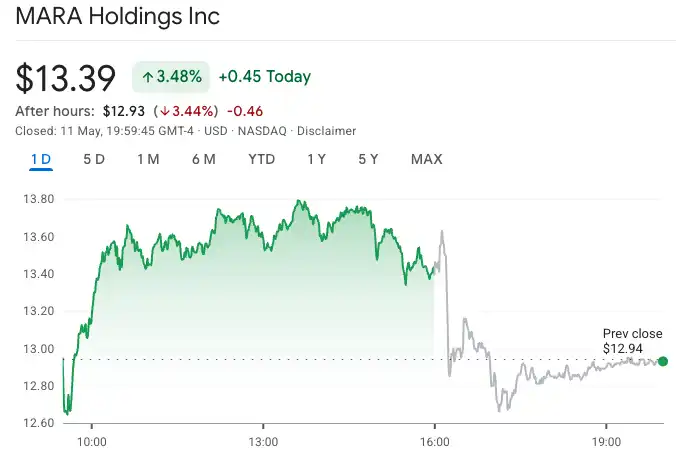
Caption: MARA's after-hours stock price movement, source: Google Finance

Where Did the $1.3 Billion Loss Come From?

The main reason for the loss was the unrealized losses on MARA's holdings of 38,689 bitcoins. Bitcoin price fell 23% in Q1, directly dragging down the book value.

MARA sold over 15,100 bitcoins in the final week of March, worth approximately $1.1 billion, to repurchase its debt at a discount.

Mining Environment Continues to Deteriorate

MARA's predicament is not an isolated case. The entire U.S. Bitcoin mining sector is sliding from profit to loss.

Two core pressures: Bitcoin is down over 35% from its all-time high of $126,080, significantly reducing miner revenue per block; simultaneously, mining difficulty has increased by nearly 30% over the past year, pushing hashing costs consistently higher.

MARA's industry standing is also declining. By market cap, it has fallen from being the largest Bitcoin miner to seventh place, as competitors move faster in their AI pivots.

Full Pivot to AI Data Centers

MARA says Bitcoin mining remains the "operational foundation" of the company, but its actions are already clear.

The company's AI strategy has two main thrusts: first, collaborating with Starwood Capital to convert existing mining sites into AI and High-Performance Computing (HPC) data centers; second, acquiring Long Ridge Energy & Power for $1.5 billion in late April, a natural gas power plant with an associated data center.

MARA's statement is:

"Our strategy is to colocate new infrastructure with our existing Bitcoin mining sites. The flexibility this creates is that we can generate revenue through mining today while preserving the option to divert power to AI and other critical IT loads."

The Long Ridge acquisition ultimately supports 600 MW of AI compute power, and approximately 90% of MARA's non-custodial mining capacity could be redeployed for AI and IT computing.

A one-sentence summary of its transformation resolve: The company explicitly stated it has no plans to purchase new mining rigs in the future.


Perguntas relacionadas

QWhy did MARA Holdings' stock price drop after-hours despite a gain during the day?

AThe stock dropped because the company released its Q1 earnings report, which showed both revenue and profits missing analyst expectations. Revenue fell 18% year-over-year, and the net loss expanded to $1.3 billion, causing investors to sell.

QWhat was the primary cause of MARA's significant $1.3 billion net loss in Q1?

AThe primary cause of the $1.3 billion net loss was the unrealized loss on the company's holding of 38,689 Bitcoins, as the price of Bitcoin fell by 23% during the quarter.

QWhat strategic shift did MARA announce regarding its mining operations?

AMARA announced a strategic shift away from purchasing new mining machines and towards fully transitioning into AI data centers. The company plans to repurpose its existing mining infrastructure for AI and High-Performance Computing (HPC) workloads.

QWhat actions did MARA take regarding its Bitcoin holdings in March, and why?

AIn the final week of March, MARA sold over 15,100 Bitcoins, valued at approximately $1.1 billion, in order to repurchase its debt at a discount.

QHow has the competitive landscape changed for MARA within the U.S. Bitcoin mining sector?

AMARA's position has weakened. By market capitalization, it has fallen from being the largest Bitcoin miner to the seventh largest. The company noted that competitors are moving faster in their transitions to AI-related businesses.

Leituras Relacionadas

Within Strategy's Framework, STRC's Dividend Yield Remains at 12% as Share Price Stays Below Par Value

Michael Saylor, Executive Chairman of Strategy (MSTR), confirmed that the dividend rate for its STRC perpetual preferred shares will remain at 12.00% through August 2026. The rate has increased from 9% at its July 2025 launch to the current high via a "ratchet" mechanism, which permanently raises the rate by 0.5% whenever the share price falls below $95. This mechanism is intended to push the price back toward its $100 par value and support Strategy's "at-the-market" (ATM) program for issuing new shares to fund Bitcoin purchases. However, the mechanism has not worked as intended. STRC shares closed at $89.46 on July 31, remaining about 10-11% below par value despite the record-high dividend. Competition from rival Strive's higher-yielding SATA securities has pressured demand. The persistent discount has forced Strategy to suspend new STRC issuances via its ATM program, limiting this funding channel for Bitcoin acquisitions. STRC's struggles reflect Bitcoin's own volatility, as the preferred shares historically move in tandem. Analysts have warned the ratchet structure carries long-term, one-way risk. A law firm is investigating Strategy's ability to maintain dividend payments if Bitcoin's price stays low. Retail investors own roughly 83% of outstanding STRC shares, a group seen as prone to panic selling during downturns. In response, Strategy has established financial reserves, including a liquidity cushion covering about 26 months of dividend/interest obligations, and a $2 billion share buyback program alongside a Bitcoin monetization framework, though the company emphasized it is not obligated to sell any Bitcoin.

cryptonews.ruHá 26m

Within Strategy's Framework, STRC's Dividend Yield Remains at 12% as Share Price Stays Below Par Value

cryptonews.ruHá 26m

Analyst: Bitcoin's Price Will Drop to $60k in August, Then Rebound to $70k

Financial analyst Andrey Poroshin has provided a new forecast for Bitcoin's price dynamics in August. Poroshin, an analyst at the Bitbanker exchange, expects the cryptocurrency market to experience a downturn this month, with prices retesting the $60,000 level due to a lack of supportive macroeconomic catalysts. He noted that the recent US Federal Reserve decision to hold interest rates did not significantly impact the market, while inflation remains above the 2% target. Poroshin stated that Bitcoin is ending July under pressure from moderate volatility and a lack of new macroeconomic stimuli, leading to continued market caution. According to his base scenario, Bitcoin will drop to a range of $60,000 to $62,000 before recovering to $70,000. He pointed out that even $70,000 remains below the cost of mining in the US, which has prompted some miners to shift towards AI data center operations. Poroshin cited the winding down of BitMEX's operations as a potential catalyst for a price rebound, suggesting the exit of weaker players often coincides with market reversals and reduced short-term selling pressure. He believes Bitcoin is currently less susceptible to geopolitical shocks, such as the Iran-US conflict, and does not expect significant market changes in August related to the pending CLARITY Act. Looking ahead, Poroshin forecasts that September will bring more active price fluctuations driven by potential Fed rate decisions and possible discussions or approval of the CLARITY Act.

cryptonews.ruHá 27m

Analyst: Bitcoin's Price Will Drop to $60k in August, Then Rebound to $70k

cryptonews.ruHá 27m

Trading

Spot
活动图片




